


Achievable logoAchievable logo
USMLE/1
Sign in
Sign up
Purchase
Textbook
Support
How it works
Resources
Exam catalog
Mountain with a flag at the peak
Textbook
Introduction
1. Anatomy
2. Microbiology
2.1 General bacteriology
2.2 Introduction to systemic bacteriology
2.3 Gram positive cocci
2.4 Gram negative cocci
2.5 Gram positive bacilli
2.6 Gram negative bacilli
2.7 Other important bacteria
2.8 Virology
2.9 Parasitology
2.9.1 Entamoeba histolytica
2.9.2 Acanthamoeba
2.9.3 Naegleria fowleri
2.9.4 Giardia lamblia
2.9.5 Cryptosporidium parvum
2.9.6 Trichomonas
2.9.7 Plasmodium spp.
2.9.8 Babesia
2.9.9 Toxoplasma gondii
2.9.10 Taenia
2.9.11 Hymenolepis nana
2.9.12 Enterobius vermicularis
2.9.13 Trichuris
2.9.14 Trichinella
2.9.15 Ascaris
2.9.16 Hookworms
2.9.17 Strongyloides
2.9.18 Additional information
2.10 Mycology
3. Physiology
4. Pathology
5. Pharmacology
6. Immunology
7. Biochemistry
8. Cell and molecular biology
9. Biostatistics and epidemiology
10. Genetics
11. Behavioral science
Wrapping up
Achievable logoAchievable logo
2.9.15 Ascaris
Achievable USMLE/1
2. Microbiology
2.9. Parasitology

Ascaris

2 min read
Font
Discuss
Share
Feedback

Ascaris

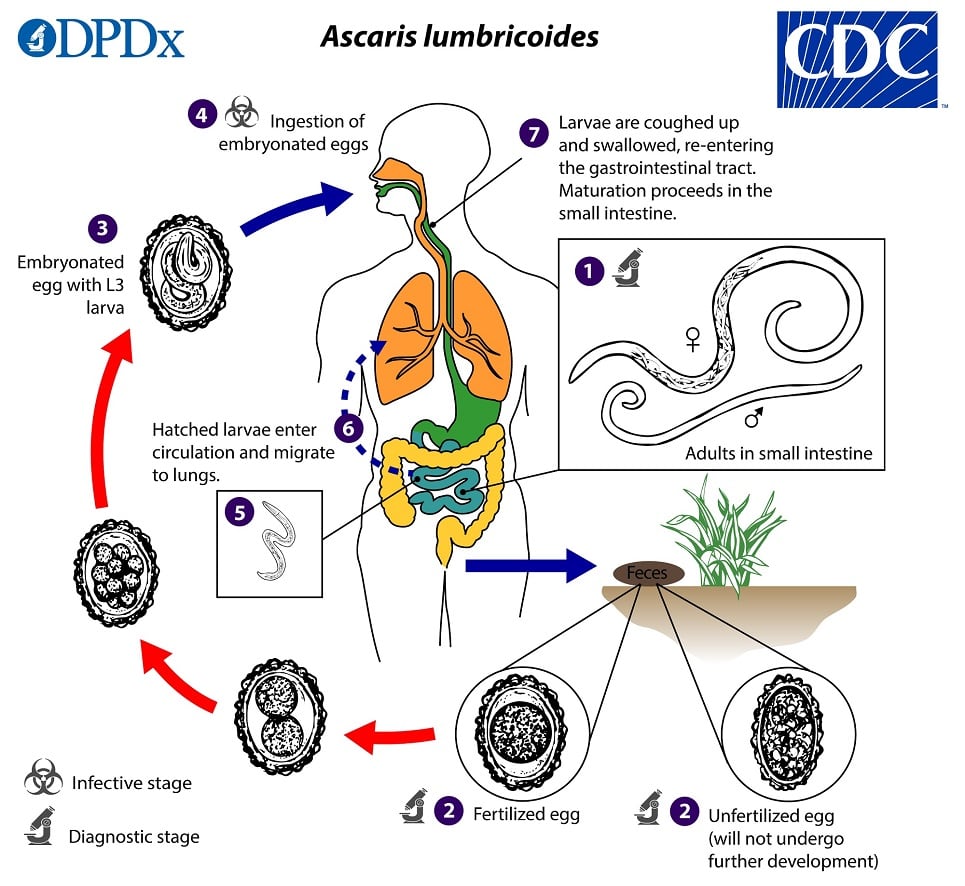
Infection spreads when you ingest fertile eggs from contaminated hands, food, or water. The common pathogens are Ascaris lumbricoides and Ascaris suum. A. suum is transmitted from pigs.

After you ingest fertile eggs, they hatch in the small intestine and invade the intestinal mucosa. The larvae then travel through the portal and systemic circulation to the lungs. From the lungs, they either:

  • Ascend the bronchi, reach the throat, and are swallowed, or
  • Penetrate the alveoli

Adult worms live in the small intestine.

Ascaris life cycle
Ascaris life cycle

Infection may be asymptomatic. Heavy infections may present with abdominal pain and discomfort, intestinal obstruction (and sometimes perforation), growth retardation, and malnutrition in children - especially vitamin A deficiency and protein-energy malnutrition.

Migrating adult worms can:

  • Occlude the biliary tree
  • Cause appendicitis
  • Be extruded from the nasopharynx

Loeffler’s syndrome is caused by larvae migrating through the lungs. It presents with fever, dry cough, dyspnea, eosinophilia, and urticaria.

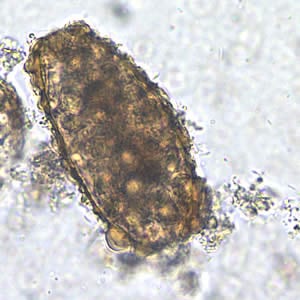
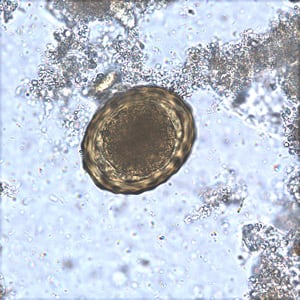
Diagnosis is made by demonstrating eggs in stool samples.

Ascaris egg
Ascaris egg

Unfertilized egg of A. lumbricoides in an unstained wet mount, 200x magnification.

Acscaris egg
Acscaris egg

Fertilized egg of A. lumbricoides in an unstained wet mount of stool.

All rights reserved ©2016 - 2026 Achievable, Inc.