Feet are flat and parallel, with toes pointing straight ahead.
Arms are extended at the sides, with palms facing forward.
Head is held erect, with eyes looking straight ahead.
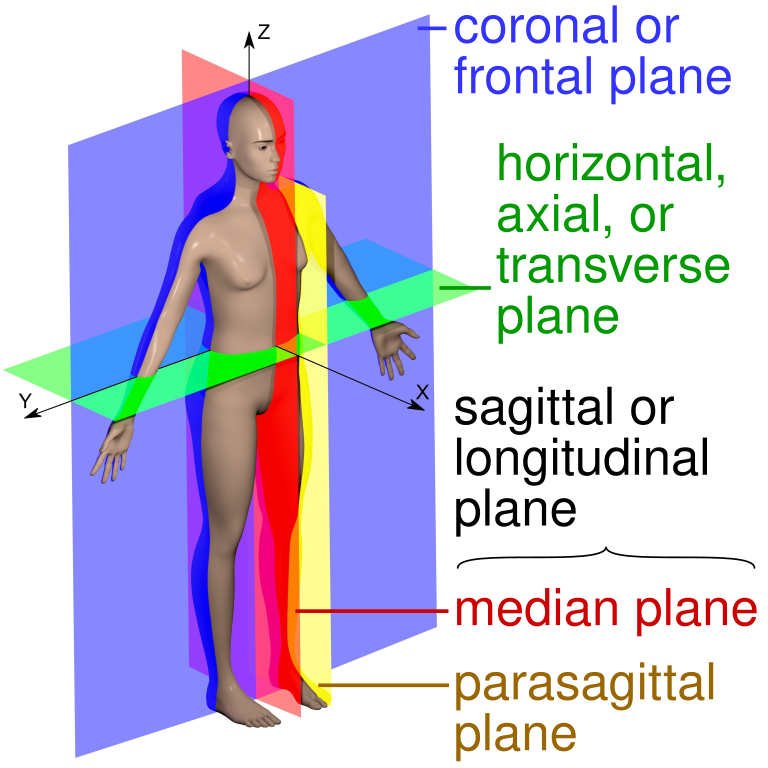
Body planes
By - David Richfield and Mikael Häggström, M.D. and cmglee, https://commons.wikimedia.org/wiki/File:Human_anatomy_planes,_labeled.jpg#/media/File:Human_anatomy_planes.jpg , CC-BY 4.0
Examples: Muscles for quick movements and eye muscles
Guidelines for strength training
The foundational concepts of strength training are
Contraindications to strength training
Types of exercise for strength training
Isometric
Muscle contraction without change in muscle length
Example: Quad sets
Typically used during the acute phase of healing or when learning muscle control
Isotonic
A muscle produces force and changes length, with tension remaining relatively constant, allowing movement at a joint.
Example: Bicep curls with a 20-pound weight
Used during sub-acute and chronic phases of healing when pain and inflammation are reduced. Requires that adequate motor planning and movement control have already been established.
Concentric: The muscle shortens, for example, standing from a seated position with shortening of the hip and knee extensors.
Eccentric: The muscle lengthens while holding tension, for example, controlled sitting from a standing position, controlled with lengthening of the knee and hip extensors.
Isokinetic
Muscle changes length (shortening or lengthening) while moving at a constant, controlled velocity.
Example: Isokinetic machines using electric or hydraulic dynamometers
Provides accommodating resistance that matches the force the muscle generates, it loads the muscle maximally throughout the entire range of motion
Used during the sub-acute phase of healing when the concern of re-injuring muscle is a concern due to control of movement and resistance throughout the movement
Endurance training
Effects of endurance training
Capillary growth: More capillaries in muscles improve blood flow and oxygen delivery.
Contraindications: incontinence, severe kidney disease, seizures, uncontrolled cardiac/respiratory disorders, PVD, open wounds, active bleeding/infection
Ways to progress therapeutic activities
Exercise progression increases challenge as tolerance improves
Common progression patterns:
Small→large motion, low→high center of gravity, low→high resistance
Slow→fast movement, stable→unstable surface, large→small base of support
Anatomical terminology and exercise training principles
Anatomical position
Specifications
The body is upright and facing forward.
Feet are flat and parallel, with toes pointing straight ahead.
Arms are extended at the sides, with palms facing forward.
Head is held erect, with eyes looking straight ahead.
Basics of strength training
Muscle fiber types
Slow twitch (Type I)
Slow contraction speed
Low force production
Highly resistant to fatigue
Example: Postural muscles
Fast twitch (Type IIA)
Fast contraction speed
Fatigue resistant
Can be influenced by training
Examples: Muscles used for strength and movement
Fast twitch (Type IIB)
Fast contraction speed
High force production
Susceptible to quick fatigue
Examples: Muscles for quick movements and eye muscles
Guidelines for strength training
The foundational concepts of strength training are
Contraindications to strength training
Types of exercise for strength training
Isometric
Muscle contraction without change in muscle length
Example: Quad sets
Typically used during the acute phase of healing or when learning muscle control
Isotonic
A muscle produces force and changes length, with tension remaining relatively constant, allowing movement at a joint.
Example: Bicep curls with a 20-pound weight
Used during sub-acute and chronic phases of healing when pain and inflammation are reduced. Requires that adequate motor planning and movement control have already been established.
Concentric: The muscle shortens, for example, standing from a seated position with shortening of the hip and knee extensors.
Eccentric: The muscle lengthens while holding tension, for example, controlled sitting from a standing position, controlled with lengthening of the knee and hip extensors.
Isokinetic
Muscle changes length (shortening or lengthening) while moving at a constant, controlled velocity.
Example: Isokinetic machines using electric or hydraulic dynamometers
Provides accommodating resistance that matches the force the muscle generates, it loads the muscle maximally throughout the entire range of motion
Used during the sub-acute phase of healing when the concern of re-injuring muscle is a concern due to control of movement and resistance throughout the movement
Endurance training
Effects of endurance training
Capillary growth: More capillaries in muscles improve blood flow and oxygen delivery.