


Achievable logoAchievable logo
NCLEX
Sign in
Sign up
Purchase
Textbook
Practice exams
Support
How it works
Resources
Exam catalog
Mountain with a flag at the peak
Textbook
Introduction
1. Safe and effective care environment
2. Health promotion and maintenance
3. Psychosocial Integrity
3.1 Mental health concepts
3.2 Psychiatric disorders
3.2.1 Mood disorders (depression and bipolar)
3.2.2 Anxiety and stress-related disorders (PTSD, OCD)
3.2.3 Psychotic disorders
3.2.4 Personality disorders
3.2.5 Substance use and addiction
3.2.6 Eating disorders
3.3 Crisis intervention and safety
3.4 End-of-life care and grief counseling
3.5 Behavioral Interventions and Safety Precautions
4. Physiological Integrity
Wrapping up
Achievable logoAchievable logo
3.2.1 Mood disorders (depression and bipolar)
Achievable NCLEX
3. Psychosocial Integrity
3.2. Psychiatric disorders
Our NCLEX course is currently in development and is a work-in-progress.

Mood disorders (depression and bipolar)

7 min read
Font
Discuss
Share
Feedback

Introduction

Mood disorders affect how individuals feel, think, behave, and function in daily life. They are characterized by persistent disturbances in mood that interfere with relationships, work, self-care, and safety. Depression and bipolar disorder exist on a spectrum of mood dysregulation and are among the most frequently tested psychiatric conditions on the NCLEX.

For nurses, the priority is not diagnosis but assessment, safety, therapeutic communication, and medication monitoring. Many NCLEX questions focus on recognizing mood patterns, identifying suicide risk, responding to mania safely, and choosing the most therapeutic nursing action.

Other psychosocial integrity topics - crisis intervention, grief and loss, and cultural or spiritual influences on care - are covered in their own dedicated chapters rather than here.

Learning objectives

By the end of this section, you should be able to:

  • Differentiate depressive episodes from manic and hypomanic episodes.
  • Identify common assessment findings in mood disorders.
  • Recognize suicide risk and implement safety interventions.
  • Apply nursing care strategies for both depression and bipolar disorder.
  • Anticipate medication-related nursing considerations.
  • Answer NCLEX-style questions involving mood instability and safety.

Overview of mood disorders

Mood disorders involve disruptions in emotional regulation that persist beyond normal mood fluctuations.

Core features

  • Altered mood (sadness, irritability, euphoria).
  • Changes in energy and activity level.
  • Impaired concentration and decision-making.
  • Sleep and appetite disturbances.
  • Impaired functioning.
  • Increased suicide risk.
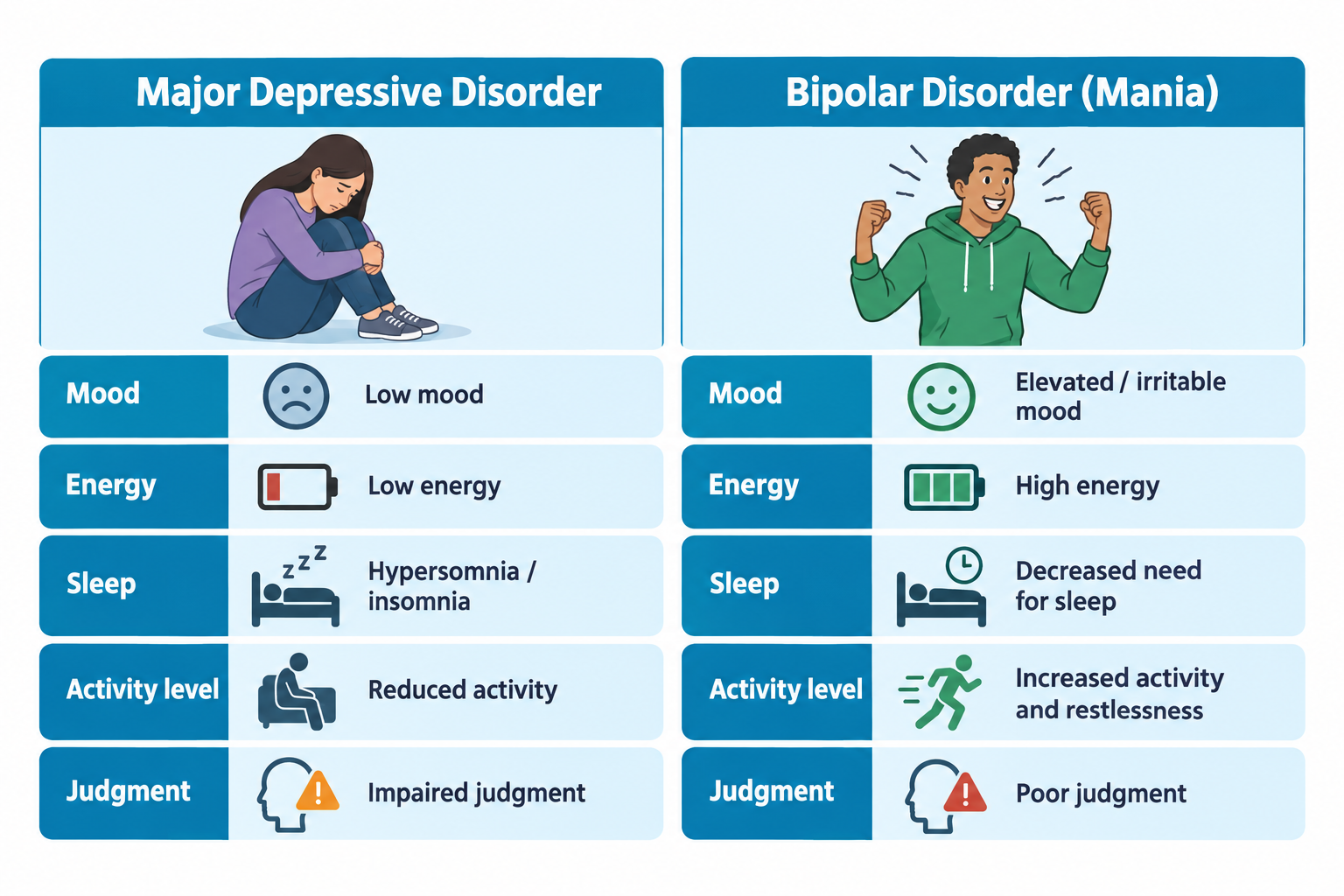
A side-by-side comparison chart contrasting Major Depressive Disorder and Bipolar Disorder (Mania). Left column shows an illustration of a person sitting curled up looking sad, with rows for Mood (low mood, sad face icon), Energy (low energy, mostly empty battery icon), Sleep (hypersomnia/insomnia, sleeping figure icon), Activity level (reduced activity, seated figure icon), and Judgment (impaired judgment, warning icon). Right column shows an illustration of a person smiling with raised fists and energy lines, with matching rows for Mood (elevated/irritable mood, smiling face icon), Energy (high energy, full battery icon), Sleep (decreased need for sleep, clock/bed icon), Activity level (increased activity and restlessness, running figure icon), and Judgment (poor judgment, warning icon).
Major depressive disorder and bipolar disorder at a glance
Achievable
Definitions
Major depressive disorder
A condition marked by persistent depressed mood and loss of interest lasting at least two weeks.
Bipolar disorder
A mood disorder characterized by episodes of mania or hypomania, often alternating with episodes of depression.
Mania
A period of abnormally elevated or irritable mood with increased energy and impaired judgment, lasting at least 1 week (or any duration if hospitalization is required).
Hypomania
A milder form of mania lasting at least 4 consecutive days that does not cause severe functional impairment, psychosis, or require hospitalization.
Therapeutic range
The specific blood concentration of a medication (like lithium) required to achieve its desired effect without causing toxicity.
Extrapyramidal symptoms
Involuntary movements, tremors, or motor side effects associated with certain psychotropic medications, such as antipsychotics.
Grandiosity
An inflated sense of self-esteem, power, or importance, often seen in manic episodes.

Comparing the three episode types

The load-bearing distinction is duration and severity. Depression and mania are opposite poles of mood; hypomania is a milder, shorter version of mania that never reaches the severity that defines a full manic episode.

The following table compares depressive, manic, and hypomanic episodes by minimum duration and by severity, including whether psychosis or hospitalization can occur.


Episode Minimum duration Severity
Depressive At least 2 weeks Marked impairment; suicide risk
Manic At least 1 week (any duration if hospitalized) Marked impairment; psychosis and hospitalization possible
Hypomanic At least 4 days Noticeable change but no severe impairment, no psychosis, no hospitalization

The key exam discriminator between mania and hypomania: if there is psychosis, marked impairment, or a need for hospitalization, the episode is mania, not hypomania.

Depressive disorders

Depression is more than sadness. It is a pervasive condition that affects emotional, cognitive, physical, and behavioral functioning.

Assessment findings in depression

  • Persistent sadness or emptiness.
  • Anhedonia (loss of interest or pleasure).
  • Fatigue or low energy.
  • Sleep disturbances (insomnia or hypersomnia).
  • Appetite or weight changes.
  • Impaired concentration.
  • Feelings of worthlessness or guilt.
  • Slowed speech or movement.
  • Suicidal ideation or passive death wishes.

Nursing interventions

  • Assess suicide risk directly and repeatedly.
  • Establish a therapeutic relationship.
  • Encourage expression of feelings.
  • Promote structure and routine.
  • Assist with basic self-care.
  • Reinforce medication adherence.
  • Coordinate mental health referrals.

Bipolar disorder

Bipolar disorder includes episodes of mania or hypomania, often alternating with periods of depression. Manic episodes are medical emergencies characterized by deteriorating judgment, sleep disturbances, and impaired impulse control.

Assessment findings in mania

  • Elevated or irritable mood
  • Decreased need for sleep
  • Pressured or rapid speech
  • Flight of ideas
  • Distractibility
  • Grandiosity
  • Impulsive or risky behaviors
  • Poor judgment
  • Agitation or aggression

Nursing interventions during mania

  • Ensure the safety of client and others.
  • Set clear, consistent limits.
  • Reduce environmental stimuli.
  • Use calm, firm communication.
  • Avoid power struggles.
  • Provide high-calorie finger foods, since a manic client is too restless and distractible to sit through a meal and is at risk for nutritional and fluid deficits.
  • Monitor sleep, hydration, and activity.
  • Administer medications as prescribed.

Suicide risk and safety

Suicide risk exists in both depression and bipolar disorder and may increase during energy improvement before mood improves.

High-risk indicators

  • Expressed suicidal ideation or plan.
  • Prior suicide attempts.
  • Sudden calmness after depression.
  • Giving away possessions.
  • Severe agitation or insomnia.
  • Substance use.
  • Lack of social support.

Example: Sudden calmness after depression

A client who has been severely depressed for two weeks suddenly seems calm, cheerful, and full of energy. A nurse unfamiliar with mood disorders might chart this as improvement.

  • Sudden calmness after a period of depression can mean the client has decided on a suicide plan and now has the energy to act on it, not that the depression has lifted.
  • The nurse asks directly: “Are you thinking of harming yourself?”
  • The nurse maintains close observation and initiates suicide precautions per facility policy rather than waiting to see if the calm mood continues.

Answer: Treat sudden calmness after depression as a possible suicide risk indicator, not as evidence of improvement, until a direct risk assessment says otherwise.

Nursing interventions

  • Ask directly about suicidal thoughts.
  • Implement suicide precautions as indicated.
  • Maintain close observation.
  • Remove harmful objects.
  • Involve interdisciplinary mental health teams.
  • Document assessments objectively.

Medication considerations

While medication management is provider-directed, nurses play a crucial role in monitoring the effects and safety of medications.

Antidepressants

  • May take several weeks for full effect.
  • Monitor for increased suicidality early in treatment.
  • Educate clients not to stop abruptly.

Mood stabilizers (e.g., lithium)

  • Narrow therapeutic range.
    • Therapeutic range: 0.6-0.8 mEq/L for maintenance therapy, up to 0.8-1.2 mEq/L during acute mania.
  • Monitor serum levels.
  • Ensure adequate hydration and sodium intake, because dehydration or a low-sodium diet (from vomiting, diaphoresis, diuretics, or NSAID use) causes the kidneys to reabsorb more lithium along with sodium, raising serum lithium toward toxic levels.
  • Report tremors, diarrhea, vomiting, confusion, or ataxia.

Antipsychotics (often used in mixed mania)

  • Monitor for extrapyramidal symptoms.
  • Assess metabolic side effects.
  • Reinforce adherence.

Therapeutic communication strategies

  • Use empathy and validation.
  • Avoid minimizing feelings.
  • Maintain calm, structured interactions.
  • Set limits respectfully.
  • Redirect impulsive behaviors.
  • Reinforce reality gently when appropriate.

Common NCLEX pitfalls:

  • Assuming improved mood means reduced suicide risk.
  • Engaging in power struggles with manic clients.
  • Skipping a direct suicide risk assessment.
  • Referring to the person as a “patient” instead of a “client” in documentation and NCLEX answer choices.
  • Mood disorders affect safety and functioning.
  • Depression requires assessment and emotional support.
  • Mania requires structure and safety.
  • Suicide risk must always be evaluated directly. nurses prioritize safety over insight. :::

Sign up for free to take 5 quiz questions on this topic

Previous
Next  | 3.2.2 Anxiety and stress-related disorders (PTSD, OCD)
All rights reserved ©2016 - 2026 Achievable, Inc.

Mood disorders (depression and bipolar)

Introduction

Mood disorders affect how individuals feel, think, behave, and function in daily life. They are characterized by persistent disturbances in mood that interfere with relationships, work, self-care, and safety. Depression and bipolar disorder exist on a spectrum of mood dysregulation and are among the most frequently tested psychiatric conditions on the NCLEX.

For nurses, the priority is not diagnosis but assessment, safety, therapeutic communication, and medication monitoring. Many NCLEX questions focus on recognizing mood patterns, identifying suicide risk, responding to mania safely, and choosing the most therapeutic nursing action.

Other psychosocial integrity topics - crisis intervention, grief and loss, and cultural or spiritual influences on care - are covered in their own dedicated chapters rather than here.

Learning objectives

By the end of this section, you should be able to:

  • Differentiate depressive episodes from manic and hypomanic episodes.
  • Identify common assessment findings in mood disorders.
  • Recognize suicide risk and implement safety interventions.
  • Apply nursing care strategies for both depression and bipolar disorder.
  • Anticipate medication-related nursing considerations.
  • Answer NCLEX-style questions involving mood instability and safety.

Overview of mood disorders

Mood disorders involve disruptions in emotional regulation that persist beyond normal mood fluctuations.

Core features

  • Altered mood (sadness, irritability, euphoria).
  • Changes in energy and activity level.
  • Impaired concentration and decision-making.
  • Sleep and appetite disturbances.
  • Impaired functioning.
  • Increased suicide risk.
Definitions
Major depressive disorder
A condition marked by persistent depressed mood and loss of interest lasting at least two weeks.
Bipolar disorder
A mood disorder characterized by episodes of mania or hypomania, often alternating with episodes of depression.
Mania
A period of abnormally elevated or irritable mood with increased energy and impaired judgment, lasting at least 1 week (or any duration if hospitalization is required).
Hypomania
A milder form of mania lasting at least 4 consecutive days that does not cause severe functional impairment, psychosis, or require hospitalization.
Therapeutic range
The specific blood concentration of a medication (like lithium) required to achieve its desired effect without causing toxicity.
Extrapyramidal symptoms
Involuntary movements, tremors, or motor side effects associated with certain psychotropic medications, such as antipsychotics.
Grandiosity
An inflated sense of self-esteem, power, or importance, often seen in manic episodes.

Comparing the three episode types

The load-bearing distinction is duration and severity. Depression and mania are opposite poles of mood; hypomania is a milder, shorter version of mania that never reaches the severity that defines a full manic episode.

The following table compares depressive, manic, and hypomanic episodes by minimum duration and by severity, including whether psychosis or hospitalization can occur.


Episode Minimum duration Severity
Depressive At least 2 weeks Marked impairment; suicide risk
Manic At least 1 week (any duration if hospitalized) Marked impairment; psychosis and hospitalization possible
Hypomanic At least 4 days Noticeable change but no severe impairment, no psychosis, no hospitalization

The key exam discriminator between mania and hypomania: if there is psychosis, marked impairment, or a need for hospitalization, the episode is mania, not hypomania.

Depressive disorders

Depression is more than sadness. It is a pervasive condition that affects emotional, cognitive, physical, and behavioral functioning.

Assessment findings in depression

  • Persistent sadness or emptiness.
  • Anhedonia (loss of interest or pleasure).
  • Fatigue or low energy.
  • Sleep disturbances (insomnia or hypersomnia).
  • Appetite or weight changes.
  • Impaired concentration.
  • Feelings of worthlessness or guilt.
  • Slowed speech or movement.
  • Suicidal ideation or passive death wishes.

Nursing interventions

  • Assess suicide risk directly and repeatedly.
  • Establish a therapeutic relationship.
  • Encourage expression of feelings.
  • Promote structure and routine.
  • Assist with basic self-care.
  • Reinforce medication adherence.
  • Coordinate mental health referrals.

Bipolar disorder

Bipolar disorder includes episodes of mania or hypomania, often alternating with periods of depression. Manic episodes are medical emergencies characterized by deteriorating judgment, sleep disturbances, and impaired impulse control.

Assessment findings in mania

  • Elevated or irritable mood
  • Decreased need for sleep
  • Pressured or rapid speech
  • Flight of ideas
  • Distractibility
  • Grandiosity
  • Impulsive or risky behaviors
  • Poor judgment
  • Agitation or aggression

Nursing interventions during mania

  • Ensure the safety of client and others.
  • Set clear, consistent limits.
  • Reduce environmental stimuli.
  • Use calm, firm communication.
  • Avoid power struggles.
  • Provide high-calorie finger foods, since a manic client is too restless and distractible to sit through a meal and is at risk for nutritional and fluid deficits.
  • Monitor sleep, hydration, and activity.
  • Administer medications as prescribed.

Suicide risk and safety

Suicide risk exists in both depression and bipolar disorder and may increase during energy improvement before mood improves.

High-risk indicators

  • Expressed suicidal ideation or plan.
  • Prior suicide attempts.
  • Sudden calmness after depression.
  • Giving away possessions.
  • Severe agitation or insomnia.
  • Substance use.
  • Lack of social support.

Example: Sudden calmness after depression

A client who has been severely depressed for two weeks suddenly seems calm, cheerful, and full of energy. A nurse unfamiliar with mood disorders might chart this as improvement.

  • Sudden calmness after a period of depression can mean the client has decided on a suicide plan and now has the energy to act on it, not that the depression has lifted.
  • The nurse asks directly: “Are you thinking of harming yourself?”
  • The nurse maintains close observation and initiates suicide precautions per facility policy rather than waiting to see if the calm mood continues.

Answer: Treat sudden calmness after depression as a possible suicide risk indicator, not as evidence of improvement, until a direct risk assessment says otherwise.

Nursing interventions

  • Ask directly about suicidal thoughts.
  • Implement suicide precautions as indicated.
  • Maintain close observation.
  • Remove harmful objects.
  • Involve interdisciplinary mental health teams.
  • Document assessments objectively.

Medication considerations

While medication management is provider-directed, nurses play a crucial role in monitoring the effects and safety of medications.

Antidepressants

  • May take several weeks for full effect.
  • Monitor for increased suicidality early in treatment.
  • Educate clients not to stop abruptly.

Mood stabilizers (e.g., lithium)

  • Narrow therapeutic range.
    • Therapeutic range: 0.6-0.8 mEq/L for maintenance therapy, up to 0.8-1.2 mEq/L during acute mania.
  • Monitor serum levels.
  • Ensure adequate hydration and sodium intake, because dehydration or a low-sodium diet (from vomiting, diaphoresis, diuretics, or NSAID use) causes the kidneys to reabsorb more lithium along with sodium, raising serum lithium toward toxic levels.
  • Report tremors, diarrhea, vomiting, confusion, or ataxia.

Antipsychotics (often used in mixed mania)

  • Monitor for extrapyramidal symptoms.
  • Assess metabolic side effects.
  • Reinforce adherence.

Therapeutic communication strategies

  • Use empathy and validation.
  • Avoid minimizing feelings.
  • Maintain calm, structured interactions.
  • Set limits respectfully.
  • Redirect impulsive behaviors.
  • Reinforce reality gently when appropriate.

Common NCLEX pitfalls:

  • Assuming improved mood means reduced suicide risk.
  • Engaging in power struggles with manic clients.
  • Skipping a direct suicide risk assessment.
  • Referring to the person as a “patient” instead of a “client” in documentation and NCLEX answer choices.
Key points
  • Mood disorders affect safety and functioning.
  • Depression requires assessment and emotional support.
  • Mania requires structure and safety.
  • Suicide risk must always be evaluated directly. nurses prioritize safety over insight. :::

More from Psychiatric disorders

  • Anxiety and stress-related disorders (PTSD, OCD)
  • Psychotic disorders
  • Personality disorders
  • Substance use and addiction
  • Eating disorders