


Achievable logoAchievable logo
NCLEX
Sign in
Sign up
Purchase
Textbook
Practice exams
Support
How it works
Exam catalog
Mountain with a flag at the peak
Textbook
Introduction
1. Safe and effective care environment
2. Health promotion and maintenance
3. Psychosocial Integrity
3.1 Mental health concepts
3.2 Psychiatric disorders
3.2.1 Mood disorders (depression and bipolar)
3.2.2 Anxiety and stress-related disorders (PTSD, OCD)
3.2.3 Psychotic disorders
3.2.4 Personality disorders
3.2.5 Substance use and addiction
3.2.6 Eating disorders
3.3 Crisis intervention and safety
3.4 End-of-life care and grief counseling
3.5 Behavioral Interventions and Safety Precautions
4. Physiological Integrity
Wrapping up
Achievable logoAchievable logo
3.2.4 Personality disorders
Achievable NCLEX
3. Psychosocial Integrity
3.2. Psychiatric disorders
Our NCLEX course is currently in development and is a work-in-progress.

Personality disorders

5 min read
Font
Discuss
Share
Feedback

Introduction

Personality disorders are enduring patterns of inner experience and behavior that deviate from cultural expectations and cause distress or impairment in functioning. These patterns are inflexible and long-standing and often interfere with relationships, work, and self-care.

On the NCLEX, personality disorders are not tested for diagnostic memorization but for the nurse’s ability to maintain boundaries, manage manipulation, communicate therapeutically, and ensure safety. Nurses must approach care with consistency, professionalism, and emotional neutrality.

Learning objectives

By the end of this section, you should be able to:

  • Describe general characteristics of personality disorders.
  • Recognize common behavioral patterns across disorder types.
  • Apply boundary-setting and communication strategies.
  • Identify safety risks and prioritize nursing interventions.
  • Respond appropriately to manipulation and splitting behaviors.
  • Answer NCLEX-style questions involving personality disorders.

Overview of personality disorders

Personality disorders involve persistent maladaptive patterns of thinking, feeling, and behaving that are evident across multiple contexts and begin in early adulthood.

alt_text
//////Caption: Core characteristics of personality disorders.
Illustration type: Medical infographic
Illustration note: An infographic summarizing the defining features of personality disorders, including inflexible behavior patterns, impaired interpersonal relationships, poor emotional regulation, limited insight, chronic maladaptive coping, and long-term functional impairment.///////

Etiology and contributing factors

Personality disorders develop through a combination of biological, psychological, and environmental influences.

Contributing factors:

  • Genetic predisposition
  • Childhood trauma or neglect
  • Inconsistent or invalidating environments
  • Maladaptive coping mechanisms developed early in life
  • Chronic interpersonal stress

These patterns typically begin in adolescence or early adulthood and are pervasive across relationships and settings.

Personality disorders are chronic and enduring, not acute reactions to stress.

Shared features

  • Inflexible behavioral patterns
  • Impaired interpersonal relationships
  • Difficulty regulating emotions
  • Poor insight into behavior
  • Resistance to change
  • Frequent conflict with others

Insight and ego-syntonic behavior

Many personality disorders are ego-syntonic, meaning the client does not see their behavior as problematic.

This differs from disorders like obsessive-compulsive disorder (OCD), where behaviors are distressing to the individual.

Lack of insight often contributes to resistance to treatment.

Definitions
Personality disorder
A long-standing pattern of maladaptive behavior and inner experience that impairs functioning.
Splitting
Viewing people or situations as all good or all bad.
Manipulation
Attempts to control others through behavior rather than direct communication.
Boundary
A professional limit that protects both client and nurse.

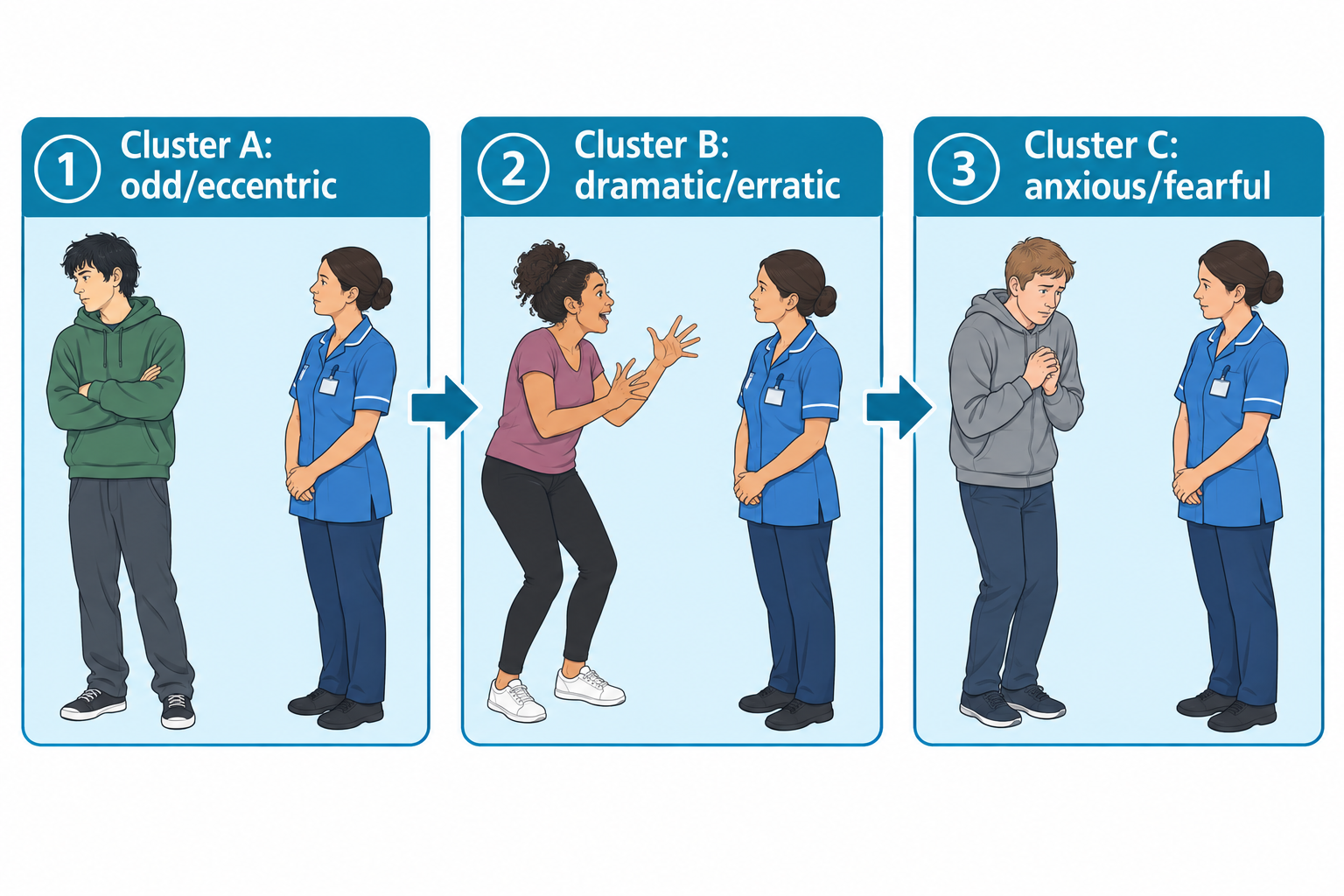
Clusters of personality disorders

Personality disorders are grouped into three clusters based on behavior patterns.

Cluster A (odd or eccentric)

  • Paranoid
  • Schizoid (Schiz-oid lives on an aster-oid)
  • Schizotypal

Common traits:

  • Social withdrawal
  • Suspiciousness
  • Limited emotional expression

Cluster B (dramatic, emotional, erratic)

  • Antisocial
  • Borderline
  • Narcissistic
  • Histrionic

Common traits:

  • Impulsivity
  • Emotional instability
  • Attention-seeking behaviors
  • Difficulty with boundaries
  • Manipulation or splitting

NCLEX most commonly tests borderline and antisocial personality disorders.

alt_text
//////OPTIONAL IMAGE. Caption: The three clusters of personality disorders.
Illustration type: Classification infographic
Illustration note: A color-coded infographic organizing personality disorders into Cluster A (odd/eccentric), Cluster B (dramatic/emotional/erratic), and Cluster C (anxious/fearful), with the hallmark behavioral characteristics of each cluster.///////

Cluster C (anxious or fearful)

  • Avoidant
  • Dependent
  • Obsessive-compulsive personality disorder

Common traits:

  • Anxiety
  • Fear of rejection
  • Excessive need for control or reassurance

Defense mechanisms in personality disorders

Clients often rely on maladaptive defense mechanisms. Common examples:

  • Splitting: Borderline personality disorder
  • Projection: Paranoid personality disorder
  • Rationalization: Antisocial personality disorder
  • Regression: Dependent personality disorder
  • Fantasy and grandiosity: Narcissistic personality disorder

These are the most commonly tested pairings; in practice, defenses overlap across disorders.

Nursing priorities in personality disorders

The foundation of care is structure, consistency, and boundaries.

Communication strategies

  • Remain calm and emotionally neutral
  • Use clear, simple language
  • Set limits respectfully and consistently
  • Avoid arguing or power struggles
  • Reinforce appropriate behavior
  • Avoid rescuing or over-involvement

Consistency among staff prevents manipulation and splitting.

Managing manipulation and splitting

Clients may attempt to manipulate staff or pit team members against one another.

Nursing interventions

  • Maintain consistent rules and expectations
  • Communicate clearly with the healthcare team
  • Document behaviors objectively
  • Avoid emotional reactions
  • Redirect behavior to appropriate coping

Treatment approaches

There is no medication that cures personality disorders.

Treatment focuses on long-term psychotherapy.

Primary treatment modalities

  • Dialectical behavior therapy (DBT): Borderline personality disorder.
  • Cognitive behavioral therapy (CBT): This is widely used across personality disorders, particularly effective for Cluster C.
  • Group therapy: Structured settings for interpersonal skill building.
  • Schema therapy: Long-term restructuring of maladaptive personality patterns.

Medication management

Medications treat associated symptoms:

  • SSRIs: Depression or anxiety.
  • Mood stabilizers: Impulsivity or mood swings.
  • Antipsychotics: Severe cognitive-perceptual distortions (schizotypal personality disorder) or transient psychotic symptoms under stress (borderline personality disorder).

The most effective long-term treatment is psychotherapy.

Safety considerations

Certain personality disorders increase risk for harm.

Borderline personality disorder

  • Self-harm behaviors
  • Fear of abandonment
  • Intense emotional reactions

Antisocial personality disorder

  • Disregard for rules
  • Lack of remorse
  • Risk for aggression or harm to others

Nursing interventions

  • Assess for self-harm or violence
  • Maintain safety precautions
  • Avoid confrontation
  • Follow institutional protocols

Therapeutic relationship considerations

  • Nurses should not expect rapid change.
  • Progress is often slow and incremental.
  • The nurse’s role is to support safety and adaptive behaviors.
  • Avoid taking behaviors personally.

Clinical vignette: A client with borderline personality disorder tells the nurse, “You’re the only one who understands me, the other nurses are terrible.” The nurse responds calmly, “All members of your care team are here to support you. Let’s talk about what you need right now.” The nurse documents the interaction and communicates with the team to maintain consistency.

Nursing considerations

  • Maintain firm, consistent boundaries.
  • Do not engage in manipulation or splitting.
  • Focus on safety and structure.
  • Remain emotionally neutral.
  • Maintain consistency among staff.

Common NCLEX pitfalls

  • Taking client behavior personally.
  • Engaging in power struggles.
  • Giving in to manipulation.
  • Being inconsistent among staff members.
  • Attempting deep psychotherapy instead of setting limits.
  • Over-involvement or rescuing behaviors.
  • Ignoring safety risks related to self-harm or aggression.
  • Personality disorders involve long-standing behavior patterns.
  • Boundaries protect both nurse and client.
  • Manipulation is addressed through consistency.
  • Safety is always the priority.
  • Change is slow and requires structure. :::

Sign up for free to take 5 quiz questions on this topic

Previous
Next  | 3.2.5 Substance use and addiction
All rights reserved ©2016 - 2026 Achievable, Inc.

Personality disorders

Introduction

Personality disorders are enduring patterns of inner experience and behavior that deviate from cultural expectations and cause distress or impairment in functioning. These patterns are inflexible and long-standing and often interfere with relationships, work, and self-care.

On the NCLEX, personality disorders are not tested for diagnostic memorization but for the nurse’s ability to maintain boundaries, manage manipulation, communicate therapeutically, and ensure safety. Nurses must approach care with consistency, professionalism, and emotional neutrality.

Learning objectives

By the end of this section, you should be able to:

  • Describe general characteristics of personality disorders.
  • Recognize common behavioral patterns across disorder types.
  • Apply boundary-setting and communication strategies.
  • Identify safety risks and prioritize nursing interventions.
  • Respond appropriately to manipulation and splitting behaviors.
  • Answer NCLEX-style questions involving personality disorders.

Overview of personality disorders

Personality disorders involve persistent maladaptive patterns of thinking, feeling, and behaving that are evident across multiple contexts and begin in early adulthood.

alt_text
//////Caption: Core characteristics of personality disorders.
Illustration type: Medical infographic
Illustration note: An infographic summarizing the defining features of personality disorders, including inflexible behavior patterns, impaired interpersonal relationships, poor emotional regulation, limited insight, chronic maladaptive coping, and long-term functional impairment.///////

Etiology and contributing factors

Personality disorders develop through a combination of biological, psychological, and environmental influences.

Contributing factors:

  • Genetic predisposition
  • Childhood trauma or neglect
  • Inconsistent or invalidating environments
  • Maladaptive coping mechanisms developed early in life
  • Chronic interpersonal stress

These patterns typically begin in adolescence or early adulthood and are pervasive across relationships and settings.

Personality disorders are chronic and enduring, not acute reactions to stress.

Shared features

  • Inflexible behavioral patterns
  • Impaired interpersonal relationships
  • Difficulty regulating emotions
  • Poor insight into behavior
  • Resistance to change
  • Frequent conflict with others

Insight and ego-syntonic behavior

Many personality disorders are ego-syntonic, meaning the client does not see their behavior as problematic.

This differs from disorders like obsessive-compulsive disorder (OCD), where behaviors are distressing to the individual.

Lack of insight often contributes to resistance to treatment.

Definitions
Personality disorder
A long-standing pattern of maladaptive behavior and inner experience that impairs functioning.
Splitting
Viewing people or situations as all good or all bad.
Manipulation
Attempts to control others through behavior rather than direct communication.
Boundary
A professional limit that protects both client and nurse.

Clusters of personality disorders

Personality disorders are grouped into three clusters based on behavior patterns.

Cluster A (odd or eccentric)

  • Paranoid
  • Schizoid (Schiz-oid lives on an aster-oid)
  • Schizotypal

Common traits:

  • Social withdrawal
  • Suspiciousness
  • Limited emotional expression

Cluster B (dramatic, emotional, erratic)

  • Antisocial
  • Borderline
  • Narcissistic
  • Histrionic

Common traits:

  • Impulsivity
  • Emotional instability
  • Attention-seeking behaviors
  • Difficulty with boundaries
  • Manipulation or splitting

NCLEX most commonly tests borderline and antisocial personality disorders.

alt_text
//////OPTIONAL IMAGE. Caption: The three clusters of personality disorders.
Illustration type: Classification infographic
Illustration note: A color-coded infographic organizing personality disorders into Cluster A (odd/eccentric), Cluster B (dramatic/emotional/erratic), and Cluster C (anxious/fearful), with the hallmark behavioral characteristics of each cluster.///////

Cluster C (anxious or fearful)

  • Avoidant
  • Dependent
  • Obsessive-compulsive personality disorder

Common traits:

  • Anxiety
  • Fear of rejection
  • Excessive need for control or reassurance

Defense mechanisms in personality disorders

Clients often rely on maladaptive defense mechanisms. Common examples:

  • Splitting: Borderline personality disorder
  • Projection: Paranoid personality disorder
  • Rationalization: Antisocial personality disorder
  • Regression: Dependent personality disorder
  • Fantasy and grandiosity: Narcissistic personality disorder

These are the most commonly tested pairings; in practice, defenses overlap across disorders.

Nursing priorities in personality disorders

The foundation of care is structure, consistency, and boundaries.

Communication strategies

  • Remain calm and emotionally neutral
  • Use clear, simple language
  • Set limits respectfully and consistently
  • Avoid arguing or power struggles
  • Reinforce appropriate behavior
  • Avoid rescuing or over-involvement

Consistency among staff prevents manipulation and splitting.

Managing manipulation and splitting

Clients may attempt to manipulate staff or pit team members against one another.

Nursing interventions

  • Maintain consistent rules and expectations
  • Communicate clearly with the healthcare team
  • Document behaviors objectively
  • Avoid emotional reactions
  • Redirect behavior to appropriate coping

Treatment approaches

There is no medication that cures personality disorders.

Treatment focuses on long-term psychotherapy.

Primary treatment modalities

  • Dialectical behavior therapy (DBT): Borderline personality disorder.
  • Cognitive behavioral therapy (CBT): This is widely used across personality disorders, particularly effective for Cluster C.
  • Group therapy: Structured settings for interpersonal skill building.
  • Schema therapy: Long-term restructuring of maladaptive personality patterns.

Medication management

Medications treat associated symptoms:

  • SSRIs: Depression or anxiety.
  • Mood stabilizers: Impulsivity or mood swings.
  • Antipsychotics: Severe cognitive-perceptual distortions (schizotypal personality disorder) or transient psychotic symptoms under stress (borderline personality disorder).

The most effective long-term treatment is psychotherapy.

Safety considerations

Certain personality disorders increase risk for harm.

Borderline personality disorder

  • Self-harm behaviors
  • Fear of abandonment
  • Intense emotional reactions

Antisocial personality disorder

  • Disregard for rules
  • Lack of remorse
  • Risk for aggression or harm to others

Nursing interventions

  • Assess for self-harm or violence
  • Maintain safety precautions
  • Avoid confrontation
  • Follow institutional protocols

Therapeutic relationship considerations

  • Nurses should not expect rapid change.
  • Progress is often slow and incremental.
  • The nurse’s role is to support safety and adaptive behaviors.
  • Avoid taking behaviors personally.

Clinical vignette: A client with borderline personality disorder tells the nurse, “You’re the only one who understands me, the other nurses are terrible.” The nurse responds calmly, “All members of your care team are here to support you. Let’s talk about what you need right now.” The nurse documents the interaction and communicates with the team to maintain consistency.

Nursing considerations

  • Maintain firm, consistent boundaries.
  • Do not engage in manipulation or splitting.
  • Focus on safety and structure.
  • Remain emotionally neutral.
  • Maintain consistency among staff.

Common NCLEX pitfalls

  • Taking client behavior personally.
  • Engaging in power struggles.
  • Giving in to manipulation.
  • Being inconsistent among staff members.
  • Attempting deep psychotherapy instead of setting limits.
  • Over-involvement or rescuing behaviors.
  • Ignoring safety risks related to self-harm or aggression.
Key points
  • Personality disorders involve long-standing behavior patterns.
  • Boundaries protect both nurse and client.
  • Manipulation is addressed through consistency.
  • Safety is always the priority.
  • Change is slow and requires structure. :::

More from Psychiatric disorders

  • Mood disorders (depression and bipolar)
  • Anxiety and stress-related disorders (PTSD, OCD)
  • Psychotic disorders
  • Substance use and addiction
  • Eating disorders