


Achievable logoAchievable logo
NCLEX
Sign in
Sign up
Purchase
Textbook
Practice exams
Support
How it works
Exam catalog
Mountain with a flag at the peak
Textbook
Introduction
1. Safe and effective care environment
2. Health promotion and maintenance
3. Psychosocial Integrity
3.1 Mental health concepts
3.2 Psychiatric disorders
3.3 Crisis intervention and safety
3.4 End-of-life care and grief counseling
3.5 Behavioral Interventions and Safety Precautions
4. Physiological Integrity
Wrapping up
Achievable logoAchievable logo
3.5 Behavioral Interventions and Safety Precautions
Achievable NCLEX
3. Psychosocial Integrity
Our NCLEX course is currently in development and is a work-in-progress.

Behavioral Interventions and Safety Precautions

6 min read
Font
Discuss
Share
Feedback

Introduction

A therapeutic environment is more than a physical space. It is an intentional setting designed to promote safety, emotional regulation, healing, and respectful interaction. In mental health and general nursing settings alike, the environment influences behavior, coping, and recovery.

On the NCLEX, therapeutic environment questions test whether the nurse understands how structure, boundaries, consistency, and safety reduce distress and prevent harm. The nurse’s role is to create conditions that support stability while preserving dignity and autonomy.

Learning objectives

By the end of this section, you should be able to:

  • Define key elements of a therapeutic environment.
  • Describe the nurse’s role in milieu management.
  • Apply structure, routines, and boundaries to support safety.
  • Recognize behaviors that threaten the therapeutic milieu.
  • Intervene appropriately to maintain order and emotional safety.
  • Answer NCLEX-style questions related to environmental and behavioral management.
Definitions
Therapeutic environment
A structured, safe, and supportive setting that promotes emotional stability, healing, and appropriate behavior.
Milieu
The total physical, emotional, social, and cultural environment in which care occurs.
Milieu therapy
Planned use of the environment, activities, and relationships to support therapeutic goals.
Structure
Predictable routines, rules, and expectations that reduce anxiety and improve behavior.
Limit setting
Establishing clear, consistent behavioral expectations to maintain safety and boundaries.
Behavioral escalation
A progression from agitation to loss of control that threatens safety if not addressed early.
Least restrictive environment
The safest setting that preserves maximum autonomy while preventing harm.
Unit rules
Clearly defined expectations that promote safety, consistency, and respectful behavior throughout the unit.
Consistency
Uniform application of rules and responses by all staff members.
Boundaries
Professional limits that protect clients and staff emotionally and physically.

Purpose of a therapeutic environment

The therapeutic environment serves multiple clinical goals. Core purposes:

  • Promote physical and emotional safety
  • Reduce anxiety and overstimulation
  • Support self-control and emotional regulation
  • Encourage appropriate social interaction
  • Foster trust and predictability
  • Prevent escalation and crisis

NCLEX frequently tests whether the nurse understands that environmental control is a form of intervention, not punishment.

Components of a therapeutic milieu

Physical environment

  • Clean, uncluttered spaces
  • Adequate lighting
  • Reduced noise
  • Safe furniture and fixtures
  • Removal of ligature risks and hazards
  • Clear exit access for staff

Emotional environment

  • Calm, respectful tone
  • Nonjudgmental communication
  • Validation of feelings
  • Consistent staff responses

Social environment

  • Structured group activities
  • Clear expectations for behavior
  • Respectful peer interactions
  • Staff modeling appropriate behavior

A calm environment helps regulate emotions before clients can regulate themselves.

Structure, routines, and rules

Structure reduces uncertainty, which in turn reduces anxiety and acting-out behaviors.

Examples of therapeutic structure:

  • Consistent daily schedules
  • Planned meals and activities
  • Predictable medication times
  • Clearly posted unit rules
  • Defined quiet hours

Nursing responsibilities

  • Explain rules clearly and calmly
  • Apply rules consistently
  • Avoid favoritism or exceptions
  • Reinforce expectations before correcting behavior

Limit setting and boundaries

Limit setting is essential for safety and therapeutic progress.

Effective limit setting includes:

  • Clear, simple statements
  • Focus on behavior, not character
  • Consistent follow-through
  • Calm tone
  • Explanation of consequences

Example: “I can’t allow yelling on the unit. If you continue, we’ll need to move to a quieter space.”

Avoid threats, bargaining, or emotional reactions.

Managing disruptive or unsafe behaviors

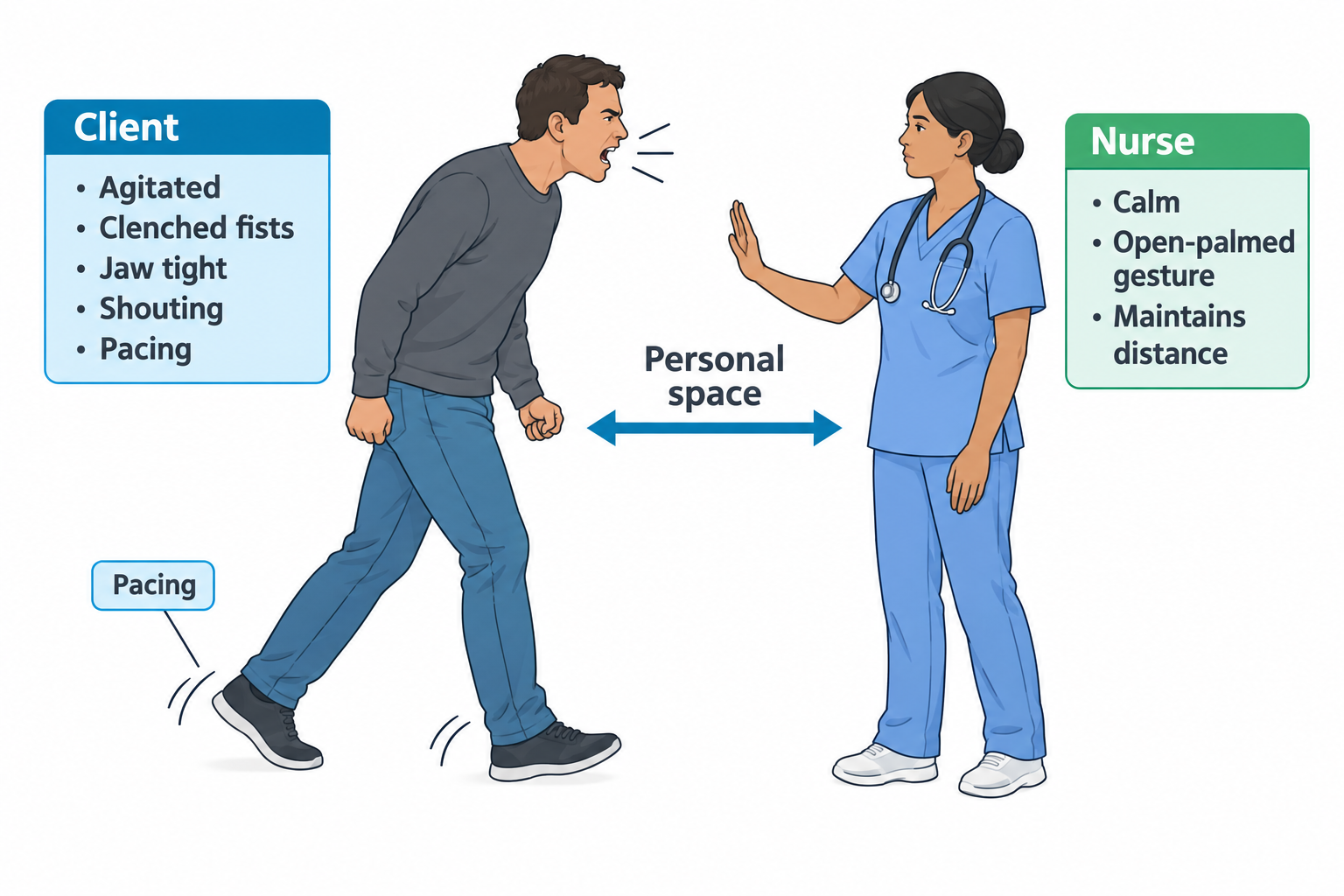
Early warning signs

  • Pacing or restlessness
  • Irritability or rapid speech
  • Raised voice
  • Refusal to follow simple directions
  • Invading personal space
alt_text
//////Caption: Recognizing early warning signs of escalating behavior.
Illustration type: Medical Illustration
Illustration Note: Depict a client displaying behaviors such as pacing, clenched fists, raised voice, invading personal space, and increasing agitation, highlighting cues that warrant early nursing intervention…///////

Nursing interventions

  • Intervene early with de-escalation
  • Redirect to safe activities
  • Reduce environmental stimuli
  • Offer choices when possible
  • Involve team support early
  • Maintain personal space and safety

Early intervention prevents escalation and preserves client dignity.

Nurse’s role in milieu management

The nurse is the anchor of the therapeutic environment.

Nursing responsibilities

  • Model respectful communication
  • Maintain emotional neutrality
  • Observe interactions continuously
  • Reinforce positive behaviors
  • Address unsafe behavior promptly
  • Collaborate with the interdisciplinary team

The nurse does not control the environment through authority and force but through presence, consistency, and clarity.

Least restrictive environment

Clients should always be cared for in the least restrictive setting that ensures safety.

Hierarchy of interventions

  1. Verbal de-escalation and therapeutic communication
  2. Environmental modification
  3. Increased observation
  4. Medication as ordered
  5. Restraints or seclusion (last resort)

NCLEX prioritizes the least restrictive first.

alt_text
//////Caption: Progression from least to most restrictive behavioral intervention.
Illustration type: Flowchart
Illustration Note: Show the sequence: Verbal De-escalation → Environmental Modification → Increased Observation → Medication (as ordered) → Restraints/Seclusion (Last Resort).///////

Suicide and Self-Harm Precautions (High-Yield NCLEX)

Suicide risk is a priority safety concern across psychiatric, medical, and emergency settings.

Key Nursing Interventions

  • Perform a suicide risk assessment according to facility policy and whenever suicide risk is suspected.
  • Remove potentially harmful objects (belts, cords, sharps).
  • Ensure ligature-safe environment.
  • Maintain close, supportive presence.

NCLEX Priority:

Safety interventions take precedence over privacy or autonomy when suicide risk is present.

Violence and Aggression Precautions

When a client poses a risk of harm to others, the nurse must act early and decisively.

Safety-Focused Nursing Actions

  • Maintain personal space and clear exit access
  • Use calm, low-volume communication
  • Avoid confrontation or power struggles
  • Call for assistance early
  • Remove other clients from the area if needed

NCLEX Tip:

The nurse’s first responsibility is the safety of all clients and staff.

Use of Restraints and Seclusion (Legal & Ethical Focus)

Restraints and seclusion are emergency interventions used only when less restrictive measures have failed.

Key NCLEX Principles

  • Require a provider order (except in emergencies per policy).
  • Use the least restrictive type possible.
  • Continuous monitoring is required.
  • Assess circulation, skin, and vital signs frequently.
  • Remove restraints as soon as the client is safe.

NCLEX Red Flag: Restraints are never used for convenience, punishment, or staff shortages.

Clinical vignette: A psychiatric unit becomes increasingly loud during shift change. One client begins pacing and shouting. The nurse reduces noise, redirects other clients to activities, and calmly approaches the pacing client, offering a quiet space and choices. The client settles without further escalation, preserving safety and dignity.

Nursing considerations

  • The environment is a therapeutic tool
  • Structure and consistency reduce anxiety.
  • Limit setting protects safety.
  • Intervene early to prevent escalation.
  • Least restrictive interventions come first.

Common NCLEX pitfalls

  • Using rules as punishment.
  • Inconsistent enforcement of limits.
  • Ignoring early signs of agitation.
  • Escalating situations with authority or threats.
  • Overusing restraints instead of de-escalation.
  • Taking disruptive behavior personally.
  • Therapeutic environments support healing.
  • Structure reduces anxiety.
  • Consistency prevents manipulation.
  • Early intervention preserves safety.
  • Least restrictive measures are always preferred. :::

Sign up for free to take 5 quiz questions on this topic

Previous
Next  | 4.1.1 Assistive devices and mobility aids
All rights reserved ©2016 - 2026 Achievable, Inc.

Behavioral Interventions and Safety Precautions

Introduction

A therapeutic environment is more than a physical space. It is an intentional setting designed to promote safety, emotional regulation, healing, and respectful interaction. In mental health and general nursing settings alike, the environment influences behavior, coping, and recovery.

On the NCLEX, therapeutic environment questions test whether the nurse understands how structure, boundaries, consistency, and safety reduce distress and prevent harm. The nurse’s role is to create conditions that support stability while preserving dignity and autonomy.

Learning objectives

By the end of this section, you should be able to:

  • Define key elements of a therapeutic environment.
  • Describe the nurse’s role in milieu management.
  • Apply structure, routines, and boundaries to support safety.
  • Recognize behaviors that threaten the therapeutic milieu.
  • Intervene appropriately to maintain order and emotional safety.
  • Answer NCLEX-style questions related to environmental and behavioral management.
Definitions
Therapeutic environment
A structured, safe, and supportive setting that promotes emotional stability, healing, and appropriate behavior.
Milieu
The total physical, emotional, social, and cultural environment in which care occurs.
Milieu therapy
Planned use of the environment, activities, and relationships to support therapeutic goals.
Structure
Predictable routines, rules, and expectations that reduce anxiety and improve behavior.
Limit setting
Establishing clear, consistent behavioral expectations to maintain safety and boundaries.
Behavioral escalation
A progression from agitation to loss of control that threatens safety if not addressed early.
Least restrictive environment
The safest setting that preserves maximum autonomy while preventing harm.
Unit rules
Clearly defined expectations that promote safety, consistency, and respectful behavior throughout the unit.
Consistency
Uniform application of rules and responses by all staff members.
Boundaries
Professional limits that protect clients and staff emotionally and physically.

Purpose of a therapeutic environment

The therapeutic environment serves multiple clinical goals. Core purposes:

  • Promote physical and emotional safety
  • Reduce anxiety and overstimulation
  • Support self-control and emotional regulation
  • Encourage appropriate social interaction
  • Foster trust and predictability
  • Prevent escalation and crisis

NCLEX frequently tests whether the nurse understands that environmental control is a form of intervention, not punishment.

Components of a therapeutic milieu

Physical environment

  • Clean, uncluttered spaces
  • Adequate lighting
  • Reduced noise
  • Safe furniture and fixtures
  • Removal of ligature risks and hazards
  • Clear exit access for staff

Emotional environment

  • Calm, respectful tone
  • Nonjudgmental communication
  • Validation of feelings
  • Consistent staff responses

Social environment

  • Structured group activities
  • Clear expectations for behavior
  • Respectful peer interactions
  • Staff modeling appropriate behavior

A calm environment helps regulate emotions before clients can regulate themselves.

Structure, routines, and rules

Structure reduces uncertainty, which in turn reduces anxiety and acting-out behaviors.

Examples of therapeutic structure:

  • Consistent daily schedules
  • Planned meals and activities
  • Predictable medication times
  • Clearly posted unit rules
  • Defined quiet hours

Nursing responsibilities

  • Explain rules clearly and calmly
  • Apply rules consistently
  • Avoid favoritism or exceptions
  • Reinforce expectations before correcting behavior

Limit setting and boundaries

Limit setting is essential for safety and therapeutic progress.

Effective limit setting includes:

  • Clear, simple statements
  • Focus on behavior, not character
  • Consistent follow-through
  • Calm tone
  • Explanation of consequences

Example: “I can’t allow yelling on the unit. If you continue, we’ll need to move to a quieter space.”

Avoid threats, bargaining, or emotional reactions.

Managing disruptive or unsafe behaviors

Early warning signs

  • Pacing or restlessness
  • Irritability or rapid speech
  • Raised voice
  • Refusal to follow simple directions
  • Invading personal space
alt_text
//////Caption: Recognizing early warning signs of escalating behavior.
Illustration type: Medical Illustration
Illustration Note: Depict a client displaying behaviors such as pacing, clenched fists, raised voice, invading personal space, and increasing agitation, highlighting cues that warrant early nursing intervention…///////

Nursing interventions

  • Intervene early with de-escalation
  • Redirect to safe activities
  • Reduce environmental stimuli
  • Offer choices when possible
  • Involve team support early
  • Maintain personal space and safety

Early intervention prevents escalation and preserves client dignity.

Nurse’s role in milieu management

The nurse is the anchor of the therapeutic environment.

Nursing responsibilities

  • Model respectful communication
  • Maintain emotional neutrality
  • Observe interactions continuously
  • Reinforce positive behaviors
  • Address unsafe behavior promptly
  • Collaborate with the interdisciplinary team

The nurse does not control the environment through authority and force but through presence, consistency, and clarity.

Least restrictive environment

Clients should always be cared for in the least restrictive setting that ensures safety.

Hierarchy of interventions

  1. Verbal de-escalation and therapeutic communication
  2. Environmental modification
  3. Increased observation
  4. Medication as ordered
  5. Restraints or seclusion (last resort)

NCLEX prioritizes the least restrictive first.

alt_text
//////Caption: Progression from least to most restrictive behavioral intervention.
Illustration type: Flowchart
Illustration Note: Show the sequence: Verbal De-escalation → Environmental Modification → Increased Observation → Medication (as ordered) → Restraints/Seclusion (Last Resort).///////

Suicide and Self-Harm Precautions (High-Yield NCLEX)

Suicide risk is a priority safety concern across psychiatric, medical, and emergency settings.

Key Nursing Interventions

  • Perform a suicide risk assessment according to facility policy and whenever suicide risk is suspected.
  • Remove potentially harmful objects (belts, cords, sharps).
  • Ensure ligature-safe environment.
  • Maintain close, supportive presence.

NCLEX Priority:

Safety interventions take precedence over privacy or autonomy when suicide risk is present.

Violence and Aggression Precautions

When a client poses a risk of harm to others, the nurse must act early and decisively.

Safety-Focused Nursing Actions

  • Maintain personal space and clear exit access
  • Use calm, low-volume communication
  • Avoid confrontation or power struggles
  • Call for assistance early
  • Remove other clients from the area if needed

NCLEX Tip:

The nurse’s first responsibility is the safety of all clients and staff.

Use of Restraints and Seclusion (Legal & Ethical Focus)

Restraints and seclusion are emergency interventions used only when less restrictive measures have failed.

Key NCLEX Principles

  • Require a provider order (except in emergencies per policy).
  • Use the least restrictive type possible.
  • Continuous monitoring is required.
  • Assess circulation, skin, and vital signs frequently.
  • Remove restraints as soon as the client is safe.

NCLEX Red Flag: Restraints are never used for convenience, punishment, or staff shortages.

Clinical vignette: A psychiatric unit becomes increasingly loud during shift change. One client begins pacing and shouting. The nurse reduces noise, redirects other clients to activities, and calmly approaches the pacing client, offering a quiet space and choices. The client settles without further escalation, preserving safety and dignity.

Nursing considerations

  • The environment is a therapeutic tool
  • Structure and consistency reduce anxiety.
  • Limit setting protects safety.
  • Intervene early to prevent escalation.
  • Least restrictive interventions come first.

Common NCLEX pitfalls

  • Using rules as punishment.
  • Inconsistent enforcement of limits.
  • Ignoring early signs of agitation.
  • Escalating situations with authority or threats.
  • Overusing restraints instead of de-escalation.
  • Taking disruptive behavior personally.
Key points
  • Therapeutic environments support healing.
  • Structure reduces anxiety.
  • Consistency prevents manipulation.
  • Early intervention preserves safety.
  • Least restrictive measures are always preferred. :::

More from Psychosocial Integrity

  • Crisis intervention and safety
  • End-of-life care and grief counseling