



Crisis intervention and safety
Introduction
Crisis is the moment when a person’s internal coping system collapses under the weight of stress, fear, loss, trauma, or illness. It can look loud or quiet, chaotic or frozen, dramatic or invisible. In that moment, nursing becomes less about fixing and more about stabilizing: protecting life, restoring psychological safety, and guiding the client back to a place where thinking becomes possible again.
The NCLEX repeatedly tests crisis intervention because it sits at the intersection of psychosocial integrity and basic survival. Expect scenarios involving suicidal ideation, escalating agitation, violence risk, abuse reporting, restraints, and legal-ethical decisions. The nurse’s priority is consistent: safety first, then stabilization, then support and planning.
Learning objectives
By the end of this section, you should be able to:
- Recognize crisis states and distinguish expected stress responses from emergencies.
- Perform rapid safety-focused assessments for suicide, self-harm, and violence risk.
- Apply de-escalation techniques and trauma-informed interventions.
- Implement appropriate observation levels and environmental safety measures.
- Describe appropriate use of restraints and seclusion and related nursing responsibilities.
- Identify reporting requirements for abuse, neglect, and threats.
- Apply NCLEX-style clinical judgment to crisis prioritization scenarios.
Recognizing crisis and prioritizing nursing actions
Crisis can present as panic, rage, withdrawal, silence, crying, confusion, risky behavior, or sudden calmness. The nurse’s first job is to determine whether the situation is unsafe, unstable, or deteriorating.
Rapid crisis assessment priorities
- Is anyone at immediate risk of harm (self, others, staff)?
- Is the client intoxicated, withdrawing, or medically unstable?
- Are there command hallucinations, severe mania, or delirium?
- Does the client have access to means (meds, sharp objects, ligatures)?
- Can the client follow directions and engage in reality-based communication?
Suicide risk assessment and precautions
NCLEX expects the nurse to assess suicide directly. Asking about suicide does not “plant the idea.” It clarifies risk.
High-risk indicators
- Active suicidal ideation with a plan
- Access to means (especially firearms)
- Past attempts or self-harm history
- Severe hopelessness, agitation, insomnia
- Substance use or intoxication
- Recent major loss, humiliation, trauma
- Command hallucinations to self-harm
- Sudden calmness after severe depression
What the nurse should ask
Use direct, calm, nonjudgmental questions:
- “Are you thinking about hurting yourself?”
- “Do you have a plan?”
- “Do you have access to the means?”
- “Have you attempted before?”
- “What has kept you safe so far?”
Immediate nursing interventions
- Do not leave a high-risk client alone.
- Notify provider and follow facility suicide protocol.
- Implement observation level per policy (often 1:1).
- Remove hazards (belts, cords, sharps, unsafe meds).
- Maintain a calm, safe environment.
- Document objectively: exact quotes, behaviors, actions taken.
Violence risk and behavioral escalation
Violence risk increases with intoxication, withdrawal, psychosis, severe mania, paranoia, and trauma triggers. A client may escalate quickly when they feel cornered, shamed, controlled, or unheard.
Warning signs of escalation
- Pacing, clenched fists, jaw tightening.
- Loud voice, threatening language.
- Intense staring, invasion of space.
- Refusal to follow simple directions.
- Sudden change in affect (flat to explosive).
- Paranoid statements (“you’re trying to poison me”).
Nursing priorities
- Protect staff and other clients.
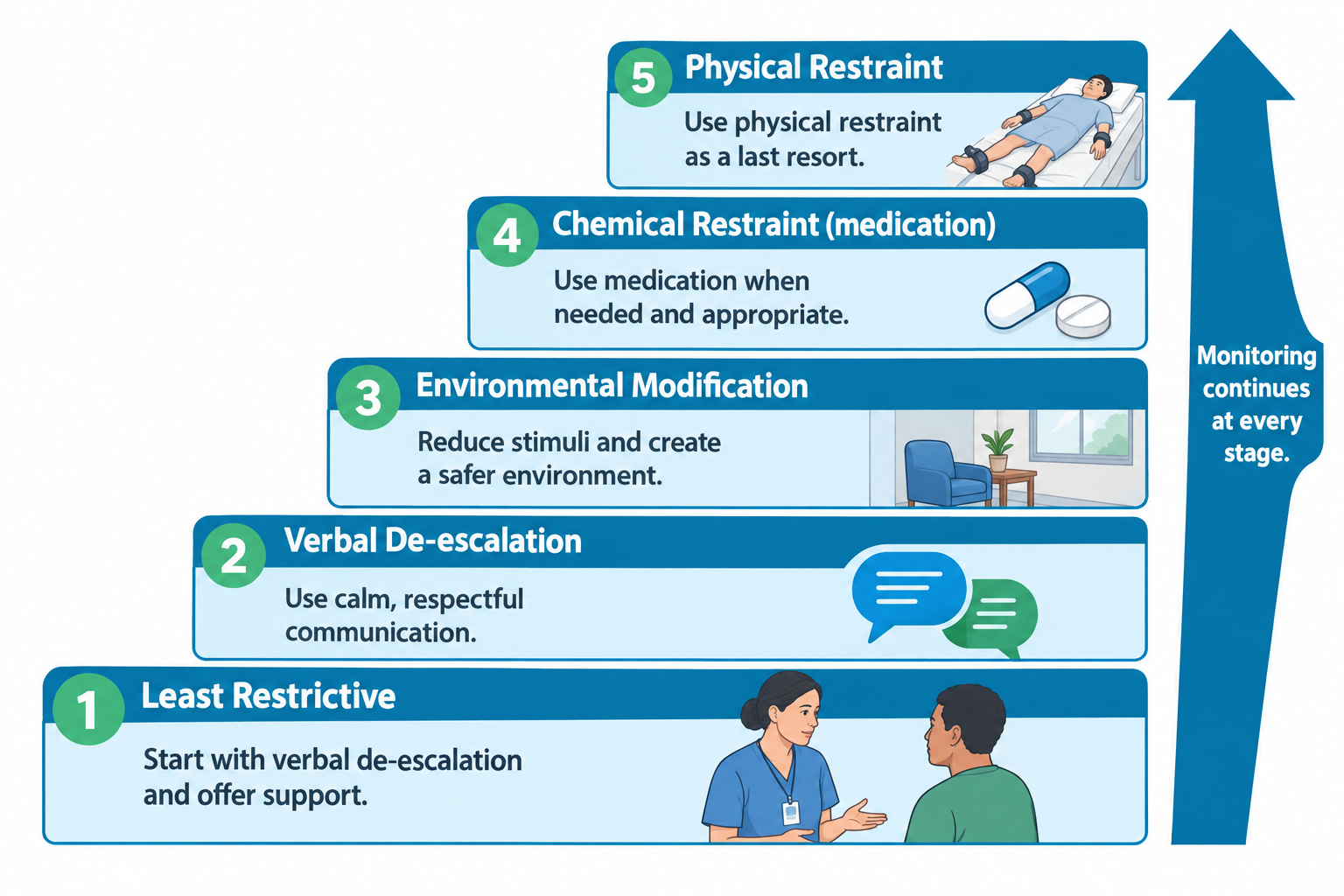
- Use de-escalation before restraint.
- Ensure access to exit; do not block the door.
- Avoid arguing or power struggles.
- Call for assistance early (team response).
De-escalation and therapeutic limit setting
De-escalation works best when it starts early. The nurse becomes the “weather” in the room: calm tone, steady presence, clear limits.
Evidence-based de-escalation strategies
- Keep voice low and slow.
- Maintain nonthreatening posture, hands visible.
- Give space; respect personal boundaries.
- Use simple choices: “would you like to sit here or over there?”
- Acknowledge emotion: “I can see you’re angry.”
- Set limits clearly: “I will help you, but I cannot allow yelling or hitting.”
- Focus on safety and the next small step.
- Reduce stimuli (lights, noise, crowding).
Phrases that work on NCLEX
- “Tell me what you need right now to feel safe.”
- “I’m here to help. Let’s work through this together.”
- “You can be angry, but you cannot hurt anyone.”
- “We can talk when your voice is at a safe level.”
Phrases that worsen escalation
- “Calm down.”
- “Because I said so.”
- “If you don’t stop, you’ll be restrained.” (threatening)
- “You’re acting crazy.”
Trauma-informed crisis care
Trauma-informed care reduces retraumatization, which can present as agitation, dissociation, refusal, or shutdown.
Trauma-informed principles in crisis
- Offer choice whenever possible.
- Explain actions before doing them.
- Ask permission before touch.
- Avoid sudden movements.
- Give predictable structure (“here is what will happen next”).
- Validate without forcing disclosure.
Observation levels and environmental safety
Observation is a safety intervention, not a punishment.
Common observation approaches
- Routine observation (standard rounding).
- Close observation (more frequent checks).
- Continuous observation (often 1:1) for imminent risk.
Environmental safety actions
- Remove ligature risks (cords, belts, drawstrings).
- Secure sharps and hazardous supplies.
- Ensure safe room layout and exit access.
- Monitor visitor items if policy requires.
- Ensure medications are administered safely (cheeking precautions if needed).
Restraints and seclusion
Restraints and seclusion are last-resort measures used only when the client poses immediate danger and less restrictive interventions have failed.
Key principles
- Use the least restrictive measure for the shortest time.
- Protect dignity and safety throughout.
- Follow facility policy and provider order requirements.
- Continuous monitoring is essential.
Nursing responsibilities
- Attempt and document less restrictive measures first.
- Monitor airway, breathing, circulation, skin integrity.
- Assess hydration, elimination, pain, range of motion.
- Remove restraints as soon as safe criteria are met.
- Document behavior, interventions, monitoring, and response objectively.
Abuse, neglect, and mandatory reporting
Crisis safety includes recognizing harm caused by others.
Populations at increased risk
- Children
- Older adults
- Dependent adults
- Intimate partner violence survivors
Red flags
- Injuries inconsistent with explanation.
- Delays in seeking care.
- Fearful behavior, controlling partner at bedside.
- Malnutrition, poor hygiene, unsafe living situation.
- Repeated “accidents” or frequent ED visits.
Nursing actions
- Ensure immediate safety and privacy.
- Use nonjudgmental questions.
- Follow mandatory reporting procedures per policy.
- Document objective findings (quotes, injuries, descriptions).
- Involve social work and appropriate agencies.
Clinical vignette: A 33-year-old client with schizophrenia becomes agitated, pacing and shouting that the staff is “plotting to kill” him. He clenches his fists and steps toward another client. The nurse signals for help, keeps a safe distance, speaks calmly, and says, “I can see you feel threatened. You are safe here. Let’s move to a quieter space.” The nurse reduces stimuli, offers choices, and sets clear limits. When the client reports voices telling him to hurt someone, the nurse initiates safety protocols and notifies the provider immediately.
Nursing interventions
- Safety comes before teaching.
- Assess suicide and violence risk directly.
- Command hallucinations require immediate action.
- De-escalation is first-line intervention.
- Restraints and seclusion are last resort.
- Document objectively and follow reporting laws.