


Achievable logoAchievable logo
NCLEX
Sign in
Sign up
Purchase
Textbook
Practice exams
Support
How it works
Exam catalog
Mountain with a flag at the peak
Textbook
Introduction
1. Safe and effective care environment
2. Health promotion and maintenance
3. Psychosocial Integrity
3.1 Mental health concepts
3.2 Psychiatric disorders
3.3 Crisis intervention and safety
3.4 End-of-life care and grief counseling
3.5 Behavioral Interventions and Safety Precautions
4. Physiological Integrity
Wrapping up
Achievable logoAchievable logo
3.4 End-of-life care and grief counseling
Achievable NCLEX
3. Psychosocial Integrity
Our NCLEX course is currently in development and is a work-in-progress.

End-of-life care and grief counseling

6 min read
Font
Discuss
Share
Feedback

Introduction

Death is not just a medical event. It’s a human experience shared by clients, families, and care teams alike. Nursing care at the end of life goes beyond symptom control. It means providing presence, compassion, dignity, and cultural respect during a time of emotional and spiritual vulnerability.

On the NCLEX, end-of-life care questions focus on comfort measures, advance directives, therapeutic communication, and support for grieving families. Mastery of this chapter means being able to care deeply, communicate clearly, and advocate respectfully.

Learning objectives

By the end of this section, you should be able to:

  • Describe the nurse’s role in palliative and hospice care.
  • Implement physical, emotional, and spiritual comfort measures.
  • Communicate therapeutically with clients and families facing loss.
  • Understand the stages and types of grief.
  • Support diverse cultural and religious end-of-life preferences.
  • Anticipate NCLEX-style questions related to ethics, decision-making, and death care.

Principles of end-of-life care

End-of-life care is client-centered, comfort-focused, and honors the individual’s values and goals.

Palliative care

  • Can begin at the diagnosis of a serious illness.
  • Supports symptom relief and quality of life at any stage.
  • Does not require the cessation of curative treatments.

Hospice care

  • Begins when a provider certifies a life expectancy of approximately 6 months or less if the disease follows its expected course, and the client elects comfort-focused care.
  • Focuses exclusively on quality of life and dignified death.
  • Provided at home, hospital, or dedicated hospice settings.
alt_text
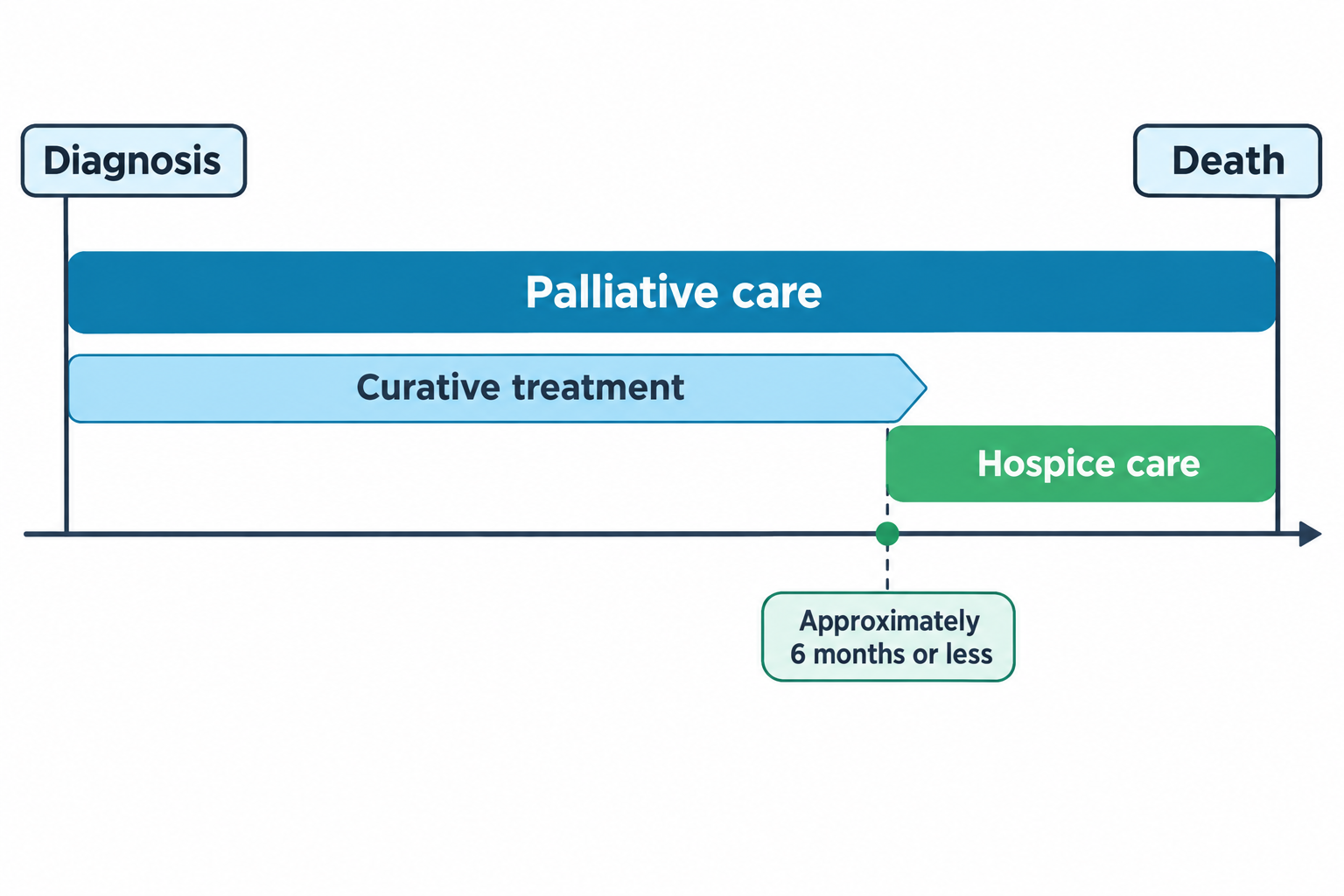
//////Caption: Relationship between palliative care and hospice care across the course of serious illness.
Illustration type: Timeline Diagram
Illustration Note: Show palliative care beginning alongside diagnosis and continuing throughout illness, while hospice care begins near the end of life after curative treatment is no longer the focus.///////

Nursing interventions

End-of-life care requires physical comfort measures and emotional presence.

Physical care

  • Manage pain (use scheduled analgesics; opioids are common).
  • Treat dyspnea with positioning, airflow (fan), and oxygen when indicated.
  • Manage secretions (anticholinergics) and dry mouth (oral swabs).
  • Reposition regularly to maximize comfort, while avoiding unnecessary discomfort from frequent turning.
  • Avoid unnecessary procedures or diagnostics.

Emotional and spiritual care

  • Offer silence, touch, and presence.
  • Allow the client and family to guide conversations.
  • Ask about spiritual or cultural needs.
  • Provide clergy or chaplain referrals as appropriate.
  • Support legacy-making and memory preservation.
Definitions
Palliative care
Specialized care that focuses on relieving symptoms and stress from serious illness, regardless of prognosis.
Hospice care
Comfort-based care for clients near the end of life who are no longer receiving curative treatment.
Advance directive
A legal document that expresses a client’s healthcare preferences if they can no longer communicate.
Living will
Part of an advance directive that outlines treatment preferences, such as mechanical ventilation, artificial nutrition, and other life-sustaining treatments.
Healthcare proxy
A designated person who makes medical decisions if the client becomes incapacitated.
Do not resuscitate (DNR)
A medical order to withhold CPR if the client’s heart or breathing stops.
Mottling
Skin discoloration seen near death, typically bluish or purple patterns on the extremities.
Cheyne-Stokes respirations
Irregular breathing pattern seen in dying clients, alternating deep breaths with apnea.
Anticipatory grief
Emotional response to an expected loss, occurring before death.
Bereavement
The state of loss after the death of a loved one.
Complicated grief
Persistent and disabling grief that interferes with daily functioning.

Grief and bereavement support

Grief is a normal, individual response to loss.

Stages of grief (Kubler-Ross model)

  1. Denial: “This isn’t happening.”
  2. Anger: “Why is this happening to me?”
  3. Bargaining: “If I do this, maybe they won’t die.”
  4. Depression: Profound sadness.
  5. Acceptance: Coming to peace with reality.

Clients may move through stages nonlinearly or revisit stages repeatedly.

Nursing role

  • Normalize emotions: “There’s no right or wrong way to grieve.”
  • Offer support, not solutions.
  • Provide community resources or referrals (support groups, counseling).
  • Allow expressions of sadness, guilt, or anger
  • Don’t rush or pressure closure.

Cultural and ethical considerations

Respect cultural practices surrounding death.

  • Some cultures prioritize family consensus over individual autonomy.
  • Dietary, prayer, or end-of-life rituals may vary (e.g., burning incense, facing Mecca, anointing with oil).
  • Always ask the family what traditions are important to them.
  • Support culturally competent care without assumptions

Ethically, the nurse must:

  • Respect client autonomy and choices.
  • Advocate for dignity and comfort.
  • Avoid imposing personal values.
  • Communicate clearly with families about care goals and expectations.

Post-mortem care

Nurses often perform the first steps after death.

  • Confirm death according to institutional policy (e.g., assess for absence of respirations and pulse) and follow facility procedures for pronouncement of death.
  • Notify provider and family.
  • Allow time for family to be present with the body.
  • Provide respectful hygiene (clean the body, close the eyes and mouth when possible, and remove tubes or lines according to institutional policy).
  • Tag and prepare the body for the morgue.
  • Document time of death and notifications made.
alt_text
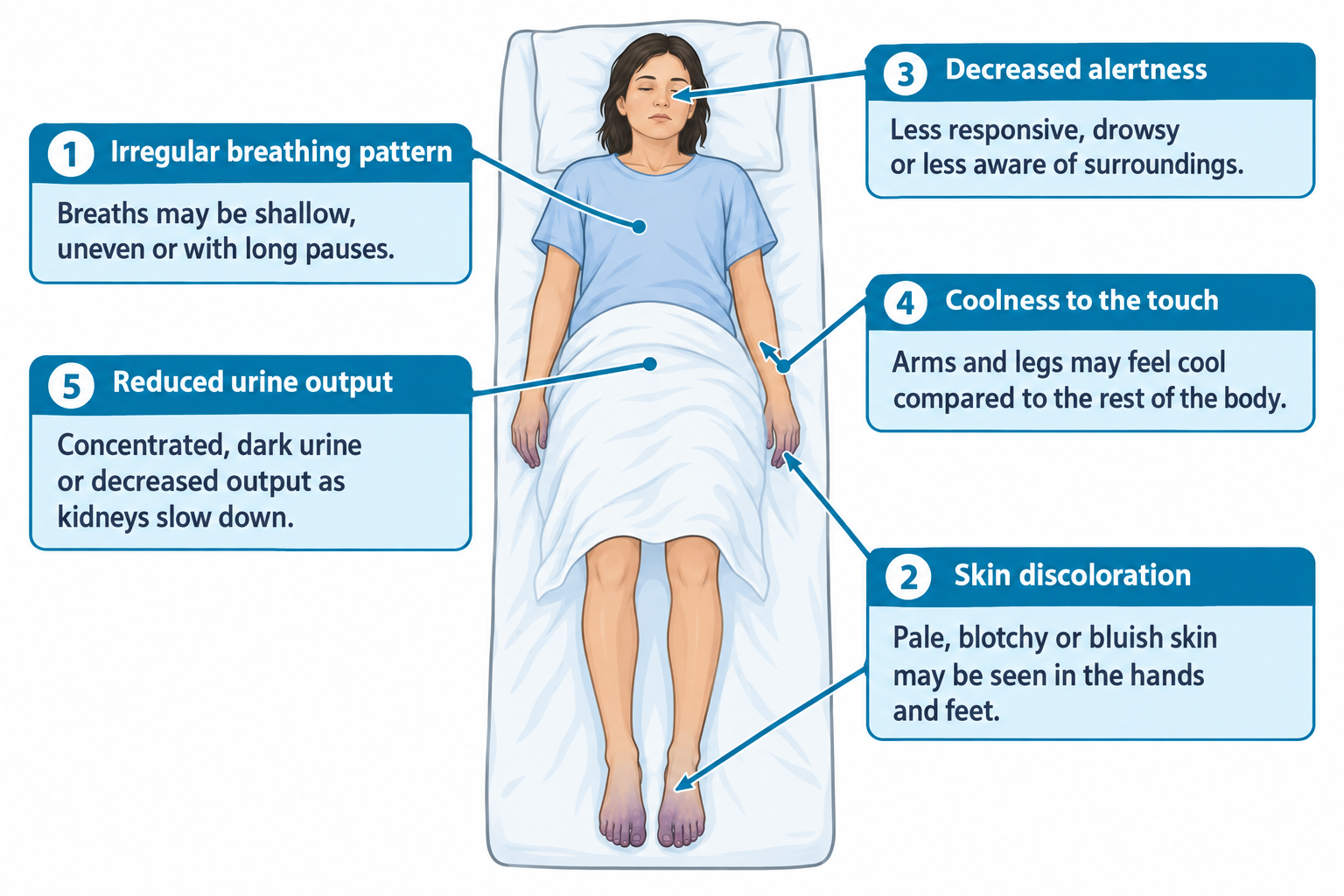
//////Caption: Common physical changes observed during the active dying process.
Illustration type: Medical Illustration
Illustration Note: Label common end-of-life signs such as Cheyne-Stokes respirations, mottling of the extremities, decreased level of consciousness, reduced urine output, and cool extremities. This illustration should emphasize recognition of expected changes rather than pathology.///////

Clinical vignette: A 76-year-old woman with terminal cancer is receiving home hospice. She becomes unresponsive, with shallow breathing and mottled extremities. The nurse sits with her family, explains what to expect, and provides morphine for comfort. After death, the nurse supports the family, offers memory-making resources, and assists with respectful post-mortem care.

Dying clients need comfort, not a cure. Family members need support, not solutions. Your presence matters more than your words.

Nursing interventions

  • Pain control is a priority in hospice.
  • DNR means no CPR, but still provide full comfort care.
  • Do not force “acceptance” of grief.
  • Allow expressions of sadness, guilt, or anger without correction.
  • Document factual observations, not judgments.
  • Prioritize dignity in both life and death.

Common NCLEX pitfalls

  • Assuming clients move through grief in order.
  • Failing to manage symptoms like pain or dyspnea.
  • Ignoring family distress or spiritual needs.
  • Initiating resuscitation when DNR is in place.
  • Assuming all families want the same post-mortem rituals.
  • Palliative care = comfort at any stage
  • Hospice = comfort near death
  • Advance directives guide care when the client can’t speak
  • Support grief without rushing it
  • Honor all expressions of loss :::

Sign up for free to take 5 quiz questions on this topic

Previous
Next  | 3.5 Behavioral Interventions and Safety Precautions
All rights reserved ©2016 - 2026 Achievable, Inc.

End-of-life care and grief counseling

Introduction

Death is not just a medical event. It’s a human experience shared by clients, families, and care teams alike. Nursing care at the end of life goes beyond symptom control. It means providing presence, compassion, dignity, and cultural respect during a time of emotional and spiritual vulnerability.

On the NCLEX, end-of-life care questions focus on comfort measures, advance directives, therapeutic communication, and support for grieving families. Mastery of this chapter means being able to care deeply, communicate clearly, and advocate respectfully.

Learning objectives

By the end of this section, you should be able to:

  • Describe the nurse’s role in palliative and hospice care.
  • Implement physical, emotional, and spiritual comfort measures.
  • Communicate therapeutically with clients and families facing loss.
  • Understand the stages and types of grief.
  • Support diverse cultural and religious end-of-life preferences.
  • Anticipate NCLEX-style questions related to ethics, decision-making, and death care.

Principles of end-of-life care

End-of-life care is client-centered, comfort-focused, and honors the individual’s values and goals.

Palliative care

  • Can begin at the diagnosis of a serious illness.
  • Supports symptom relief and quality of life at any stage.
  • Does not require the cessation of curative treatments.

Hospice care

  • Begins when a provider certifies a life expectancy of approximately 6 months or less if the disease follows its expected course, and the client elects comfort-focused care.
  • Focuses exclusively on quality of life and dignified death.
  • Provided at home, hospital, or dedicated hospice settings.
alt_text
//////Caption: Relationship between palliative care and hospice care across the course of serious illness.
Illustration type: Timeline Diagram
Illustration Note: Show palliative care beginning alongside diagnosis and continuing throughout illness, while hospice care begins near the end of life after curative treatment is no longer the focus.///////

Nursing interventions

End-of-life care requires physical comfort measures and emotional presence.

Physical care

  • Manage pain (use scheduled analgesics; opioids are common).
  • Treat dyspnea with positioning, airflow (fan), and oxygen when indicated.
  • Manage secretions (anticholinergics) and dry mouth (oral swabs).
  • Reposition regularly to maximize comfort, while avoiding unnecessary discomfort from frequent turning.
  • Avoid unnecessary procedures or diagnostics.

Emotional and spiritual care

  • Offer silence, touch, and presence.
  • Allow the client and family to guide conversations.
  • Ask about spiritual or cultural needs.
  • Provide clergy or chaplain referrals as appropriate.
  • Support legacy-making and memory preservation.
Definitions
Palliative care
Specialized care that focuses on relieving symptoms and stress from serious illness, regardless of prognosis.
Hospice care
Comfort-based care for clients near the end of life who are no longer receiving curative treatment.
Advance directive
A legal document that expresses a client’s healthcare preferences if they can no longer communicate.
Living will
Part of an advance directive that outlines treatment preferences, such as mechanical ventilation, artificial nutrition, and other life-sustaining treatments.
Healthcare proxy
A designated person who makes medical decisions if the client becomes incapacitated.
Do not resuscitate (DNR)
A medical order to withhold CPR if the client’s heart or breathing stops.
Mottling
Skin discoloration seen near death, typically bluish or purple patterns on the extremities.
Cheyne-Stokes respirations
Irregular breathing pattern seen in dying clients, alternating deep breaths with apnea.
Anticipatory grief
Emotional response to an expected loss, occurring before death.
Bereavement
The state of loss after the death of a loved one.
Complicated grief
Persistent and disabling grief that interferes with daily functioning.

Grief and bereavement support

Grief is a normal, individual response to loss.

Stages of grief (Kubler-Ross model)

  1. Denial: “This isn’t happening.”
  2. Anger: “Why is this happening to me?”
  3. Bargaining: “If I do this, maybe they won’t die.”
  4. Depression: Profound sadness.
  5. Acceptance: Coming to peace with reality.

Clients may move through stages nonlinearly or revisit stages repeatedly.

Nursing role

  • Normalize emotions: “There’s no right or wrong way to grieve.”
  • Offer support, not solutions.
  • Provide community resources or referrals (support groups, counseling).
  • Allow expressions of sadness, guilt, or anger
  • Don’t rush or pressure closure.

Cultural and ethical considerations

Respect cultural practices surrounding death.

  • Some cultures prioritize family consensus over individual autonomy.
  • Dietary, prayer, or end-of-life rituals may vary (e.g., burning incense, facing Mecca, anointing with oil).
  • Always ask the family what traditions are important to them.
  • Support culturally competent care without assumptions

Ethically, the nurse must:

  • Respect client autonomy and choices.
  • Advocate for dignity and comfort.
  • Avoid imposing personal values.
  • Communicate clearly with families about care goals and expectations.

Post-mortem care

Nurses often perform the first steps after death.

  • Confirm death according to institutional policy (e.g., assess for absence of respirations and pulse) and follow facility procedures for pronouncement of death.
  • Notify provider and family.
  • Allow time for family to be present with the body.
  • Provide respectful hygiene (clean the body, close the eyes and mouth when possible, and remove tubes or lines according to institutional policy).
  • Tag and prepare the body for the morgue.
  • Document time of death and notifications made.
alt_text
//////Caption: Common physical changes observed during the active dying process.
Illustration type: Medical Illustration
Illustration Note: Label common end-of-life signs such as Cheyne-Stokes respirations, mottling of the extremities, decreased level of consciousness, reduced urine output, and cool extremities. This illustration should emphasize recognition of expected changes rather than pathology.///////

Clinical vignette: A 76-year-old woman with terminal cancer is receiving home hospice. She becomes unresponsive, with shallow breathing and mottled extremities. The nurse sits with her family, explains what to expect, and provides morphine for comfort. After death, the nurse supports the family, offers memory-making resources, and assists with respectful post-mortem care.

Dying clients need comfort, not a cure. Family members need support, not solutions. Your presence matters more than your words.

Nursing interventions

  • Pain control is a priority in hospice.
  • DNR means no CPR, but still provide full comfort care.
  • Do not force “acceptance” of grief.
  • Allow expressions of sadness, guilt, or anger without correction.
  • Document factual observations, not judgments.
  • Prioritize dignity in both life and death.

Common NCLEX pitfalls

  • Assuming clients move through grief in order.
  • Failing to manage symptoms like pain or dyspnea.
  • Ignoring family distress or spiritual needs.
  • Initiating resuscitation when DNR is in place.
  • Assuming all families want the same post-mortem rituals.
Key points
  • Palliative care = comfort at any stage
  • Hospice = comfort near death
  • Advance directives guide care when the client can’t speak
  • Support grief without rushing it
  • Honor all expressions of loss :::

More from Psychosocial Integrity

  • Crisis intervention and safety
  • Behavioral Interventions and Safety Precautions