


Achievable logoAchievable logo
NCLEX
Sign in
Sign up
Purchase
Textbook
Practice exams
Support
How it works
Exam catalog
Mountain with a flag at the peak
Textbook
Introduction
1. Safe and effective care environment
2. Health promotion and maintenance
3. Psychosocial Integrity
3.1 Mental health concepts
3.2 Psychiatric disorders
3.2.1 Mood disorders (depression and bipolar)
3.2.2 Anxiety and stress-related disorders (PTSD, OCD)
3.2.3 Psychotic disorders
3.2.4 Personality disorders
3.2.5 Substance use and addiction
3.2.6 Eating disorders
3.3 Crisis intervention and safety
3.4 End-of-life care and grief counseling
3.5 Behavioral Interventions and Safety Precautions
4. Physiological Integrity
Wrapping up
Achievable logoAchievable logo
3.2.3 Psychotic disorders
Achievable NCLEX
3. Psychosocial Integrity
3.2. Psychiatric disorders
Our NCLEX course is currently in development and is a work-in-progress.

Psychotic disorders

5 min read
Font
Discuss
Share
Feedback

Introduction

Psychotic disorders are characterized by a loss of contact with reality that affects perception, thought, emotion, and behavior. Clients may experience hallucinations, delusions, disorganized thinking, and impaired functioning that interfere with safety, relationships, and self-care.

On the NCLEX, psychotic disorders are tested less on diagnostic labels and more on recognition of symptoms, safety prioritization, therapeutic communication, and medication monitoring. Nurses play a critical role in stabilizing clients, maintaining reality-based interactions, and preventing harm.

Learning objectives

By the end of this section, you should be able to:

  • Identify key features of psychotic disorders.
  • Differentiate positive, negative, and cognitive symptoms.
  • Apply therapeutic communication techniques with psychotic clients.
  • Prioritize safety during hallucinations and delusions.
  • Recognize medication considerations and adverse effects.
  • Answer NCLEX-style questions involving psychosis and impaired reality testing.

Overview of psychotic disorders

Psychotic disorders involve disturbances in thought processes and perception that significantly impair functioning.

Core characteristics

  • Impaired reality testing
  • Hallucinations or delusions
  • Disorganized speech or behavior
  • Social and occupational dysfunction
  • Poor insight into illness

Common psychotic disorders

Schizophrenia: Characterized by a mix of major symptoms (delusions, hallucinations, disorganized speech, etc.) that persist for at least six months.

Schizoaffective disorder: Features a continuous illness where there are both mood episodes (major depression or mania) and psychotic symptoms, with psychotic symptoms also occurring for at least two weeks without the mood episode.

Brief psychotic disorder: A sudden onset of psychotic symptoms that lasts for more than one day but less than one month, followed by a complete return to prior level of functioning.

Delusional disorder: The predominant symptom is the presence of one or more non-bizarre delusions for at least one month, with no other prominent psychotic symptoms and relatively little impairment in functioning.

Substance-induced psychosis: Psychotic symptoms (hallucinations and/or delusions) that develop during or soon after substance intoxication or withdrawal or exposure to a medication, and are judged to be directly caused by the substance.

Definitions
Psychosis
A state in which an individual has lost contact with reality.
Hallucination
A sensory perception without an external stimulus.
Delusion
A fixed false belief not consistent with reality or culture.
Thought disorder
Disorganized thinking that affects communication and logic.

Symptom categories

Positive symptoms

Additions to normal experience.

  • Hallucinations (auditory most common)
  • Delusions (paranoid, grandiose, somatic)
  • Disorganized speech
  • Bizarre behavior

Negative symptoms

Loss of normal functioning.

  • Flat or blunted affect
  • Alogia (poverty of speech)
  • Avolition (lack of motivation)
  • Anhedonia (loss of pleasure associated with usual hobbies)
  • Social withdrawal

Cognitive symptoms

  • Impaired attention
  • Poor memory
  • Difficulty with executive functioning

NCLEX frequently tests recognition of negative symptoms, which are often mistaken for depression.

alt_text
//////Caption: Positive, negative, and cognitive symptoms of schizophrenia.
Illustration type: Comparison infographic
Illustration note: A three-column infographic comparing positive symptoms (hallucinations, delusions, disorganized speech, bizarre behavior), negative symptoms (flat affect, alogia, avolition, anhedonia, social withdrawal), and cognitive symptoms (impaired attention, memory, and executive functioning).///////

Hallucinations

Hallucinations can involve any sensory modality, but auditory hallucinations are most common in schizophrenia.

Nursing assessment

  • Determine the content of hallucinations
  • Assess for command hallucinations
  • Evaluate safety risk
  • Assess the level of distress

Nursing interventions

  • Acknowledge the experience without validating it.
  • Present reality calmly: “I don’t hear the voices, but I know this is frightening.”
  • Encourage distraction and grounding.
  • Reduce environmental stimuli.
  • Ensure safety if hallucinations involve harm.

Delusions

Delusions are fixed beliefs that persist despite evidence to the contrary.

Nursing intervention

  • Do not argue or reinforce delusions.
  • Avoid validating false beliefs.
  • Redirect to reality-based topics.
  • Focus on feelings behind the belief.

Never argue with a delusion or agree with it. Acknowledge the emotion, not the belief.

alt_text
//////Caption: Distinguishing hallucinations from delusions.
Illustration type: Comparison infographic
Illustration note: A side-by-side infographic explaining hallucinations as false sensory perceptions and delusions as fixed false beliefs, with common clinical examples of each and key nursing considerations.///////

Communication with psychotic clients

Effective communication reduces anxiety and supports reality orientation.

Communication strategies

  • Use simple, concrete language.
  • Speak calmly and clearly.
  • Give one instruction at a time.
  • Avoid abstract concepts or metaphors.
  • Reinforce reality gently.
  • Maintain consistency among staff.

Avoid

  • Arguing
  • Validating hallucinations or delusions
  • Prolonged explanations
  • Whispering or side conversations

Safety considerations

Psychosis increases risk for harm due to impaired judgment.

Safety priorities

  • Assess risk for violence or self-harm
  • Monitor command hallucinations closely
  • Maintain safe environment
  • Avoid overstimulation
  • Set clear, consistent limits

Medication considerations

Antipsychotic medications are the cornerstone of treatment.

Typical antipsychotics

  • Higher risk for extrapyramidal symptoms (EPS).
  • Monitor for dystonia, akathisia, parkinsonism.

Atypical antipsychotics

  • Lower EPS risk
  • Higher metabolic risk (weight gain, diabetes)

Nursing responsibilities

  • Monitor therapeutic response.
  • Monitor for tardive dyskinesia with long-term use: involuntary repetitive movements of the face, tongue, and limbs.
  • Assess for other side effects.
  • Encourage medication adherence.
  • Educate on long-term treatment importance.
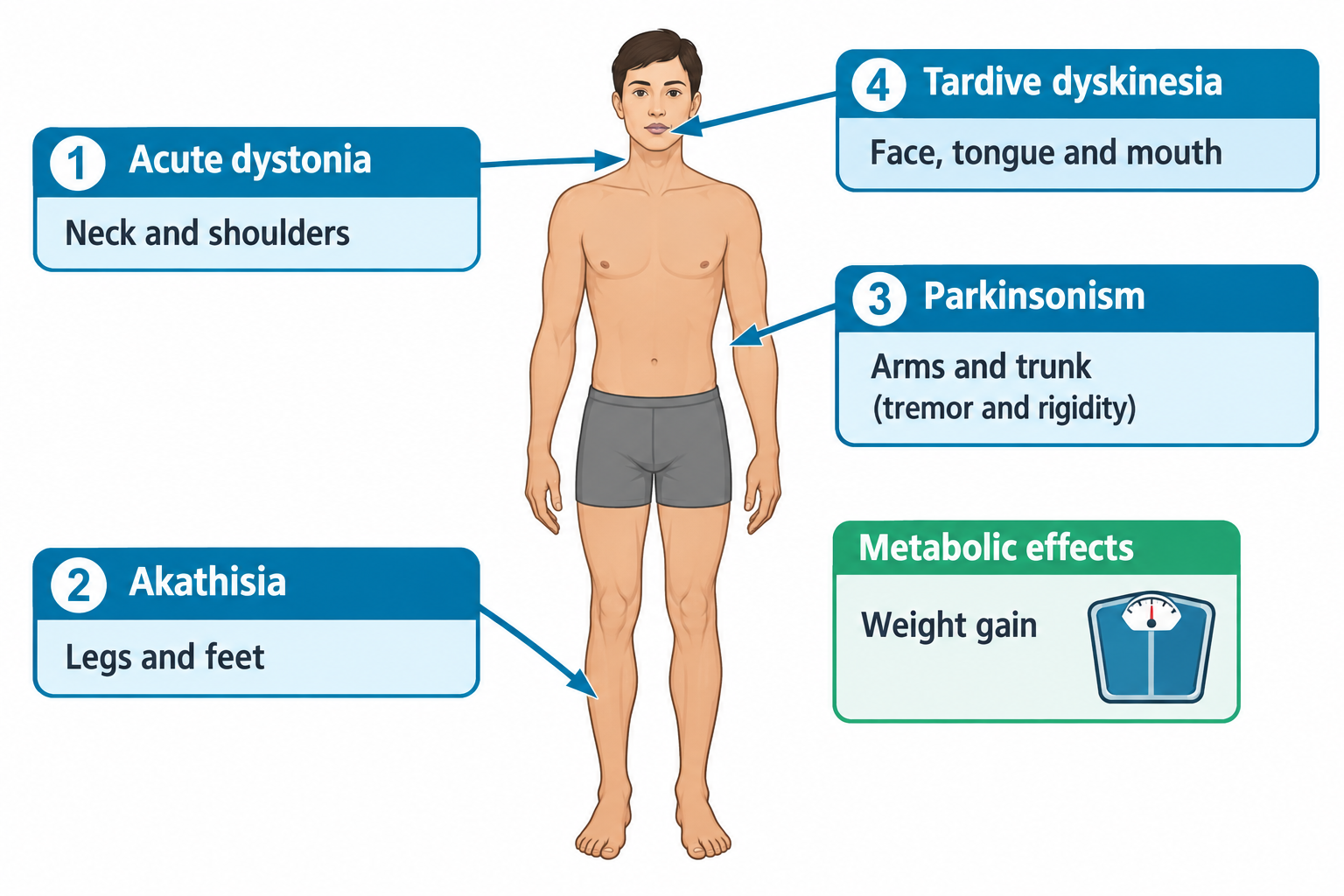
alt_text
//////Caption: Monitoring for adverse effects of antipsychotic medications.
Illustration type: Medical infographic
Illustration note: An infographic comparing typical and atypical antipsychotics, highlighting extrapyramidal symptoms (acute dystonia, akathisia, parkinsonism), tardive dyskinesia, metabolic syndrome (weight gain, diabetes), and key nursing monitoring responsibilities.//////

Clinical vignette: A 28-year-old client with schizophrenia reports hearing voices telling him to harm himself. The nurse remains calm, stays with the client, removes sharp objects, and notifies the provider. The nurse states, “I don’t hear the voices, but I want to help you stay safe,” and redirects the client to grounding activities.

Common NCLEX pitfalls

  • Arguing with delusions.
  • Agreeing with hallucinations.
  • Ignoring command hallucinations.
  • Using abstract language.
  • Providing long explanations.
  • Confusing negative symptoms with laziness or depression.
  • Failing to assess safety risk.
  • Psychosis affects reality testing.
  • Auditory hallucinations are most common.
  • Never validate delusions or hallucinations.
  • Use calm, concrete communication.
  • Safety always comes first.
  • Assess command hallucinations immediately
  • Acknowledge feelings without reinforcing false beliefs
  • Use short, simple communication
  • Safety is the top priority
  • Negative symptoms are often mistaken for depression :::

Sign up for free to take 5 quiz questions on this topic

Previous
Next  | 3.2.4 Personality disorders
All rights reserved ©2016 - 2026 Achievable, Inc.

Psychotic disorders

Introduction

Psychotic disorders are characterized by a loss of contact with reality that affects perception, thought, emotion, and behavior. Clients may experience hallucinations, delusions, disorganized thinking, and impaired functioning that interfere with safety, relationships, and self-care.

On the NCLEX, psychotic disorders are tested less on diagnostic labels and more on recognition of symptoms, safety prioritization, therapeutic communication, and medication monitoring. Nurses play a critical role in stabilizing clients, maintaining reality-based interactions, and preventing harm.

Learning objectives

By the end of this section, you should be able to:

  • Identify key features of psychotic disorders.
  • Differentiate positive, negative, and cognitive symptoms.
  • Apply therapeutic communication techniques with psychotic clients.
  • Prioritize safety during hallucinations and delusions.
  • Recognize medication considerations and adverse effects.
  • Answer NCLEX-style questions involving psychosis and impaired reality testing.

Overview of psychotic disorders

Psychotic disorders involve disturbances in thought processes and perception that significantly impair functioning.

Core characteristics

  • Impaired reality testing
  • Hallucinations or delusions
  • Disorganized speech or behavior
  • Social and occupational dysfunction
  • Poor insight into illness

Common psychotic disorders

Schizophrenia: Characterized by a mix of major symptoms (delusions, hallucinations, disorganized speech, etc.) that persist for at least six months.

Schizoaffective disorder: Features a continuous illness where there are both mood episodes (major depression or mania) and psychotic symptoms, with psychotic symptoms also occurring for at least two weeks without the mood episode.

Brief psychotic disorder: A sudden onset of psychotic symptoms that lasts for more than one day but less than one month, followed by a complete return to prior level of functioning.

Delusional disorder: The predominant symptom is the presence of one or more non-bizarre delusions for at least one month, with no other prominent psychotic symptoms and relatively little impairment in functioning.

Substance-induced psychosis: Psychotic symptoms (hallucinations and/or delusions) that develop during or soon after substance intoxication or withdrawal or exposure to a medication, and are judged to be directly caused by the substance.

Definitions
Psychosis
A state in which an individual has lost contact with reality.
Hallucination
A sensory perception without an external stimulus.
Delusion
A fixed false belief not consistent with reality or culture.
Thought disorder
Disorganized thinking that affects communication and logic.

Symptom categories

Positive symptoms

Additions to normal experience.

  • Hallucinations (auditory most common)
  • Delusions (paranoid, grandiose, somatic)
  • Disorganized speech
  • Bizarre behavior

Negative symptoms

Loss of normal functioning.

  • Flat or blunted affect
  • Alogia (poverty of speech)
  • Avolition (lack of motivation)
  • Anhedonia (loss of pleasure associated with usual hobbies)
  • Social withdrawal

Cognitive symptoms

  • Impaired attention
  • Poor memory
  • Difficulty with executive functioning

NCLEX frequently tests recognition of negative symptoms, which are often mistaken for depression.

alt_text
//////Caption: Positive, negative, and cognitive symptoms of schizophrenia.
Illustration type: Comparison infographic
Illustration note: A three-column infographic comparing positive symptoms (hallucinations, delusions, disorganized speech, bizarre behavior), negative symptoms (flat affect, alogia, avolition, anhedonia, social withdrawal), and cognitive symptoms (impaired attention, memory, and executive functioning).///////

Hallucinations

Hallucinations can involve any sensory modality, but auditory hallucinations are most common in schizophrenia.

Nursing assessment

  • Determine the content of hallucinations
  • Assess for command hallucinations
  • Evaluate safety risk
  • Assess the level of distress

Nursing interventions

  • Acknowledge the experience without validating it.
  • Present reality calmly: “I don’t hear the voices, but I know this is frightening.”
  • Encourage distraction and grounding.
  • Reduce environmental stimuli.
  • Ensure safety if hallucinations involve harm.

Delusions

Delusions are fixed beliefs that persist despite evidence to the contrary.

Nursing intervention

  • Do not argue or reinforce delusions.
  • Avoid validating false beliefs.
  • Redirect to reality-based topics.
  • Focus on feelings behind the belief.

Never argue with a delusion or agree with it. Acknowledge the emotion, not the belief.

alt_text
//////Caption: Distinguishing hallucinations from delusions.
Illustration type: Comparison infographic
Illustration note: A side-by-side infographic explaining hallucinations as false sensory perceptions and delusions as fixed false beliefs, with common clinical examples of each and key nursing considerations.///////

Communication with psychotic clients

Effective communication reduces anxiety and supports reality orientation.

Communication strategies

  • Use simple, concrete language.
  • Speak calmly and clearly.
  • Give one instruction at a time.
  • Avoid abstract concepts or metaphors.
  • Reinforce reality gently.
  • Maintain consistency among staff.

Avoid

  • Arguing
  • Validating hallucinations or delusions
  • Prolonged explanations
  • Whispering or side conversations

Safety considerations

Psychosis increases risk for harm due to impaired judgment.

Safety priorities

  • Assess risk for violence or self-harm
  • Monitor command hallucinations closely
  • Maintain safe environment
  • Avoid overstimulation
  • Set clear, consistent limits

Medication considerations

Antipsychotic medications are the cornerstone of treatment.

Typical antipsychotics

  • Higher risk for extrapyramidal symptoms (EPS).
  • Monitor for dystonia, akathisia, parkinsonism.

Atypical antipsychotics

  • Lower EPS risk
  • Higher metabolic risk (weight gain, diabetes)

Nursing responsibilities

  • Monitor therapeutic response.
  • Monitor for tardive dyskinesia with long-term use: involuntary repetitive movements of the face, tongue, and limbs.
  • Assess for other side effects.
  • Encourage medication adherence.
  • Educate on long-term treatment importance.
alt_text
//////Caption: Monitoring for adverse effects of antipsychotic medications.
Illustration type: Medical infographic
Illustration note: An infographic comparing typical and atypical antipsychotics, highlighting extrapyramidal symptoms (acute dystonia, akathisia, parkinsonism), tardive dyskinesia, metabolic syndrome (weight gain, diabetes), and key nursing monitoring responsibilities.//////

Clinical vignette: A 28-year-old client with schizophrenia reports hearing voices telling him to harm himself. The nurse remains calm, stays with the client, removes sharp objects, and notifies the provider. The nurse states, “I don’t hear the voices, but I want to help you stay safe,” and redirects the client to grounding activities.

Common NCLEX pitfalls

  • Arguing with delusions.
  • Agreeing with hallucinations.
  • Ignoring command hallucinations.
  • Using abstract language.
  • Providing long explanations.
  • Confusing negative symptoms with laziness or depression.
  • Failing to assess safety risk.
Key points
  • Psychosis affects reality testing.
  • Auditory hallucinations are most common.
  • Never validate delusions or hallucinations.
  • Use calm, concrete communication.
  • Safety always comes first.
  • Assess command hallucinations immediately
  • Acknowledge feelings without reinforcing false beliefs
  • Use short, simple communication
  • Safety is the top priority
  • Negative symptoms are often mistaken for depression :::

More from Psychiatric disorders

  • Mood disorders (depression and bipolar)
  • Anxiety and stress-related disorders (PTSD, OCD)
  • Personality disorders
  • Substance use and addiction
  • Eating disorders