


Achievable logoAchievable logo
NCLEX
Sign in
Sign up
Purchase
Textbook
Practice exams
Support
How it works
Exam catalog
Mountain with a flag at the peak
Textbook
Introduction
1. Safe and effective care environment
2. Health promotion and maintenance
3. Psychosocial Integrity
3.1 Mental health concepts
3.2 Psychiatric disorders
3.2.1 Mood disorders (depression and bipolar)
3.2.2 Anxiety and stress-related disorders (PTSD, OCD)
3.2.3 Psychotic disorders
3.2.4 Personality disorders
3.2.5 Substance use and addiction
3.2.6 Eating disorders
3.3 Crisis intervention and safety
3.4 End-of-life care and grief counseling
3.5 Behavioral Interventions and Safety Precautions
4. Physiological Integrity
Wrapping up
Achievable logoAchievable logo
3.2.5 Substance use and addiction
Achievable NCLEX
3. Psychosocial Integrity
3.2. Psychiatric disorders
Our NCLEX course is currently in development and is a work-in-progress.

Substance use and addiction

5 min read
Font
Discuss
Share
Feedback

Introduction

Substance use disorders affect physical health, mental well-being, relationships, and safety. They are chronic, relapsing conditions characterized by compulsive substance use despite harmful consequences. Nurses encounter substance use disorders across all clinical settings, not only in psychiatric units.

On the NCLEX, substance use is tested through withdrawal emergencies, intoxication assessment, safety prioritization, nonjudgmental communication, and client education. The nurse’s role is to support recovery, reduce harm, and ensure client and staff safety.

Learning objectives

By the end of this section, you should be able to:

  • Identify signs of substance intoxication and withdrawal.
  • Differentiate between stimulant, depressant, and opioid effects.
  • Recognize life-threatening withdrawal syndromes.
  • Apply therapeutic, nonjudgmental communication strategies.
  • Implement nursing interventions that prioritize safety.
  • Answer NCLEX-style questions involving substance use scenarios.

Understanding substance use disorders

Substance use disorders involve maladaptive patterns of use leading to impairment or distress.

Diagnostic criteria and severity levels

While nurses do not diagnose, understanding how substance use disorder is classified improves clinical reasoning.

Substance use disorder is diagnosed when at least 2 of 11 criteria occur within 12 months.

Severity levels

  • Mild: 2–3 symptoms
  • Moderate: 4–5 symptoms
  • Severe: 6 or more symptoms

Core features of substance-use disorders

  • Loss of control over substance use
  • Continued use despite negative consequences
  • Tolerance
  • Withdrawal symptoms
  • Cravings
  • Impaired social and occupational functioning
Definitions
Substance use disorder
A chronic condition involving compulsive substance use despite harm.
Tolerance
Need for increasing amounts of a substance to achieve the same effect.
Withdrawal
Physiological symptoms that occur when substance use is reduced or stopped.
Intoxication
Acute effects of substance use on behavior and physiology.

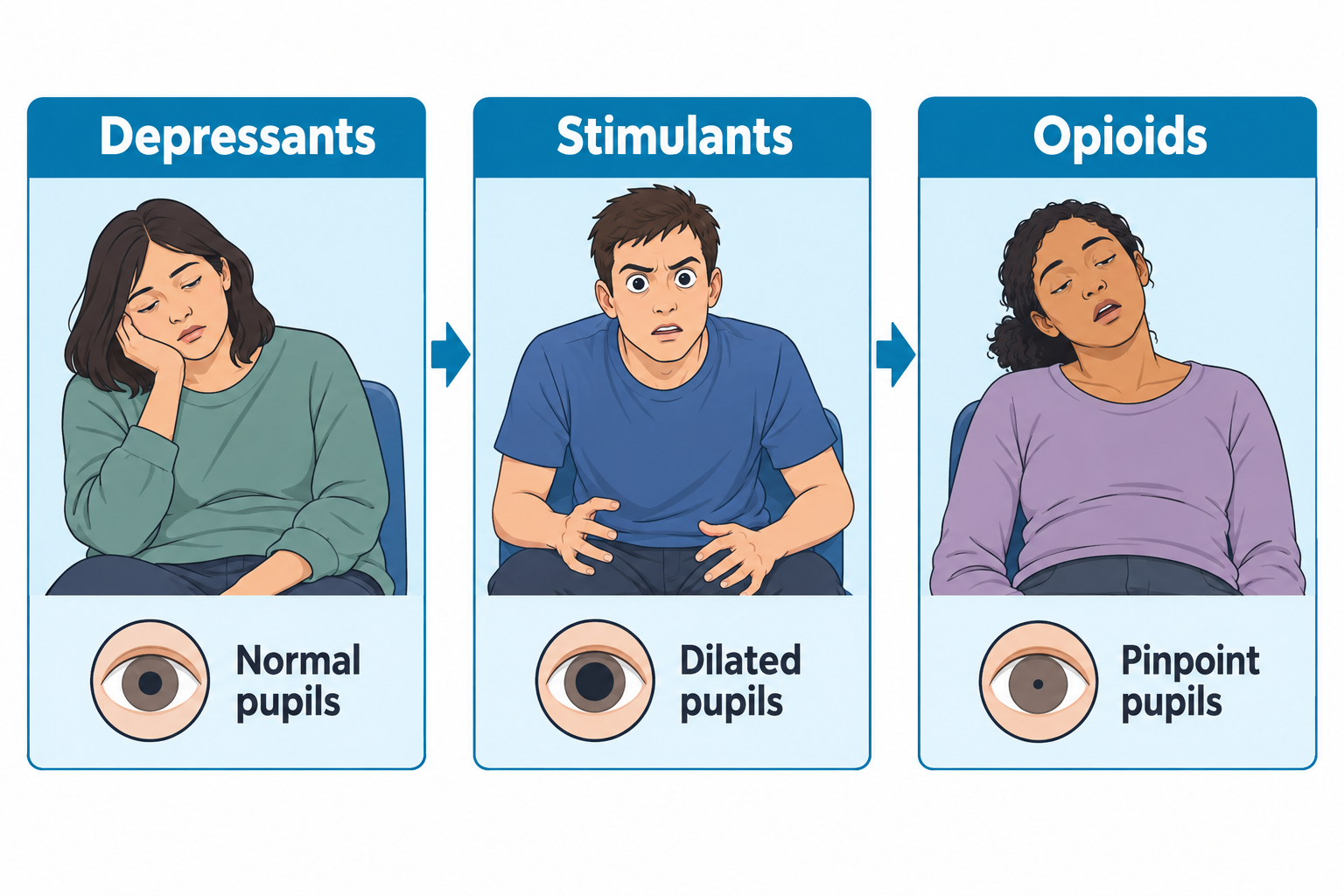
Categories of substances

alt_text
//////Caption: Comparison of depressants, stimulants, and opioids
Illustration type: Comparison infographic
Illustration note: A side-by-side infographic comparing depressants, stimulants, and opioids, highlighting common examples, signs of intoxication, withdrawal symptoms, and major nursing concerns for each category.///////

Depressants

Examples: alcohol, benzodiazepines, and barbiturates.

Intoxication signs:

  • Slurred speech
  • Unsteady gait
  • Decreased level of consciousness
  • Respiratory depression

Withdrawal risks:

  • Tremors
  • Seizures
  • Hallucinations
  • Delirium tremens (alcohol withdrawal)

Alcohol withdrawal timeline

6–12 hours:

  • Tremors
  • Anxiety
  • Insomnia
  • Nausea
  • Tachycardia

12–24 hours:

  • Hallucinations
  • Worsening autonomic instability

24–48 hours:

  • Seizures (peak risk window)

48–96 hours:

  • Delirium tremens (DTs) characterized by:
    • Severe confusion
    • Agitation
    • Fever
    • Severe hypertension
    • Hallucinations
alt_text
//////Caption: Progression of alcohol withdrawal.
Illustration type: Timeline infographic
Illustration note: A timeline illustrating the progression of alcohol withdrawal from 6–12 hours through 48–96 hours, highlighting tremors, hallucinations, seizures, and delirium tremens, with emphasis on the peak periods for life-threatening complications.///////

Wernicke–Korsakoff syndrome

Chronic alcohol use can cause thiamine deficiency.

Wernicke’s encephalopathy (acute)

  • Confusion
  • Ataxia
  • Ophthalmoplegia

Korsakoff syndrome (chronic)

  • Memory loss
  • Confabulation

Nursing management for alcohol withdrawal

  • Use CIWA-Ar scoring.
  • Administer benzodiazepines (e.g., lorazepam, diazepam).
  • Give thiamine BEFORE glucose to prevent worsening neurologic injury.
  • Implement seizure precautions.
  • Monitor electrolytes.

Stimulants

Examples: cocaine, methamphetamine, and amphetamines.

Intoxication signs:

  • Agitation
  • Tachycardia
  • Hypertension
  • Dilated pupils
  • Paranoia

Withdrawal signs:

  • Fatigue
  • Depression
  • Hypersomnia
  • Increased appetite

Opioids

Examples: heroin, morphine, fentanyl, and oxycodone.

Intoxication signs:

  • Pinpoint pupils
  • Respiratory depression
  • Decreased consciousness

Withdrawal signs:

  • Muscle aches
  • Diarrhea
  • Vomiting
  • Yawning
  • Goosebumps

Alcohol and benzodiazepine withdrawal can be fatal. Opioid withdrawal is rarely fatal but extremely distressing.

Special populations

Older adults

  • Increased fall risk
  • Higher medication sensitivity
  • Risk for polypharmacy interactions

Pregnant clients

  • Abrupt opioid withdrawal may cause fetal distress.
  • Methadone or buprenorphine maintenance is standard care.

Adolescents

  • Higher impulsivity
  • Peer influence significant

Medication-assisted treatment (MAT)

For opioid use disorder

  • Methadone: full opioid agonist
  • Buprenorphine: partial agonist
  • Naltrexone: opioid antagonist

For Alcohol Use Disorder

  • Naltrexone: reduces cravings.
  • Disulfiram: causes severe reaction if alcohol consumed.
  • Acamprosate: supports abstinence.

Nursing priorities in substance use disorders

Assessment

  • Assess substance type, amount, duration, and last use.
  • Identify withdrawal risk.
  • Assess mental health comorbidities.
  • Evaluate suicide risk.
  • Assess social supports.

Safety interventions

  • Ensure airway and respiratory safety.
  • Monitor vital signs closely.
  • Implement seizure precautions if indicated.
  • Administer medications as prescribed (e.g., benzodiazepines for alcohol withdrawal).
  • Remove hazards during intoxication.

Therapeutic communication

  • Use nonjudgmental language.
  • Avoid moralizing or lecturing.
  • Focus on safety and immediate needs.
  • Encourage honesty without punishment.
  • Validate effort toward recovery.

Avoid statements like “You should just stop” or “Why don’t you quit?”

Harm reduction and recovery support

Harm reduction acknowledges that recovery is a process.

Strategies

  • Medication-assisted treatment (e.g., methadone, buprenorphine).
  • Naloxone education for opioid users.
  • Referral to counseling or support groups.
  • Client education on overdose prevention.

Clinical vignette: A 56-year-old man admitted for pneumonia begins to tremble, sweat, and become confused 48 hours after admission. The nurse recognizes signs of alcohol withdrawal, initiates seizure precautions, notifies the provider, and administers prescribed benzodiazepines. Early recognition prevents progression to delirium tremens.

Nursing considerations

  • Assess withdrawal risk in all hospitalized clients.
  • Alcohol and benzodiazepine withdrawal are medical emergencies.
  • Maintain airway and safety during intoxication.
  • Use nonjudgmental, therapeutic communication.
  • Relapse does not equal failure.

Client education

  • Educate about tolerance, withdrawal, cravings, and the risk of relapse.
  • Teach what withdrawal symptoms to expect and when to seek medical attention, especially for alcohol or benzodiazepines.
  • Review purpose, dosing, and side effects of prescribed medications (e.g., disulfiram reaction).
  • Provide naloxone training for opioid users and their families, including how and when to administer it.
  • Discuss safe storage of medications and avoiding polysubstance use.
  • Teach coping strategies (exercise, mindfulness, and hobbies), and reinforce the importance of sleep, nutrition, hydration, and follow-up appointments.

Common NCLEX pitfalls

  • Underestimating alcohol withdrawal severity.
  • Confusing opioid withdrawal with opioid intoxication.
  • Moralizing substance use.
  • Ignoring coexisting mental illness.
  • Delaying treatment until withdrawal worsens.
  • Assuming young clients are not at risk.
  • Substance use disorders are chronic conditions.
  • Withdrawal assessment saves lives.
  • Safety and airway come first.
  • Nonjudgmental care supports recovery.
  • Early intervention prevents complications. :::

Sign up for free to take 5 quiz questions on this topic

Previous
Next  | 3.2.6 Eating disorders
All rights reserved ©2016 - 2026 Achievable, Inc.

Substance use and addiction

Introduction

Substance use disorders affect physical health, mental well-being, relationships, and safety. They are chronic, relapsing conditions characterized by compulsive substance use despite harmful consequences. Nurses encounter substance use disorders across all clinical settings, not only in psychiatric units.

On the NCLEX, substance use is tested through withdrawal emergencies, intoxication assessment, safety prioritization, nonjudgmental communication, and client education. The nurse’s role is to support recovery, reduce harm, and ensure client and staff safety.

Learning objectives

By the end of this section, you should be able to:

  • Identify signs of substance intoxication and withdrawal.
  • Differentiate between stimulant, depressant, and opioid effects.
  • Recognize life-threatening withdrawal syndromes.
  • Apply therapeutic, nonjudgmental communication strategies.
  • Implement nursing interventions that prioritize safety.
  • Answer NCLEX-style questions involving substance use scenarios.

Understanding substance use disorders

Substance use disorders involve maladaptive patterns of use leading to impairment or distress.

Diagnostic criteria and severity levels

While nurses do not diagnose, understanding how substance use disorder is classified improves clinical reasoning.

Substance use disorder is diagnosed when at least 2 of 11 criteria occur within 12 months.

Severity levels

  • Mild: 2–3 symptoms
  • Moderate: 4–5 symptoms
  • Severe: 6 or more symptoms

Core features of substance-use disorders

  • Loss of control over substance use
  • Continued use despite negative consequences
  • Tolerance
  • Withdrawal symptoms
  • Cravings
  • Impaired social and occupational functioning
Definitions
Substance use disorder
A chronic condition involving compulsive substance use despite harm.
Tolerance
Need for increasing amounts of a substance to achieve the same effect.
Withdrawal
Physiological symptoms that occur when substance use is reduced or stopped.
Intoxication
Acute effects of substance use on behavior and physiology.

Categories of substances

alt_text
//////Caption: Comparison of depressants, stimulants, and opioids
Illustration type: Comparison infographic
Illustration note: A side-by-side infographic comparing depressants, stimulants, and opioids, highlighting common examples, signs of intoxication, withdrawal symptoms, and major nursing concerns for each category.///////

Depressants

Examples: alcohol, benzodiazepines, and barbiturates.

Intoxication signs:

  • Slurred speech
  • Unsteady gait
  • Decreased level of consciousness
  • Respiratory depression

Withdrawal risks:

  • Tremors
  • Seizures
  • Hallucinations
  • Delirium tremens (alcohol withdrawal)

Alcohol withdrawal timeline

6–12 hours:

  • Tremors
  • Anxiety
  • Insomnia
  • Nausea
  • Tachycardia

12–24 hours:

  • Hallucinations
  • Worsening autonomic instability

24–48 hours:

  • Seizures (peak risk window)

48–96 hours:

  • Delirium tremens (DTs) characterized by:
    • Severe confusion
    • Agitation
    • Fever
    • Severe hypertension
    • Hallucinations
alt_text
//////Caption: Progression of alcohol withdrawal.
Illustration type: Timeline infographic
Illustration note: A timeline illustrating the progression of alcohol withdrawal from 6–12 hours through 48–96 hours, highlighting tremors, hallucinations, seizures, and delirium tremens, with emphasis on the peak periods for life-threatening complications.///////

Wernicke–Korsakoff syndrome

Chronic alcohol use can cause thiamine deficiency.

Wernicke’s encephalopathy (acute)

  • Confusion
  • Ataxia
  • Ophthalmoplegia

Korsakoff syndrome (chronic)

  • Memory loss
  • Confabulation

Nursing management for alcohol withdrawal

  • Use CIWA-Ar scoring.
  • Administer benzodiazepines (e.g., lorazepam, diazepam).
  • Give thiamine BEFORE glucose to prevent worsening neurologic injury.
  • Implement seizure precautions.
  • Monitor electrolytes.

Stimulants

Examples: cocaine, methamphetamine, and amphetamines.

Intoxication signs:

  • Agitation
  • Tachycardia
  • Hypertension
  • Dilated pupils
  • Paranoia

Withdrawal signs:

  • Fatigue
  • Depression
  • Hypersomnia
  • Increased appetite

Opioids

Examples: heroin, morphine, fentanyl, and oxycodone.

Intoxication signs:

  • Pinpoint pupils
  • Respiratory depression
  • Decreased consciousness

Withdrawal signs:

  • Muscle aches
  • Diarrhea
  • Vomiting
  • Yawning
  • Goosebumps

Alcohol and benzodiazepine withdrawal can be fatal. Opioid withdrawal is rarely fatal but extremely distressing.

Special populations

Older adults

  • Increased fall risk
  • Higher medication sensitivity
  • Risk for polypharmacy interactions

Pregnant clients

  • Abrupt opioid withdrawal may cause fetal distress.
  • Methadone or buprenorphine maintenance is standard care.

Adolescents

  • Higher impulsivity
  • Peer influence significant

Medication-assisted treatment (MAT)

For opioid use disorder

  • Methadone: full opioid agonist
  • Buprenorphine: partial agonist
  • Naltrexone: opioid antagonist

For Alcohol Use Disorder

  • Naltrexone: reduces cravings.
  • Disulfiram: causes severe reaction if alcohol consumed.
  • Acamprosate: supports abstinence.

Nursing priorities in substance use disorders

Assessment

  • Assess substance type, amount, duration, and last use.
  • Identify withdrawal risk.
  • Assess mental health comorbidities.
  • Evaluate suicide risk.
  • Assess social supports.

Safety interventions

  • Ensure airway and respiratory safety.
  • Monitor vital signs closely.
  • Implement seizure precautions if indicated.
  • Administer medications as prescribed (e.g., benzodiazepines for alcohol withdrawal).
  • Remove hazards during intoxication.

Therapeutic communication

  • Use nonjudgmental language.
  • Avoid moralizing or lecturing.
  • Focus on safety and immediate needs.
  • Encourage honesty without punishment.
  • Validate effort toward recovery.

Avoid statements like “You should just stop” or “Why don’t you quit?”

Harm reduction and recovery support

Harm reduction acknowledges that recovery is a process.

Strategies

  • Medication-assisted treatment (e.g., methadone, buprenorphine).
  • Naloxone education for opioid users.
  • Referral to counseling or support groups.
  • Client education on overdose prevention.

Clinical vignette: A 56-year-old man admitted for pneumonia begins to tremble, sweat, and become confused 48 hours after admission. The nurse recognizes signs of alcohol withdrawal, initiates seizure precautions, notifies the provider, and administers prescribed benzodiazepines. Early recognition prevents progression to delirium tremens.

Nursing considerations

  • Assess withdrawal risk in all hospitalized clients.
  • Alcohol and benzodiazepine withdrawal are medical emergencies.
  • Maintain airway and safety during intoxication.
  • Use nonjudgmental, therapeutic communication.
  • Relapse does not equal failure.

Client education

  • Educate about tolerance, withdrawal, cravings, and the risk of relapse.
  • Teach what withdrawal symptoms to expect and when to seek medical attention, especially for alcohol or benzodiazepines.
  • Review purpose, dosing, and side effects of prescribed medications (e.g., disulfiram reaction).
  • Provide naloxone training for opioid users and their families, including how and when to administer it.
  • Discuss safe storage of medications and avoiding polysubstance use.
  • Teach coping strategies (exercise, mindfulness, and hobbies), and reinforce the importance of sleep, nutrition, hydration, and follow-up appointments.

Common NCLEX pitfalls

  • Underestimating alcohol withdrawal severity.
  • Confusing opioid withdrawal with opioid intoxication.
  • Moralizing substance use.
  • Ignoring coexisting mental illness.
  • Delaying treatment until withdrawal worsens.
  • Assuming young clients are not at risk.
Key points
  • Substance use disorders are chronic conditions.
  • Withdrawal assessment saves lives.
  • Safety and airway come first.
  • Nonjudgmental care supports recovery.
  • Early intervention prevents complications. :::

More from Psychiatric disorders

  • Mood disorders (depression and bipolar)
  • Anxiety and stress-related disorders (PTSD, OCD)
  • Psychotic disorders
  • Personality disorders
  • Eating disorders