




Early childhood (1–5 years)
Introduction
Early childhood is a season of explosive growth. Toddlers transform into preschoolers with emerging independence, language skills, imagination, and social awareness. It’s also the period where injuries peak, routines form, and early experiences shape lifelong habits. NCLEX focuses heavily on this stage because nurses must guide caregivers through nutrition, toilet training, safety, developmental norms, and spotting early delays that can impact school readiness.
Learning objectives
By the end of this section, you should be able to:
- Identify physical, cognitive, and psychosocial milestones in toddlers and preschoolers.
- Provide appropriate safety, nutrition, and anticipatory guidance for ages 1-5.
- Recognize normal variations vs. red flags requiring evaluation.
- Apply NCLEX-based nursing interventions to support healthy development.
Growth and physical development
Nurses must track growth on standardized percentiles to ensure the child is meeting the expected steady, but slower, rate of weight and height gain for this age group and has appropriate body proportion changes.
General patterns
- Growth slows compared to infancy but remains steady.
- By age 2, toddlers reach half their adult height.
- Weight gain averages 4-6 lbs/year, height increases 2-3 inches/year.
- Head circumference growth slows; body proportions lengthen.
Motor development
The NCLEX requires nurses to understand age-appropriate gross and fine motor milestones to provide anticipatory guidance and recognize red flags, such as no walking by 18 months, which warrant further evaluation for developmental delays.
Gross motor milestones
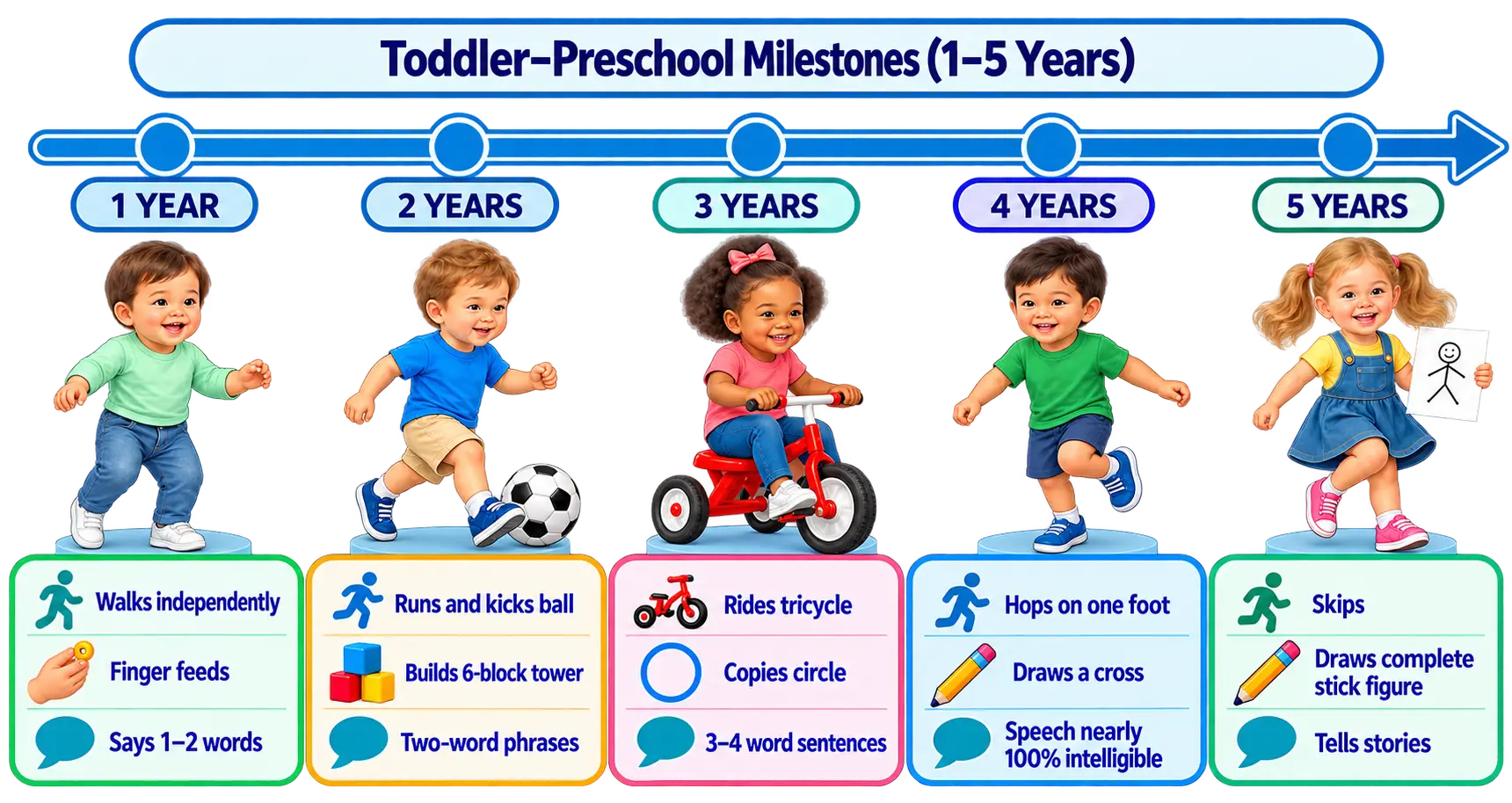
- 12-18 months: Walks independently, climbs stairs with assistance, throws ball.
- 2 years: Runs with coordination, climbs furniture, kicks ball, walks up/down stairs with two feet per step.
- 3 years: Rides tricycle, alternates feet on stairs, jumps forward.
- 4 years: Hops on one foot, catches ball reliably.
- 5 years: Skips, swings independently, and balances on one foot for 10 seconds.
Fine motor milestones
- 12-18 months: Scribbles, builds a 2-3 block tower.
- 2 years: Builds 6-block tower, turns doorknobs, opens containers.
- 3 years: Copies a circle, undresses self.
- 4 years: Copies a cross, uses scissors, draws a simple stick figure.
- 5 years: Prints some letters, ties shoelaces (late stage), draws a full stick figure.
Cognitive development
Piaget: preoperational stage (2-7 years)
- Thinking is egocentric, meaning the child sees world through their own perspective.
- Magical thinking, pretend play, and symbolic understanding emerge.
- Limited understanding of cause-and-effect and conservation (quantity ≠ appearance).
- Toddlers and preschoolers learn best through repetition, play, and routine.
Psychosocial and emotional development
NCLEX questions on psychosocial development often test the nurse’s ability to provide anticipatory guidance that supports the child’s drive for independence (autonomy and initiative) while distinguishing between normal developmental behaviors, such as tantrums and parallel play, and potential red flags.
Erikson’s developmental stages
- Autonomy vs shame and doubt (1-3 years): Toddlers seek independence. Support self-feeding, dressing, choices (“apple or banana?”). Overcontrol fosters shame and doubt.
- Initiative vs. guilt (3-6 years): Preschoolers explore creativity and leadership. Encouraging play and imagination strengthens initiative; harsh criticism leads to guilt.
Social and emotional milestones
- Shows affection to caregivers.
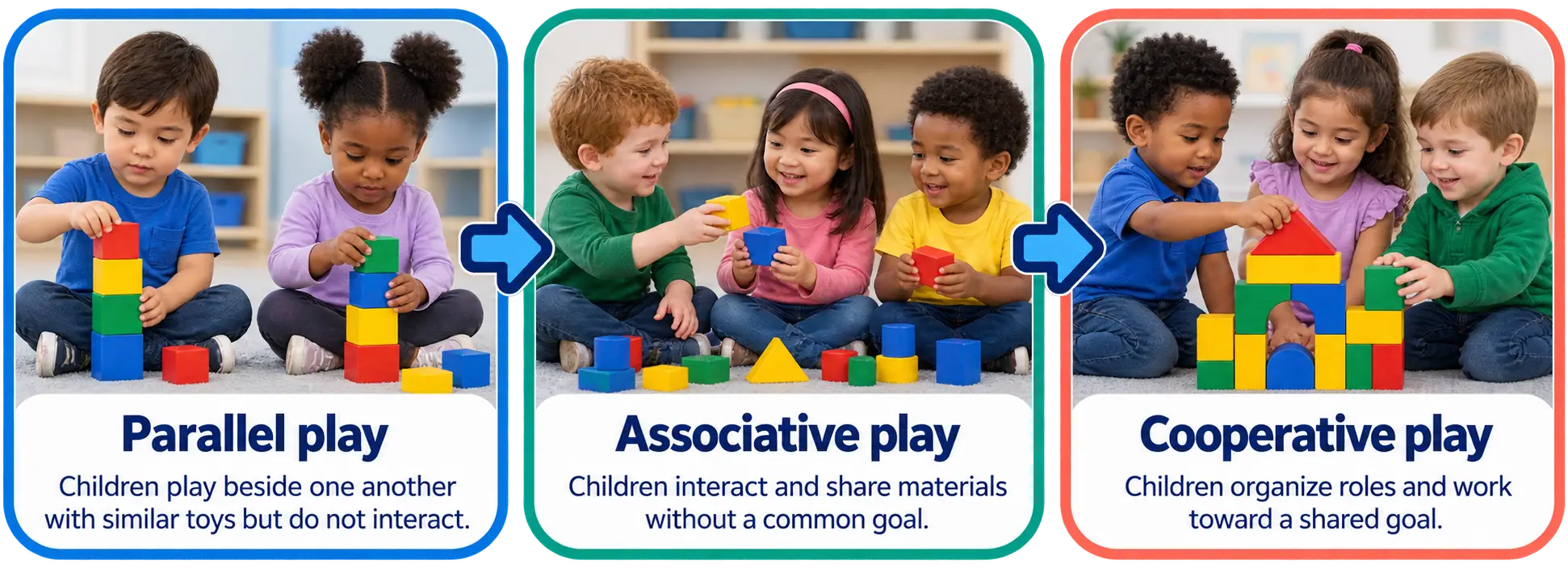
- Parallel play → associative play → cooperative play by age 5.
- Begins turn-taking, sharing, and empathy.
- Nighttime fears, imaginary friends, and mild regression during stress are normal.
Language development
The nurse is expected to assess age-appropriate language milestones, recognize red flags for delayed speech, and teach caregivers anticipatory guidance on promoting a language-rich environment through reading and interactive play.
| Age | Expected language milestone | Speech intelligibility |
|---|---|---|
| 18 months | Uses 10 or more words | About 25% intelligible |
| 2 years | Uses two-word phrases | About 50% intelligible |
| 3 years | Uses three- to four-word sentences | About 75% intelligible |
| 4 years | Tells simple stories | Nearly 100% intelligible |
| 5 years | Participates in full conversations | 100% intelligible |
Nutrition
The nurse must guide caregivers on appropriate dietary transitions (e.g., whole milk until age 2), manage common issues like picky eating, and teach injury prevention related to choking hazards and appropriate juice limits for this age group.
- Transition fully to whole milk at 12-24 months, then low-fat milk after age 2 if appropriate.
- Offer 3 meals + 2-3 snacks daily.
- Limit 100% juice to 4 oz/day for ages 1-3 and 4-6 oz/day for ages 4-6 (AAP guidance).
- Avoid choking hazards: whole grapes, hot dogs, nuts, and popcorn.
- Picky eating peaks at 2-3 years; this is normal. Offer repeated exposure without forcing.
Safety and injury prevention
Injury risk peaks due to mobility without judgment.
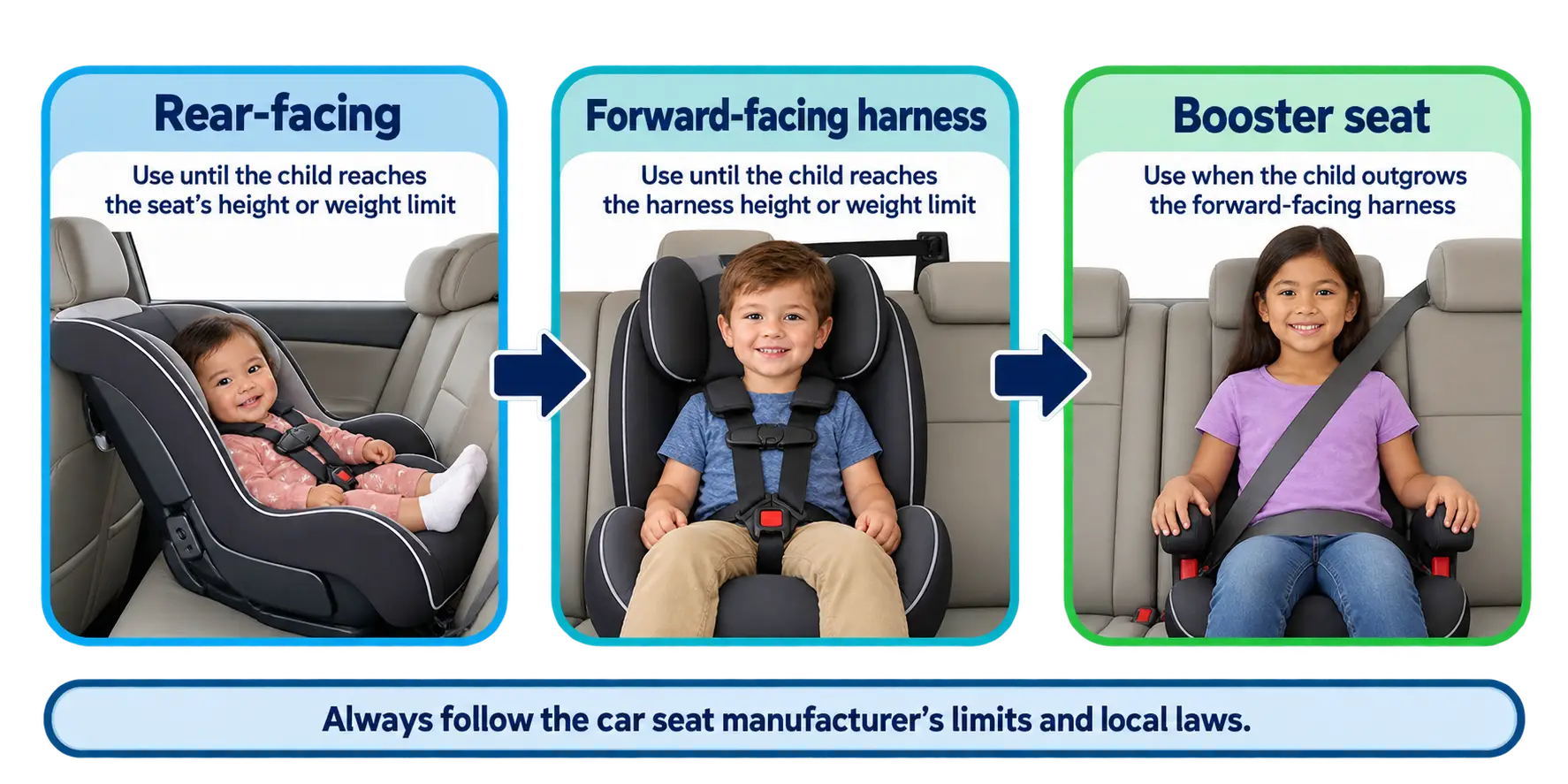
- Rear-facing until the car seat’s height/weight limit (often past age 2) → forward-facing with a harness until at least age 4 → booster seat until the child reaches 4’9" (typically ages 8-12).
- Lock away cleaning agents, meds, and small objects.
- Use stair gates, window guards, and outlet covers.
- Provide constant supervision near water (bathtubs, pools, buckets).
- Teach safe street crossing and helmet use by preschool age.
Toilet training
Begins around 2-3 years when child shows readiness signs:
- Dry for 2 hours, follows simple directions, expresses need to go, interest in toilet.
- Encourage positive reinforcement; avoid punishment or pressure.
Sleep
- Toddlers sleep ~12 hours/day with 1-2 naps.
- Preschoolers sleep 10-13 hours; nightmares and night terrors may occur.
- Maintain consistent bedtime routines.
Red flags (ages 1-5)
- No walking by 18 months.
- No 2-word phrases by 2 years.
- Persistent toe-walking or hand flapping.
- No pretend play by 3 years.
- Difficulties with eye contact or lack of social interest (ASD concern).
- Loss of previously acquired skills (urgent evaluation).
| Age | Developmental red flags |
|---|---|
| 18 months | Not walking independently No pointing or gesturing No meaningful single words |
| 2 years | No two-word phrases Cannot follow simple commands Little interest in social interaction |
| 3 years | No pretend play Speech mostly unintelligible Poor eye contact |
| 4 years | Cannot jump or hop Cannot draw simple shapes Very limited speech clarity |
| 5 years | Cannot skip or balance Cannot tell simple stories Difficulty interacting with peers |
Nursing interventions
- Track growth on standardized percentiles.
- Screen for autism at 18 and 24 months.
- Teach anticipatory guidance for nutrition, discipline, safety, and routines.
- Reinforce importance of active play, limit screen time <1 hour/day (age 2-5).
- Support parent coping during tantrums and limit-setting.
Clinical vignette: A 2½-year-old is brought in for delayed speech. The nurse learns the child watches TV for several hours/day. After evaluation, she teaches the caregiver about responsive language interaction: reading daily, naming objects, asking simple questions, reducing screen time. Follow-up shows improved language and engagement.
Client education
- Daily reading and interactive play.
- Use consistent routines (sleep, meals, toilet training).
- Provide age-appropriate expectations; tantrums are communication.
- Promote family meals, physical activity, and minimized screen exposure.
| Healthy routine | Recommendation |
|---|---|
| Daily reading | Read with the child every day. |
| Active play | Encourage regular physical activity and outdoor play. |
| Consistent bedtime | Maintain a predictable bedtime routine and sleep schedule. |
| Family meals | Share regular meals as a family. |
| Limited screen time | Limit screen time to 1 hour per day. |
| Positive discipline | Use praise, clear expectations, redirection, and consistent consequences. |
This chapter picks up where infancy (0-1 year) leaves off; the next age band, school age (6-12 years), builds on these same milestones as children move into formal schooling.