


Achievable logoAchievable logo
NCLEX
Sign in
Sign up
Purchase
Textbook
Practice exams
Support
How it works
Resources
Exam catalog
Mountain with a flag at the peak
Textbook
Introduction
1. Safe and effective care environment
2. Health promotion and maintenance
2.1 Growth and development across the lifespan
2.1.1 Infancy (0–1 year)
2.1.2 Early childhood (1–5 years)
2.1.3 School age (6–12 years)
2.1.4 Adolescence (13–18 years)
2.1.5 Adulthood (19–64 years)
2.1.6 Older adults (65+ years)
2.2 Antepartum, intrapartum and postpartum
2.3 Newborn care and developmental milestones
2.4 Health screenings and preventive care (vision, cancer, immunizations)
2.5 Lifestyle counseling and high-risk behaviors
2.6 Aging, transitions, and end-of-life considerations
3. Psychosocial Integrity
4. Physiological Integrity
Wrapping up
Achievable logoAchievable logo
2.1.3 School age (6–12 years)
Achievable NCLEX
2. Health promotion and maintenance
2.1. Growth and development across the lifespan
Our NCLEX course is currently in development and is a work-in-progress.

School age (6–12 years)

7 min read
Font
Discuss
Share
Feedback

Introduction

The school-age period marks the shift from early childhood’s imagination-driven world to a stage defined by mastery, competence, and expanding social circles. Children ages 6-12 refine motor skills, build academic foundations, develop moral understanding, and begin forming their identity through school, peers, and extracurriculars. NCLEX emphasizes this stage because nurses must support healthy development while identifying bullying, learning difficulties, nutritional risks, and early warning signs of emotional distress.

Learning objectives

By the end of this section, you should be able to:

  • identify physical, cognitive, social, and emotional milestones for ages 6-12.
  • provide anticipatory guidance for school performance, safety, nutrition, and peer interactions.
  • recognize normal variations vs. red flags requiring follow-up.
  • support families as children develop independence, self-esteem, and healthy coping skills.
Definitions
Conservation
Understanding that quantity remains constant despite visual changes.
Industry
Confidence gained through mastery of skills, tasks, and responsibilities.
Inferiority
Feelings of inadequacy resulting from repeated failure or criticism.
Seriation
Ability to order objects based on measurable attributes.
ADHD
Neurodevelopmental disorder affecting attention, impulsivity, and activity.

Growth and physical development

For the NCLEX, nurses must understand the steady, predictable physical growth and the normal onset of early pubertal changes in school-age children to correctly assess development and provide anticipatory guidance.

General patterns

  • Growth is steady: ~4-7 lbs/year, ~2 inches/year.
  • Growth spurts occur late in this stage, especially near puberty.
  • Body proportions lengthen: legs grow faster than trunk.
  • Improved coordination, balance, and endurance.
  • First signs of prepubertal changes may appear near ages 9-11.

Puberty (early/precursor changes)

  • Girls: Breast budding (thelarche) ~8-12 years, growth spurt soon follows.
  • Boys: Testicular enlargement ~9-14 years, followed by voice and muscle changes.
  • Emotional fluctuations and body-image concerns often begin here.

Motor development

Motor development is characterized by a significant refinement of both gross and fine motor skills, resulting in improved coordination, balance, and endurance that supports team sports, detailed activities, and overall health.

Gross motor skills

  • Refined coordination allows for running, jumping, swimming, team sports.
  • Balance improves significantly, enabling gymnastics, skating, and biking.
  • Activity tolerance increases, which is important for school PE, sports, and healthy weight.

Fine motor skills

  • Prints letters neatly, ties shoes, uses utensils with precision.
  • Engages in crafts, drawing, building models, and detailed projects.
  • Hand and eye coordination matures for writing and musical instruments.

Cognitive development

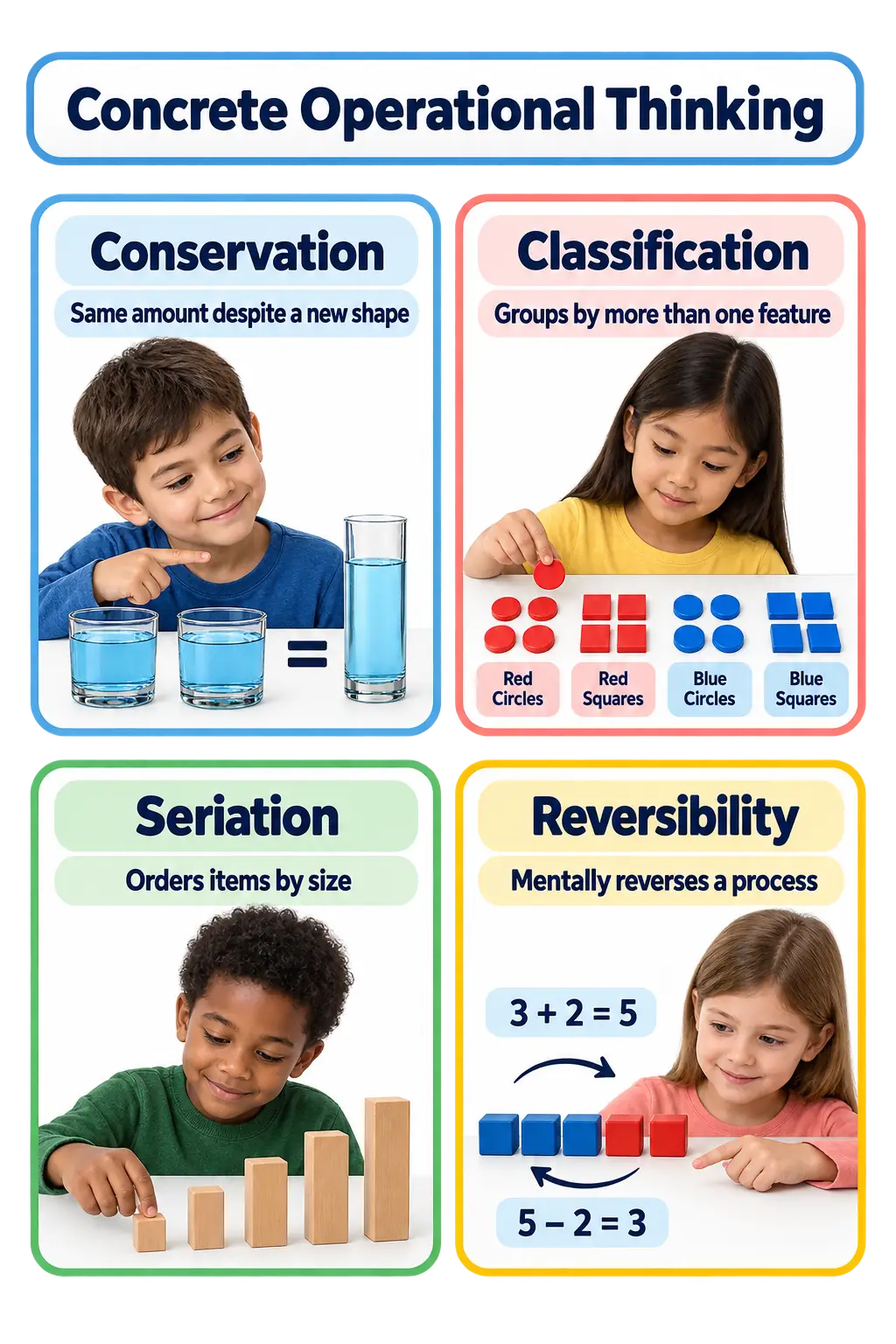
Piaget: concrete operational stage (7-11 years)

Children shift from magical thinking to logical, organized, rule-based thought. They develop:

  • Conservation (quantity stays the same despite shape changes).
  • Reversibility (thinking steps backward).
  • Classification (sorting objects by multiple traits).
  • Seriation (ordering items by size, number, etc.).
  • Improved attention, memory, and problem-solving.

These changes support school readiness, math, reading comprehension, and following multistep directions.

Four panels illustrate concrete operational thinking: Conservation shows a boy noting two short glasses equal one tall glass of water; Classification shows a girl sorting red circles, red squares, blue circles, and blue squares; Seriation shows a boy arranging wooden blocks from shortest to tallest; Reversibility shows a girl with blue and red blocks demonstrating 3+2=5 reversed to 5-2=3.
Concrete operational thinking
Achievable

Psychosocial development

This stage centers on how children measure themselves against peers, teachers, and expectations, making competence and self-worth the central psychosocial themes of the school years.

Erikson: industry vs inferiority

Success in school, sports, and friendships builds industry, a growing confidence in one’s skills and abilities. Repeated failure, criticism, bullying, or lack of support fosters inferiority, withdrawal, and poor self-esteem.

Industry Inferiority
Encouragement builds competence Discouragement reduces confidence
Success in school Academic struggles
Skills in sports and hobbies Frequent negative feedback
Effort recognized Peer exclusion
Positive reinforcement Withdrawal and self-doubt

What are the stages of Erikson’s psychosociological development model?

(spoiler)

The eight stages of Erik Erikson’s psychosocial development are:

  1. Trust vs. mistrust (infancy: 0 to 1 year)
  2. Autonomy vs. shame and doubt (early childhood: 1 to 3 years)
  3. Initiative vs. guilt (play age: 3 to 6 years)
  4. Industry vs. inferiority (school age: 6 to 12 years)
  5. Identity vs. role confusion (adolescence: 12 to 18 years)
  6. Intimacy vs. isolation (young adulthood: 18 to 40 years)
  7. Generativity vs. Stagnation (middle adulthood: 40 to 65 years)
  8. Ego integrity vs. despair (maturity: 65 years and older)

Social and emotional development

  • Peers gain importance; friendships become more stable.
  • Understand rules and fairness (“that’s not fair!” is common).
  • Begin to internalize moral values and empathy.
  • May experience anxiety about school performance or fitting in.
  • Sibling rivalry and competition are normalizing.

Play

  • Cooperative play dominates.
  • Organized sports, clubs, hobbies, collections, and team activities.

Language and communication

  • Vocabulary expands rapidly; understands jokes, riddles, and idioms.
  • Reads independently; enjoys chapter books.
  • Able to write stories, reports, and use complex grammar.
  • Increasing ability to express thoughts, emotions, and perspectives.

Nutrition

  • Appetite increases with activity and slow growth, but must be monitored.
  • Risks: Obesity, iron deficiency, and excessive screen time/snacking.
  • Encourage balanced meals, family eating, and limiting processed foods.
  • Limit sugary drinks; encourage hydration.
  • Model healthy eating and offer nutrient-dense snacks rather than using food as a reward.
  • Promote at least 60 minutes/day of physical activity.

Sleep

  • Require 9-12 hours of sleep.
  • Bedtime resistance decreases but screen use can disrupt sleep cycles.
  • Encourage consistent bedtime routines and screen-free bedrooms.

Safety and injury prevention

  • Wear a bicycle helmet and appropriate protective gear.
  • Use a seat belt on every ride.
  • Follow pedestrian signals and use designated crosswalks.
  • Swim only with adult supervision.
  • Store firearms locked, unloaded, and inaccessible to children.
  • Practice safe online behavior and report cyberbullying.

School performance and mental health

  • Screen for learning disabilities, anxiety, depression, and bullying.
  • Encourage a consistent, quiet homework routine with breaks, supportive adult relationships, and stable daily routines.

Red flags (ages 6-12)

Any of these findings warrant follow-up and should be reported to the primary health care provider for further evaluation rather than managed by the nurse alone.

  • Difficulty reading by age 7-8.
  • Behavioral issues interfering with school (possible ADHD).
  • Lack of friendships or social withdrawal.
  • Declining grades or school avoidance.
  • Persistent low self-esteem or hopeless statements.
  • Early sexualized behaviors.
  • Significant weight gain or loss.

Nursing interventions and caregiver education

These build on the guidance above rather than repeating it:

  • Use age-appropriate explanations for procedures and treatments.
  • Promote self-esteem through mastery experiences and positive reinforcement.
  • Support caregivers in encouraging independence while setting limits.
  • Provide guidance on bullying prevention and digital safety, and teach caregivers to recognize signs of bullying or academic stress.
  • Promote reading and limit recreational screen time (<2 hours/day).

Clinical vignette

A 9-year-old presents for a routine visit with declining grades and new stomachaches on school mornings. The nurse assesses for bullying and learns the child is being teased about weight. She provides supportive counseling, refers the family to school resources, reports the red-flag findings to the primary health care provider, and collaborates with caregivers to create a safe, structured routine that supports coping and confidence.

Common pitfalls on NCLEX:

  • Expecting school-age children to consistently resist peer pressure (peers remain highly influential).
  • Providing explanations that are too vague or abstract for the child’s developmental level.
  • If a question doesn’t state the client’s age, don’t default to assuming an adult - check the stem for developmental cues like grade level or milestones.
  • Using “patient” instead of “client” in your reasoning - NCLEX questions and rationales consistently use “client”.
  • Concrete operational = logical, organized thought.
  • Industry develops through success; inferiority develops through criticism.
  • Peers gain importance — friendships shape self-image. Screen time, safety, and nutrition are major NCLEX priorities.
  • School performance changes often signal deeper emotional needs.

Sign up for free to take 5 quiz questions on this topic

Previous
Next  | 2.1.4 Adolescence (13–18 years)
All rights reserved ©2016 - 2026 Achievable, Inc.

School age (6–12 years)

Introduction

The school-age period marks the shift from early childhood’s imagination-driven world to a stage defined by mastery, competence, and expanding social circles. Children ages 6-12 refine motor skills, build academic foundations, develop moral understanding, and begin forming their identity through school, peers, and extracurriculars. NCLEX emphasizes this stage because nurses must support healthy development while identifying bullying, learning difficulties, nutritional risks, and early warning signs of emotional distress.

Learning objectives

By the end of this section, you should be able to:

  • identify physical, cognitive, social, and emotional milestones for ages 6-12.
  • provide anticipatory guidance for school performance, safety, nutrition, and peer interactions.
  • recognize normal variations vs. red flags requiring follow-up.
  • support families as children develop independence, self-esteem, and healthy coping skills.
Definitions
Conservation
Understanding that quantity remains constant despite visual changes.
Industry
Confidence gained through mastery of skills, tasks, and responsibilities.
Inferiority
Feelings of inadequacy resulting from repeated failure or criticism.
Seriation
Ability to order objects based on measurable attributes.
ADHD
Neurodevelopmental disorder affecting attention, impulsivity, and activity.

Growth and physical development

For the NCLEX, nurses must understand the steady, predictable physical growth and the normal onset of early pubertal changes in school-age children to correctly assess development and provide anticipatory guidance.

General patterns

  • Growth is steady: ~4-7 lbs/year, ~2 inches/year.
  • Growth spurts occur late in this stage, especially near puberty.
  • Body proportions lengthen: legs grow faster than trunk.
  • Improved coordination, balance, and endurance.
  • First signs of prepubertal changes may appear near ages 9-11.

Puberty (early/precursor changes)

  • Girls: Breast budding (thelarche) ~8-12 years, growth spurt soon follows.
  • Boys: Testicular enlargement ~9-14 years, followed by voice and muscle changes.
  • Emotional fluctuations and body-image concerns often begin here.

Motor development

Motor development is characterized by a significant refinement of both gross and fine motor skills, resulting in improved coordination, balance, and endurance that supports team sports, detailed activities, and overall health.

Gross motor skills

  • Refined coordination allows for running, jumping, swimming, team sports.
  • Balance improves significantly, enabling gymnastics, skating, and biking.
  • Activity tolerance increases, which is important for school PE, sports, and healthy weight.

Fine motor skills

  • Prints letters neatly, ties shoes, uses utensils with precision.
  • Engages in crafts, drawing, building models, and detailed projects.
  • Hand and eye coordination matures for writing and musical instruments.

Cognitive development

Piaget: concrete operational stage (7-11 years)

Children shift from magical thinking to logical, organized, rule-based thought. They develop:

  • Conservation (quantity stays the same despite shape changes).
  • Reversibility (thinking steps backward).
  • Classification (sorting objects by multiple traits).
  • Seriation (ordering items by size, number, etc.).
  • Improved attention, memory, and problem-solving.

These changes support school readiness, math, reading comprehension, and following multistep directions.

Psychosocial development

This stage centers on how children measure themselves against peers, teachers, and expectations, making competence and self-worth the central psychosocial themes of the school years.

Erikson: industry vs inferiority

Success in school, sports, and friendships builds industry, a growing confidence in one’s skills and abilities. Repeated failure, criticism, bullying, or lack of support fosters inferiority, withdrawal, and poor self-esteem.

Industry Inferiority
Encouragement builds competence Discouragement reduces confidence
Success in school Academic struggles
Skills in sports and hobbies Frequent negative feedback
Effort recognized Peer exclusion
Positive reinforcement Withdrawal and self-doubt

What are the stages of Erikson’s psychosociological development model?

(spoiler)

The eight stages of Erik Erikson’s psychosocial development are:

  1. Trust vs. mistrust (infancy: 0 to 1 year)
  2. Autonomy vs. shame and doubt (early childhood: 1 to 3 years)
  3. Initiative vs. guilt (play age: 3 to 6 years)
  4. Industry vs. inferiority (school age: 6 to 12 years)
  5. Identity vs. role confusion (adolescence: 12 to 18 years)
  6. Intimacy vs. isolation (young adulthood: 18 to 40 years)
  7. Generativity vs. Stagnation (middle adulthood: 40 to 65 years)
  8. Ego integrity vs. despair (maturity: 65 years and older)

Social and emotional development

  • Peers gain importance; friendships become more stable.
  • Understand rules and fairness (“that’s not fair!” is common).
  • Begin to internalize moral values and empathy.
  • May experience anxiety about school performance or fitting in.
  • Sibling rivalry and competition are normalizing.

Play

  • Cooperative play dominates.
  • Organized sports, clubs, hobbies, collections, and team activities.

Language and communication

  • Vocabulary expands rapidly; understands jokes, riddles, and idioms.
  • Reads independently; enjoys chapter books.
  • Able to write stories, reports, and use complex grammar.
  • Increasing ability to express thoughts, emotions, and perspectives.

Nutrition

  • Appetite increases with activity and slow growth, but must be monitored.
  • Risks: Obesity, iron deficiency, and excessive screen time/snacking.
  • Encourage balanced meals, family eating, and limiting processed foods.
  • Limit sugary drinks; encourage hydration.
  • Model healthy eating and offer nutrient-dense snacks rather than using food as a reward.
  • Promote at least 60 minutes/day of physical activity.

Sleep

  • Require 9-12 hours of sleep.
  • Bedtime resistance decreases but screen use can disrupt sleep cycles.
  • Encourage consistent bedtime routines and screen-free bedrooms.

Safety and injury prevention

  • Wear a bicycle helmet and appropriate protective gear.
  • Use a seat belt on every ride.
  • Follow pedestrian signals and use designated crosswalks.
  • Swim only with adult supervision.
  • Store firearms locked, unloaded, and inaccessible to children.
  • Practice safe online behavior and report cyberbullying.

School performance and mental health

  • Screen for learning disabilities, anxiety, depression, and bullying.
  • Encourage a consistent, quiet homework routine with breaks, supportive adult relationships, and stable daily routines.

Red flags (ages 6-12)

Any of these findings warrant follow-up and should be reported to the primary health care provider for further evaluation rather than managed by the nurse alone.

  • Difficulty reading by age 7-8.
  • Behavioral issues interfering with school (possible ADHD).
  • Lack of friendships or social withdrawal.
  • Declining grades or school avoidance.
  • Persistent low self-esteem or hopeless statements.
  • Early sexualized behaviors.
  • Significant weight gain or loss.

Nursing interventions and caregiver education

These build on the guidance above rather than repeating it:

  • Use age-appropriate explanations for procedures and treatments.
  • Promote self-esteem through mastery experiences and positive reinforcement.
  • Support caregivers in encouraging independence while setting limits.
  • Provide guidance on bullying prevention and digital safety, and teach caregivers to recognize signs of bullying or academic stress.
  • Promote reading and limit recreational screen time (<2 hours/day).

Clinical vignette

A 9-year-old presents for a routine visit with declining grades and new stomachaches on school mornings. The nurse assesses for bullying and learns the child is being teased about weight. She provides supportive counseling, refers the family to school resources, reports the red-flag findings to the primary health care provider, and collaborates with caregivers to create a safe, structured routine that supports coping and confidence.

Common pitfalls on NCLEX:

  • Expecting school-age children to consistently resist peer pressure (peers remain highly influential).
  • Providing explanations that are too vague or abstract for the child’s developmental level.
  • If a question doesn’t state the client’s age, don’t default to assuming an adult - check the stem for developmental cues like grade level or milestones.
  • Using “patient” instead of “client” in your reasoning - NCLEX questions and rationales consistently use “client”.
Key points
  • Concrete operational = logical, organized thought.
  • Industry develops through success; inferiority develops through criticism.
  • Peers gain importance — friendships shape self-image. Screen time, safety, and nutrition are major NCLEX priorities.
  • School performance changes often signal deeper emotional needs.

More from Growth and development across the lifespan

  • Infancy (0–1 year)
  • Early childhood (1–5 years)
  • Adolescence (13–18 years)
  • Adulthood (19–64 years)
  • Older adults (65+ years)