


Achievable logoAchievable logo
NCLEX
Sign in
Sign up
Purchase
Textbook
Practice exams
Support
How it works
Exam catalog
Mountain with a flag at the peak
Textbook
Introduction
1. Safe and effective care environment
2. Health promotion and maintenance
2.1 Growth and development across the lifespan
2.1.1 Infancy (0–1 year)
2.1.2 Early childhood (1–5 years)
2.1.3 School age (6–12 years)
2.1.4 Adolescence (13–18 years)
2.1.5 Adulthood (19–64 years)
2.1.6 Older adults (65+ years)
2.2 Antepartum, intrapartum and postpartum
2.3 Newborn care and developmental milestones
2.4 Health screenings and preventive care (vision, cancer, immunizations)
2.5 Lifestyle counseling and high-risk behaviors
2.6 Aging, transitions, and end-of-life considerations
3. Psychosocial Integrity
4. Physiological Integrity
Wrapping up
Achievable logoAchievable logo
2.1.1 Infancy (0–1 year)
Achievable NCLEX
2. Health promotion and maintenance
2.1. Growth and development across the lifespan
Our NCLEX course is currently in development and is a work-in-progress.

Infancy (0–1 year)

9 min read
Font
Discuss
Share
Feedback

Introduction

The first year of life unfolds at remarkable speed. It’s a period where newborn reflexes transform into intentional movement, babbles evolve into early words, and emotional bonds lay the foundation for lifelong trust. Nurses play a pivotal role in guiding caregivers through this fragile stage, recognizing when development is on track and when early intervention is needed. The NCLEX emphasizes infancy because early milestones, safety practices, and anticipatory guidance can have a profound influence on physical and cognitive outcomes.

Learning objectives

By the end of this section, you should be able to:

  • Describe physical, cognitive, and psychosocial developmental milestones from birth to 12 months.
  • Provide evidence-based anticipatory guidance for nutrition, safety, and parent–infant bonding.
  • Recognize red flags and deviations from typical development requiring follow-up.
  • Apply NCLEX-relevant nursing interventions for promoting healthy infant growth.

Growth and physical development

Infants experience rapid physical growth during the first year, and deviations may signal underlying health concerns.

Weight, length, and head circumference

  • Birth weight doubles by 5–6 months and triples by 12 months.
  • Length increases by ~50% from birth to 1 year.
  • Head circumference increases 1.5 cm/month for the first 3 months, then ~0.5 cm/month.
  • Posterior fontanel closes by 2–3 months; anterior closes by 12–18 months.

Motor development

This section outlines the sequential progression of an infant’s gross motor skills (like rolling and walking) and fine motor skills (like grasping and pincer use) from birth to 12 months.

Gross motor milestones

  • 0–1 month: Moves head side to side, primitive reflexes present.

  • 2 months: Lifts head briefly while prone.

  • 3 months: Holds head steady, begins to bear weight on forearms.

  • 4 months: Rolls front → back.

  • 5–6 months: Rolls back → front, sits with support.

  • 7–8 months: Sits independently, begins crawling/army crawl.

  • 9–10 months: Pulls to stand, cruises along furniture.

  • 12 months: takes first steps, stands independently.

alt_text
//////Caption: Infant motor development milestones (0–12 months)
Illustration type: Timeline infographic
Illustration note: Show progression from head control → rolling → sitting → crawling → pulling to stand → first steps, with age labels.///////

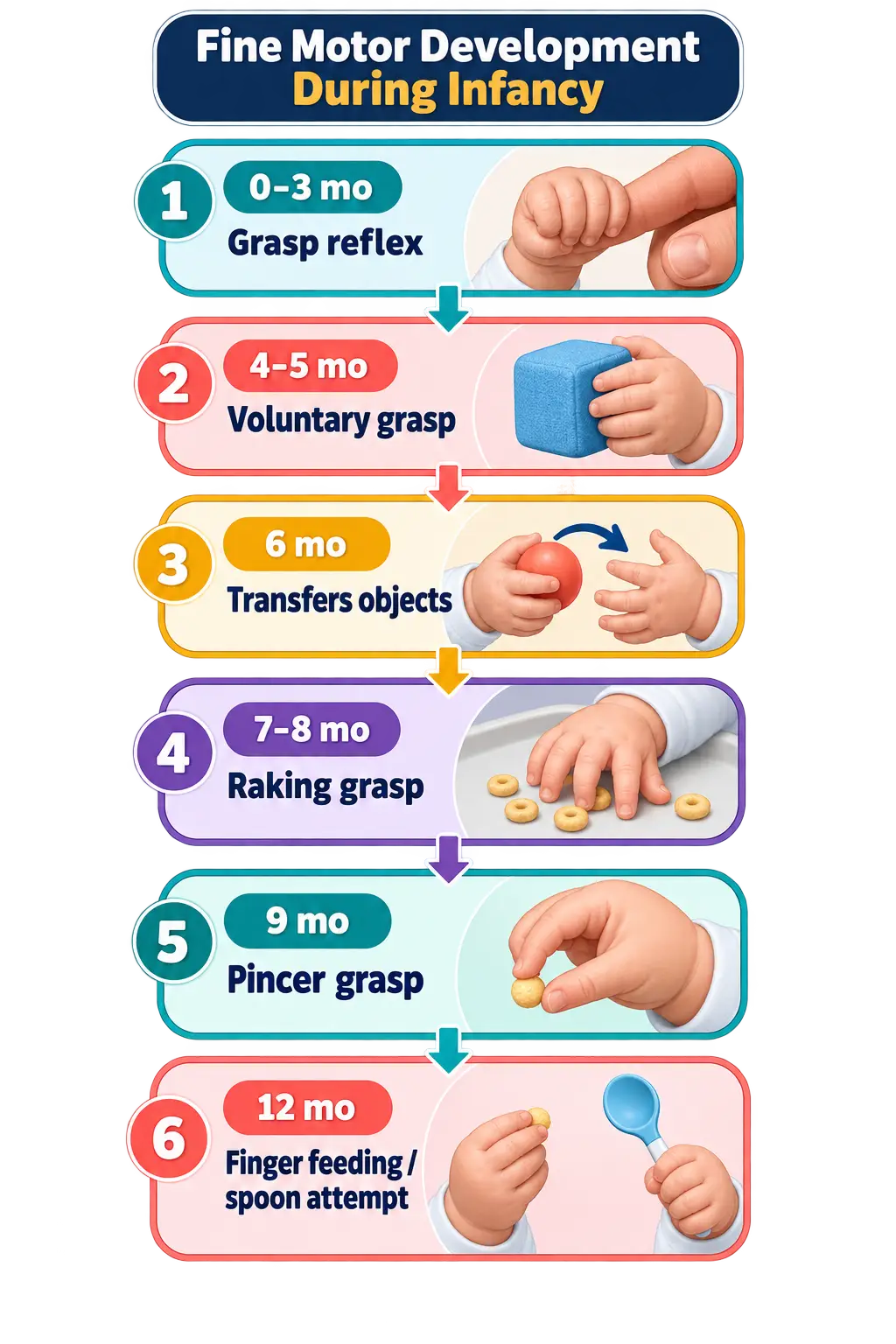
Fine motor milestones

  • 0–3 months: Grasp reflex, opens hands.

  • 4–5 months: Holds objects voluntarily, brings hands to midline.

  • 6 months: Transfers objects between hands.

  • 7–8 months: Raking grasp for small items.

  • 9 months: Pincer grasp (important NCLEX marker).

  • 12 months: Self-feeds with fingers, attempts spoon use.

alt_text
//////Caption: Fine motor development during infancy
Illustration type: Sequential milestone infographic
Illustration note: Show grasp reflex → voluntary grasp → transfer between hands → raking grasp → pincer grasp → finger feeding/spoon attempt.///////
Definitions
Object permanence
Understanding that objects continue to exist even when not visible.
Stranger anxiety
The normal fear of unfamiliar people emerges around 6–8 months.
Separation anxiety
Distress when caregiver leaves; strongest 8–12 months.
Pincer grasp
Ability to pick up small objects between the thumb and index finger.
Extrusion reflex
Automatic tongue-thrust movement that prevents swallowing solids.

Cognitive development

The nursing focus is on recognizing early cognitive milestones, such as object permanence development, to ensure timely intervention for any developmental delays in the sensorimotor stage.

Piaget: Sensorimotor stage (0–2 years)

Infants learn through their senses and motor exploration.

  • 4–7 months: Intentional actions begin (grasping, reaching).
  • ~9 months: Object permanence develops.
  • 12 months: Understands cause-and-effect (e.g., shaking a toy makes noise).

Object permanence marks the transition from reflex-driven responses to intentional thinking, a major NCLEX developmental signpost.

alt_text
//////Caption: Object permanence in infancy
Illustration type: Before-and-after educational illustration
Illustration note: Caregiver hides a toy under a cloth; infant lifts the cloth to find it.///////

Psychosocial and emotional development

Development in this stage centers on Erikson’s trust vs mistrust, where responsive, nurturing care establishes a foundation of trust and secure attachment.

What are the stages of Erikson’s psychosocial development model?

(spoiler)

The eight stages of Erik Erikson’s psychosocial development are:

  1. Trust vs. mistrust (infancy: 0 to 1 year)
  2. Autonomy vs. shame and doubt (early childhood: 1 to 3 years)
  3. Initiative vs. guilt (play age: 3 to 6 years)
  4. Industry vs. inferiority (school age: 6 to 12 years)
  5. Identity vs. role confusion (adolescence: 12 to 18 years)
  6. Intimacy vs. isolation (young adulthood: 18 to 40 years)
  7. Generativity vs. Stagnation (middle adulthood: 40 to 65 years)
  8. Ego integrity vs. despair (maturity: 65 years and older)

Erikson: trust vs mistrust

  • Responsive, nurturing care fosters trust and secure attachment.
  • Inconsistent or neglectful care fosters mistrust, anxiety, and insecure bonding.

Social milestones

  • 2 months: Social smile.

  • 6 months: Stranger anxiety.

  • 8–12 months: Separation anxiety.

  • 12 months: Imitates gestures, waves “bye-bye,” and plays simple interactive games (peek-a-boo).

Language development

The nursing role in language development involves assessing the sequential emergence of vocalizations and words to provide anticipatory guidance and recognize red flags requiring early intervention.

  • 2 months: Cooing.

  • 4–5 months: Laughing, squealing.

  • 6 months: Babbling (“ba-ba,” “da-da”).

  • 9 months: Responds to name, understands “no.”

  • 12 months: Says 1–2 meaningful words, follows simple commands.

alt_text
//////Caption: Language milestones from birth to 12 months
Illustration type: Timeline infographic
Illustration note: Cooing → laughing/squealing → babbling → responds to name → first meaningful words.///////
Milestones from birth to 12 months
Infant development milestones

Nutrition and feeding

The nursing focus in this stage is on promoting exclusive breast milk or iron-fortified formula for the first six months, safe introduction of solids at 4–6 months, and providing guidance on feeding practices up to 12 months.

  • Exclusive breast milk or iron-fortified formula for first 6 months.
  • Introduce solids at 4–6 months when extrusion reflex disappears.
  • Introduce one new food every 3–5 days to identify allergies.
  • By 12 months, introduce whole milk, encourage self-feeding.

Do not give honey (botulism), cow’s milk <12 months, choking hazards (grapes, nuts), juice in bottles.

alt_text
//////Caption: Safe infant feeding during the first year
Illustration type: Feeding timeline infographic Illustration note: Breast milk/formula → introduction of solids → one new food every 3–5 days → whole milk at 12 months; include “Avoid honey, cow’s milk <12 months, choking hazards.”///////

Safety and injury prevention

  • Place infants supine to sleep (SIDS prevention).
  • Rear-facing car seat as long as possible, until the child reaches the maximum height or weight limit set by the car seat manufacturer (often beyond age 2).
  • Avoid pillows, blankets, and bumpers in the crib.
  • Use safety gates once mobility increases.
  • Keep small objects, cords, and hot liquids out of reach.
  • Set water heater ≤120°F (49°C).
alt_text
//////Caption: Essential infant safety measures
Illustration type: Nursery safety illustration Illustration note: Safe sleep (supine, empty crib), rear-facing car seat, safety gate, covered outlets, hot liquids out of reach, water heater ≤120°F (49°C).///////

Red flags (require evaluation)

  • No social smile by 3 months.
  • Poor head control at 4 months.
  • Not rolling by 6 months.
  • No babbling by 6 months.
  • Not sitting independently by 9 months.
  • Not crawling or pulling to stand by 12 months.
  • No single words by 12 months.
Red flag milestones from birth to 12 months
High-yield red flags during Infant development

Nursing interventions

  • Promote bonding (skin-to-skin, eye contact, caregiver presence).
  • Reinforce immunization schedule: Hep B, DTaP, Hib, IPV, PCV, rota, influenza (≥6 months).
  • Teach safe sleep practices and home-proofing strategies.
  • Encourage tummy time to support motor development.
  • Assess milestone achievement at every visit.
  • Provide emotional support for caregivers, especially first-time parents.
alt_text
//////Caption: Nursing support for healthy infant development
Illustration type: Clinical nursing illustration
Illustration note: Nurse demonstrating tummy time, reviewing milestones with caregiver, reinforcing immunizations, and encouraging skin-to-skin bonding.///////

Clinical vignette: A 9-month-old presents for a wellness visit and is not yet sitting independently. The nurse reviews the developmental history and learns that the infant spends most of the day in a swing. The nurse educates the caregiver on increasing floor play and schedules a follow-up developmental check. Early, supportive intervention may prevent motor delay.

Client/Caregiver education

  • “Back to sleep, tummy to play.”
  • Introduce solids slowly and safely.
  • Use consistent, soothing routines for sleep.
  • Offer safe toys that stimulate sensory and motor development.
  • Keep routine well-child visits to track growth and intervene early.

Common pitfalls on NCLEX

  • Giving cow’s milk before 12 months.
  • Thinking stranger anxiety is abnormal.
  • Placing infants prone to sleep.
  • Ignoring weight that does not double by 5–6 months.
  • Failing to recognize absence of pincer grasp by 9–10 months.
  • Misinterpreting normal crying, teething, or cluster feeding as illness.
  • Birth weight doubles by 5–6 months and triples by 12.

  • Object permanence develops around 9 months.

  • Pincer grasp emerges at 9 months.

  • Stranger anxiety = normal.

  • Supine sleep prevents SIDS.

Sign up for free to take 5 quiz questions on this topic

Previous
Next  | 2.1.2 Early childhood (1–5 years)
All rights reserved ©2016 - 2026 Achievable, Inc.

Infancy (0–1 year)

Introduction

The first year of life unfolds at remarkable speed. It’s a period where newborn reflexes transform into intentional movement, babbles evolve into early words, and emotional bonds lay the foundation for lifelong trust. Nurses play a pivotal role in guiding caregivers through this fragile stage, recognizing when development is on track and when early intervention is needed. The NCLEX emphasizes infancy because early milestones, safety practices, and anticipatory guidance can have a profound influence on physical and cognitive outcomes.

Learning objectives

By the end of this section, you should be able to:

  • Describe physical, cognitive, and psychosocial developmental milestones from birth to 12 months.
  • Provide evidence-based anticipatory guidance for nutrition, safety, and parent–infant bonding.
  • Recognize red flags and deviations from typical development requiring follow-up.
  • Apply NCLEX-relevant nursing interventions for promoting healthy infant growth.

Growth and physical development

Infants experience rapid physical growth during the first year, and deviations may signal underlying health concerns.

Weight, length, and head circumference

  • Birth weight doubles by 5–6 months and triples by 12 months.
  • Length increases by ~50% from birth to 1 year.
  • Head circumference increases 1.5 cm/month for the first 3 months, then ~0.5 cm/month.
  • Posterior fontanel closes by 2–3 months; anterior closes by 12–18 months.

Motor development

This section outlines the sequential progression of an infant’s gross motor skills (like rolling and walking) and fine motor skills (like grasping and pincer use) from birth to 12 months.

Gross motor milestones

  • 0–1 month: Moves head side to side, primitive reflexes present.

  • 2 months: Lifts head briefly while prone.

  • 3 months: Holds head steady, begins to bear weight on forearms.

  • 4 months: Rolls front → back.

  • 5–6 months: Rolls back → front, sits with support.

  • 7–8 months: Sits independently, begins crawling/army crawl.

  • 9–10 months: Pulls to stand, cruises along furniture.

  • 12 months: takes first steps, stands independently.

alt_text
//////Caption: Infant motor development milestones (0–12 months)
Illustration type: Timeline infographic
Illustration note: Show progression from head control → rolling → sitting → crawling → pulling to stand → first steps, with age labels.///////

Fine motor milestones

  • 0–3 months: Grasp reflex, opens hands.

  • 4–5 months: Holds objects voluntarily, brings hands to midline.

  • 6 months: Transfers objects between hands.

  • 7–8 months: Raking grasp for small items.

  • 9 months: Pincer grasp (important NCLEX marker).

  • 12 months: Self-feeds with fingers, attempts spoon use.

alt_text
//////Caption: Fine motor development during infancy
Illustration type: Sequential milestone infographic
Illustration note: Show grasp reflex → voluntary grasp → transfer between hands → raking grasp → pincer grasp → finger feeding/spoon attempt.///////
Definitions
Object permanence
Understanding that objects continue to exist even when not visible.
Stranger anxiety
The normal fear of unfamiliar people emerges around 6–8 months.
Separation anxiety
Distress when caregiver leaves; strongest 8–12 months.
Pincer grasp
Ability to pick up small objects between the thumb and index finger.
Extrusion reflex
Automatic tongue-thrust movement that prevents swallowing solids.

Cognitive development

The nursing focus is on recognizing early cognitive milestones, such as object permanence development, to ensure timely intervention for any developmental delays in the sensorimotor stage.

Piaget: Sensorimotor stage (0–2 years)

Infants learn through their senses and motor exploration.

  • 4–7 months: Intentional actions begin (grasping, reaching).
  • ~9 months: Object permanence develops.
  • 12 months: Understands cause-and-effect (e.g., shaking a toy makes noise).

Object permanence marks the transition from reflex-driven responses to intentional thinking, a major NCLEX developmental signpost.

alt_text
//////Caption: Object permanence in infancy
Illustration type: Before-and-after educational illustration
Illustration note: Caregiver hides a toy under a cloth; infant lifts the cloth to find it.///////

Psychosocial and emotional development

Development in this stage centers on Erikson’s trust vs mistrust, where responsive, nurturing care establishes a foundation of trust and secure attachment.

What are the stages of Erikson’s psychosocial development model?

(spoiler)

The eight stages of Erik Erikson’s psychosocial development are:

  1. Trust vs. mistrust (infancy: 0 to 1 year)
  2. Autonomy vs. shame and doubt (early childhood: 1 to 3 years)
  3. Initiative vs. guilt (play age: 3 to 6 years)
  4. Industry vs. inferiority (school age: 6 to 12 years)
  5. Identity vs. role confusion (adolescence: 12 to 18 years)
  6. Intimacy vs. isolation (young adulthood: 18 to 40 years)
  7. Generativity vs. Stagnation (middle adulthood: 40 to 65 years)
  8. Ego integrity vs. despair (maturity: 65 years and older)

Erikson: trust vs mistrust

  • Responsive, nurturing care fosters trust and secure attachment.
  • Inconsistent or neglectful care fosters mistrust, anxiety, and insecure bonding.

Social milestones

  • 2 months: Social smile.

  • 6 months: Stranger anxiety.

  • 8–12 months: Separation anxiety.

  • 12 months: Imitates gestures, waves “bye-bye,” and plays simple interactive games (peek-a-boo).

Language development

The nursing role in language development involves assessing the sequential emergence of vocalizations and words to provide anticipatory guidance and recognize red flags requiring early intervention.

  • 2 months: Cooing.

  • 4–5 months: Laughing, squealing.

  • 6 months: Babbling (“ba-ba,” “da-da”).

  • 9 months: Responds to name, understands “no.”

  • 12 months: Says 1–2 meaningful words, follows simple commands.

alt_text
//////Caption: Language milestones from birth to 12 months
Illustration type: Timeline infographic
Illustration note: Cooing → laughing/squealing → babbling → responds to name → first meaningful words.///////

Nutrition and feeding

The nursing focus in this stage is on promoting exclusive breast milk or iron-fortified formula for the first six months, safe introduction of solids at 4–6 months, and providing guidance on feeding practices up to 12 months.

  • Exclusive breast milk or iron-fortified formula for first 6 months.
  • Introduce solids at 4–6 months when extrusion reflex disappears.
  • Introduce one new food every 3–5 days to identify allergies.
  • By 12 months, introduce whole milk, encourage self-feeding.

Do not give honey (botulism), cow’s milk <12 months, choking hazards (grapes, nuts), juice in bottles.

alt_text
//////Caption: Safe infant feeding during the first year
Illustration type: Feeding timeline infographic Illustration note: Breast milk/formula → introduction of solids → one new food every 3–5 days → whole milk at 12 months; include “Avoid honey, cow’s milk <12 months, choking hazards.”///////

Safety and injury prevention

  • Place infants supine to sleep (SIDS prevention).
  • Rear-facing car seat as long as possible, until the child reaches the maximum height or weight limit set by the car seat manufacturer (often beyond age 2).
  • Avoid pillows, blankets, and bumpers in the crib.
  • Use safety gates once mobility increases.
  • Keep small objects, cords, and hot liquids out of reach.
  • Set water heater ≤120°F (49°C).
alt_text
//////Caption: Essential infant safety measures
Illustration type: Nursery safety illustration Illustration note: Safe sleep (supine, empty crib), rear-facing car seat, safety gate, covered outlets, hot liquids out of reach, water heater ≤120°F (49°C).///////

Red flags (require evaluation)

  • No social smile by 3 months.
  • Poor head control at 4 months.
  • Not rolling by 6 months.
  • No babbling by 6 months.
  • Not sitting independently by 9 months.
  • Not crawling or pulling to stand by 12 months.
  • No single words by 12 months.

Nursing interventions

  • Promote bonding (skin-to-skin, eye contact, caregiver presence).
  • Reinforce immunization schedule: Hep B, DTaP, Hib, IPV, PCV, rota, influenza (≥6 months).
  • Teach safe sleep practices and home-proofing strategies.
  • Encourage tummy time to support motor development.
  • Assess milestone achievement at every visit.
  • Provide emotional support for caregivers, especially first-time parents.
alt_text
//////Caption: Nursing support for healthy infant development
Illustration type: Clinical nursing illustration
Illustration note: Nurse demonstrating tummy time, reviewing milestones with caregiver, reinforcing immunizations, and encouraging skin-to-skin bonding.///////

Clinical vignette: A 9-month-old presents for a wellness visit and is not yet sitting independently. The nurse reviews the developmental history and learns that the infant spends most of the day in a swing. The nurse educates the caregiver on increasing floor play and schedules a follow-up developmental check. Early, supportive intervention may prevent motor delay.

Client/Caregiver education

  • “Back to sleep, tummy to play.”
  • Introduce solids slowly and safely.
  • Use consistent, soothing routines for sleep.
  • Offer safe toys that stimulate sensory and motor development.
  • Keep routine well-child visits to track growth and intervene early.

Common pitfalls on NCLEX

  • Giving cow’s milk before 12 months.
  • Thinking stranger anxiety is abnormal.
  • Placing infants prone to sleep.
  • Ignoring weight that does not double by 5–6 months.
  • Failing to recognize absence of pincer grasp by 9–10 months.
  • Misinterpreting normal crying, teething, or cluster feeding as illness.
Key points
  • Birth weight doubles by 5–6 months and triples by 12.

  • Object permanence develops around 9 months.

  • Pincer grasp emerges at 9 months.

  • Stranger anxiety = normal.

  • Supine sleep prevents SIDS.

More from Growth and development across the lifespan

  • Early childhood (1–5 years)
  • School age (6–12 years)
  • Adolescence (13–18 years)
  • Adulthood (19–64 years)
  • Older adults (65+ years)