


Achievable logoAchievable logo
NCLEX
Sign in
Sign up
Purchase
Textbook
Practice exams
Support
How it works
Exam catalog
Mountain with a flag at the peak
Textbook
Introduction
1. Safe and effective care environment
2. Health promotion and maintenance
2.1 Growth and development across the lifespan
2.1.1 Infancy (0–1 year)
2.1.2 Early childhood (1–5 years)
2.1.3 School age (6–12 years)
2.1.4 Adolescence (13–18 years)
2.1.5 Adulthood (19–64 years)
2.1.6 Older adults (65+ years)
2.2 Antepartum, intrapartum and postpartum
2.3 Newborn care and developmental milestones
2.4 Health screenings and preventive care (vision, cancer, immunizations)
2.5 Lifestyle counseling and high-risk behaviors
2.6 Aging, transitions, and end-of-life considerations
3. Psychosocial Integrity
4. Physiological Integrity
Wrapping up
Achievable logoAchievable logo
2.1.5 Adulthood (19–64 years)
Achievable NCLEX
2. Health promotion and maintenance
2.1. Growth and development across the lifespan
Our NCLEX course is currently in development and is a work-in-progress.

Adulthood (19–64 years)

9 min read
Font
Discuss
Share
Feedback

Introduction

Adulthood covers the longest span of the human lifespan: a broad, dynamic era where identity solidifies, careers evolve, families form, and health behaviors establish lifelong patterns. While often viewed as a period of stability, adults face unique challenges: chronic disease risk, occupational stresses, reproductive decisions, and significant psychosocial transitions. NCLEX emphasizes this stage because nurses support adults through health screenings, counseling, disease prevention, and early detection of lifestyle-related conditions.

Learning objectives

By the end of this section, you should be able to:

  • Describe physical, cognitive, social, and emotional development across early, middle, and late adulthood.
  • Identify age-appropriate health screenings and preventive care per CDC/USPSTF guidelines.
  • Recognize emerging risk factors for chronic illness, mental health concerns, and high-risk behaviors.
  • Apply nursing interventions that promote wellness and healthy lifestyle choices.
Definitions
Generativity
Motivation to contribute to society through work, family, and community roles.
Stagnation
Sense of unproductivity, disconnection, or lack of purpose.
Perimenopause
Transitional period before menopause marked by hormonal fluctuations.
PSA
Prostate-specific antigen, used for prostate cancer screening.
Fluid intelligence
The capacity to think logically, analyze new problems, and identify patterns in novel situations independent of previously acquired knowledge.
Screening
Early detection of disease before symptoms appear.

Development across adulthood

This section reviews the physical, cognitive, and psychosocial changes across early and middle adulthood, which are critical areas for NCLEX focus on preventive care and client education.

Physical development

This section details the progression from peak physical performance in early adulthood to the onset of gradual physiological changes and the emergence of chronic disease risks in middle adulthood, guiding the nurse’s focus on preventive care and age-appropriate screening.

Early adulthood (19–40 years)

  • Peak physical performance occurs during the 20s and early 30s.
  • Optimal muscle strength, cardiac output, flexibility, and reaction time.
  • Fertility highest between ages 20–29; gradually declines afterward.
  • Common stressors: work, financial stability, family roles, and establishing independence.

Middle adulthood (40–64 years)

  • Gradual physiological changes begin:

    • Skin elasticity decreases
    • Metabolism slows
    • Vision changes (presbyopia)
    • Reduced muscle mass
  • Women: perimenopause → menopause (average 51 years).

  • Men: gradual testosterone decline, possible erectile dysfunction.

  • Chronic conditions may emerge: hypertension, hyperlipidemia, type 2 diabetes, arthritis.

alt_text
//////Caption: Physical changes across adulthood (19–64 years)
Illustration type: Timeline infographic
Illustration note: Compare early adulthood (peak muscle strength, fertility, cardiac output, flexibility) with middle adulthood (slower metabolism, presbyopia, reduced muscle mass, perimenopause/menopause, gradual testosterone decline, increased chronic disease risk).///////

What are the stages of Erikson’s psychosocial development model?

(spoiler)

The eight stages of Erik Erikson’s psychosocial development are:

  1. Trust vs. Mistrust (Infancy: birth to 1 year)
  2. Autonomy vs. Shame and Doubt (Early Childhood: 1 to 3 years)
  3. Initiative vs. Guilt (Play Age: 3 to 6 years)
  4. Industry vs. Inferiority (School Age: 6 to 12 years)
  5. Identity vs. Role Confusion (Adolescence: 12 to 18 years)
  6. Intimacy vs. Isolation (Young Adulthood: 18 to 40 years)
  7. Generativity vs. Stagnation (Middle Adulthood: 40 to 65 years)
  8. Ego Integrity vs. Despair (Maturity: 65 years and older)

Cognitive development

This section details the balance between increasing experience-based (crystallized intelligence) and slowly declining processing speed (fluid intelligence), guiding the nurse to assess for normal aging versus pathological cognitive changes.

Stable intelligence with experience-based growth

  • Fluid intelligence (speed of thinking) slowly declines with age.
  • Crystallized intelligence (knowledge, skills, expertise) increases through midlife.
  • Adults excel in problem-solving, decision-making, and executive function.
  • Cognitive decline is not normative before age 65.

Psychosocial development

This section explores how adults navigate relationships, identity, and purpose, with Erikson’s stages of intimacy versus isolation and generativity versus stagnation guiding the nurse’s understanding of emotional well-being across early and middle adulthood.

Early adulthood: Erikson: intimacy vs isolation

  • Goal: form meaningful relationships.
  • Secure identity allows commitment; isolation arises from fear of vulnerability or unresolved identity issues.
  • Career building, partnership, and long-term goal setting dominate this stage.

Middle adulthood: Erikson: generativity vs stagnation

  • Focus on contributing to society through work, parenting, community service.
  • Generativity = productivity, mentorship, legacy building. Stagnation = self-absorption, dissatisfaction, lack of progress.

Emotional and social development

This section explores the complex balance of multiple life roles, the influence of midlife reassessment and major life transitions, and the improvement in emotional regulation that guides the nurse’s assessment of coping mechanisms and social support.

  • Adults balance roles: parent, partner, employee, caregiver.
  • Midlife “reassessment” may occur — evaluating goals, identity, life direction.
  • Stress from caregiving (“sandwich generation”) common.
  • Divorce, remarriage, blended families, and career transitions influence well-being.
  • Emotional regulation generally improves with age and experience.

Sexual and reproductive health

This section addresses the nurse’s role in providing counseling, screening for STIs, and delivering evidence-based education on family planning and age-related hormonal changes across early and middle adulthood.

Early adulthood

  • Family planning, fertility, contraception counseling.
  • STI screening remains important due to behavioral risks.

Middle adulthood

  • Women: perimenopause symptoms (hot flashes, mood changes, irregular cycles).
  • Men: ED, decreased libido, prostate enlargement.
  • Nurses provide evidence-based education on sexual health, hormone changes, and safe practices.

Nutrition

  • Metabolic rate decreases across adulthood → higher risk of weight gain.
  • Encourage balanced diet: whole grains, lean proteins, fruits, vegetables.
  • Limit saturated fats, sodium, and added sugars.
  • Promote adequate calcium and vitamin D to prevent osteoporosis.
  • Moderate alcohol consumption; avoid tobacco and vaping.
alt_text
//////Caption: Healthy nutrition priorities during adulthood
Illustration type: Healthy plate infographic
Illustration note: Show balanced portions of vegetables, fruits, whole grains, lean proteins, and healthy fats, alongside icons highlighting calcium, vitamin D, hydration, limiting sodium, added sugars, saturated fats, alcohol moderation, and tobacco avoidance.///////

Physical activity

  • Adults should engage in:

    • 150 minutes/week moderate aerobic activity or
    • 75 minutes/week vigorous activity
      • muscle-strengthening twice per week
  • Regular activity reduces chronic disease risk and supports mental health.

alt_text
//////Caption: Weekly physical activity recommendations for adults
Illustration type: Infographic
Illustration note: Illustrate 150 minutes/week moderate aerobic activity or 75 minutes/week vigorous activity plus muscle-strengthening exercises at least 2 days/week, with examples such as brisk walking, cycling, swimming, resistance training, and body-weight exercises.///////

Safety and lifestyle behaviors

This section identifies the highest risks for lifestyle-related illnesses, injuries, and high-risk behaviors in adults, guiding the nurse to implement essential screenings, counseling, and harm reduction strategies.

  • Highest risk for lifestyle-related illnesses and injuries:

    • Hypertension, diabetes, obesity
    • Occupational injuries
    • Substance use disorders
    • Domestic violence or partner abuse
  • Promote screenings, counseling, and harm reduction strategies.

Health screening guidelines (NCLEX priority)

Nurses must master age-appropriate health screening guidelines, including general, reproductive, and cancer checks, because early detection significantly improves client outcomes.

General adult screenings

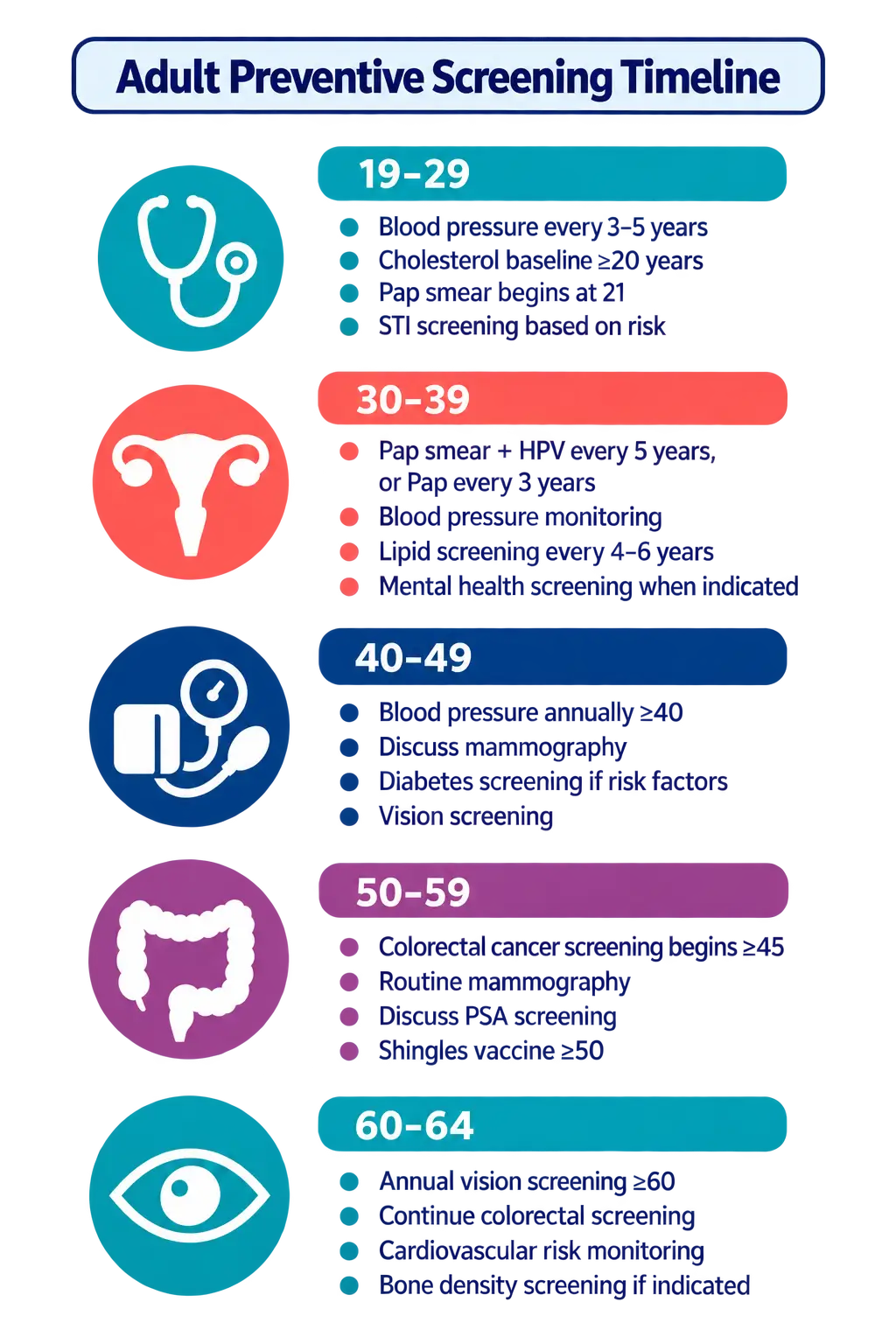
  • Blood pressure: every 3–5 years (18–39), annually ≥40.
  • Cholesterol: baseline at 20; q4–6 years; more frequent with risk factors.
  • Diabetes: q3 years ≥45, or earlier with risk factors (BMI >25).
  • Dental: every 6 months.
  • Vision: every 2 years; annually >60.

Reproductive screenings

  • Pap smear:

    • 21–29: q3 years (cytology alone)
    • 30–65: q5 years (primary HPV testing or co-testing), or q3 years with cytology alone
  • Mammogram: biennial screening recommended for ages 40 through 74 (2024 USPSTF guideline).

  • Testicular exam: self-exam is not routinely recommended for asymptomatic males (USPSTF Grade D); teach self-awareness and prompt reporting of new masses, especially in high-risk clients.

  • Prostate screening: USPSTF recommends individualized PSA-based screening decisions for ages 55–69 (Grade C); screening is not recommended for age 70+ (Grade D). Discussion may begin earlier for high-risk clients (e.g., family history, African American men), per shared decision-making.

Note: screening guidelines can vary slightly between organizations (e.g., USPSTF vs. ACS) and may be individualized based on risk factors. For NCLEX, use the USPSTF standard above.

Cancer screenings

  • Colorectal cancer: begin at 45, intervals depend on test type.
  • Skin cancer: routine self-checks and periodic clinical exams.
Screening timelines for preventative care
Adult preventative screening timelines

Mental health

Adults face stress from careers, parenting, finances, illness, and caregiving.

Common concerns

  • Anxiety
  • Depression
  • Burnout
  • Sleep disorders
  • Substance use
  • Domestic violence

Nurses assess mood, coping, social supports, and safety.

Red flags (Ages 19–64)

  • Persistent fatigue, weight changes, or sleep disruption
  • Loss of interest in activities
  • Difficulty maintaining employment
  • Declining cognitive function in midlife
  • Intimate partner violence
  • High alcohol consumption
  • Thoughts of self-harm or hopelessness

Nursing interventions

  • Encourage regular primary care visits and screenings.
  • Counsel on exercise, nutrition, smoking cessation, and alcohol moderation.
  • Teach stress reduction and healthy coping strategies.
  • Support patients managing chronic illness or caring for aging relatives.
  • Provide sexually transmitted infection (STI) counseling and safe-sex education.
  • Screen for mental health issues and intimate partner violence.

Clinical vignette: A 42-year-old reports exhaustion, weight gain, and difficulty sleeping. She works full-time while caring for two children and an aging parent. The nurse screens for depression, assesses thyroid function, and provides education on sleep hygiene and stress management. She also connects the client with community support services for caregivers.

Client education

  • Maintain annual wellness exams.
  • Follow cancer screening guidelines by age and risk.
  • Practice safe sex; update vaccinations (flu annually, Tdap q10 years, shingles ≥50, pneumococcal if indicated).
  • Prioritize sleep, nutrition, and physical activity.
  • Build healthy coping skills and stress management routines.

Common pitfalls on NCLEX

  • Failing to recommend Pap smears or mammograms based on age.
  • Assuming adults do not experience developmental challenges.
  • Neglecting screening for intimate partner violence.
  • Underestimating mental health issues in middle-age adults.
  • Ignoring chronic disease risks associated with diet and low activity.
  • Early adulthood: intimacy and career-building.

  • Middle adulthood: generativity and long-term stability.

  • Health screenings save lives — timing matters.

  • Lifestyle choices strongly impact chronic disease risk.

  • Nurses support physical, emotional, and relational well-being.

Sign up for free to take 5 quiz questions on this topic

Previous
Next  | 2.1.6 Older adults (65+ years)
All rights reserved ©2016 - 2026 Achievable, Inc.

Adulthood (19–64 years)

Introduction

Adulthood covers the longest span of the human lifespan: a broad, dynamic era where identity solidifies, careers evolve, families form, and health behaviors establish lifelong patterns. While often viewed as a period of stability, adults face unique challenges: chronic disease risk, occupational stresses, reproductive decisions, and significant psychosocial transitions. NCLEX emphasizes this stage because nurses support adults through health screenings, counseling, disease prevention, and early detection of lifestyle-related conditions.

Learning objectives

By the end of this section, you should be able to:

  • Describe physical, cognitive, social, and emotional development across early, middle, and late adulthood.
  • Identify age-appropriate health screenings and preventive care per CDC/USPSTF guidelines.
  • Recognize emerging risk factors for chronic illness, mental health concerns, and high-risk behaviors.
  • Apply nursing interventions that promote wellness and healthy lifestyle choices.
Definitions
Generativity
Motivation to contribute to society through work, family, and community roles.
Stagnation
Sense of unproductivity, disconnection, or lack of purpose.
Perimenopause
Transitional period before menopause marked by hormonal fluctuations.
PSA
Prostate-specific antigen, used for prostate cancer screening.
Fluid intelligence
The capacity to think logically, analyze new problems, and identify patterns in novel situations independent of previously acquired knowledge.
Screening
Early detection of disease before symptoms appear.

Development across adulthood

This section reviews the physical, cognitive, and psychosocial changes across early and middle adulthood, which are critical areas for NCLEX focus on preventive care and client education.

Physical development

This section details the progression from peak physical performance in early adulthood to the onset of gradual physiological changes and the emergence of chronic disease risks in middle adulthood, guiding the nurse’s focus on preventive care and age-appropriate screening.

Early adulthood (19–40 years)

  • Peak physical performance occurs during the 20s and early 30s.
  • Optimal muscle strength, cardiac output, flexibility, and reaction time.
  • Fertility highest between ages 20–29; gradually declines afterward.
  • Common stressors: work, financial stability, family roles, and establishing independence.

Middle adulthood (40–64 years)

  • Gradual physiological changes begin:

    • Skin elasticity decreases
    • Metabolism slows
    • Vision changes (presbyopia)
    • Reduced muscle mass
  • Women: perimenopause → menopause (average 51 years).

  • Men: gradual testosterone decline, possible erectile dysfunction.

  • Chronic conditions may emerge: hypertension, hyperlipidemia, type 2 diabetes, arthritis.

alt_text
//////Caption: Physical changes across adulthood (19–64 years)
Illustration type: Timeline infographic
Illustration note: Compare early adulthood (peak muscle strength, fertility, cardiac output, flexibility) with middle adulthood (slower metabolism, presbyopia, reduced muscle mass, perimenopause/menopause, gradual testosterone decline, increased chronic disease risk).///////

What are the stages of Erikson’s psychosocial development model?

(spoiler)

The eight stages of Erik Erikson’s psychosocial development are:

  1. Trust vs. Mistrust (Infancy: birth to 1 year)
  2. Autonomy vs. Shame and Doubt (Early Childhood: 1 to 3 years)
  3. Initiative vs. Guilt (Play Age: 3 to 6 years)
  4. Industry vs. Inferiority (School Age: 6 to 12 years)
  5. Identity vs. Role Confusion (Adolescence: 12 to 18 years)
  6. Intimacy vs. Isolation (Young Adulthood: 18 to 40 years)
  7. Generativity vs. Stagnation (Middle Adulthood: 40 to 65 years)
  8. Ego Integrity vs. Despair (Maturity: 65 years and older)

Cognitive development

This section details the balance between increasing experience-based (crystallized intelligence) and slowly declining processing speed (fluid intelligence), guiding the nurse to assess for normal aging versus pathological cognitive changes.

Stable intelligence with experience-based growth

  • Fluid intelligence (speed of thinking) slowly declines with age.
  • Crystallized intelligence (knowledge, skills, expertise) increases through midlife.
  • Adults excel in problem-solving, decision-making, and executive function.
  • Cognitive decline is not normative before age 65.

Psychosocial development

This section explores how adults navigate relationships, identity, and purpose, with Erikson’s stages of intimacy versus isolation and generativity versus stagnation guiding the nurse’s understanding of emotional well-being across early and middle adulthood.

Early adulthood: Erikson: intimacy vs isolation

  • Goal: form meaningful relationships.
  • Secure identity allows commitment; isolation arises from fear of vulnerability or unresolved identity issues.
  • Career building, partnership, and long-term goal setting dominate this stage.

Middle adulthood: Erikson: generativity vs stagnation

  • Focus on contributing to society through work, parenting, community service.
  • Generativity = productivity, mentorship, legacy building. Stagnation = self-absorption, dissatisfaction, lack of progress.

Emotional and social development

This section explores the complex balance of multiple life roles, the influence of midlife reassessment and major life transitions, and the improvement in emotional regulation that guides the nurse’s assessment of coping mechanisms and social support.

  • Adults balance roles: parent, partner, employee, caregiver.
  • Midlife “reassessment” may occur — evaluating goals, identity, life direction.
  • Stress from caregiving (“sandwich generation”) common.
  • Divorce, remarriage, blended families, and career transitions influence well-being.
  • Emotional regulation generally improves with age and experience.

Sexual and reproductive health

This section addresses the nurse’s role in providing counseling, screening for STIs, and delivering evidence-based education on family planning and age-related hormonal changes across early and middle adulthood.

Early adulthood

  • Family planning, fertility, contraception counseling.
  • STI screening remains important due to behavioral risks.

Middle adulthood

  • Women: perimenopause symptoms (hot flashes, mood changes, irregular cycles).
  • Men: ED, decreased libido, prostate enlargement.
  • Nurses provide evidence-based education on sexual health, hormone changes, and safe practices.

Nutrition

  • Metabolic rate decreases across adulthood → higher risk of weight gain.
  • Encourage balanced diet: whole grains, lean proteins, fruits, vegetables.
  • Limit saturated fats, sodium, and added sugars.
  • Promote adequate calcium and vitamin D to prevent osteoporosis.
  • Moderate alcohol consumption; avoid tobacco and vaping.
alt_text
//////Caption: Healthy nutrition priorities during adulthood
Illustration type: Healthy plate infographic
Illustration note: Show balanced portions of vegetables, fruits, whole grains, lean proteins, and healthy fats, alongside icons highlighting calcium, vitamin D, hydration, limiting sodium, added sugars, saturated fats, alcohol moderation, and tobacco avoidance.///////

Physical activity

  • Adults should engage in:

    • 150 minutes/week moderate aerobic activity or
    • 75 minutes/week vigorous activity
      • muscle-strengthening twice per week
  • Regular activity reduces chronic disease risk and supports mental health.

alt_text
//////Caption: Weekly physical activity recommendations for adults
Illustration type: Infographic
Illustration note: Illustrate 150 minutes/week moderate aerobic activity or 75 minutes/week vigorous activity plus muscle-strengthening exercises at least 2 days/week, with examples such as brisk walking, cycling, swimming, resistance training, and body-weight exercises.///////

Safety and lifestyle behaviors

This section identifies the highest risks for lifestyle-related illnesses, injuries, and high-risk behaviors in adults, guiding the nurse to implement essential screenings, counseling, and harm reduction strategies.

  • Highest risk for lifestyle-related illnesses and injuries:

    • Hypertension, diabetes, obesity
    • Occupational injuries
    • Substance use disorders
    • Domestic violence or partner abuse
  • Promote screenings, counseling, and harm reduction strategies.

Health screening guidelines (NCLEX priority)

Nurses must master age-appropriate health screening guidelines, including general, reproductive, and cancer checks, because early detection significantly improves client outcomes.

General adult screenings

  • Blood pressure: every 3–5 years (18–39), annually ≥40.
  • Cholesterol: baseline at 20; q4–6 years; more frequent with risk factors.
  • Diabetes: q3 years ≥45, or earlier with risk factors (BMI >25).
  • Dental: every 6 months.
  • Vision: every 2 years; annually >60.

Reproductive screenings

  • Pap smear:

    • 21–29: q3 years (cytology alone)
    • 30–65: q5 years (primary HPV testing or co-testing), or q3 years with cytology alone
  • Mammogram: biennial screening recommended for ages 40 through 74 (2024 USPSTF guideline).

  • Testicular exam: self-exam is not routinely recommended for asymptomatic males (USPSTF Grade D); teach self-awareness and prompt reporting of new masses, especially in high-risk clients.

  • Prostate screening: USPSTF recommends individualized PSA-based screening decisions for ages 55–69 (Grade C); screening is not recommended for age 70+ (Grade D). Discussion may begin earlier for high-risk clients (e.g., family history, African American men), per shared decision-making.

Note: screening guidelines can vary slightly between organizations (e.g., USPSTF vs. ACS) and may be individualized based on risk factors. For NCLEX, use the USPSTF standard above.

Cancer screenings

  • Colorectal cancer: begin at 45, intervals depend on test type.
  • Skin cancer: routine self-checks and periodic clinical exams.

Mental health

Adults face stress from careers, parenting, finances, illness, and caregiving.

Common concerns

  • Anxiety
  • Depression
  • Burnout
  • Sleep disorders
  • Substance use
  • Domestic violence

Nurses assess mood, coping, social supports, and safety.

Red flags (Ages 19–64)

  • Persistent fatigue, weight changes, or sleep disruption
  • Loss of interest in activities
  • Difficulty maintaining employment
  • Declining cognitive function in midlife
  • Intimate partner violence
  • High alcohol consumption
  • Thoughts of self-harm or hopelessness

Nursing interventions

  • Encourage regular primary care visits and screenings.
  • Counsel on exercise, nutrition, smoking cessation, and alcohol moderation.
  • Teach stress reduction and healthy coping strategies.
  • Support patients managing chronic illness or caring for aging relatives.
  • Provide sexually transmitted infection (STI) counseling and safe-sex education.
  • Screen for mental health issues and intimate partner violence.

Clinical vignette: A 42-year-old reports exhaustion, weight gain, and difficulty sleeping. She works full-time while caring for two children and an aging parent. The nurse screens for depression, assesses thyroid function, and provides education on sleep hygiene and stress management. She also connects the client with community support services for caregivers.

Client education

  • Maintain annual wellness exams.
  • Follow cancer screening guidelines by age and risk.
  • Practice safe sex; update vaccinations (flu annually, Tdap q10 years, shingles ≥50, pneumococcal if indicated).
  • Prioritize sleep, nutrition, and physical activity.
  • Build healthy coping skills and stress management routines.

Common pitfalls on NCLEX

  • Failing to recommend Pap smears or mammograms based on age.
  • Assuming adults do not experience developmental challenges.
  • Neglecting screening for intimate partner violence.
  • Underestimating mental health issues in middle-age adults.
  • Ignoring chronic disease risks associated with diet and low activity.
Key points
  • Early adulthood: intimacy and career-building.

  • Middle adulthood: generativity and long-term stability.

  • Health screenings save lives — timing matters.

  • Lifestyle choices strongly impact chronic disease risk.

  • Nurses support physical, emotional, and relational well-being.

More from Growth and development across the lifespan

  • Infancy (0–1 year)
  • Early childhood (1–5 years)
  • School age (6–12 years)
  • Adolescence (13–18 years)
  • Older adults (65+ years)