


Achievable logoAchievable logo
NCLEX
Sign in
Sign up
Purchase
Textbook
Practice exams
Support
How it works
Exam catalog
Mountain with a flag at the peak
Textbook
Introduction
1. Safe and effective care environment
2. Health promotion and maintenance
2.1 Growth and development across the lifespan
2.1.1 Infancy (0–1 year)
2.1.2 Early childhood (1–5 years)
2.1.3 School age (6–12 years)
2.1.4 Adolescence (13–18 years)
2.1.5 Adulthood (19–64 years)
2.1.6 Older adults (65+ years)
2.2 Antepartum, intrapartum and postpartum
2.3 Newborn care and developmental milestones
2.4 Health screenings and preventive care (vision, cancer, immunizations)
2.5 Lifestyle counseling and high-risk behaviors
2.6 Aging, transitions, and end-of-life considerations
3. Psychosocial Integrity
4. Physiological Integrity
Wrapping up
Achievable logoAchievable logo
2.1.4 Adolescence (13–18 years)
Achievable NCLEX
2. Health promotion and maintenance
2.1. Growth and development across the lifespan
Our NCLEX course is currently in development and is a work-in-progress.

Adolescence (13–18 years)

7 min read
Font
Discuss
Share
Feedback

Introduction

Adolescence is a bridge: a turbulent, transformative journey from childhood to adult identity. Bodies change rapidly, emotions intensify, thinking becomes more abstract, and peer influence reaches its peak. Nurses play a critical role in supporting safe risk-taking, promoting healthy coping, and identifying early signs of depression, substance use, or unsafe behaviors.

NCLEX focuses on this age group because decisions made during adolescence, from sexual health to injury prevention, often define long-term well-being.

Learning objectives

By the end of this section, you should be able to:

  • Describe the physical, cognitive, emotional, and social milestones of adolescents.
  • Provide anticipatory guidance for puberty, mental health, sexual health, and high-risk behaviors.
  • Identify red flags requiring immediate referral or safety interventions.
  • Apply developmentally appropriate nursing communication strategies.
alt_text
//////Caption: Overview of adolescent development
Illustration type: Infographic Illustration note: Four-part overview showing the major developmental domains: physical, cognitive, psychosocial, and emotional development during adolescence.///////
Definitions
Formal operational thinking
Ability to reason abstractly, think hypothetically, and consider multiple outcomes.
Identity formation
Process of exploring and committing to personal beliefs, roles, and values.
CRAFFT
Screening tool for adolescent substance use.
Emancipated minor
Adolescent legally able to consent for own care (varies by jurisdiction).

Physical development

The physical changes of puberty, including growth spurts and shifts in sleep patterns, require nurses to provide anticipatory guidance on nutrition, sleep hygiene, and body image to support healthy adolescent development.

Puberty and growth

  • Adolescence begins with puberty, triggered by hormonal changes.

  • Girls: breast development → growth spurt → menarche (typically 10–14 years).

  • Boys: testicular enlargement → genital growth → voice changes → increased muscle mass (typically 12–16 years).

  • Peak height velocity:

    • Girls: ~12 years
    • Boys: ~14 years
  • Acne, sweating, and increased oil production are common as sebaceous glands mature.

Sleep

  • Require 8–10 hours nightly, but circadian shifts cause later sleep–wake cycles.
  • Screen time, stress, and academic pressure commonly impair sleep hygiene.

Cognitive development

Understanding that adolescents are in Piaget’s Formal Operational stage (abstract thought) but still possess impulsivity (immature prefrontal cortex) is relevant for NCLEX nurses to provide developmentally appropriate, safety-focused patient education and anticipate high-risk behaviors.

Piaget: Formal operational stage (age 11 to adulthood)

Adolescents acquire the ability to think abstractly and hypothetically. They develop:

  • Logical reasoning (“If… then…” thinking).
  • Ability to debate, analyze fairness, and question rules.
  • Future orientation: planning for career, identity, and long-term goals.
  • Increased metacognition (awareness of one’s own thoughts).

However, cognitive growth does not eliminate impulsivity; the prefrontal cortex (responsible for judgment) continues maturing into the mid-20s.

alt_text
//////Caption: Formal operational thinking
Illustration type: Concept diagram Illustration note: Illustrate abstract thinking, hypothetical reasoning, future planning, and metacognition using simple everyday adolescent examples.///////

Psychosocial development

The psychosocial relevance of this age group is that the stage of Identity vs. Role Confusion requires nurses to provide confidential, nonjudgmental communication and supportive guidance to foster healthy identity formation and navigate high-risk behaviors.

Erikson: Identity vs role confusion

Adolescents struggle to define who they are, experimenting with roles, beliefs, and peer groups. Supportive guidance fosters identity formation; criticism or lack of direction may cause role confusion, insecurity, or rebellion.

What are the stages of Erikson’s psychosocial development model?

(spoiler)

The eight stages of Erik Erikson’s psychosocial development are:

  1. Trust vs. Mistrust (Infancy: birth to 1 year)
  2. Autonomy vs. Shame and Doubt (Early Childhood: 1 to 3 years)
  3. Initiative vs. Guilt (Play Age: 3 to 6 years)
  4. Industry vs. Inferiority (School Age: 6 to 12 years)
  5. Identity vs. Role Confusion (Adolescence: 12 to 18 years)
  6. Intimacy vs. Isolation (Young Adulthood: 18 to 40 years)
  7. Generativity vs. Stagnation (Middle Adulthood: 40 to 65 years)
  8. Ego Integrity vs. Despair (Maturity: 65 years and older)

Emotional and social development

  • Peer relationships take priority over family.
  • Romantic relationships emerge; body image concerns intensify.
  • Mood swings, sensitivity to criticism, and heightened emotional responses are common.
  • Desire for independence grows; conflict with caregivers often increases.

Sexuality and reproductive health

  • Adolescents explore sexual identity, orientation, and values.

  • Nurses must provide nonjudgmental, confidential teaching about:

    • Contraception options (condoms, hormonal methods).
    • STI prevention, screening, and symptoms.
    • Consent and healthy relationships.
    • Menstrual health, irregularities, and hygiene.
  • HPV vaccination recommended through age 26.

Mental health

Adolescence is a high-risk period for anxiety, depression, eating disorders, and substance use.

Warning signs

  • Sudden drop in grades
  • Social withdrawal
  • Sleep changes
  • Risk-taking behaviors
  • Statements of hopelessness
  • Self-harm or suicidal ideation

Nurses must maintain a trauma-informed, supportive approach and ensure safety above all.

Nutrition

  • Increased caloric needs during growth spurts.
  • Encourage balanced meals, limit sugary drinks and fast food.
  • Monitor for eating disorders: anorexia, bulimia, binge-eating.
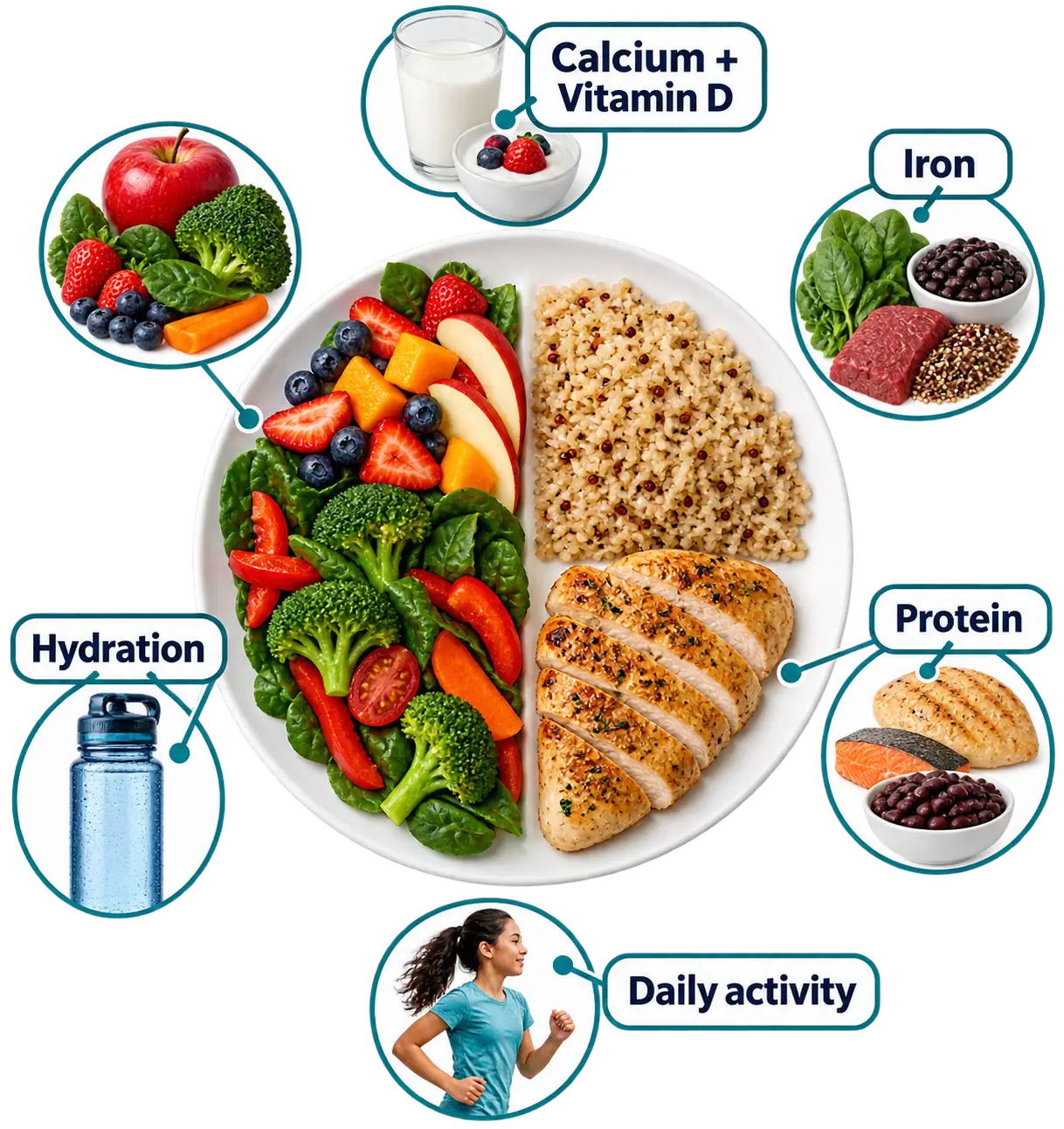
  • Common deficiencies: iron (especially menstruating teens), calcium, vitamin D.
  • Promote physical activity >60 minutes/day.
alt_text
//////Caption: Nutritional priorities during adolescence
Illustration note: Infographic
Illustration note: Balanced plate emphasizing adequate calories, protein, calcium, iron, vitamin D, hydration, and daily physical activity.///////

Safety and high-risk behaviors

Adolescents face the highest risk for injuries due to a combination of independence, peer pressure, and underdeveloped impulse control.

Key risks

  • Motor vehicle accidents (leading cause of teen death).
  • Substance experimentation (alcohol, vaping, marijuana).
  • Sexual risk-taking.
  • Online exploitation and cyberbullying.
  • Violence, firearm exposure, unsafe driving (“texting and driving”).

Prevention

  • Seatbelts always; no texting while driving.
  • Avoid riding with impaired drivers.
  • Substance use counseling; refusal-skills training.
  • Healthy peer networks and supportive adult mentors.
alt_text
//////Caption: Common adolescent safety risks and prevention
Illustration note: Infographic
Illustration note: Include seatbelt use, avoiding texting while driving, substance avoidance, helmet use, cyber safety, firearm safety, and healthy peer choices.///////

Red flags (ages 13–18)

  • No interest in friendships or activities
  • Severe body image concerns
  • Violent behavior or weapon use
  • Risky sexual behavior
  • Substance misuse (vaping, alcohol, pills)
  • Persistent depression, irritability, sleep changes
  • Self-harm, cutting, or suicidal thoughts (emergent action)

Nursing interventions

  • Maintain confidentiality within legal limits; disclose only if safety is at risk.
  • Use open-ended questions (“Tell me about…”) to encourage dialogue.
  • Screen for depression, anxiety, substance use (CRAFFT tool), and bullying.
  • Offer STI screening and education without judgment.
  • Provide resources for mental health, peer support, and crisis hotlines.
  • Encourage balanced routines: sleep, nutrition, academics, exercise, screen time.
  • Reinforce parental support, communication, and appropriate boundaries.

Clinical vignette: A 15-year-old arrives for a sports physical. The nurse observes weight loss and hears the teen express fear of “getting fat.” Upon gentle questioning, she reveals skipping meals to “stay light for track.” The nurse screens for disordered eating, provides education on nutrition and performance, and collaborates with caregivers and a dietitian for early intervention.

Client/Adolescent education

  • Normalize puberty changes and reassure about timelines.
  • Discuss contraception, consent, and STI prevention.
  • Promote digital safety: privacy, cyberbullying awareness.
  • Encourage participation in sports, hobbies, and supportive peer groups.
  • Teach emotional regulation and stress coping strategies.
alt_text
//////Caption: Healthy lifestyle habits for adolescents
Illustration note: Infographic
Illustration note: Summarize healthy sleep, balanced nutrition, regular physical activity, stress management, digital safety, healthy relationships, and routine healthcare visits.///////

Common pitfalls on NCLEX

  • Assuming adolescents think like adults (they have emotional and cognitive immaturity).
  • Ignoring confidentiality; critical for honest disclosure.
  • Overlooking depression masked as irritability or academic decline.
  • Providing overly directive, authoritarian teaching (ineffective for teens).
  • Using technical jargon instead of clear, relatable language.
  • Adolescence = identity, independence, and emotional intensity.

  • Formal operational thinking begins, but impulse control lags behind.

  • Confidential, nonjudgmental communication is essential.

  • Risk behaviors require proactive screening and safety interventions.

  • Supportive adults dramatically improve developmental outcomes.

Sign up for free to take 5 quiz questions on this topic

Previous
Next  | 2.1.5 Adulthood (19–64 years)
All rights reserved ©2016 - 2026 Achievable, Inc.

Adolescence (13–18 years)

Introduction

Adolescence is a bridge: a turbulent, transformative journey from childhood to adult identity. Bodies change rapidly, emotions intensify, thinking becomes more abstract, and peer influence reaches its peak. Nurses play a critical role in supporting safe risk-taking, promoting healthy coping, and identifying early signs of depression, substance use, or unsafe behaviors.

NCLEX focuses on this age group because decisions made during adolescence, from sexual health to injury prevention, often define long-term well-being.

Learning objectives

By the end of this section, you should be able to:

  • Describe the physical, cognitive, emotional, and social milestones of adolescents.
  • Provide anticipatory guidance for puberty, mental health, sexual health, and high-risk behaviors.
  • Identify red flags requiring immediate referral or safety interventions.
  • Apply developmentally appropriate nursing communication strategies.
alt_text
//////Caption: Overview of adolescent development
Illustration type: Infographic Illustration note: Four-part overview showing the major developmental domains: physical, cognitive, psychosocial, and emotional development during adolescence.///////
Definitions
Formal operational thinking
Ability to reason abstractly, think hypothetically, and consider multiple outcomes.
Identity formation
Process of exploring and committing to personal beliefs, roles, and values.
CRAFFT
Screening tool for adolescent substance use.
Emancipated minor
Adolescent legally able to consent for own care (varies by jurisdiction).

Physical development

The physical changes of puberty, including growth spurts and shifts in sleep patterns, require nurses to provide anticipatory guidance on nutrition, sleep hygiene, and body image to support healthy adolescent development.

Puberty and growth

  • Adolescence begins with puberty, triggered by hormonal changes.

  • Girls: breast development → growth spurt → menarche (typically 10–14 years).

  • Boys: testicular enlargement → genital growth → voice changes → increased muscle mass (typically 12–16 years).

  • Peak height velocity:

    • Girls: ~12 years
    • Boys: ~14 years
  • Acne, sweating, and increased oil production are common as sebaceous glands mature.

Sleep

  • Require 8–10 hours nightly, but circadian shifts cause later sleep–wake cycles.
  • Screen time, stress, and academic pressure commonly impair sleep hygiene.

Cognitive development

Understanding that adolescents are in Piaget’s Formal Operational stage (abstract thought) but still possess impulsivity (immature prefrontal cortex) is relevant for NCLEX nurses to provide developmentally appropriate, safety-focused patient education and anticipate high-risk behaviors.

Piaget: Formal operational stage (age 11 to adulthood)

Adolescents acquire the ability to think abstractly and hypothetically. They develop:

  • Logical reasoning (“If… then…” thinking).
  • Ability to debate, analyze fairness, and question rules.
  • Future orientation: planning for career, identity, and long-term goals.
  • Increased metacognition (awareness of one’s own thoughts).

However, cognitive growth does not eliminate impulsivity; the prefrontal cortex (responsible for judgment) continues maturing into the mid-20s.

alt_text
//////Caption: Formal operational thinking
Illustration type: Concept diagram Illustration note: Illustrate abstract thinking, hypothetical reasoning, future planning, and metacognition using simple everyday adolescent examples.///////

Psychosocial development

The psychosocial relevance of this age group is that the stage of Identity vs. Role Confusion requires nurses to provide confidential, nonjudgmental communication and supportive guidance to foster healthy identity formation and navigate high-risk behaviors.

Erikson: Identity vs role confusion

Adolescents struggle to define who they are, experimenting with roles, beliefs, and peer groups. Supportive guidance fosters identity formation; criticism or lack of direction may cause role confusion, insecurity, or rebellion.

What are the stages of Erikson’s psychosocial development model?

(spoiler)

The eight stages of Erik Erikson’s psychosocial development are:

  1. Trust vs. Mistrust (Infancy: birth to 1 year)
  2. Autonomy vs. Shame and Doubt (Early Childhood: 1 to 3 years)
  3. Initiative vs. Guilt (Play Age: 3 to 6 years)
  4. Industry vs. Inferiority (School Age: 6 to 12 years)
  5. Identity vs. Role Confusion (Adolescence: 12 to 18 years)
  6. Intimacy vs. Isolation (Young Adulthood: 18 to 40 years)
  7. Generativity vs. Stagnation (Middle Adulthood: 40 to 65 years)
  8. Ego Integrity vs. Despair (Maturity: 65 years and older)

Emotional and social development

  • Peer relationships take priority over family.
  • Romantic relationships emerge; body image concerns intensify.
  • Mood swings, sensitivity to criticism, and heightened emotional responses are common.
  • Desire for independence grows; conflict with caregivers often increases.

Sexuality and reproductive health

  • Adolescents explore sexual identity, orientation, and values.

  • Nurses must provide nonjudgmental, confidential teaching about:

    • Contraception options (condoms, hormonal methods).
    • STI prevention, screening, and symptoms.
    • Consent and healthy relationships.
    • Menstrual health, irregularities, and hygiene.
  • HPV vaccination recommended through age 26.

Mental health

Adolescence is a high-risk period for anxiety, depression, eating disorders, and substance use.

Warning signs

  • Sudden drop in grades
  • Social withdrawal
  • Sleep changes
  • Risk-taking behaviors
  • Statements of hopelessness
  • Self-harm or suicidal ideation

Nurses must maintain a trauma-informed, supportive approach and ensure safety above all.

Nutrition

  • Increased caloric needs during growth spurts.
  • Encourage balanced meals, limit sugary drinks and fast food.
  • Monitor for eating disorders: anorexia, bulimia, binge-eating.
  • Common deficiencies: iron (especially menstruating teens), calcium, vitamin D.
  • Promote physical activity >60 minutes/day.
alt_text
//////Caption: Nutritional priorities during adolescence
Illustration note: Infographic
Illustration note: Balanced plate emphasizing adequate calories, protein, calcium, iron, vitamin D, hydration, and daily physical activity.///////

Safety and high-risk behaviors

Adolescents face the highest risk for injuries due to a combination of independence, peer pressure, and underdeveloped impulse control.

Key risks

  • Motor vehicle accidents (leading cause of teen death).
  • Substance experimentation (alcohol, vaping, marijuana).
  • Sexual risk-taking.
  • Online exploitation and cyberbullying.
  • Violence, firearm exposure, unsafe driving (“texting and driving”).

Prevention

  • Seatbelts always; no texting while driving.
  • Avoid riding with impaired drivers.
  • Substance use counseling; refusal-skills training.
  • Healthy peer networks and supportive adult mentors.
alt_text
//////Caption: Common adolescent safety risks and prevention
Illustration note: Infographic
Illustration note: Include seatbelt use, avoiding texting while driving, substance avoidance, helmet use, cyber safety, firearm safety, and healthy peer choices.///////

Red flags (ages 13–18)

  • No interest in friendships or activities
  • Severe body image concerns
  • Violent behavior or weapon use
  • Risky sexual behavior
  • Substance misuse (vaping, alcohol, pills)
  • Persistent depression, irritability, sleep changes
  • Self-harm, cutting, or suicidal thoughts (emergent action)

Nursing interventions

  • Maintain confidentiality within legal limits; disclose only if safety is at risk.
  • Use open-ended questions (“Tell me about…”) to encourage dialogue.
  • Screen for depression, anxiety, substance use (CRAFFT tool), and bullying.
  • Offer STI screening and education without judgment.
  • Provide resources for mental health, peer support, and crisis hotlines.
  • Encourage balanced routines: sleep, nutrition, academics, exercise, screen time.
  • Reinforce parental support, communication, and appropriate boundaries.

Clinical vignette: A 15-year-old arrives for a sports physical. The nurse observes weight loss and hears the teen express fear of “getting fat.” Upon gentle questioning, she reveals skipping meals to “stay light for track.” The nurse screens for disordered eating, provides education on nutrition and performance, and collaborates with caregivers and a dietitian for early intervention.

Client/Adolescent education

  • Normalize puberty changes and reassure about timelines.
  • Discuss contraception, consent, and STI prevention.
  • Promote digital safety: privacy, cyberbullying awareness.
  • Encourage participation in sports, hobbies, and supportive peer groups.
  • Teach emotional regulation and stress coping strategies.
alt_text
//////Caption: Healthy lifestyle habits for adolescents
Illustration note: Infographic
Illustration note: Summarize healthy sleep, balanced nutrition, regular physical activity, stress management, digital safety, healthy relationships, and routine healthcare visits.///////

Common pitfalls on NCLEX

  • Assuming adolescents think like adults (they have emotional and cognitive immaturity).
  • Ignoring confidentiality; critical for honest disclosure.
  • Overlooking depression masked as irritability or academic decline.
  • Providing overly directive, authoritarian teaching (ineffective for teens).
  • Using technical jargon instead of clear, relatable language.
Key points
  • Adolescence = identity, independence, and emotional intensity.

  • Formal operational thinking begins, but impulse control lags behind.

  • Confidential, nonjudgmental communication is essential.

  • Risk behaviors require proactive screening and safety interventions.

  • Supportive adults dramatically improve developmental outcomes.

More from Growth and development across the lifespan

  • Infancy (0–1 year)
  • Early childhood (1–5 years)
  • School age (6–12 years)
  • Adulthood (19–64 years)
  • Older adults (65+ years)