


This browser is too old to run Achievable.

Update it, or open this page in a current version of Chrome, Safari, Firefox or Edge. On an iPhone or iPad, update iOS: every browser there runs on the version of Safari that comes with it.

Achievable logoAchievable logo
NPTE-PTA
Sign in
Sign up
Purchase
Textbook
Practice exams
Support
How it works
Resources
Exam catalog
Mountain with a flag at the peak
Textbook
Introduction
1. Cardiovascular system
2. Pulmonary system
3. Neuromuscular system
3.1 Central nervous system
3.2 Anatomy and function of spinal cord
3.3 Peripheral nervous system
3.4 Stroke deficits and recovery
3.5 Traumatic brain injury
3.6 Spinal cord injury
3.7 Neurodegenerative disorders and epilepsy
3.8 Peripheral nervous system conditions
3.9 Other neurological conditions
3.10 Interventions for neurological conditions
3.10.1 Motor learning and PNF
3.10.2 Treatment approaches, outcome measures, and medications
3.11 Vestibular system
4. Pediatrics
5. Musculoskeletal system
6. Other systems
7. Non-systems
Wrapping up
Achievable logoAchievable logo
3.10.1 Motor learning and PNF
Achievable NPTE-PTA
3. Neuromuscular system
3.10. Interventions for neurological conditions
Our NPTE-PTA course is now in "early access" - get 50% off for a limited time.

Motor learning and PNF

9 min read
Font
Discuss
Share
Feedback

Principles of motor learning/motor control

Definitions
Motor learning and motor control
Integrated concepts that encompass both the body’s intrinsic neuromuscular capabilities - relying on intact physiological systems - and external environmental factors that enhance an individual’s ability to execute movements accurately. The central nervous system relies on continuous input to learn and retain the ability to perform tasks.
Motor program
A sequence of movements or motor actions stored in the brain that are activated when performing specific tasks or motor skills.
Motor plan
The cognitive process involved in preparing and executing a movement.
Feedback
Information provided after a task is performed, regarding the accuracy of that performance.
Feedforward
Information provided before a task is performed, about how to prepare for the activity.

Strategies for motor learning

Motor learning strategies are required when attempting to learn a new skill through a combination of mass practice and experience. Specific strategies to assist an individual in learning a new skill are as follows:

  • Practice skill
    • Early practice may use guided movement (the clinician passively moves the limb through the movement so the patient feels it) and mental practice or guided imagery (the patient rehearses the movement mentally without moving)
    • Practice initially uses a blocked schedule, progresses to a variable schedule, and finally progresses to a random schedule as repetitions increase and learning improves
    • Massed practice has fewer and shorter rest intervals between trials, while distributed practice spaces the repetitions with rest intervals between them
  • Provide effective feedback
    • Begin with extrinsic (augmented) feedback from the clinician
    • Fade extrinsic feedback over time so the patient relies more on intrinsic feedback
      • The two types of extrinsic (augmented) feedback are knowledge of results and knowledge of performance
    • Types of feedback schedules
      • Feedback given after completion of every task (early stage of learning)
      • Summary feedback - feedback given after a set number of attempts
      • Fading feedback - decreasing the amount of feedback given to none, as appropriate
      • Bandwidth feedback - feedback only given if the movement is outside the designated range
  • Transfer of skill
    • Skill acquisition leads to the skill being generalized and applied successfully in varied situations and environments
    • This occurs after the patient is deemed proficient in the original skill
Definitions
Blocked practice
Practice of a single motor skill repetitively.
Variable practice
Practice of variations of the same motor skill under changing conditions (e.g., different speeds, distances, or surfaces).
Random practice
Practice of a group of motor skills in no predictable order.
Intrinsic feedback
Internal sensory information used to correct oneself when performing a motor skill.
Extrinsic feedback
External sensory information used to correct the performance of a motor skill by an outside observer.
Knowledge of results
Augmented feedback about the outcome of movement (understanding the goal).
Knowledge of performance
Augmented feedback about the characteristics of the movement performed (understanding the process of attaining a goal).

Stages of motor learning

Motor skill acquisition follows three stages.

  • Cognitive - “What to do” stage
    • Learner develops an understanding of the task and how to perform it
    • Movements are slow and inconsistent, with an increased amount of trial and error
      • Extrinsic feedback only
      • Blocked scheduling
      • Consistent feedback after each trial of movement
  • Associative - “How to do” stage
    • Learner practices and refines movement
    • Learner begins to understand errors of movement
      • 50% extrinsic feedback and 50% intrinsic feedback
      • Continue with blocked scheduling, progressing to variable scheduling as skill acquisition occurs
      • Feedback should progress from summary to faded, or decreasing, over time
  • Autonomous - “How to succeed” stage
    • Skills performed automatically and with minimal conscious error
    • Highly skilled and consistent performance
      • Intrinsic feedback only
      • Random practice schedule
      • If any feedback is given, it is bandwidth feedback

Task-specific training

Definitions
Task-specific training
A treatment approach with the goal of promoting recovery of motor function to baseline after injury due to a central nervous system insult. The involved segments are the target of practice.

Examples of task-specific training

  • Locomotor training
    • Motorized treadmill training with partial body weight support to promote early gait training
    • This activity is tailored to the patient’s current functional status to help them return to baseline
  • Constraint-induced movement therapy (CIMT)
    • Utilized post-stroke to constrain the unaffected upper extremity by use of a protective hand mitt
      • The goal is to constrain the unaffected extremity and force the use of the affected limb
  • Mirror therapy
    • The patient moves the unaffected limb while watching its reflection in a mirror, which creates the illusion of normal movement in the affected limb; it is used to improve movement after stroke

Bridging

Bridging is lifting the pelvis off the mat from hook-lying (knees bent, feet flat), working the hip and trunk extensors. After a stroke, or an incomplete spinal cord injury with working hip extensors, it is an early bed-mobility skill (scooting, placing a bedpan, preparing to roll and sit up) and a pre-gait activity that trains the hip extension and pelvic control needed in stance; after a stroke, the patient is cued to bear weight evenly through the affected leg. It treats weakness and trunk control, not visual or attention deficits such as neglect.

Proprioceptive neuromuscular facilitation (PNF)

Definitions
Proprioceptive neuromuscular facilitation (PNF)
An approach that uses spiral and diagonal movement patterns, which combine motions outside typical synergy patterns, to facilitate mobility, stability, and strength. PNF uses procedures such as quick stretch, resistance, irradiation (overflow), manual contacts, approximation, and traction.

PNF techniques can be broken down into the following categories.

Rhythmic initiation

  • A progression of movement from passive → active-assisted → active → resisted. This technique is used to improve the initiation and coordination of movement.
  • Example:
    • Patient: A person with Parkinson’s disease.
    • Application: The therapist helps initiate movement for rolling from supine to side-lying, gradually allowing the patient to take over the movement and eventually providing resistance for strengthening.

The table below summarizes the remaining PNF techniques using the same pattern: the therapist applies the technique to address a specific movement or stability deficit.

Technique Description Example application
Rhythmic rotation Slow, passive rotational movement around a longitudinal axis to reduce hypertonia and promote relaxation Slowly rotating the trunk of a patient with trunk spasticity before trunk flexion activities
Rhythmic stabilization Isometric contractions of antagonist muscle groups simultaneously to improve joint stability and postural control Applying multidirectional resistance to the shoulders of a patient sitting unsupported
Approximation Gentle joint compression, typically in weight-bearing positions, to stimulate mechanoreceptors and enhance postural stability and muscle activation Compressing the shoulder joints of a patient in quadruped or standing to promote co-contraction
Slow reversals Alternating concentric contractions of agonist and antagonist muscles without relaxation to improve coordination and smooth transitions Alternately resisting knee flexion and extension in a seated patient with knee weakness
Hold-relax Isometric contraction of a muscle group followed by relaxation and passive stretching to improve range of motion Isometric hamstring contraction against resistance followed by passive stretching for hamstring tightness
Contract-relax Isotonic contraction through the available range, followed by relaxation and passive movement into an increased range Resisting hip extension, then relaxing to allow the therapist to stretch into greater hip range of motion
Repeated contractions Repeated quick stretches followed by resisted contractions to enhance the initiation and strength of weak muscles A quick stretch to the anterior deltoid followed by resistance to strengthen shoulder flexion

PNF patterns describe the way in which the joints move to perform specific movements outside of synergy. PNF patterns exist for both the upper and lower extremities. The following are the patterns for the upper extremity:

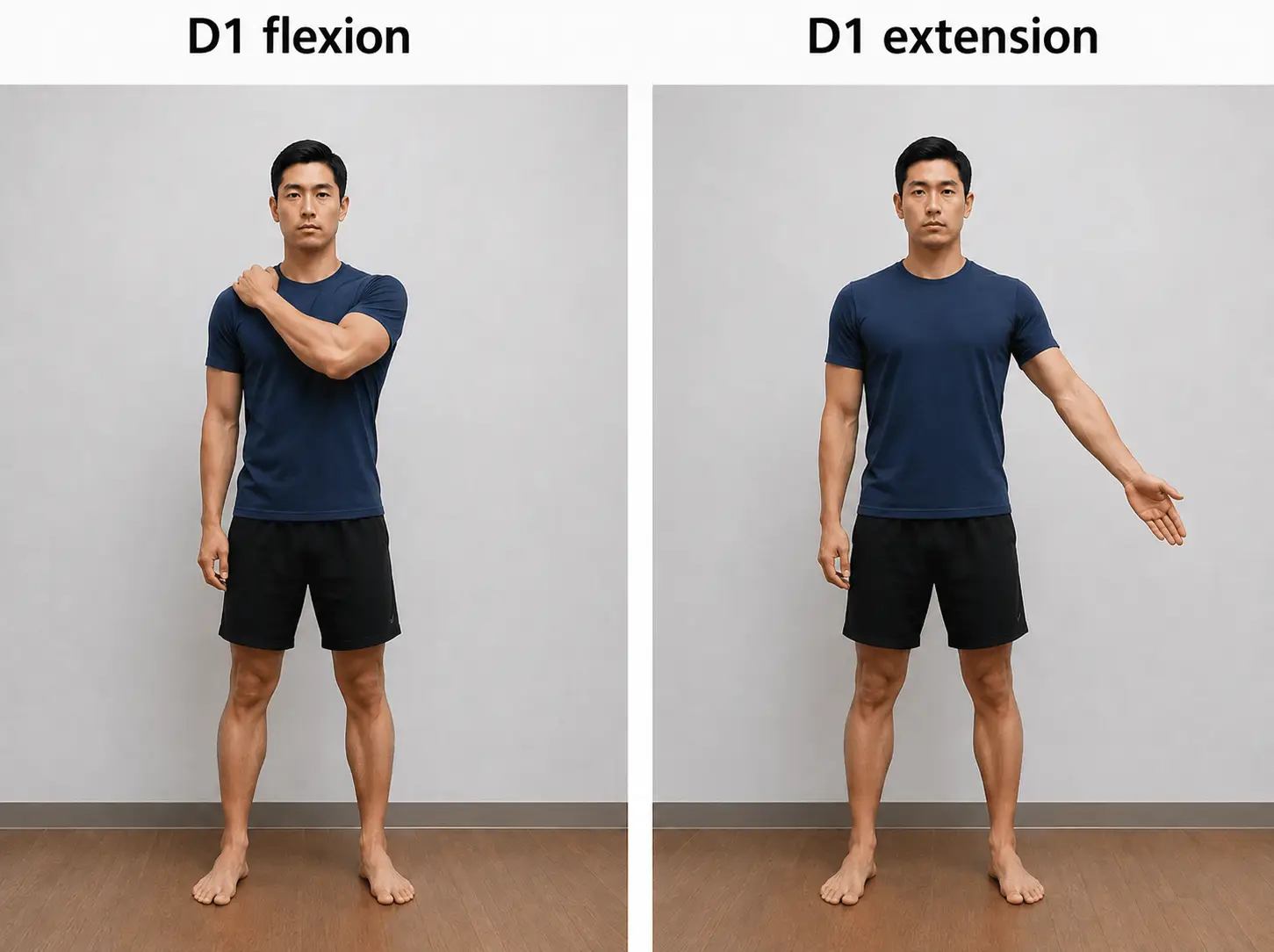
D1 flexion

  • Shoulder: flexion, adduction, external rotation
  • Forearm: supination
  • Wrist: radial deviation, flexion
  • Finger: flexion

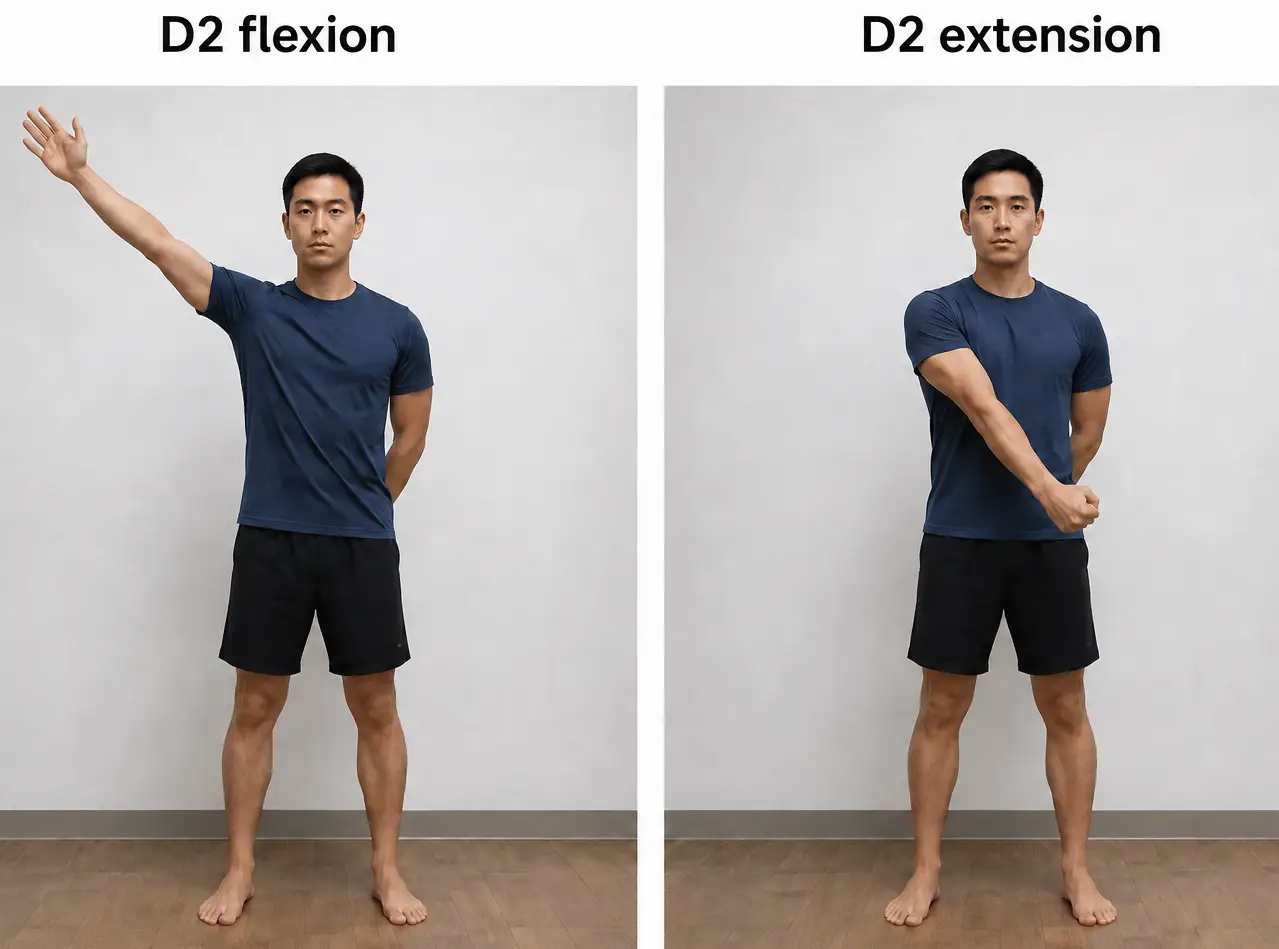
D2 flexion

  • Shoulder: flexion, abduction, external rotation
  • Forearm: supination
  • Wrist: radial deviation, extension
  • Finger: extension

D1 extension

  • Shoulder: extension, abduction, internal rotation
  • Forearm: pronation
  • Wrist: ulnar deviation, extension
  • Finger: extension

D2 extension

  • Shoulder: extension, adduction, internal rotation
  • Forearm: pronation
  • Wrist: ulnar deviation, flexion
  • Finger: flexion
Side-by-side photos demonstrating D1 shoulder flexion and D1 shoulder extension.
D1 flexion and extension
Achievable
Side-by-side photos demonstrating D2 shoulder flexion and D2 shoulder extension.
D2 flexion and extension
Achievable

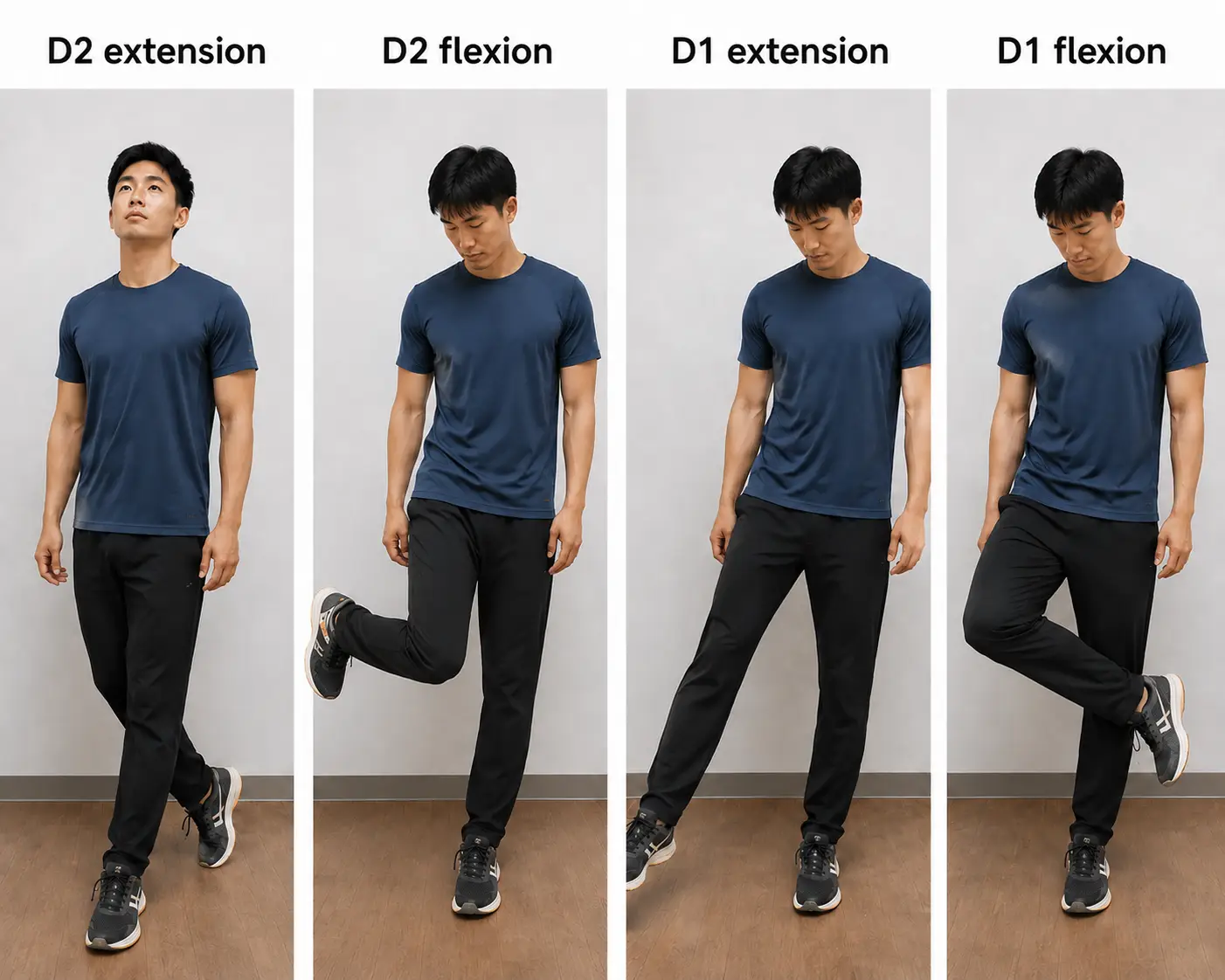
The following are the patterns for the lower extremity:

D1 flexion

  • Hip: flexion, adduction, and external rotation
  • Ankle: dorsiflexion and inversion
  • Toe: extension

D2 flexion

  • Hip: flexion, abduction, and internal rotation
  • Ankle: dorsiflexion and eversion
  • Toe: extension

D1 extension

  • Hip: extension, abduction, and internal rotation
  • Ankle: plantar flexion, eversion
  • Toe: flexion

D2 extension

  • Hip: extension, adduction, external rotation
  • Ankle: plantar flexion, inversion
  • Toe: flexion
Four-panel demonstration of D2 extension, D2 flexion, D1 extension, and D1 flexion leg positions.
Lower extremity PNF
Achievable

Exam tip: signs to stop an intervention

The PTA carries out the established plan of care but must recognize when a patient’s response means an activity should stop rather than continue. Discontinue the activity and notify the supervising PT if you see:

  • An abnormal vital sign response (e.g., excessive change in heart rate or blood pressure, oxygen desaturation)
  • Signs of autonomic dysreflexia (pounding headache, flushing, sudden hypertension) in a patient with a spinal cord injury - an emergency: first sit the patient upright with the legs lowered, loosen tight clothing, and call for help
  • Orthostatic symptoms (lightheadedness, pallor, diaphoresis) during body-weight-supported treadmill training
  • Excessive fatigue, pain, or loss of postural control beyond what the activity is meant to challenge

Motor learning/control basics

  • Motor control relies on intact neuromuscular systems + environmental input; CNS needs continuous input to learn/retain skills
  • Motor program = stored movement sequence; motor plan = cognitive prep for movement
  • Feedback = info after task performance; feedforward = info given before task to prepare

Strategies for motor learning

  • Practice progresses: blocked → variable → random schedule as learning improves
  • Feedback progresses: extrinsic (augmented: knowledge of results/performance) → intrinsic; schedule progresses from every-trial → summary → fading → bandwidth (only outside designated range)
  • Skill transfer: generalizing a mastered skill to new situations once proficiency achieved

Stages of motor learning

  • Cognitive (“what to do”): slow, inconsistent, trial-and-error; extrinsic feedback only; blocked practice; feedback after every trial
  • Associative (“how to do”): refining movement, recognizing errors; 50/50 extrinsic/intrinsic feedback; blocked→variable practice; feedback summary→fading
  • Autonomous (“how to succeed”): automatic, consistent performance; intrinsic feedback only; random practice; bandwidth feedback only if given

Task-specific training

  • Goal: restore motor function to baseline after CNS injury via targeted practice of involved segments
  • Examples: locomotor training (body-weight-supported treadmill, gait-focused); CIMT (constrains unaffected UE post-stroke to force affected limb use)
  • Bridging: hip/trunk extensor strengthening, pre-gait and bed-mobility skill, promotes symmetric weight-bearing post-stroke; addresses weakness/trunk control, not perceptual deficits like neglect

PNF overview and techniques

  • Uses diagonal/spiral movement patterns outside typical synergies; key procedures: quick stretch, resistance, irradiation, manual contacts, approximation, traction
  • Key techniques (therapist-applied, purpose-specific):
    • Rhythmic initiation: passive→active→resisted progression (e.g., Parkinson’s rolling)
    • Rhythmic rotation: reduces hypertonia via slow passive rotation
    • Rhythmic stabilization: isometric co-contraction for postural control
    • Approximation: joint compression to enhance stability/co-contraction
    • Slow reversals: alternating agonist/antagonist contractions for coordination
    • Hold-relax/contract-relax: used to increase ROM via isometric/isotonic contraction + stretch
    • Repeated contractions: quick stretch + resistance to strengthen weak muscles

PNF diagonal patterns (D1/D2, flexion/extension)

  • Upper extremity patterns involve combined shoulder, forearm, wrist, and finger motions (e.g., D1 flexion: shoulder flexion/adduction/ext rotation, forearm supination, wrist radial flexion, finger flexion)
  • Lower extremity patterns involve combined hip, ankle, and toe motions (e.g., D1 flexion: hip flexion/adduction/ext rotation, ankle dorsiflexion/inversion, toe extension)
  • Each pattern (D1/D2 flexion/extension) has a mirror-image extension pattern with opposite joint motions

Exam tip: when to stop an intervention

  • Stop and notify supervising PT for: abnormal vital signs (HR/BP changes, desaturation), autonomic dysreflexia signs (headache, flushing, hypertension) in SCI patients - act first: sit upright, lower the legs, loosen clothing, call for help
  • Also stop for orthostatic symptoms during treadmill training, or excessive fatigue/pain/loss of postural control beyond intended challenge

Sign up for free to take 16 quiz questions on this topic

Previous
Next  | 3.10.2 Treatment approaches, outcome measures, and medications
All rights reserved ©2016 - 2026 Achievable, Inc.

Motor learning and PNF

Principles of motor learning/motor control

Definitions
Motor learning and motor control
Integrated concepts that encompass both the body’s intrinsic neuromuscular capabilities - relying on intact physiological systems - and external environmental factors that enhance an individual’s ability to execute movements accurately. The central nervous system relies on continuous input to learn and retain the ability to perform tasks.
Motor program
A sequence of movements or motor actions stored in the brain that are activated when performing specific tasks or motor skills.
Motor plan
The cognitive process involved in preparing and executing a movement.
Feedback
Information provided after a task is performed, regarding the accuracy of that performance.
Feedforward
Information provided before a task is performed, about how to prepare for the activity.

Strategies for motor learning

Motor learning strategies are required when attempting to learn a new skill through a combination of mass practice and experience. Specific strategies to assist an individual in learning a new skill are as follows:

  • Practice skill
    • Early practice may use guided movement (the clinician passively moves the limb through the movement so the patient feels it) and mental practice or guided imagery (the patient rehearses the movement mentally without moving)
    • Practice initially uses a blocked schedule, progresses to a variable schedule, and finally progresses to a random schedule as repetitions increase and learning improves
    • Massed practice has fewer and shorter rest intervals between trials, while distributed practice spaces the repetitions with rest intervals between them
  • Provide effective feedback
    • Begin with extrinsic (augmented) feedback from the clinician
    • Fade extrinsic feedback over time so the patient relies more on intrinsic feedback
      • The two types of extrinsic (augmented) feedback are knowledge of results and knowledge of performance
    • Types of feedback schedules
      • Feedback given after completion of every task (early stage of learning)
      • Summary feedback - feedback given after a set number of attempts
      • Fading feedback - decreasing the amount of feedback given to none, as appropriate
      • Bandwidth feedback - feedback only given if the movement is outside the designated range
  • Transfer of skill
    • Skill acquisition leads to the skill being generalized and applied successfully in varied situations and environments
    • This occurs after the patient is deemed proficient in the original skill
Definitions
Blocked practice
Practice of a single motor skill repetitively.
Variable practice
Practice of variations of the same motor skill under changing conditions (e.g., different speeds, distances, or surfaces).
Random practice
Practice of a group of motor skills in no predictable order.
Intrinsic feedback
Internal sensory information used to correct oneself when performing a motor skill.
Extrinsic feedback
External sensory information used to correct the performance of a motor skill by an outside observer.
Knowledge of results
Augmented feedback about the outcome of movement (understanding the goal).
Knowledge of performance
Augmented feedback about the characteristics of the movement performed (understanding the process of attaining a goal).

Stages of motor learning

Motor skill acquisition follows three stages.

  • Cognitive - “What to do” stage
    • Learner develops an understanding of the task and how to perform it
    • Movements are slow and inconsistent, with an increased amount of trial and error
      • Extrinsic feedback only
      • Blocked scheduling
      • Consistent feedback after each trial of movement
  • Associative - “How to do” stage
    • Learner practices and refines movement
    • Learner begins to understand errors of movement
      • 50% extrinsic feedback and 50% intrinsic feedback
      • Continue with blocked scheduling, progressing to variable scheduling as skill acquisition occurs
      • Feedback should progress from summary to faded, or decreasing, over time
  • Autonomous - “How to succeed” stage
    • Skills performed automatically and with minimal conscious error
    • Highly skilled and consistent performance
      • Intrinsic feedback only
      • Random practice schedule
      • If any feedback is given, it is bandwidth feedback

Task-specific training

Definitions
Task-specific training
A treatment approach with the goal of promoting recovery of motor function to baseline after injury due to a central nervous system insult. The involved segments are the target of practice.

Examples of task-specific training

  • Locomotor training
    • Motorized treadmill training with partial body weight support to promote early gait training
    • This activity is tailored to the patient’s current functional status to help them return to baseline
  • Constraint-induced movement therapy (CIMT)
    • Utilized post-stroke to constrain the unaffected upper extremity by use of a protective hand mitt
      • The goal is to constrain the unaffected extremity and force the use of the affected limb
  • Mirror therapy
    • The patient moves the unaffected limb while watching its reflection in a mirror, which creates the illusion of normal movement in the affected limb; it is used to improve movement after stroke

Bridging

Bridging is lifting the pelvis off the mat from hook-lying (knees bent, feet flat), working the hip and trunk extensors. After a stroke, or an incomplete spinal cord injury with working hip extensors, it is an early bed-mobility skill (scooting, placing a bedpan, preparing to roll and sit up) and a pre-gait activity that trains the hip extension and pelvic control needed in stance; after a stroke, the patient is cued to bear weight evenly through the affected leg. It treats weakness and trunk control, not visual or attention deficits such as neglect.

Proprioceptive neuromuscular facilitation (PNF)

Definitions
Proprioceptive neuromuscular facilitation (PNF)
An approach that uses spiral and diagonal movement patterns, which combine motions outside typical synergy patterns, to facilitate mobility, stability, and strength. PNF uses procedures such as quick stretch, resistance, irradiation (overflow), manual contacts, approximation, and traction.

PNF techniques can be broken down into the following categories.

Rhythmic initiation

  • A progression of movement from passive → active-assisted → active → resisted. This technique is used to improve the initiation and coordination of movement.
  • Example:
    • Patient: A person with Parkinson’s disease.
    • Application: The therapist helps initiate movement for rolling from supine to side-lying, gradually allowing the patient to take over the movement and eventually providing resistance for strengthening.

The table below summarizes the remaining PNF techniques using the same pattern: the therapist applies the technique to address a specific movement or stability deficit.

Technique Description Example application
Rhythmic rotation Slow, passive rotational movement around a longitudinal axis to reduce hypertonia and promote relaxation Slowly rotating the trunk of a patient with trunk spasticity before trunk flexion activities
Rhythmic stabilization Isometric contractions of antagonist muscle groups simultaneously to improve joint stability and postural control Applying multidirectional resistance to the shoulders of a patient sitting unsupported
Approximation Gentle joint compression, typically in weight-bearing positions, to stimulate mechanoreceptors and enhance postural stability and muscle activation Compressing the shoulder joints of a patient in quadruped or standing to promote co-contraction
Slow reversals Alternating concentric contractions of agonist and antagonist muscles without relaxation to improve coordination and smooth transitions Alternately resisting knee flexion and extension in a seated patient with knee weakness
Hold-relax Isometric contraction of a muscle group followed by relaxation and passive stretching to improve range of motion Isometric hamstring contraction against resistance followed by passive stretching for hamstring tightness
Contract-relax Isotonic contraction through the available range, followed by relaxation and passive movement into an increased range Resisting hip extension, then relaxing to allow the therapist to stretch into greater hip range of motion
Repeated contractions Repeated quick stretches followed by resisted contractions to enhance the initiation and strength of weak muscles A quick stretch to the anterior deltoid followed by resistance to strengthen shoulder flexion

PNF patterns describe the way in which the joints move to perform specific movements outside of synergy. PNF patterns exist for both the upper and lower extremities. The following are the patterns for the upper extremity:

D1 flexion

  • Shoulder: flexion, adduction, external rotation
  • Forearm: supination
  • Wrist: radial deviation, flexion
  • Finger: flexion

D2 flexion

  • Shoulder: flexion, abduction, external rotation
  • Forearm: supination
  • Wrist: radial deviation, extension
  • Finger: extension

D1 extension

  • Shoulder: extension, abduction, internal rotation
  • Forearm: pronation
  • Wrist: ulnar deviation, extension
  • Finger: extension

D2 extension

  • Shoulder: extension, adduction, internal rotation
  • Forearm: pronation
  • Wrist: ulnar deviation, flexion
  • Finger: flexion

The following are the patterns for the lower extremity:

D1 flexion

  • Hip: flexion, adduction, and external rotation
  • Ankle: dorsiflexion and inversion
  • Toe: extension

D2 flexion

  • Hip: flexion, abduction, and internal rotation
  • Ankle: dorsiflexion and eversion
  • Toe: extension

D1 extension

  • Hip: extension, abduction, and internal rotation
  • Ankle: plantar flexion, eversion
  • Toe: flexion

D2 extension

  • Hip: extension, adduction, external rotation
  • Ankle: plantar flexion, inversion
  • Toe: flexion

Exam tip: signs to stop an intervention

The PTA carries out the established plan of care but must recognize when a patient’s response means an activity should stop rather than continue. Discontinue the activity and notify the supervising PT if you see:

  • An abnormal vital sign response (e.g., excessive change in heart rate or blood pressure, oxygen desaturation)
  • Signs of autonomic dysreflexia (pounding headache, flushing, sudden hypertension) in a patient with a spinal cord injury - an emergency: first sit the patient upright with the legs lowered, loosen tight clothing, and call for help
  • Orthostatic symptoms (lightheadedness, pallor, diaphoresis) during body-weight-supported treadmill training
  • Excessive fatigue, pain, or loss of postural control beyond what the activity is meant to challenge
Key points

Motor learning/control basics

  • Motor control relies on intact neuromuscular systems + environmental input; CNS needs continuous input to learn/retain skills
  • Motor program = stored movement sequence; motor plan = cognitive prep for movement
  • Feedback = info after task performance; feedforward = info given before task to prepare

Strategies for motor learning

  • Practice progresses: blocked → variable → random schedule as learning improves
  • Feedback progresses: extrinsic (augmented: knowledge of results/performance) → intrinsic; schedule progresses from every-trial → summary → fading → bandwidth (only outside designated range)
  • Skill transfer: generalizing a mastered skill to new situations once proficiency achieved

Stages of motor learning

  • Cognitive (“what to do”): slow, inconsistent, trial-and-error; extrinsic feedback only; blocked practice; feedback after every trial
  • Associative (“how to do”): refining movement, recognizing errors; 50/50 extrinsic/intrinsic feedback; blocked→variable practice; feedback summary→fading
  • Autonomous (“how to succeed”): automatic, consistent performance; intrinsic feedback only; random practice; bandwidth feedback only if given

Task-specific training

  • Goal: restore motor function to baseline after CNS injury via targeted practice of involved segments
  • Examples: locomotor training (body-weight-supported treadmill, gait-focused); CIMT (constrains unaffected UE post-stroke to force affected limb use)
  • Bridging: hip/trunk extensor strengthening, pre-gait and bed-mobility skill, promotes symmetric weight-bearing post-stroke; addresses weakness/trunk control, not perceptual deficits like neglect

PNF overview and techniques

  • Uses diagonal/spiral movement patterns outside typical synergies; key procedures: quick stretch, resistance, irradiation, manual contacts, approximation, traction
  • Key techniques (therapist-applied, purpose-specific):
    • Rhythmic initiation: passive→active→resisted progression (e.g., Parkinson’s rolling)
    • Rhythmic rotation: reduces hypertonia via slow passive rotation
    • Rhythmic stabilization: isometric co-contraction for postural control
    • Approximation: joint compression to enhance stability/co-contraction
    • Slow reversals: alternating agonist/antagonist contractions for coordination
    • Hold-relax/contract-relax: used to increase ROM via isometric/isotonic contraction + stretch
    • Repeated contractions: quick stretch + resistance to strengthen weak muscles

PNF diagonal patterns (D1/D2, flexion/extension)

  • Upper extremity patterns involve combined shoulder, forearm, wrist, and finger motions (e.g., D1 flexion: shoulder flexion/adduction/ext rotation, forearm supination, wrist radial flexion, finger flexion)
  • Lower extremity patterns involve combined hip, ankle, and toe motions (e.g., D1 flexion: hip flexion/adduction/ext rotation, ankle dorsiflexion/inversion, toe extension)
  • Each pattern (D1/D2 flexion/extension) has a mirror-image extension pattern with opposite joint motions

Exam tip: when to stop an intervention

  • Stop and notify supervising PT for: abnormal vital signs (HR/BP changes, desaturation), autonomic dysreflexia signs (headache, flushing, hypertension) in SCI patients - act first: sit upright, lower the legs, loosen clothing, call for help
  • Also stop for orthostatic symptoms during treadmill training, or excessive fatigue/pain/loss of postural control beyond intended challenge

More from Interventions for neurological conditions

  • Treatment approaches, outcome measures, and medications