



Neurodegenerative disorders and epilepsy
Parkinson’s disease
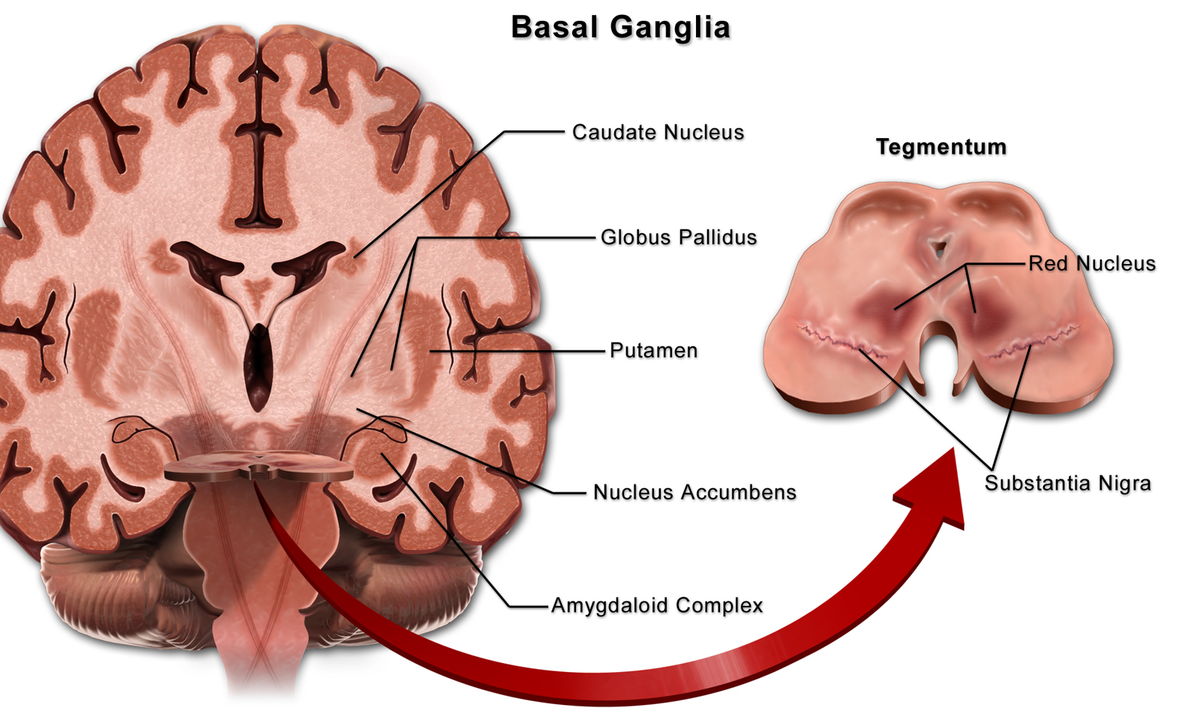
The basal ganglia are a group of structures within the cerebrum working in synchrony to aid in the initiation of voluntary movements and the smoothness of these movements by coordinating muscle activation. The basal ganglia contain dopamine, which assists in movement control. A deficit in dopamine causes difficulty with the initiation of movement and decreased ability to voluntarily activate muscles to perform tasks. Because bradykinesia impairs automatic movement initiation, treatment often starts with external cues and simple, blocked practice, then progresses to more complex, random practice schedules as motor learning improves. Because automatic movements are affected, bed mobility is taught step by step: roll onto the side by dropping the knees over first, bring the feet over the edge of the bed, then push up onto the elbows and into sitting.
Common impairments of Parkinson’s disease
- Resting tremor
- Impaired postural reflexes
- Cogwheel rigidity: rigidity produces a ratchet-like resistance when a joint is moved, whereas spasticity from a corticospinal tract lesion increases muscle tone in proportion to the rate and degree of stretch until resistance suddenly melts away (clasp-knife phenomenon)
- Bradykinesia
- Slowed reaction time
- Masked face
- Dysarthria
- Hypophonia (decreased speech volume)
- A voice amplifier is a portable speech amplification device that makes a soft voice louder without the person having to speak louder
- Contractures in the flexor and adductor muscles
- Postural deficits - rounded shoulders, kyphosis
- Gait deviations: difficulty initiating gait; short, shuffling steps with decreased step length, arm swing, and trunk rotation and a flexed posture at the trunk, hips, and knees; and festinating gait, in which the steps quicken and shorten involuntarily as the trunk leans forward
- Freezing of gait: a sudden, brief inability to take a step, most often when starting, turning, or approaching a doorway or narrow space; external cues help (see cueing strategies for Parkinson’s disease)
- Restrictive lung disease
- Visual impairment
- Dementia in later stages
Standardized tests for Parkinson’s disease
Hoehn & Yahr classification of disability
Stage 1
- Disability: Minimal or absent
- Extent of disability: Unilateral
Stage 2
- Disability: Minimal
- Extent of disability: Midline involvement and bilateral
Stage 3
- Disability: Impaired postural reflexes, unsteadiness when rising from a chair; continues to be independent and work
- Extent of disability: Midline involvement and bilateral
Stage 4
- Disability: Severe disability; still able to walk or stand unassisted but markedly incapacitated
- Extent of disability: Midline involvement and bilateral
Stage 5
- Disability: All symptoms present; confined to wheelchair or bed
- Extent of disability: Midline involvement and bilateral
Retropulsion pull test
Testing procedures
- The subject stands in a comfortable stance with eyes open (have feet shoulder width apart if they assume an unusually wide or narrow stance).
- The examiner stands behind the subject.
- The subject is instructed to do whatever it takes not to fall and is told that the examiner will catch them if they do fall.
- The examiner gives a sudden, brief backward pull to the shoulders with sufficient force to cause the subject to have to regain their balance.
- The subject should not know exactly when the pull is coming.
Interpretation of results - scoring is from 0 to 4
- 0 = recovers independently, may take 1 or 2 steps or an ankle reaction
- 1 = three steps or more backward, but recovers independently
- 2 = retropulsion, needs to be assisted to prevent a fall
- 3 = very unstable, tends to lose balance spontaneously
- 4 = unable to stand without assistance (UPDRS method)
Medication for Parkinson’s disease
- Levodopa
- Mechanism of action: relieves symptoms of Parkinson’s disease by turning levodopa into dopamine (due to a lack of dopamine in the basal ganglia)
- Side effects: mental confusion, hallucinations, postural hypotension, restlessness, abnormal movements
- On and off time: Levodopa should be given 1 hour before initiation of activity for optimal effects; medication will wear off, and symptoms will occur. Schedule therapy sessions during on time, and monitor for orthostatic hypotension when the patient changes positions quickly.
- Anticholinergic medications
- Mechanism of action: decreases tremors by blocking acetylcholine receptors in the basal ganglia
- Side effects: dry mouth, urine retention, constipation
Huntington’s disease
Although genetic (autosomal dominant), symptoms typically do not present until the 30s or 40s.
Symptoms
- Involuntary, irregular dance-like movements (chorea), present at rest and worsened by voluntary activity or stress
- Muscle rigidity
- Poor balance
- Difficulty with swallowing/speaking
- Impaired executive function
- Decline in overall mental health
- Functional decline
Physical therapy considerations with Huntington’s disease
- Balance/gait exercise - using a weighted walker
- Postural stability
- Family education/training as needed
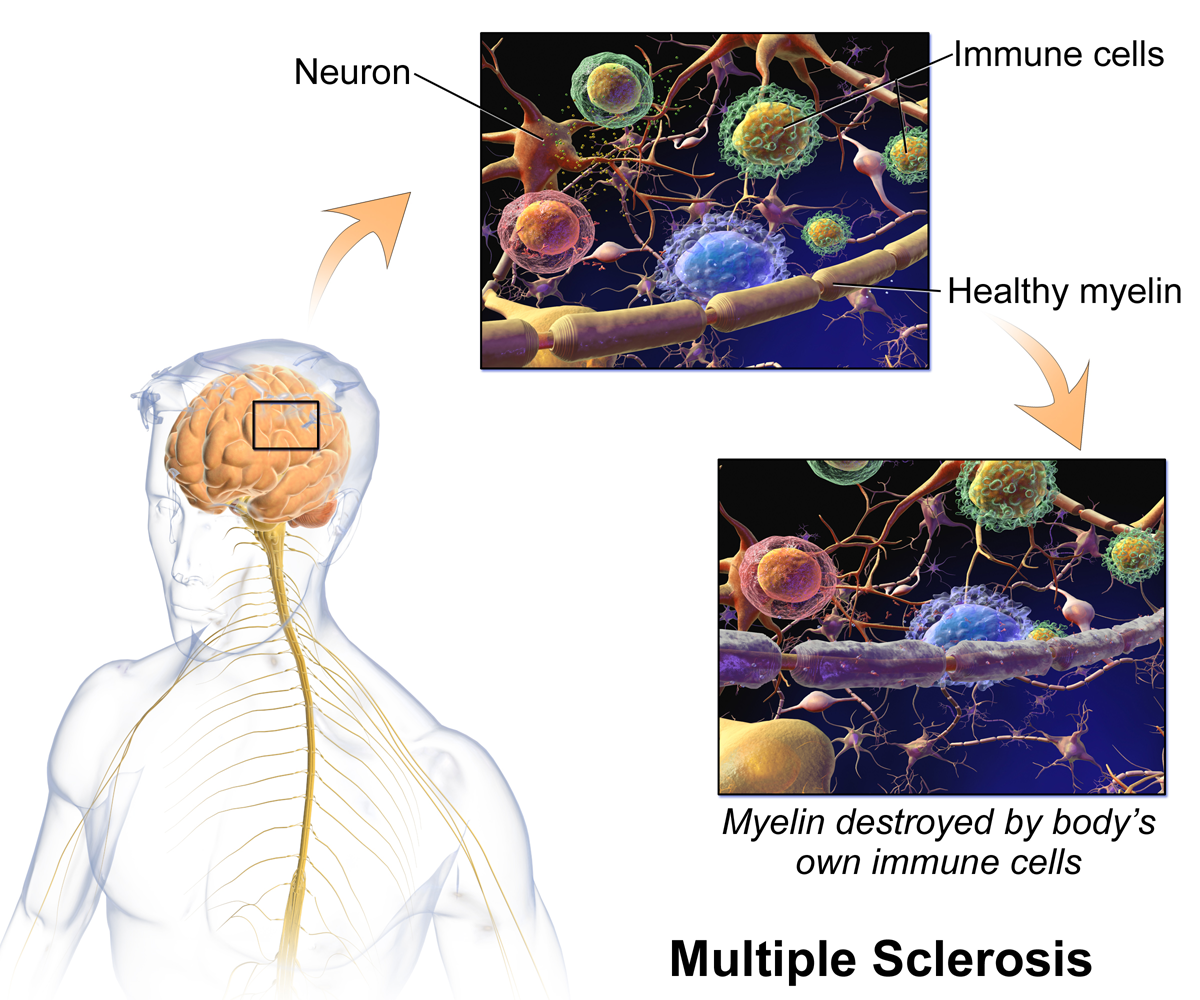
Multiple sclerosis (MS)
Types of multiple sclerosis
- Relapsing-remitting
- Characterized by cycles of disease exacerbation followed by periods of remission; varied levels of disability
- Primary progressive
- Characterized by disease consistently being present without remission; permanent disability results
- Secondary progressive
- Characterized by disease beginning as cyclic relapse/remitting initially, followed by continuous progression of disease without remission; permanent disability results
- Progressive-relapsing
- Characterized by steadily progressive disease from onset with superimposed acute relapses; permanent disability results (older term; now classified as primary progressive MS with active disease)
Symptoms of multiple sclerosis - symptoms vary depending on the location of plaques
- Fatigue (one of the most common symptoms)
- Weakness
- Spasticity
- Hyperreflexia
- Impaired coordination
- Visual deficits
- Ataxia
- Vestibular dysfunction
- Dysarthria
- Paresthesia
- Lhermitte’s sign: electric shock-like symptoms resulting from neck flexion
Special considerations with multiple sclerosis
- Avoidance of precipitating factors:
- Stress
- Trauma
- Postpartum period (relapse risk rises in the first 3 months after delivery)
- Hyperventilation
- Dehydration
- Overheating or excessive fatigue: use moderate-intensity exercise with rest breaks and a cool environment; temporary worsening of symptoms with heat (Uhthoff’s phenomenon) means rest and cool down, and report it to the supervising PT
- Common medications include corticosteroids for relapses and baclofen for spasticity; watch for steroid-related mood changes or insomnia and baclofen-related weakness or sedation during therapy sessions
Amyotrophic lateral sclerosis (ALS)
ALS damages both upper and lower motor neurons, so its presentation combines signs from each:
The following table compares upper and lower motor neuron signs seen in ALS.
| Sign type | Examples |
|---|---|
| Upper motor neuron (UMN) | Spasticity, hyperreflexia, positive Babinski sign |
| Lower motor neuron (LMN) | Flaccidity, hyporeflexia, muscle atrophy, fasciculations |
Cognition is often preserved, but up to about half of patients develop cognitive or behavioral changes, and roughly 5-15% develop frontotemporal dementia. Death typically occurs 2-5 years after the onset of symptoms due to respiratory compromise.
Symptoms
- Asymmetrical weakness
- Facial weakness
- Difficulty with swallowing
- Hyperreflexia
- Spasticity
- Fasciculations, muscle atrophy, hyporeflexia/flaccidity, and cramping (LMN signs)
- Compromised cranial nerve integrity
Stages of ALS
Stage 1: early stage
- Mild weakness or stiffness in the hands, feet, or limbs, with difficulty in fine motor tasks (e.g., writing, buttoning)
Stage 2: middle stage
- Weakness spreads to other parts of the body, causing difficulty walking, speaking, or swallowing, and a need for assistance with daily activities
Stage 3: late stage
- Severe weakness and paralysis, difficulty breathing, and need for a wheelchair and breathing support (noninvasive ventilation, or a ventilator if the patient chooses it)
Stage 4: end stage
- Total paralysis; cognitive or behavioral changes may be present
Medical management is the treatment of symptoms, as there is no cure for ALS, though riluzole may modestly slow disease progression without reversing existing weakness. Motor function progressively diminishes until the individual becomes totally dependent for activities of daily living and mobility; whether to use a ventilator is the patient’s decision. The PT selects assistive devices and adaptive equipment; the PTA trains the patient and family in their use, uses low-to-moderate intensity exercise that avoids fatigue, and reports to the supervising PT any increased weakness or prolonged fatigue after a session, or breathing changes.
Epilepsy
Seizures can also be provoked by acute causes such as electrolyte disorders, drug use or withdrawal, infection, or eclampsia; a provoked seizure does not by itself indicate epilepsy.
Symptoms
- Altered consciousness
- Convulsions
- Sensory phenomena (aura): heightened somatosensory, visual, auditory, or olfactory senses
- Autonomic phenomena: tachycardia, anxiety, diaphoresis
- Cognitive phenomena: inability to communicate, hallucinations
Classification of epilepsy
- Generalized tonic-clonic
- Involves all areas of the brain
- Symptoms include loss of consciousness, rhythmic movements of extremities (convulsions), loss of bladder function, and alterations in breathing
- Lasting 1-5 minutes
- Absence (a generalized seizure type)
- Brief lapse of awareness with blank staring and no convulsions; symptoms are subtle, which increases the difficulty of diagnosing the condition
- Repetitive blinking or small movements may be present
- Lasts for seconds and can occur multiple times per day
- Brief lapse of awareness with blank staring and no convulsions; symptoms are subtle, which increases the difficulty of diagnosing the condition
- Partial or focal
- Only one part of the brain is involved, which causes symptoms to be focal
- Temporal lobe seizures are focal seizures with impaired awareness that often include automatisms, which are coordinated, purposeless, repetitive movements such as chewing or lip smacking
- Status epilepticus
- Prolonged seizures or a series of seizures with only brief moments of recovery
- Lasting 5 minutes or longer
Physical therapy and epilepsy
- Antiepileptic drugs can cause dizziness and ataxia, which increase fall risk during therapy sessions
- To do if a seizure occurs
- Stop the activity immediately
- Time the seizure
- Protect the airway
- Roll to sidelying
- Loosen restrictive clothes
- Remove harmful objects that may be nearby
- Do not restrain limbs
- Call emergency services if the seizure lasts 5 minutes or longer, seizures repeat without recovery, or the patient is injured or does not regain consciousness. Otherwise, monitor until the patient is fully alert, and notify the supervising PT right away.