


Achievable logoAchievable logo
NCLEX
Sign in
Sign up
Purchase
Textbook
Practice exams
Support
How it works
Resources
Exam catalog
Mountain with a flag at the peak
Textbook
Introduction
1. Safe and effective care environment
2. Health promotion and maintenance
2.1 Growth and development across the lifespan
2.2 Antepartum, intrapartum and postpartum
2.3 Newborn care and developmental milestones
2.3.1 Immediate newborn adaptation & stabilization
2.3.2 Comprehensive newborn assessment
2.3.3 Feeding, elimination, and daily care
2.3.4 Newborn safety and special populations
2.3.5 Developmental milestones (birth–12 months)
2.4 Health screenings and preventive care (vision, cancer, immunizations)
2.5 Lifestyle counseling and high-risk behaviors
2.6 Aging, transitions, and end-of-life considerations
3. Psychosocial Integrity
4. Physiological Integrity
Wrapping up
Achievable logoAchievable logo
2.3.4 Newborn safety and special populations
Achievable NCLEX
2. Health promotion and maintenance
2.3. Newborn care and developmental milestones
Our NCLEX course is currently in development and is a work-in-progress.

Newborn safety and special populations

9 min read
Font
Discuss
Share
Feedback

Introduction

A newborn enters the world with breathtaking vulnerability: soft bones, immature immunity, limited temperature control, and a startle reflex that can send tiny limbs flying. Safety is not a single intervention but a network of protective habits that caregivers must learn quickly and confidently.

NCLEX tests newborn safety relentlessly because preventable injuries, such as unsafe sleep, infection, car seat misuse, and neglecting jaundice, remain among the most tragic causes of infant harm. Nurses must be masters of prevention and keen observers of early warning signs in high-risk infants.

Learning objectives

By the end of this section, you should be able to:

  • Teach and implement newborn safe sleep practices.
  • Recognize early signs of jaundice, hypoglycemia, infection, and thermoregulation failure.
  • Provide car seat safety education based on national standards.
  • Identify high-risk newborn populations (IDM, SGA/LGA, HIV-exposed, drug-exposed).
  • Apply targeted interventions for each high-risk group.
  • Interpret NCLEX-style safety scenarios and respond with the correct priority action.

Safe sleep practices (NCLEX heavy)

The American Academy of Pediatrics (AAP) recommends ABC sleep:

A: alone

  • No blankets, pillows, stuffed toys, wedges, bumpers, or parents in bed.

B: back

  • Always on the back for sleep, even for naps.
  • Side and prone positions are unsafe.

C: crib

  • Firm mattress, fitted sheet, approved crib or bassinet.

NO:

  • Couch sleeping
  • Co-sleeping
  • Bed-sharing
  • Car seats for routine sleep

Additional safe sleep guidelines

  • Room-sharing is recommended (same room, separate sleep surface).
  • Avoid overheating (one more layer than the caregiver).
  • Stop swaddling once rolling begins (~2 months).

NCLEX tip:

If a stem mentions “the infant sleeps best on their stomach,” the correct response is always place the baby on their back to sleep.

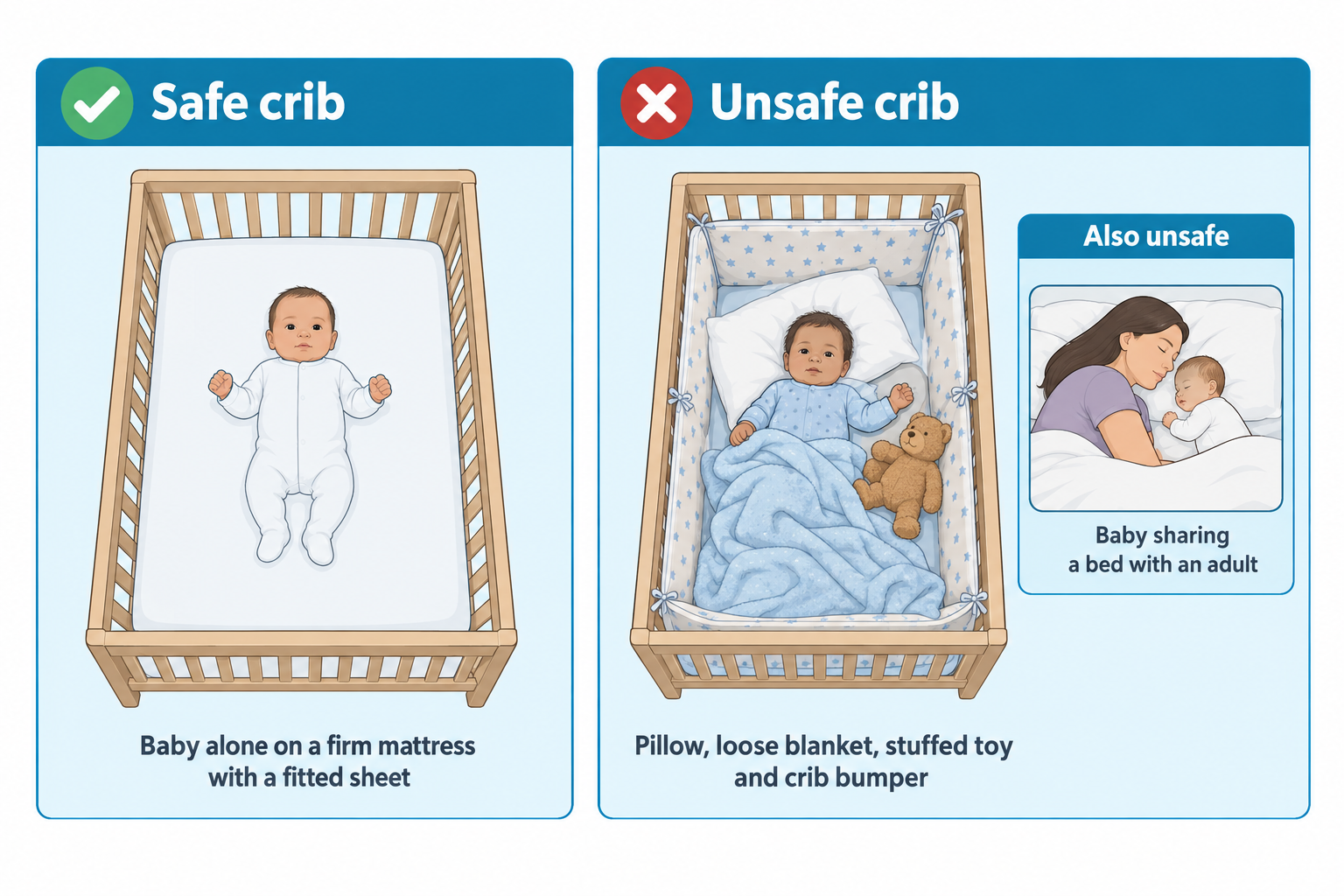
Two side-by-side crib illustrations. Left, labeled 'Safe crib' with a green check: an infant lying alone on their back on a firm mattress with a fitted sheet, no other objects in the crib. Right, labeled 'Unsafe crib' with a red X: an infant lying in a crib with a pillow, a loose blanket, a stuffed teddy bear, and a patterned crib bumper along the rails. A smaller inset panel labeled 'Also unsafe' shows an adult and infant sleeping together in the same bed, illustrating bed-sharing.
Safe sleep environment following the ABCs of safe sleep versus an unsafe setup
Achievable

Environmental & injury prevention

Temperature safety

  • Keep room at 20-22°C (68-72°F)
  • Avoid hot water bottles, heating pads, or electric blankets
  • Dress newborn in one more layer than adults wear

Fall prevention

  • Never leave newborn unattended on beds, couches, or changing tables
  • Keep one hand on infant during diaper changes

Suffocation/hazards

  • No small toys or loose fabric near face
  • Avoid pacifier clips with cords
  • Keep plastic bags, pets, and siblings monitored closely

Smoke exposure

Secondhand and thirdhand smoke increase risk of:

  • SIDS (sudden infant death syndrome, associated with unsafe sleep environments)
  • Respiratory infections
  • Asthma
  • Ear infections

Caregivers who smoke should change clothing before holding infants.

Car seat safety

Car accidents are a leading cause of preventable death in infants after the newborn period, making proper car seat use one of the most important safety interventions a nurse can teach.

Definitions
Rear-facing
Protects head, spine, and neck during collision.
Chest clip
Hard plastic clip securing harness straps at armpit level.

Basic rules

  • Rear-facing only
  • 5-point harness
  • Middle back seat is safest
  • Straps at or below shoulders
  • Chest clip at armpit level

Common errors

  • Puffy coats or blankets under harness
  • Loose straps
  • Forward-facing too early
  • Using expired or damaged seats

Angle matters

The car seat should be reclined per the manufacturer’s built-in angle indicator (typically 30-45 degrees) to keep the airway open.

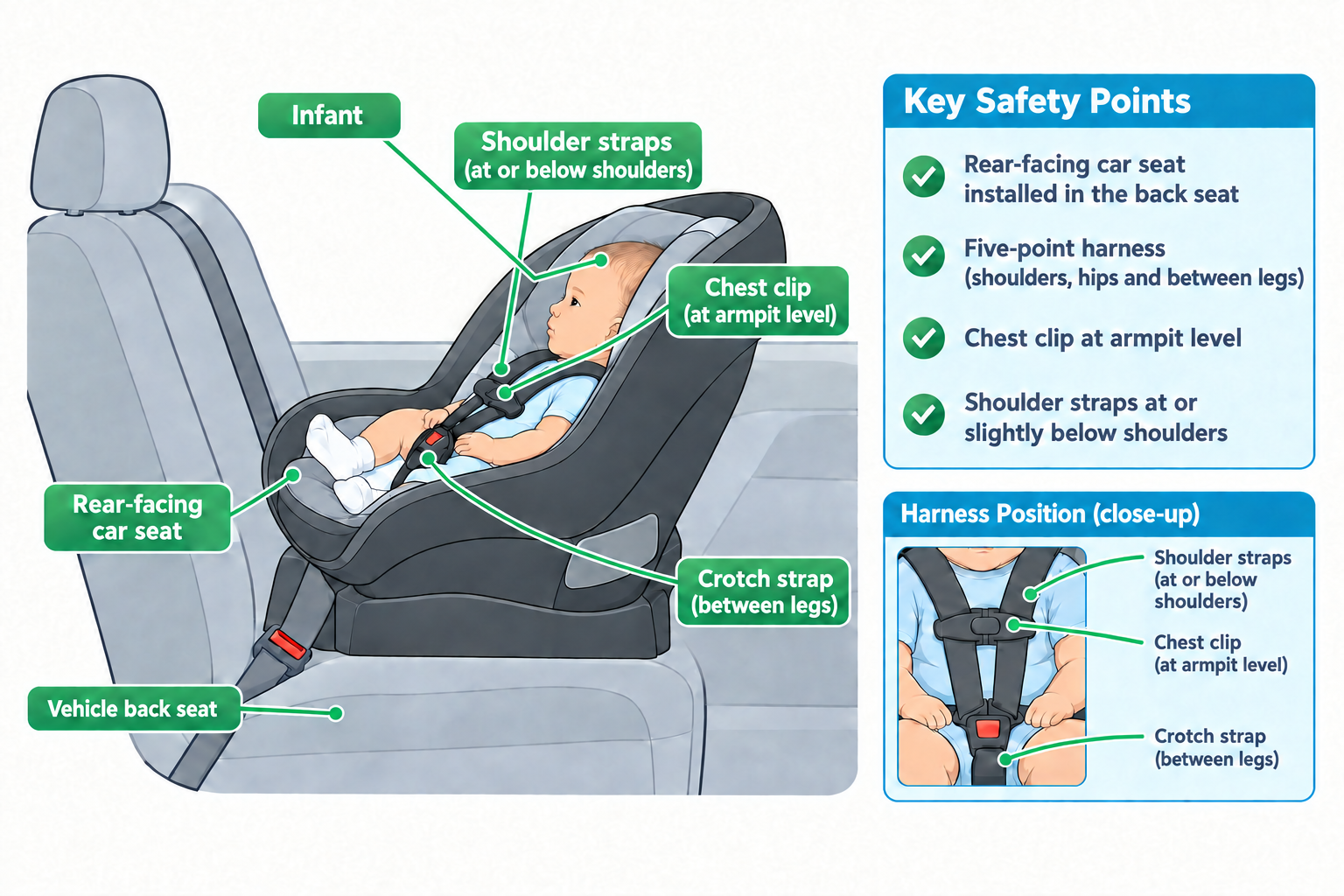
A rear-facing infant car seat installed in a vehicle's back seat, shown from the side with an infant secured inside. Callouts identify the infant, rear-facing car seat, vehicle back seat, shoulder straps positioned at or below the shoulders, a chest clip at armpit level, and a crotch strap between the legs. A side panel lists key safety points and a close-up inset of the harness repeats the shoulder strap, chest clip, and crotch strap positioning from a front view of the child's torso.
Correct rear-facing infant car seat positioning
Achievable

Newborn health safety monitoring

Jaundice & hyperbilirubinemia

Physiologic jaundice

  • Occurs after 24 hours, peaks at 3-5 days.

Pathologic jaundice

  • Occurs within 24 hours or bilirubin rising rapidly.
  • High risk for kernicterus (brain damage).

Warning signs

  • Yellow skin progressing toward abdomen
  • Lethargy or poor feeding
  • High-pitched cry
  • Arching or hypotonia
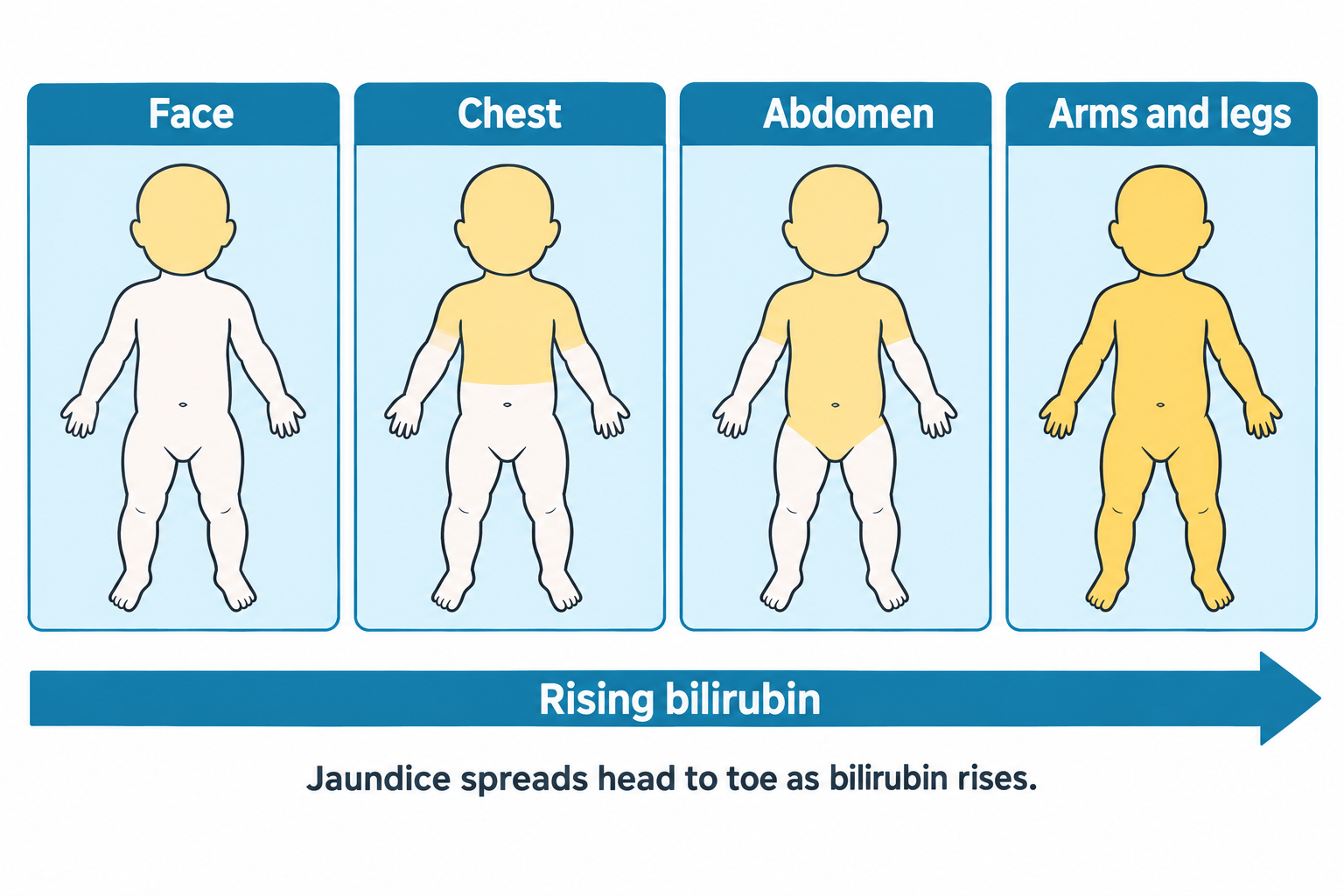
Four side-by-side panels show a newborn's body becoming progressively more yellow to illustrate cephalocaudal jaundice progression: in 'Face,' only the head is yellow-tinted while the body remains pale; in 'Chest,' the head and chest are yellow; in 'Abdomen,' the yellowing extends to include the abdomen; and in 'Arms and legs,' the entire body including the limbs is yellow. A horizontal arrow labeled 'Rising bilirubin' spans below the panels, with a caption noting that jaundice spreads head to toe as bilirubin rises.
Cephalocaudal progression of neonatal jaundice
Achievable

Interventions

  • Increase feeding (q2-3 hours)
  • Phototherapy when ordered
  • Protect eyes during phototherapy
  • Keep infant warm and hydrated
  • Turn off phototherapy lights briefly for breastfeeding
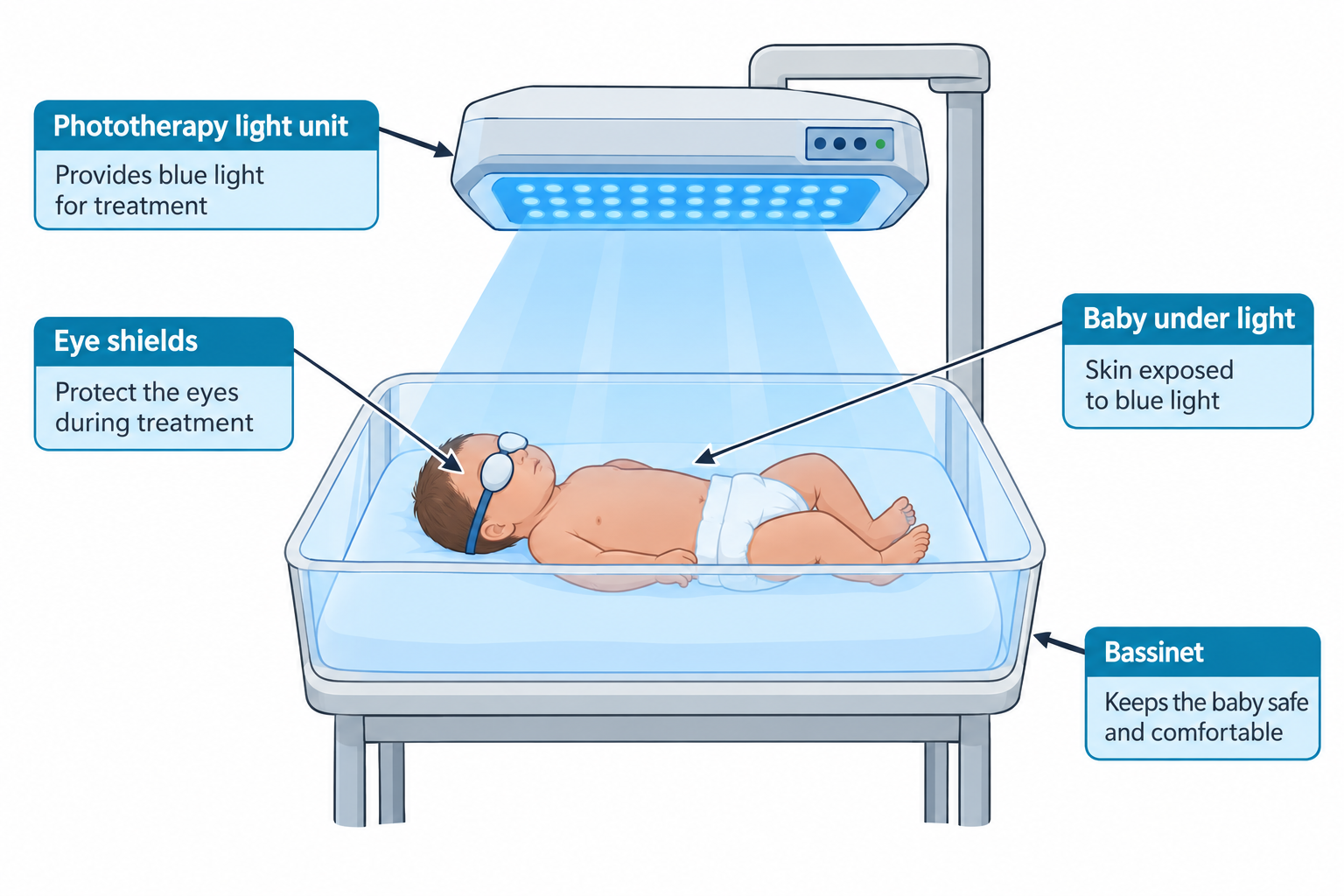
An infant lying on their back in a bassinet wearing only a diaper, with soft eye shields covering the eyes, under a ceiling-mounted phototherapy light unit that projects blue light onto the baby's skin; labeled callouts identify the phototherapy light unit, eye shields, baby under the light with skin exposed, and the bassinet that keeps the baby safe and comfortable.
Phototherapy for neonatal jaundice
Achievable

Hypoglycemia

Defined as serum glucose <40 mg/dL in the first 4 hours of life, or <45 mg/dL after 4 hours.

High-risk groups:

  • Infants of diabetic mothers (IDM)
  • LGA and SGA infants
  • Preterm infants
  • Infants with temperature instability

Signs

  • Jitteriness
  • Hypotonia
  • Cyanosis
  • Poor feeding
  • Seizures

Intervention

  • Immediate feed or glucose gel
  • Recheck glucose
  • IV dextrose if persistent

Infection/sepsis

Newborns cannot mount localized infections; they go systemic fast.

Signs

  • Temperature instability (fever or low temp)
  • Lethargy
  • Poor feeding
  • Respiratory distress
  • Jaundice in first 24 hours

Intervention

  • Notify provider
  • Obtain cultures
  • Begin broad-spectrum antibiotics as ordered

Special populations (NCLEX priority)

Infants of HIV-positive mothers

Transmission prevention

  • Formula feeding is recommended because it eliminates the risk of transmission. Per 2023 CDC/HHS guidance, a mother on ART with sustained viral suppression who chooses to breastfeed can be supported after shared decision-making counseling; breastfeeding should be avoided when viral suppression is not achieved.
  • Give antiretroviral prophylaxis to infant
  • Perform early diagnostic testing
  • Avoid invasive procedures unless necessary

Infants of diabetic mothers (IDM)

Risks

  • Hypoglycemia
  • Macrosomia → birth injuries (shoulder dystocia)
  • Respiratory distress
  • Polycythemia
  • Electrolyte abnormalities

Interventions

  • Early and frequent feeding
  • Monitor glucose at birth and 1 hr, then per protocol
  • Watch for jitteriness, apnea, or poor tone

SGA/LGA infants

SGA (small for gestational age)

  • Hypoglycemia
  • Temperature instability
  • Possible congenital anomalies

LGA (large for gestational age)

  • Birth trauma
  • Hypoglycemia
  • Respiratory distress

Interventions

  • Maintain warmth
  • Monitor glucose
  • Assess feeding tolerance

Drug-exposed newborn (NAS)

These include infants exposed to substances such as opioids, nicotine, and cocaine in utero during pregnancy, primarily through placental transfer. Exposure can continue after birth through breast milk if the mother continues use. Once the maternal substance supply is removed at birth, the newborn experiences withdrawal, noted by:

  • High-pitched cry
  • Tremors
  • Yawning, sneezing
  • Poor feeding
  • Vomiting/diarrhea

Interventions:

  • Low-stimulus environment
  • Swaddling
  • Small frequent feeds
  • Protect from skin breakdown
  • Use NAS scoring tools

NCLEX tip:

Newborns withdrawing from opioids need swaddling and reduced stimulation, not increased stimulation.

Example: Rapidly rising jaundice

A 2-day-old infant is increasingly sleepy, feeding poorly, and has yellow skin extending to the abdomen. The nurse recognizes rapidly rising bilirubin, obtains a serum bilirubin level, ensures frequent feeds, and prepares the infant for phototherapy.

Answer: Early detection prevents kernicterus.

Client/caregiver education

On the NCLEX, the caregiver or family member receiving discharge teaching is also treated as the “client” for teaching-focused items - the correct answer is the one that improves their understanding and technique.

  • Recognize fever (>100.4°F), poor feeding, or lethargy as medical emergencies.
  • Limit visitors and promote good hand hygiene.
  • Signs to report immediately: breathing difficulty, cyanosis, vomiting bile, fever, decreased wet diapers.

Common pitfalls on the NCLEX:

  • Assuming hypothermia is harmless in newborns.
  • Thinking SGA infants are “small but healthy”; they’re high risk.
  • Back to sleep, firm mattress, no soft bedding.
  • Rear-facing car seats with snug harnesses.
  • Jaundice <24 hrs = emergency.
  • Hypoglycemia presents as jitteriness.
  • NAS infants need low-stimulus care.
  • IDMs require early feeding & glucose checks.

Sign up for free to take 5 quiz questions on this topic

Previous
Next  | 2.3.5 Developmental milestones (birth–12 months)
All rights reserved ©2016 - 2026 Achievable, Inc.

Newborn safety and special populations

Introduction

A newborn enters the world with breathtaking vulnerability: soft bones, immature immunity, limited temperature control, and a startle reflex that can send tiny limbs flying. Safety is not a single intervention but a network of protective habits that caregivers must learn quickly and confidently.

NCLEX tests newborn safety relentlessly because preventable injuries, such as unsafe sleep, infection, car seat misuse, and neglecting jaundice, remain among the most tragic causes of infant harm. Nurses must be masters of prevention and keen observers of early warning signs in high-risk infants.

Learning objectives

By the end of this section, you should be able to:

  • Teach and implement newborn safe sleep practices.
  • Recognize early signs of jaundice, hypoglycemia, infection, and thermoregulation failure.
  • Provide car seat safety education based on national standards.
  • Identify high-risk newborn populations (IDM, SGA/LGA, HIV-exposed, drug-exposed).
  • Apply targeted interventions for each high-risk group.
  • Interpret NCLEX-style safety scenarios and respond with the correct priority action.

Safe sleep practices (NCLEX heavy)

The American Academy of Pediatrics (AAP) recommends ABC sleep:

A: alone

  • No blankets, pillows, stuffed toys, wedges, bumpers, or parents in bed.

B: back

  • Always on the back for sleep, even for naps.
  • Side and prone positions are unsafe.

C: crib

  • Firm mattress, fitted sheet, approved crib or bassinet.

NO:

  • Couch sleeping
  • Co-sleeping
  • Bed-sharing
  • Car seats for routine sleep

Additional safe sleep guidelines

  • Room-sharing is recommended (same room, separate sleep surface).
  • Avoid overheating (one more layer than the caregiver).
  • Stop swaddling once rolling begins (~2 months).

NCLEX tip:

If a stem mentions “the infant sleeps best on their stomach,” the correct response is always place the baby on their back to sleep.

Environmental & injury prevention

Temperature safety

  • Keep room at 20-22°C (68-72°F)
  • Avoid hot water bottles, heating pads, or electric blankets
  • Dress newborn in one more layer than adults wear

Fall prevention

  • Never leave newborn unattended on beds, couches, or changing tables
  • Keep one hand on infant during diaper changes

Suffocation/hazards

  • No small toys or loose fabric near face
  • Avoid pacifier clips with cords
  • Keep plastic bags, pets, and siblings monitored closely

Smoke exposure

Secondhand and thirdhand smoke increase risk of:

  • SIDS (sudden infant death syndrome, associated with unsafe sleep environments)
  • Respiratory infections
  • Asthma
  • Ear infections

Caregivers who smoke should change clothing before holding infants.

Car seat safety

Car accidents are a leading cause of preventable death in infants after the newborn period, making proper car seat use one of the most important safety interventions a nurse can teach.

Definitions
Rear-facing
Protects head, spine, and neck during collision.
Chest clip
Hard plastic clip securing harness straps at armpit level.

Basic rules

  • Rear-facing only
  • 5-point harness
  • Middle back seat is safest
  • Straps at or below shoulders
  • Chest clip at armpit level

Common errors

  • Puffy coats or blankets under harness
  • Loose straps
  • Forward-facing too early
  • Using expired or damaged seats

Angle matters

The car seat should be reclined per the manufacturer’s built-in angle indicator (typically 30-45 degrees) to keep the airway open.

Newborn health safety monitoring

Jaundice & hyperbilirubinemia

Physiologic jaundice

  • Occurs after 24 hours, peaks at 3-5 days.

Pathologic jaundice

  • Occurs within 24 hours or bilirubin rising rapidly.
  • High risk for kernicterus (brain damage).

Warning signs

  • Yellow skin progressing toward abdomen
  • Lethargy or poor feeding
  • High-pitched cry
  • Arching or hypotonia

Interventions

  • Increase feeding (q2-3 hours)
  • Phototherapy when ordered
  • Protect eyes during phototherapy
  • Keep infant warm and hydrated
  • Turn off phototherapy lights briefly for breastfeeding

Hypoglycemia

Defined as serum glucose <40 mg/dL in the first 4 hours of life, or <45 mg/dL after 4 hours.

High-risk groups:

  • Infants of diabetic mothers (IDM)
  • LGA and SGA infants
  • Preterm infants
  • Infants with temperature instability

Signs

  • Jitteriness
  • Hypotonia
  • Cyanosis
  • Poor feeding
  • Seizures

Intervention

  • Immediate feed or glucose gel
  • Recheck glucose
  • IV dextrose if persistent

Infection/sepsis

Newborns cannot mount localized infections; they go systemic fast.

Signs

  • Temperature instability (fever or low temp)
  • Lethargy
  • Poor feeding
  • Respiratory distress
  • Jaundice in first 24 hours

Intervention

  • Notify provider
  • Obtain cultures
  • Begin broad-spectrum antibiotics as ordered

Special populations (NCLEX priority)

Infants of HIV-positive mothers

Transmission prevention

  • Formula feeding is recommended because it eliminates the risk of transmission. Per 2023 CDC/HHS guidance, a mother on ART with sustained viral suppression who chooses to breastfeed can be supported after shared decision-making counseling; breastfeeding should be avoided when viral suppression is not achieved.
  • Give antiretroviral prophylaxis to infant
  • Perform early diagnostic testing
  • Avoid invasive procedures unless necessary

Infants of diabetic mothers (IDM)

Risks

  • Hypoglycemia
  • Macrosomia → birth injuries (shoulder dystocia)
  • Respiratory distress
  • Polycythemia
  • Electrolyte abnormalities

Interventions

  • Early and frequent feeding
  • Monitor glucose at birth and 1 hr, then per protocol
  • Watch for jitteriness, apnea, or poor tone

SGA/LGA infants

SGA (small for gestational age)

  • Hypoglycemia
  • Temperature instability
  • Possible congenital anomalies

LGA (large for gestational age)

  • Birth trauma
  • Hypoglycemia
  • Respiratory distress

Interventions

  • Maintain warmth
  • Monitor glucose
  • Assess feeding tolerance

Drug-exposed newborn (NAS)

These include infants exposed to substances such as opioids, nicotine, and cocaine in utero during pregnancy, primarily through placental transfer. Exposure can continue after birth through breast milk if the mother continues use. Once the maternal substance supply is removed at birth, the newborn experiences withdrawal, noted by:

  • High-pitched cry
  • Tremors
  • Yawning, sneezing
  • Poor feeding
  • Vomiting/diarrhea

Interventions:

  • Low-stimulus environment
  • Swaddling
  • Small frequent feeds
  • Protect from skin breakdown
  • Use NAS scoring tools

NCLEX tip:

Newborns withdrawing from opioids need swaddling and reduced stimulation, not increased stimulation.

Example: Rapidly rising jaundice

A 2-day-old infant is increasingly sleepy, feeding poorly, and has yellow skin extending to the abdomen. The nurse recognizes rapidly rising bilirubin, obtains a serum bilirubin level, ensures frequent feeds, and prepares the infant for phototherapy.

Answer: Early detection prevents kernicterus.

Client/caregiver education

On the NCLEX, the caregiver or family member receiving discharge teaching is also treated as the “client” for teaching-focused items - the correct answer is the one that improves their understanding and technique.

  • Recognize fever (>100.4°F), poor feeding, or lethargy as medical emergencies.
  • Limit visitors and promote good hand hygiene.
  • Signs to report immediately: breathing difficulty, cyanosis, vomiting bile, fever, decreased wet diapers.

Common pitfalls on the NCLEX:

  • Assuming hypothermia is harmless in newborns.
  • Thinking SGA infants are “small but healthy”; they’re high risk.
Key points
  • Back to sleep, firm mattress, no soft bedding.
  • Rear-facing car seats with snug harnesses.
  • Jaundice <24 hrs = emergency.
  • Hypoglycemia presents as jitteriness.
  • NAS infants need low-stimulus care.
  • IDMs require early feeding & glucose checks.

More from Newborn care and developmental milestones

  • Immediate newborn adaptation & stabilization
  • Comprehensive newborn assessment
  • Feeding, elimination, and daily care
  • Developmental milestones (birth–12 months)