



Feeding, elimination, and daily care
Introduction
A newborn’s world revolves around feeding, voiding, warmth, and comfort: the foundation of survival and growth. Feeding is more than nutrition; it regulates blood glucose, supports thermoregulation, and strengthens bonding. Elimination gives the earliest clues about hydration, gastrointestinal function, and overall well-being.
NCLEX frequently tests this content because misinterpreting feeding or elimination cues can lead to missed dehydration, failure to thrive, jaundice, or hypoglycemia. Nurses are the bridge between newborn physiology and caregiver skill: teaching what is normal, what is concerning, and what requires urgent intervention. On the NCLEX, the newborn is the client, and the assessment findings you gather - not assumptions about the family or the newborn’s background - should drive your teaching and interventions.
Learning objectives
By the end of this section, you should be able to:
- Describe normal feeding patterns for breastfed and formula-fed newborns.
- Recognize feeding cues and signs of poor feeding or intolerance.
- Explain the LATCH assessment and evidence-based feeding support.
- Identify normal elimination timelines and red flags requiring evaluation.
- Provide newborn daily care education (bathing, cord care, circumcision, skin care, safe handling).
- Apply NCLEX reasoning to feeding or elimination scenarios.
Feeding the newborn
Breastfeeding
Benefits
- Optimal nutrition
- Immune protection (IgA, leukocytes)
- Lower risk of infection, SIDS, NEC
- Supports bonding & thermoregulation
Initiation
- Breastfeeding should begin within the first hour (golden hour).
- Feed on demand, typically every 2-3 hours, 8-12 times per day.
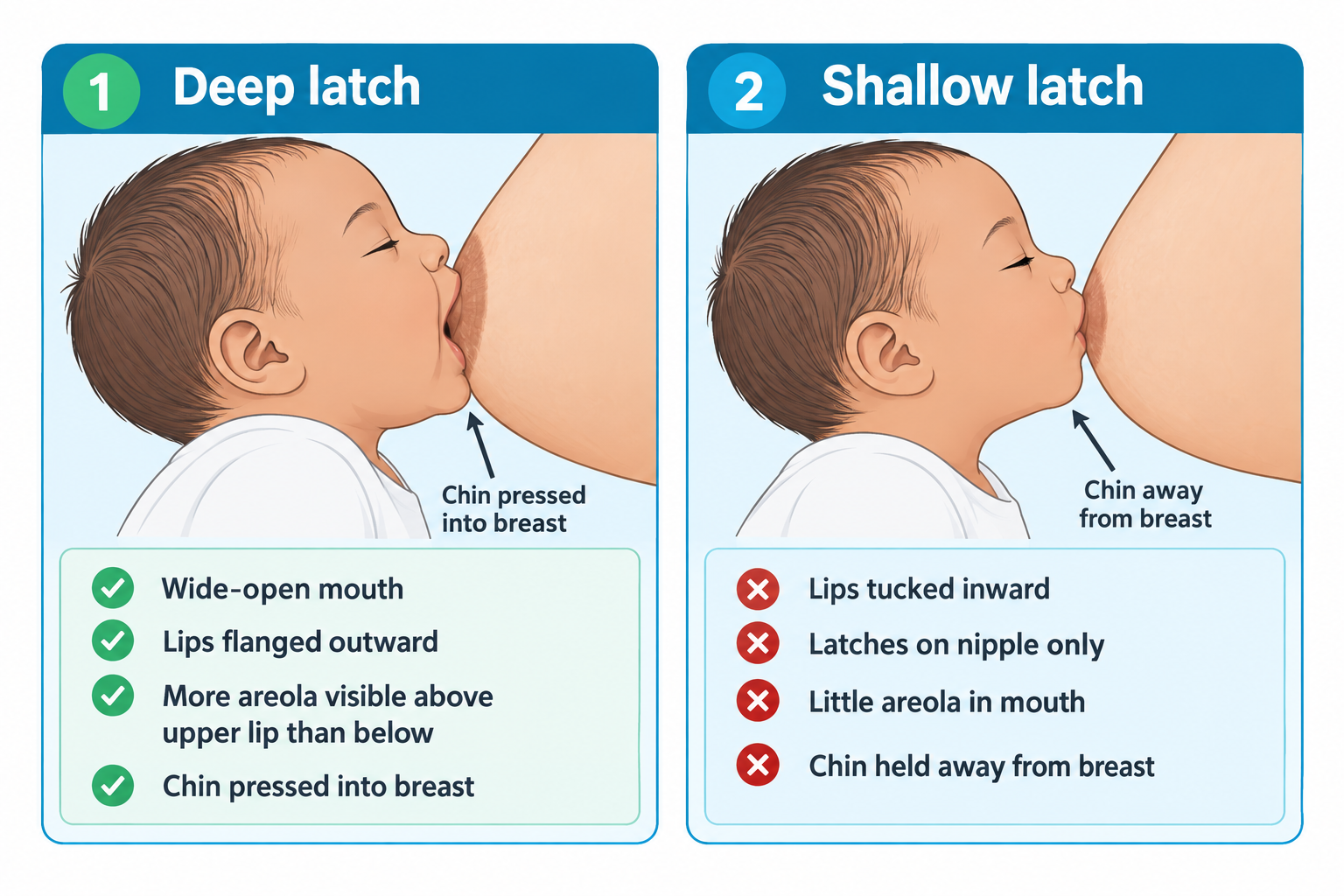
Positioning & latch
A proper latch reduces nipple trauma and ensures milk transfer.
LATCH score
Used to assess breastfeeding effectiveness:
| Letter | Meaning | What it assesses |
| L | Latch | Depth, grasp of breast |
| A | Audible swallowing | Milk transfer |
| T | Type of nipple | Everted, flat, inverted |
| C | Comfort | Breast/nipple pain |
| H | Hold | Positioning & support |
Each of the five components is scored 0-2, for a total of 0-10. A low total score, roughly 7 or below, prompts feeding support rather than serving as a fixed cutoff.
Signs of effective breastfeeding
- Audible swallowing
- Relaxed jaw
- Softening of the breast after feeding
- 6-8 wet diapers/day by the end of the first week
- Steady weight gain after day 5
Challenges & interventions
- Engorgement: warm compress pre-feed, cold compress post-feed
- Sore nipples: ensure deep latch, lanolin, air dry
- Mastitis: continue breastfeeding, apply warm compress, notify provider
Formula feeding
General guidance
- Feed every 2-3 hours in the first days of life (8-12 times/day), transitioning to every 3-4 hours as the infant grows.
- Start with 1-2 oz (30-60 mL) per feed, guided by hunger cues rather than a fixed volume.
- Prepare the formula with strict hygiene.
- Never microwave bottles.
Safe preparation
- Use boiled, cooled water when water safety is uncertain.
- Prepare exactly as directed. Improper dilution leads to hyponatremia or dehydration.
- Discard leftover formula after 1 hour.
- Refrigerated prepared formula is good for 24 hours.
Feeding cues
- Rooting
- Hands to mouth
- Crying (late sign)
Signs of intolerance
- Vomiting
- Diarrhea
- Abdominal distension
- Fussiness after feeds
- Rash possibly suggesting allergy
Newborn elimination patterns
Urine output
Normal:
- First void within 24 hours
- By day 4-6: 6-8 wet diapers/day
- Light yellow, odorless
Abnormal:
- No urine in 24 hours
- Brick-dust crystals beyond day 3
- Strong odor (possible UTI)
- Dehydration: sunken fontanelle, dry mucous membranes, fewer wet diapers
Stool patterns
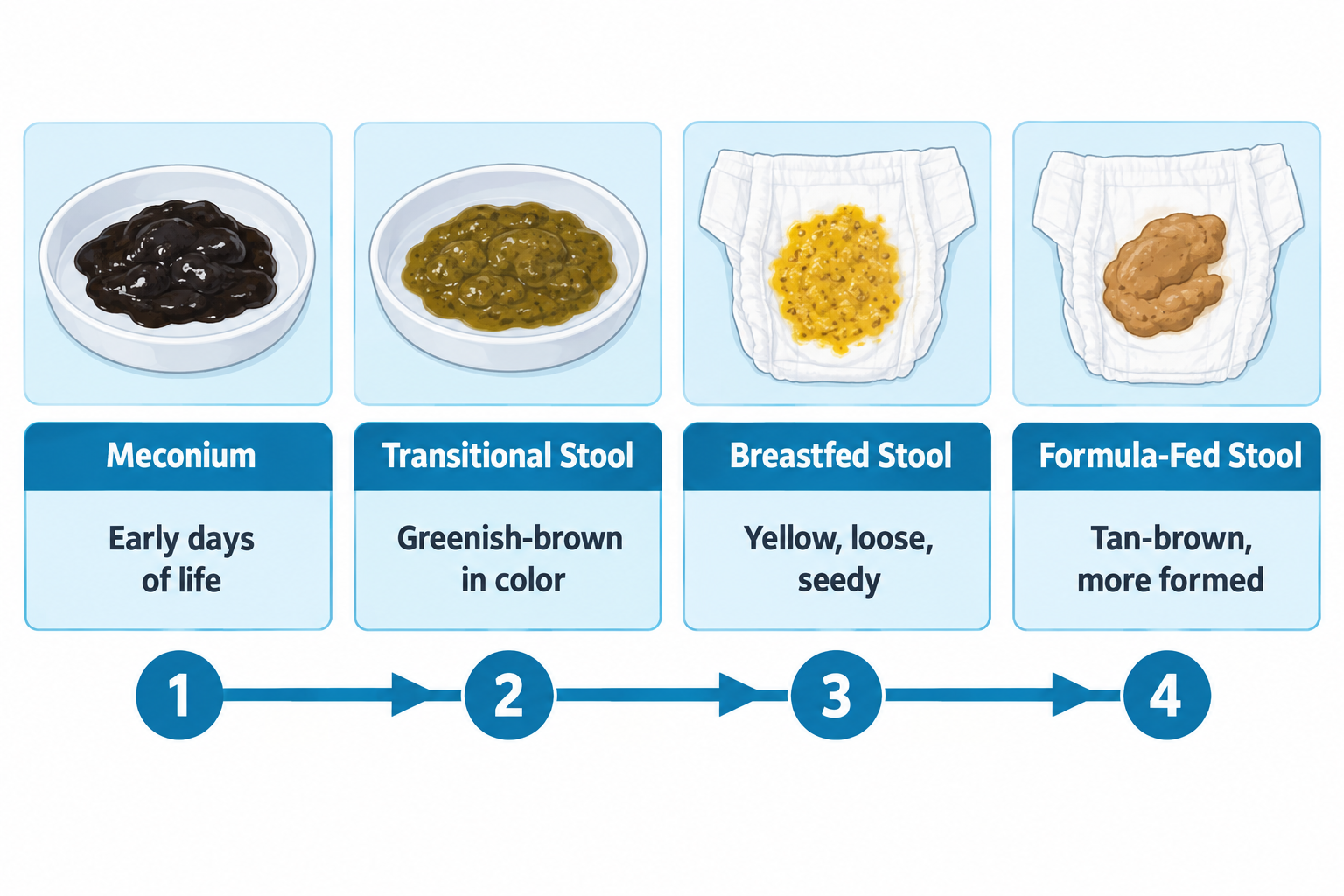
Meconium (0-48 hours)
Dark, tarry, sticky. Failure to pass → red flag.
Transition stools (day 3-4)
Greenish-brown to yellow.
Breastfed stools
- Yellow, loose, seedy
- 3+ stools/day in early weeks
Formula-fed stools
- More formed
- Tan to brown
- Less frequent
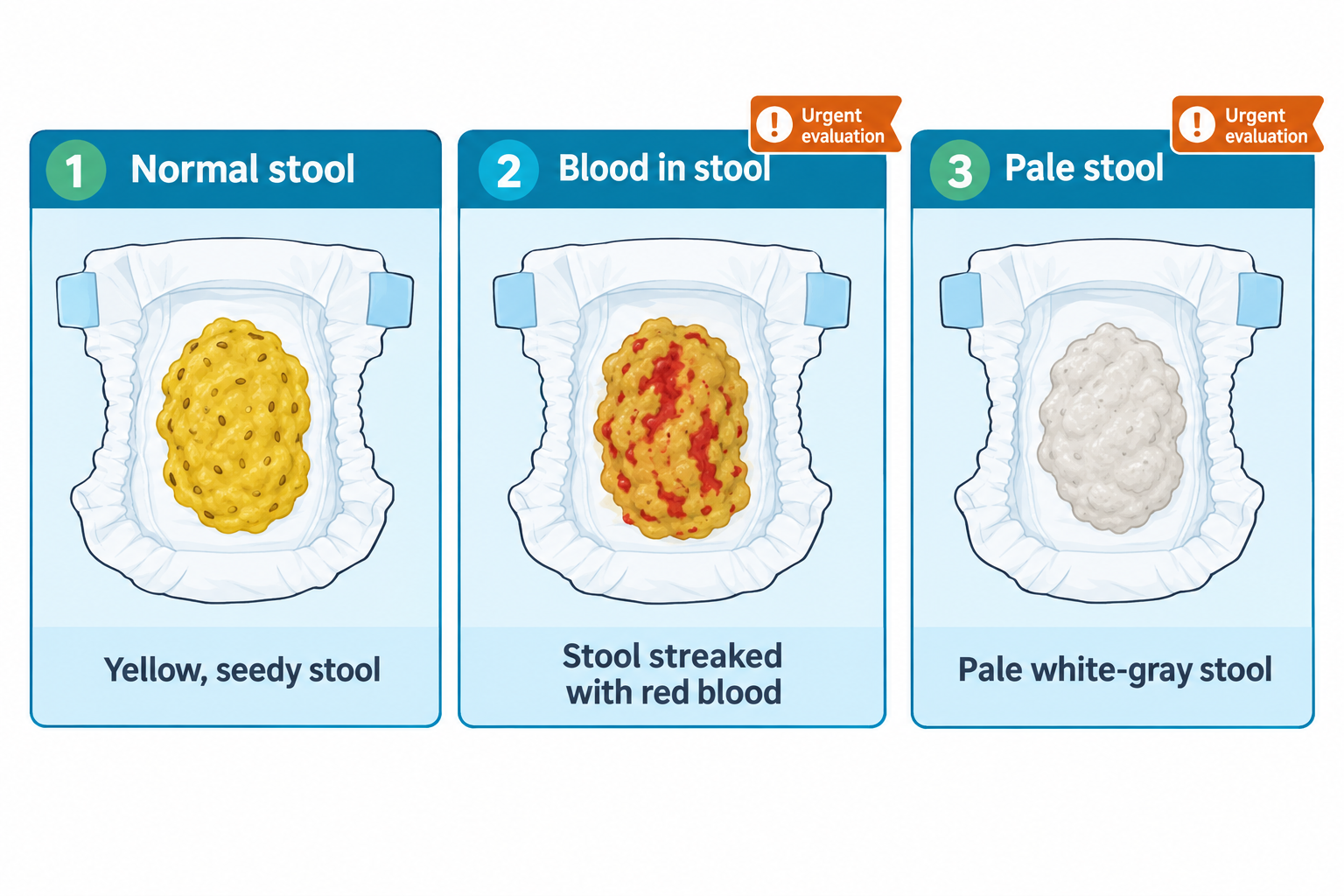
Red flags
- Blood in stool
- White/gray (biliary atresia)
- No stool after 48 hours
- Projectile vomiting → pyloric stenosis
Daily newborn care
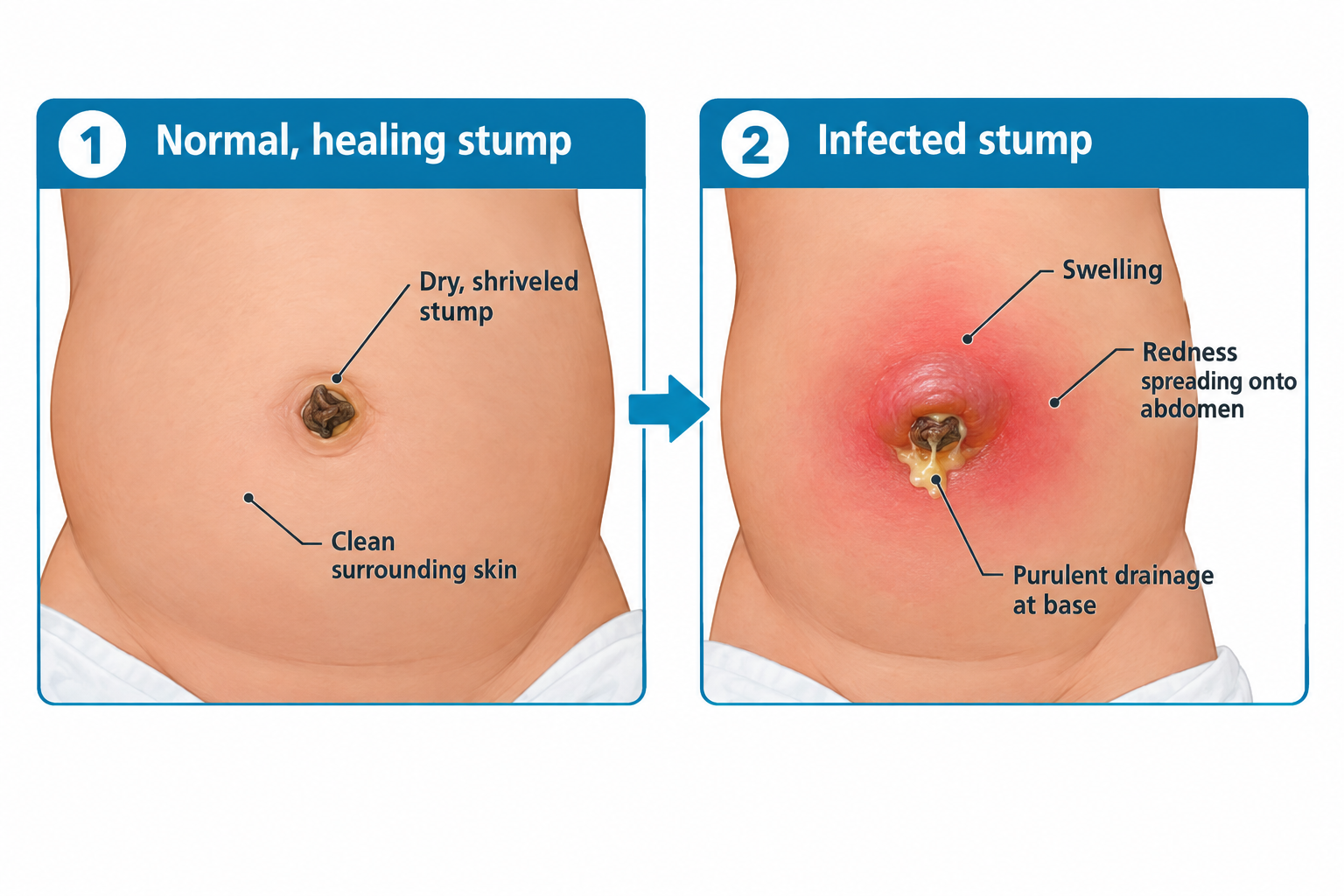
Umbilical cord care
- Keep dry and exposed to air
- Clean only if soiled (water, no alcohol)
- Clamp removed when dry (24-48 hours)
- Falls off within 1-3 weeks (up to 3 weeks is still normal); notify the provider if the cord remains attached beyond 3 weeks.
Warning signs:
- Redness spreading outward
- Foul odor
- Purulent drainage → Indicates omphalitis, a neonatal emergency
Bathing
- Delay the first bath for 24 hours to reduce hypothermia and improve breastfeeding
- Sponge baths until the cord falls off
- Avoid daily baths (drying)
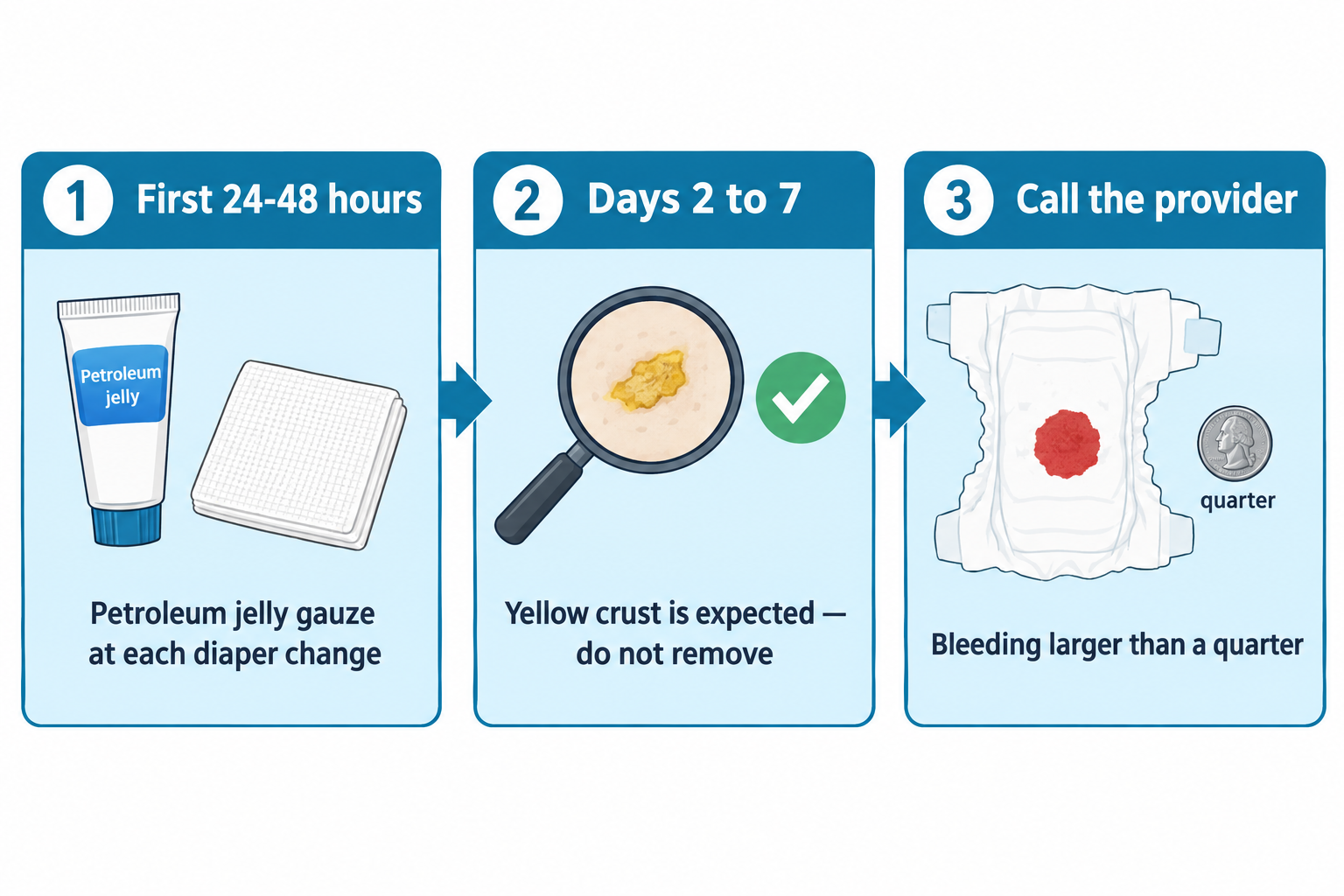
Circumcision care
For circumcised infants:
- Petroleum jelly gauze for the first 24-48 hours
- Expect yellow crust; do not remove
- Watch for bleeding > quarter size
For uncircumcised infants:
- Do not retract the foreskin
- Clean with water only
Skin care
Normal:
- Milia
- Erythema toxicum
- Peeling skin
- Dryness
Avoid:
- Powders
- Scented lotions
- Overbathing
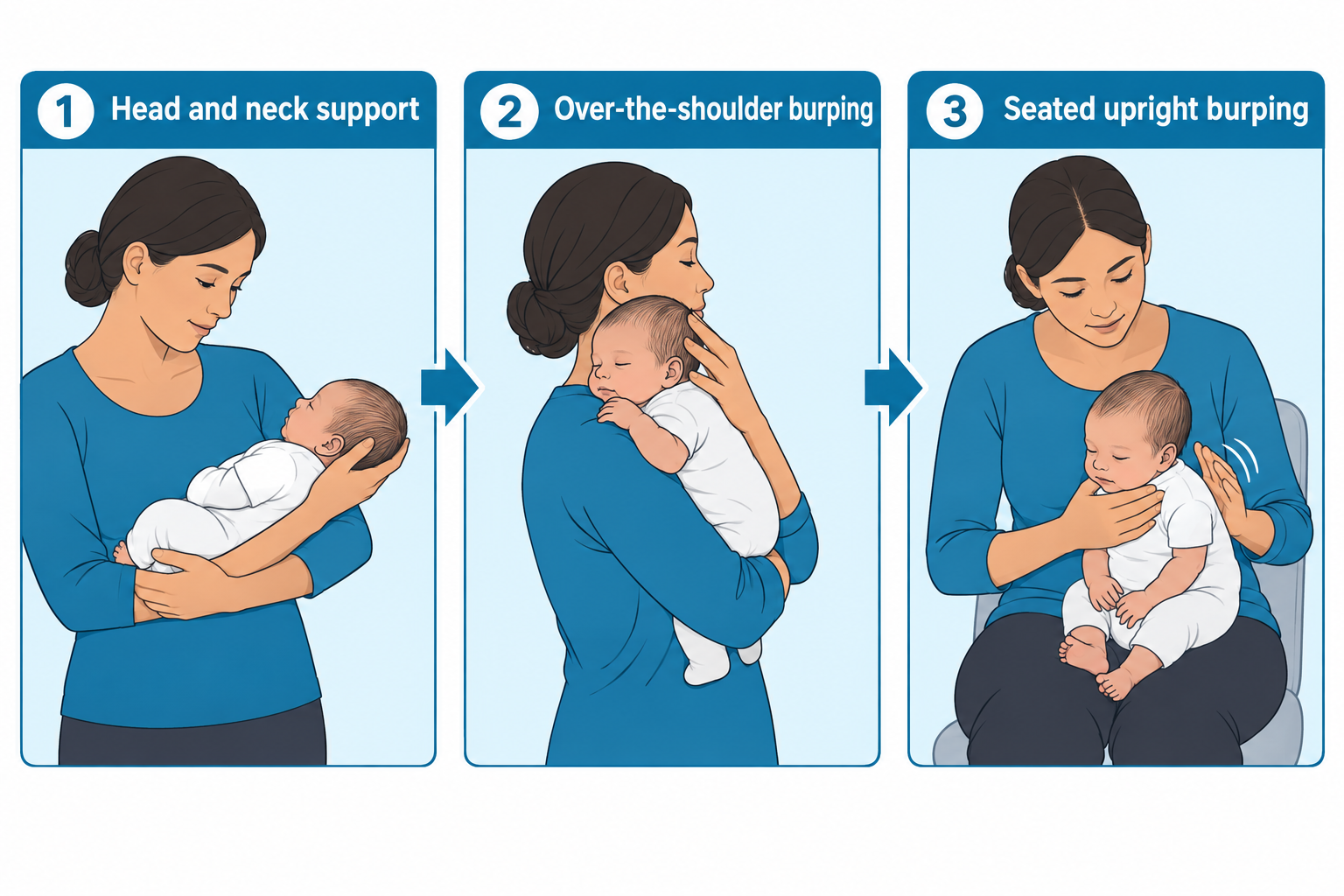
Safe handling
- Support head and neck
- Never shake a baby
- Burp during and after feeds
- Avoid overheating or overdressing
Special circumstances
Some newborns need closer monitoring for feeding and glucose stability - for example, infants of diabetic mothers, and newborns who are small- or large-for-gestational-age - because these findings raise the risk of hypoglycemia and feeding difficulty. Assess each newborn’s own glucose and feeding data rather than assuming risk from the group label alone. Drug-exposed newborns and other special populations are covered in more depth in the next chapter, Newborn safety and special populations.
Clinical vignette: On day 3, a newborn client appears lethargic with fewer wet diapers and poor feeding. The nurse notes dry mucous membranes and a sunken fontanelle. Recognizing dehydration and possible hypernatremia, the nurse notifies the provider, obtains labs, and supports the family in improving feeding frequency and technique.
Client education
- Breastfeed every 2-3 hours; bottle-feed every 2-3 hours at first, progressing to every 3-4 hours as the newborn grows.
- Expect 6-8 wet diapers/day by end of week one.
- Stools change color: meconium → transition → yellow.
- Keep cord dry; avoid submersion baths until healed.
- Always place baby on back to sleep.
- Recognize feeding cues and signs of dehydration.
- Know when to call the provider: fever, poor feeding, reduced wet diapers, vomiting, blood in stool.