


Achievable logoAchievable logo
NCLEX
Sign in
Sign up
Purchase
Textbook
Practice exams
Support
How it works
Resources
Exam catalog
Mountain with a flag at the peak
Textbook
Introduction
1. Safe and effective care environment
2. Health promotion and maintenance
2.1 Growth and development across the lifespan
2.2 Antepartum, intrapartum and postpartum
2.3 Newborn care and developmental milestones
2.3.1 Immediate newborn adaptation & stabilization
2.3.2 Comprehensive newborn assessment
2.3.3 Feeding, elimination, and daily care
2.3.4 Newborn safety and special populations
2.3.5 Developmental milestones (birth–12 months)
2.4 Health screenings and preventive care (vision, cancer, immunizations)
2.5 Lifestyle counseling and high-risk behaviors
2.6 Aging, transitions, and end-of-life considerations
3. Psychosocial Integrity
4. Physiological Integrity
Wrapping up
Achievable logoAchievable logo
2.3.5 Developmental milestones (birth–12 months)
Achievable NCLEX
2. Health promotion and maintenance
2.3. Newborn care and developmental milestones
Our NCLEX course is currently in development and is a work-in-progress.

Developmental milestones (birth–12 months)

9 min read
Font
Discuss
Share
Feedback

Introduction

The first year of life is a breathtaking cascade of growth. From the wobbly reflexes of a newborn to the confident pull-to-stand of a one-year-old, each milestone reflects a precise sequence of neural maturation, muscle development, emotional evolution, and sensory exploration.

On the NCLEX, milestone questions test whether you know what is expected, what is delayed, and what is dangerous. Nurses must identify red flags early, teach caregivers what to anticipate, and encourage environments that nurture healthy development.

Learning objectives

By the end of this section, you should be able to:

  • Describe normal physical, cognitive, language, and social milestones for infants 0-12 months.
  • Identify delays or regression requiring early intervention or referral.
  • Recognize red flags for neurodevelopmental disorders.
  • Provide anticipatory guidance for each developmental stage.
  • Apply NCLEX reasoning to milestone-based clinical scenarios.

Principles of development

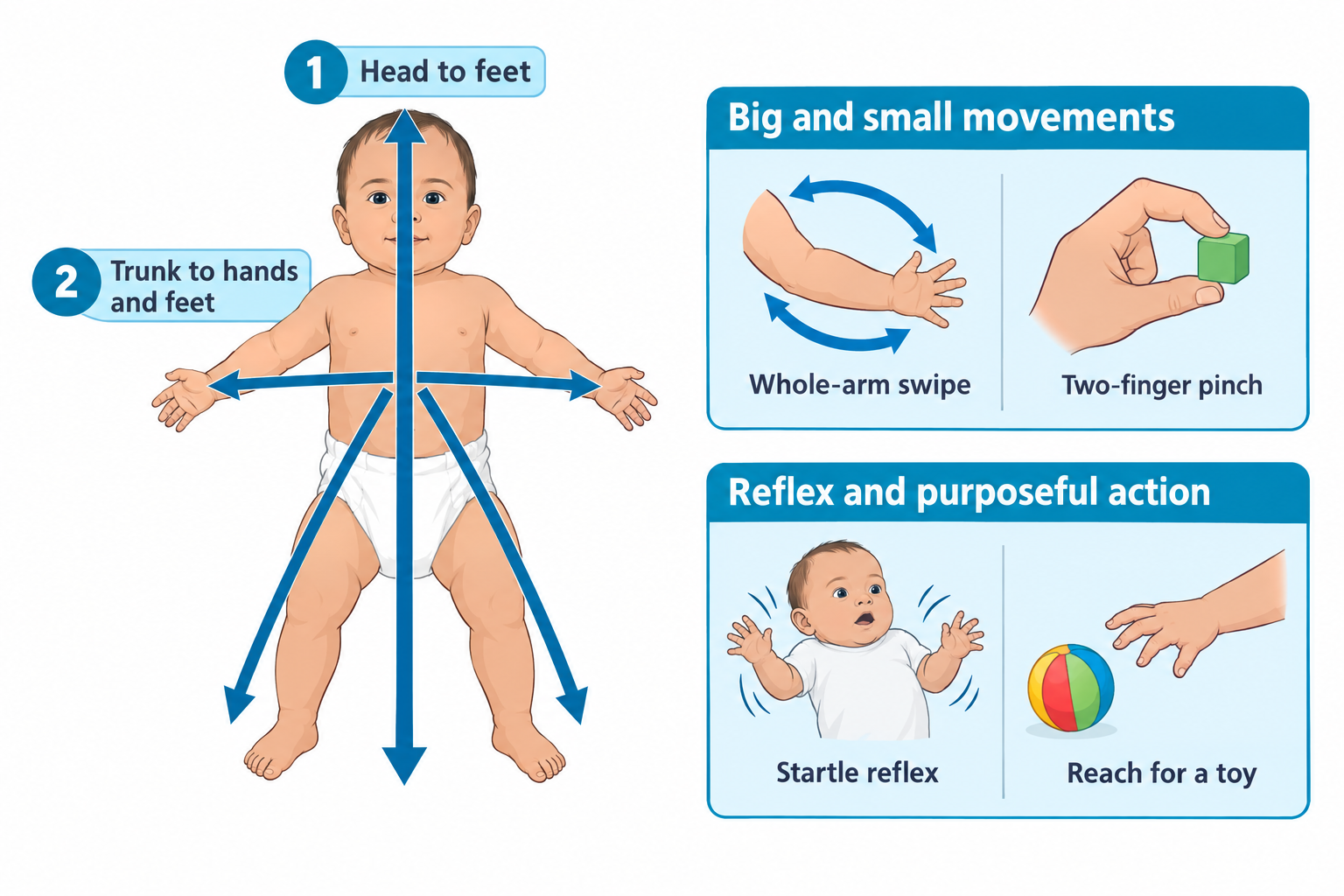
Development progresses in predictable directions:

  1. Cephalocaudal: head → toe
  2. Proximodistal: center → periphery
  3. Gross to fine: big movements → small precise ones
  4. Simple to complex: reflexes → deliberate actions

Development is not perfectly linear; infants may plateau briefly before leaps.

A diagram of an infant with two arrows illustrating developmental direction: one labeled 'Head to feet' running vertically from head to toes, and another labeled 'Trunk to hands and feet' radiating outward from the torso to the hands and legs. To the right, one panel labeled 'Big and small movements' contrasts a whole-arm swipe with a two-finger pinch, and another panel labeled 'Reflex and purposeful action' contrasts a startled infant with arms raised against a hand reaching for a colorful ball.
Principles of infant developmental progression
Achievable

Physical growth

  • Birth weight doubles by 6 months, triples by 12 months
  • Length increases ~1 inch/month for 6 months, then slower
  • Head circumference grows rapidly, reflecting brain growth

Red flags:

  • No weight gain
  • Weight loss after week 2
  • Head circumference crossing percentiles downward

Developmental milestones by domain

The lists below give the expected milestones and the red flags for each age band, across the motor, cognitive, language, and social domains.

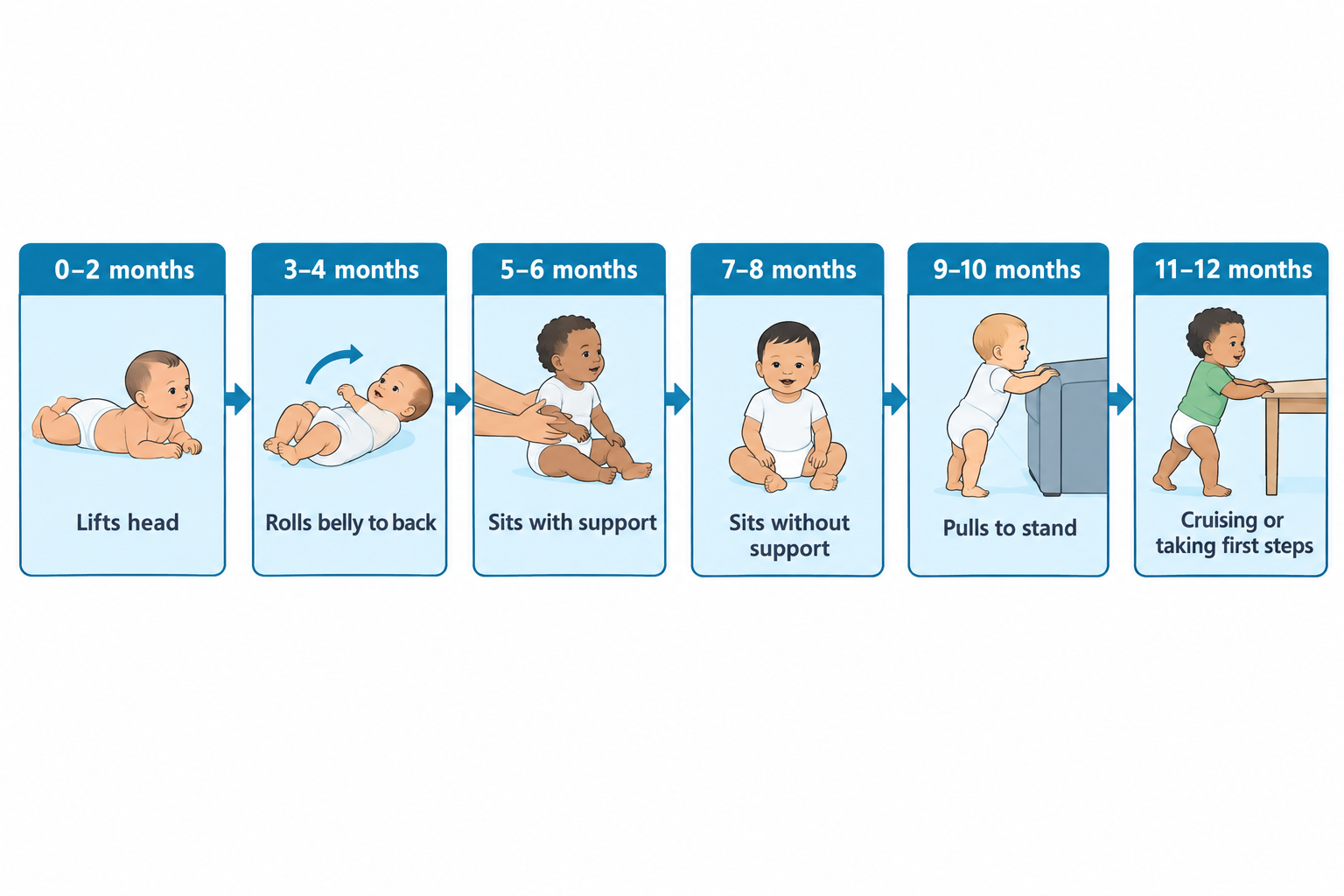
A six-panel timeline of infant motor milestones: 0-2 months, an infant lying prone lifts its head; 3-4 months, an infant rolls from belly to back; 5-6 months, an infant sits upright supported by adult hands; 7-8 months, an infant sits independently; 9-10 months, an infant pulls itself up to stand while holding a low piece of furniture; 11-12 months, a toddler cruises while holding onto a table edge.
Infant developmental milestones from birth to 12 months
Achievable

0-2 months

Motor

  • Moves arms and legs smoothly
  • Lifts head briefly when prone
  • Turns head side-to-side
  • Strong grasp reflex

Cognitive

  • Follows faces briefly
  • Prefers high-contrast images
  • Startles to loud sounds

Language

  • Makes comfort sounds
  • Cries with varying intensity

Social

  • Begins to fix gaze
  • Recognizes caregiver’s voice

Red flags:

  • No startle response
  • Poor suck
  • Floppy tone (hypotonia)

3-4 months

Motor

  • Holds head steady
  • Pushes up on forearms
  • Begins rolling belly → back
  • Reaches for objects

Cognitive

  • Tracks objects 180°
  • Looks at hands (“hand awareness”)

Language

  • Coos, gurgles
  • Begins laughing

Social

  • Social smile
  • Enjoys peek-a-boo beginnings

Red flags:

  • No smile
  • Persistent head lag
  • Lack of eye tracking

5-6 months

Motor

  • Rolls both ways
  • Sits with support
  • Transfers objects hand-to-hand

Cognitive

  • Mouths objects
  • Explores environment with hands

Language

  • Babbles (“ba,” “da”)
  • Responds to name

Social

  • Shows interest in mirror
  • Recognizes familiar faces

Red flags:

  • No babbling
  • No response to sounds

7-8 months

Motor

  • Sits without support
  • Bears weight on legs
  • Begins to crawl or scoot

Cognitive

  • Object permanence begins
  • Searches for dropped objects

Language

  • Chains consonant sounds
  • Responds to “come here”

Social

  • Stranger anxiety emerges
  • Enjoys social play

Red flags:

  • Poor sitting balance
  • No weight-bearing
  • No response to name

9-10 months

Motor

  • Pulls to stand
  • Crawls well
  • Fine pincer grasp emerging

Cognitive

  • Explores actively
  • Look-for hidden objects

Language

  • Imitates sounds
  • Understands simple commands
  • “Mama/dada” (nonspecific)

Social

  • Waves “bye-bye”
  • Plays pat-a-cake

Red flags:

  • No crawling
  • No interactive sounds
  • No gestures (pointing, waving)

11-12 months

Motor

  • Cruises along furniture
  • Stands alone
  • May take first steps
  • Perfected pincer grasp
  • Feeds self finger foods

Cognitive

  • Follows simple directions
  • Imitates gestures

Language

  • Says 1-3 real words
  • Uses purposeful “mama/dada”

Social

  • Separation anxiety
  • Enjoys solitary and interactive play with caregiver

Red flags:

  • No standing or bearing weight
  • No words
  • No pincer grasp
  • Regression in skills

NCLEX tip:

A 12-month-old who cannot pull to stand or bear weight on legs needs immediate evaluation; this is not a “late milestone.”

Major red flags (0-12 months)

Any of the following require prompt referral:

  • No rolling by 6 months
  • No sitting by 9 months
  • No pulling to stand by 12 months
  • No babbling by 6 months
  • No gestures by 9 months
  • No words by 12 months
  • Loss of skills (regression)
  • Persistent primitive reflexes (e.g., Moro past 6 months)
  • Poor eye contact or lack of social engagement

Anticipatory guidance (NCLEX-focused)

Nutrition

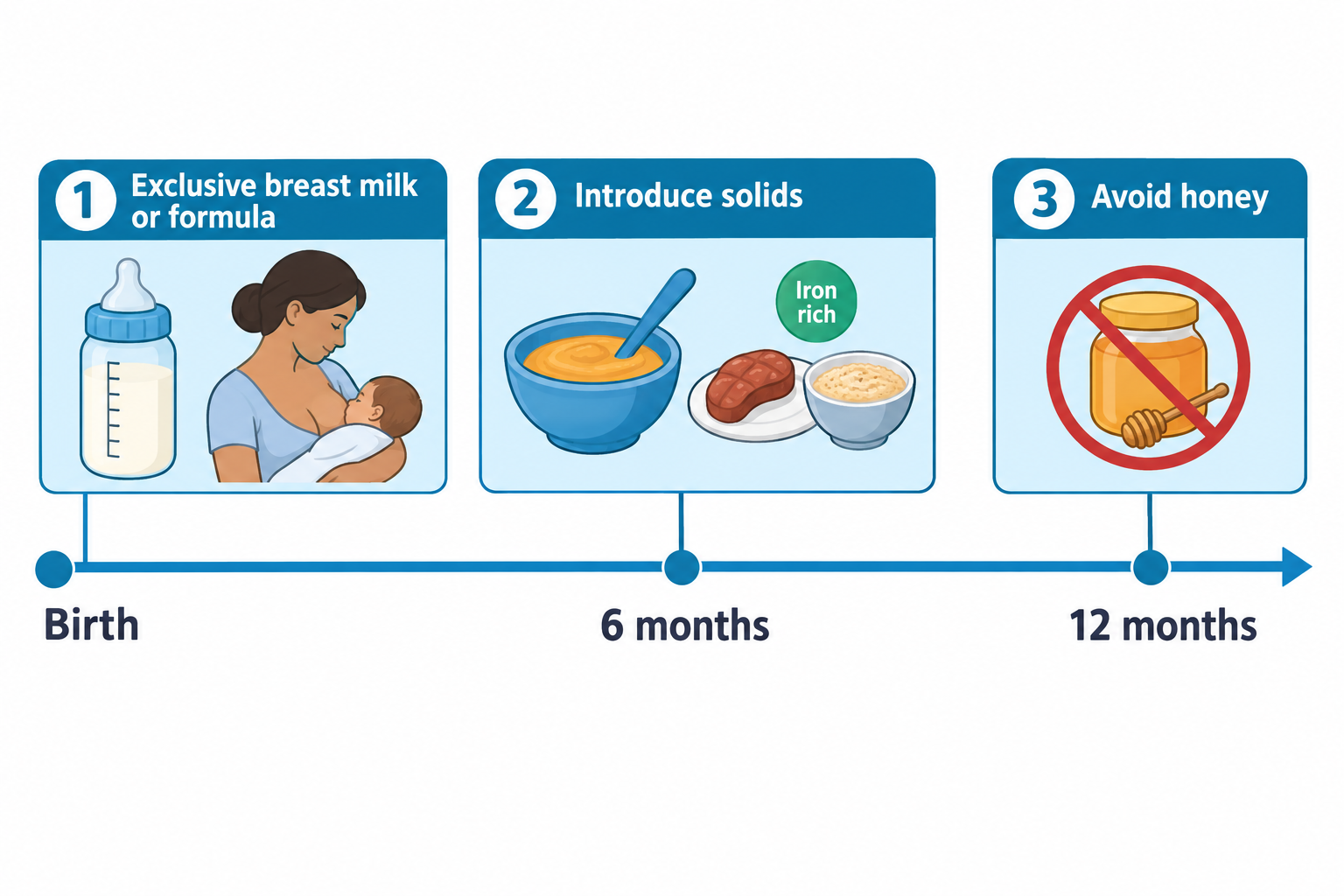
  • Exclusively breastmilk/formula until 6 months
  • Introduce solids at about 6 months
  • Avoid honey before 1 year (botulism)
  • Iron-rich foods essential after 6 months
A timeline shows three infant nutrition milestones: at birth, a caregiver breastfeeding a baby next to a bottle labeled for breast milk or formula; at 6 months, a bowl of pureed food, a piece of meat, and a bowl of cereal marked 'Iron rich' representing introduction of solids; at 12 months, a honey jar with a red prohibition symbol indicating honey should be avoided before this age.
Introduction of complementary foods during the first year
Achievable

Sleep

  • Sleep through night by 6 months (varies)
  • Safe sleep practices remain essential for full first year

Safety

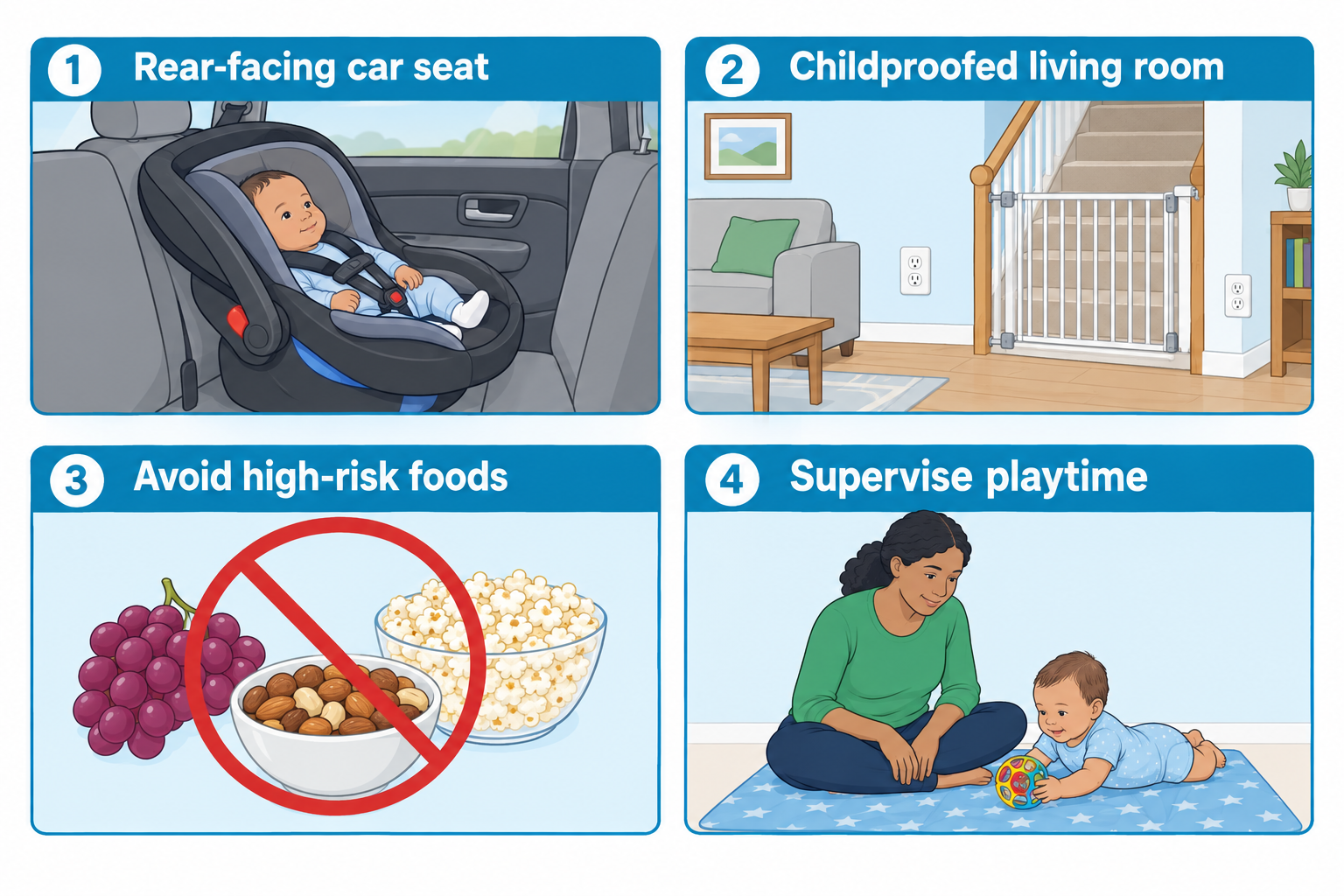
  • Rear-facing car seat as long as possible, until the child reaches the seat manufacturer’s rear-facing height or weight limit (often beyond age 2)
  • Choking hazards: avoid grapes, nuts, popcorn
  • Baby-proof home by 6 months
A four-panel infographic on infant safety: (1) an infant secured in a rear-facing car seat in the back seat of a vehicle; (2) a childproofed living room showing an installed stair safety gate and covered electrical outlets; (3) a bowl of grapes, a bowl of nuts, and a bowl of popcorn marked with a red no-entry symbol to indicate choking hazards; (4) a caregiver sitting on a mat closely supervising an infant on their tummy playing with a rattle ball.
Infant safety considerations during the first year
Achievable

Play

  • Tummy time daily from birth
  • Sensory play, social games, soft books
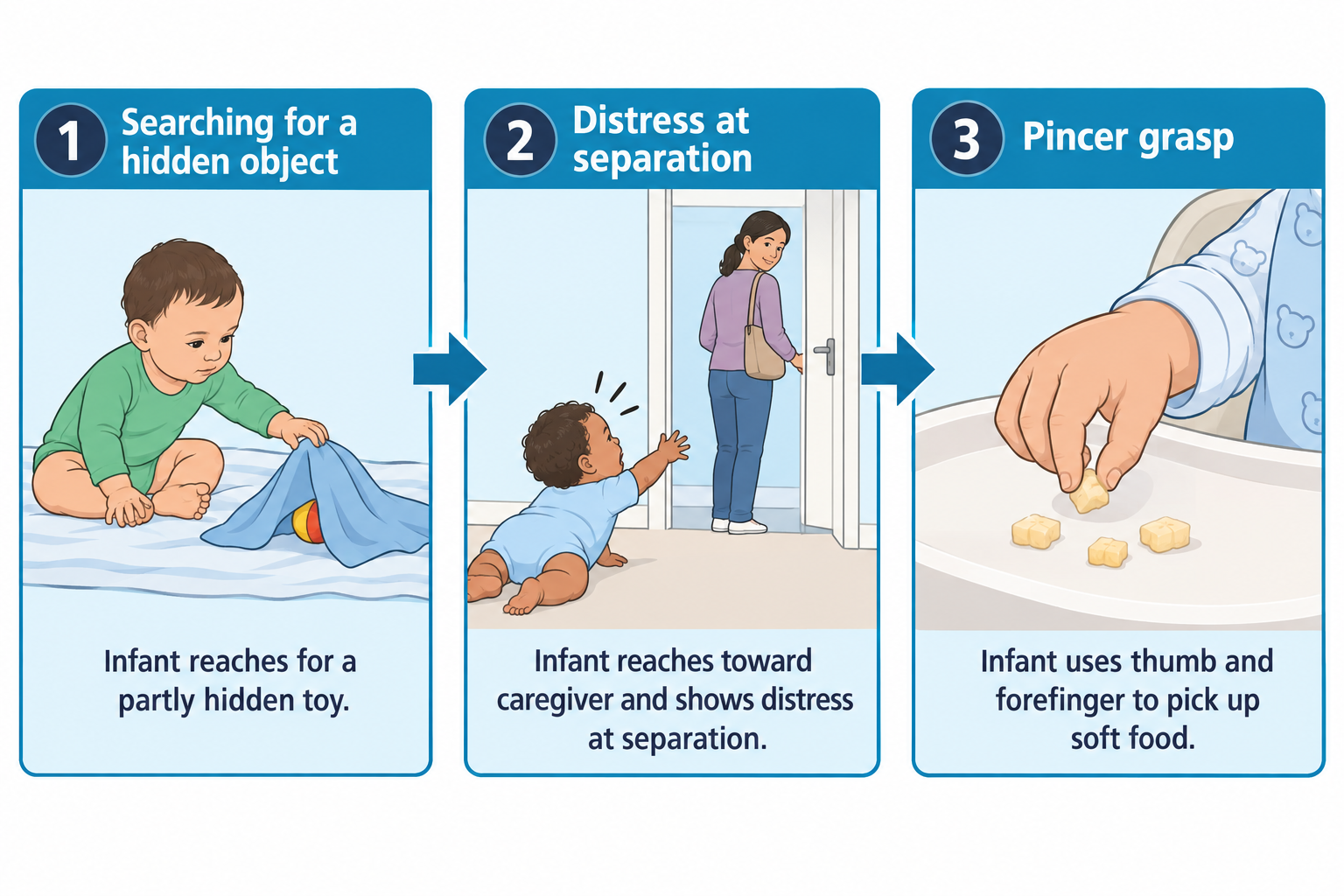
Definitions
Object permanence
Understanding objects still exist when out of sight.
Separation anxiety
Distress when caregiver leaves, normal 8-12 months.
Pincer grasp
Thumb-forefinger grasp allowing self-feeding.
Three-panel illustration: Panel 1 shows an infant sitting on a bed reaching for a toy partly covered by a blanket, illustrating object permanence. Panel 2 shows an infant on the floor reaching toward a caregiver walking out a door, arms raised in distress, illustrating separation anxiety. Panel 3 shows a close-up of an infant's hand using thumb and forefinger to pick up a small piece of soft food from a highchair tray, illustrating the pincer grasp.
Object permanence, separation anxiety, and pincer grasp
Achievable

Clinical vignette: At a 9-month check, a nurse asks the mother if the baby is making gestures such as waving or pointing. The mother says no, and reports the infant rarely responds to their name. Recognizing these as early signs of developmental delay or possible autism spectrum disorder, the nurse refers the infant for developmental screening and early intervention services.

Client/caregiver education

  • Regular tummy time helps prevent positional plagiocephaly.
  • Babies learn through repetition; talk, sing, read daily.
  • Expect stranger anxiety around 7-9 months.
  • Encourage safe exploration in a child-proofed space.
  • Report developmental regression immediately.
  • Expectations for feeding, sleep, and movement change rapidly; caregivers should keep up with well-child visits.

Common pitfalls on NCLEX

  • Assuming a 12-month-old who is not yet walking is “normal.”
  • Missing the significance of no babbling by 6 months.
  • Ignoring loss of skills (always concerning).
  • Considering absence of stranger anxiety a “calm personality” rather than a red flag.
  • Believing infants “grow out of” head lag after 4 months.
  • Birth weight triples by 12 months.
  • No babbling by 6 months = evaluation needed.
  • Gestures (waving/pointing) expected by 9–10 months.
  • Pull-to-stand is a 9–12 month milestone.
  • Regression is always abnormal.

Sign up for free to take 5 quiz questions on this topic

Previous
Next  | 2.4 Health screenings and preventive care (vision, cancer, immunizations)
All rights reserved ©2016 - 2026 Achievable, Inc.

Developmental milestones (birth–12 months)

Introduction

The first year of life is a breathtaking cascade of growth. From the wobbly reflexes of a newborn to the confident pull-to-stand of a one-year-old, each milestone reflects a precise sequence of neural maturation, muscle development, emotional evolution, and sensory exploration.

On the NCLEX, milestone questions test whether you know what is expected, what is delayed, and what is dangerous. Nurses must identify red flags early, teach caregivers what to anticipate, and encourage environments that nurture healthy development.

Learning objectives

By the end of this section, you should be able to:

  • Describe normal physical, cognitive, language, and social milestones for infants 0-12 months.
  • Identify delays or regression requiring early intervention or referral.
  • Recognize red flags for neurodevelopmental disorders.
  • Provide anticipatory guidance for each developmental stage.
  • Apply NCLEX reasoning to milestone-based clinical scenarios.

Principles of development

Development progresses in predictable directions:

  1. Cephalocaudal: head → toe
  2. Proximodistal: center → periphery
  3. Gross to fine: big movements → small precise ones
  4. Simple to complex: reflexes → deliberate actions

Development is not perfectly linear; infants may plateau briefly before leaps.

Physical growth

  • Birth weight doubles by 6 months, triples by 12 months
  • Length increases ~1 inch/month for 6 months, then slower
  • Head circumference grows rapidly, reflecting brain growth

Red flags:

  • No weight gain
  • Weight loss after week 2
  • Head circumference crossing percentiles downward

Developmental milestones by domain

The lists below give the expected milestones and the red flags for each age band, across the motor, cognitive, language, and social domains.

0-2 months

Motor

  • Moves arms and legs smoothly
  • Lifts head briefly when prone
  • Turns head side-to-side
  • Strong grasp reflex

Cognitive

  • Follows faces briefly
  • Prefers high-contrast images
  • Startles to loud sounds

Language

  • Makes comfort sounds
  • Cries with varying intensity

Social

  • Begins to fix gaze
  • Recognizes caregiver’s voice

Red flags:

  • No startle response
  • Poor suck
  • Floppy tone (hypotonia)

3-4 months

Motor

  • Holds head steady
  • Pushes up on forearms
  • Begins rolling belly → back
  • Reaches for objects

Cognitive

  • Tracks objects 180°
  • Looks at hands (“hand awareness”)

Language

  • Coos, gurgles
  • Begins laughing

Social

  • Social smile
  • Enjoys peek-a-boo beginnings

Red flags:

  • No smile
  • Persistent head lag
  • Lack of eye tracking

5-6 months

Motor

  • Rolls both ways
  • Sits with support
  • Transfers objects hand-to-hand

Cognitive

  • Mouths objects
  • Explores environment with hands

Language

  • Babbles (“ba,” “da”)
  • Responds to name

Social

  • Shows interest in mirror
  • Recognizes familiar faces

Red flags:

  • No babbling
  • No response to sounds

7-8 months

Motor

  • Sits without support
  • Bears weight on legs
  • Begins to crawl or scoot

Cognitive

  • Object permanence begins
  • Searches for dropped objects

Language

  • Chains consonant sounds
  • Responds to “come here”

Social

  • Stranger anxiety emerges
  • Enjoys social play

Red flags:

  • Poor sitting balance
  • No weight-bearing
  • No response to name

9-10 months

Motor

  • Pulls to stand
  • Crawls well
  • Fine pincer grasp emerging

Cognitive

  • Explores actively
  • Look-for hidden objects

Language

  • Imitates sounds
  • Understands simple commands
  • “Mama/dada” (nonspecific)

Social

  • Waves “bye-bye”
  • Plays pat-a-cake

Red flags:

  • No crawling
  • No interactive sounds
  • No gestures (pointing, waving)

11-12 months

Motor

  • Cruises along furniture
  • Stands alone
  • May take first steps
  • Perfected pincer grasp
  • Feeds self finger foods

Cognitive

  • Follows simple directions
  • Imitates gestures

Language

  • Says 1-3 real words
  • Uses purposeful “mama/dada”

Social

  • Separation anxiety
  • Enjoys solitary and interactive play with caregiver

Red flags:

  • No standing or bearing weight
  • No words
  • No pincer grasp
  • Regression in skills

NCLEX tip:

A 12-month-old who cannot pull to stand or bear weight on legs needs immediate evaluation; this is not a “late milestone.”

Major red flags (0-12 months)

Any of the following require prompt referral:

  • No rolling by 6 months
  • No sitting by 9 months
  • No pulling to stand by 12 months
  • No babbling by 6 months
  • No gestures by 9 months
  • No words by 12 months
  • Loss of skills (regression)
  • Persistent primitive reflexes (e.g., Moro past 6 months)
  • Poor eye contact or lack of social engagement

Anticipatory guidance (NCLEX-focused)

Nutrition

  • Exclusively breastmilk/formula until 6 months
  • Introduce solids at about 6 months
  • Avoid honey before 1 year (botulism)
  • Iron-rich foods essential after 6 months

Sleep

  • Sleep through night by 6 months (varies)
  • Safe sleep practices remain essential for full first year

Safety

  • Rear-facing car seat as long as possible, until the child reaches the seat manufacturer’s rear-facing height or weight limit (often beyond age 2)
  • Choking hazards: avoid grapes, nuts, popcorn
  • Baby-proof home by 6 months

Play

  • Tummy time daily from birth
  • Sensory play, social games, soft books
Definitions
Object permanence
Understanding objects still exist when out of sight.
Separation anxiety
Distress when caregiver leaves, normal 8-12 months.
Pincer grasp
Thumb-forefinger grasp allowing self-feeding.

Clinical vignette: At a 9-month check, a nurse asks the mother if the baby is making gestures such as waving or pointing. The mother says no, and reports the infant rarely responds to their name. Recognizing these as early signs of developmental delay or possible autism spectrum disorder, the nurse refers the infant for developmental screening and early intervention services.

Client/caregiver education

  • Regular tummy time helps prevent positional plagiocephaly.
  • Babies learn through repetition; talk, sing, read daily.
  • Expect stranger anxiety around 7-9 months.
  • Encourage safe exploration in a child-proofed space.
  • Report developmental regression immediately.
  • Expectations for feeding, sleep, and movement change rapidly; caregivers should keep up with well-child visits.

Common pitfalls on NCLEX

  • Assuming a 12-month-old who is not yet walking is “normal.”
  • Missing the significance of no babbling by 6 months.
  • Ignoring loss of skills (always concerning).
  • Considering absence of stranger anxiety a “calm personality” rather than a red flag.
  • Believing infants “grow out of” head lag after 4 months.
Key points
  • Birth weight triples by 12 months.
  • No babbling by 6 months = evaluation needed.
  • Gestures (waving/pointing) expected by 9–10 months.
  • Pull-to-stand is a 9–12 month milestone.
  • Regression is always abnormal.

More from Newborn care and developmental milestones

  • Immediate newborn adaptation & stabilization
  • Comprehensive newborn assessment
  • Feeding, elimination, and daily care
  • Newborn safety and special populations