



Put spreads
We’ll focus on put spreads in this chapter. As a reminder, a put spread is:
Long put & short put
Like call spreads, most math-based spread questions focus on vertical (price) spreads, where both contracts have the same expiration date but different strike prices. For example:
Short 1 ABC Jan 40 put
Long 1 ABC Jan 50 put
We’ll use the same four-step system from the call spreads chapter to answer maximum gain, maximum loss, and breakeven questions. This system applies to spreads, so you need to identify the strategy correctly before using it.
Let’s work through the spread system using this example:
Short 1 ABC Jan 40 put @ $5
Long 1 ABC Jan 50 put @ $11
Step 1: Net the premiums
The investor sold the short put for $5 and bought the long put for $11. That creates a net debit (purchase) of $6, or $600 total ($6 × 100 shares).
This step tells you whether the net premium is the maximum gain or maximum loss:
- Net debit = maximum loss
- Net credit = maximum gain
Because the investor has a net debit of $600, the maximum loss is $600.
Step 2: Net the strike prices
This step doesn’t give a final answer by itself, but you’ll use it in steps 3 and 4.
Short 1 ABC Jan 40 put @ $5
Long 1 ABC Jan 50 put @ $11
The difference between the strike prices ($50 and $40) is $10.
Step 3: Net strikes - net premium
Take the strike difference ($10) and subtract the net premium from step 1 ($6):
$10 − $6 = $4
That $4 is the “other max.” Since step 1 gave us the maximum loss, step 3 gives us the maximum gain, which is $400 ($4 × 100 shares).
If step 1 gives you the maximum loss, step 3 gives you the maximum gain. If step 1 gives you the maximum gain, step 3 gives you the maximum loss.
Step 4: Strike price +/- net premium
Go back to the original net premium from step 1 (a $6 debit) to find breakeven. Use the rule that matches the spread type:
- Call spreads = add the net premium to the low strike
- Put spreads = subtract the net premium from the high strike
Short 1 ABC Jan 40 put @ $5
Long 1 ABC Jan 50 put @ $11
This is a put spread, so subtract the net premium ($6) from the high strike ($50):
$50 − $6 = $44
The breakeven is $44.
The options payoff chart summarizes the “big picture” for this long put spread. Here’s the strategy again:
Short 1 ABC Jan 40 put @ $5
Long 1 ABC Jan 50 put @ $11
Here’s the payoff chart:
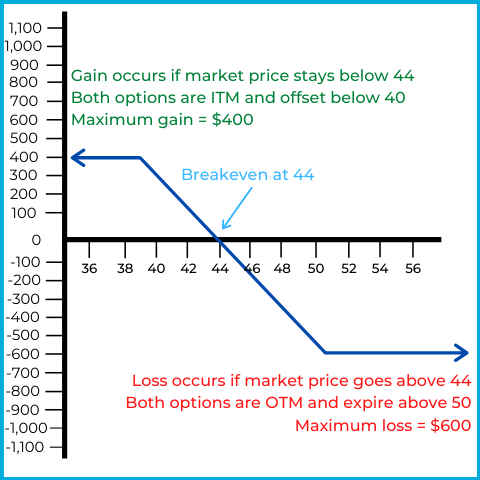
The horizontal axis represents the market price of ABC stock, while the vertical axis represents overall gain or loss.
- Maximum gain = $400
- Maximum loss = $600
- Breakeven = $44
- Option names = Long/bear/debit put spread
This investor is bearish on ABC, but the spread caps both the potential gain and the potential loss. Here’s how the position behaves at different stock prices:
If ABC’s market price stays above $50
Both options are out of the money and expire worthless. The investor loses the original net debit, which is $600 (maximum loss).
If ABC’s market price goes below $50, but stays above $40
The long put goes in the money and gains intrinsic value. At $44, the long put has $6 of intrinsic value ($50 − $44), which offsets the $6 net debit, so the position is at breakeven. Below $44, the investor has an overall profit. The short put remains out of the money as long as the market stays above $40.
If ABC’s market price goes below $40
Both puts are in the money. Below $40, the long put continues to gain intrinsic value, but the short put also gains intrinsic value (which hurts the investor). Those intrinsic values offset dollar-for-dollar, so the position is capped at its maximum gain once the stock reaches $40.
What was the investor’s intent?
The investor was bearish on ABC but thought the long put premium ($1,100) was too expensive. Selling the $40 put for $500 reduces the net cost to $600. The trade-off is that the short put creates a “floor” at $40: below $40, gains on the long put are offset by losses on the short put.
Let’s see if you can work through an example on your own:
An investor goes long 1 XYZ Dec 30 put at $2 and short 1 XYZ Dec 45 put at $10. Answer the following:
Maximum loss?
Maximum gain?
Breakeven?
Names of the spread?
- Maximum loss = $700
- Maximum gain = $800
- Breakeven = $37
- Names of the spread = Short/bull/credit spread
This is how you can determine the answers:
Step 1: Net the premiums
Bought at $2 and sold at $10, creating a net credit of $8. Therefore, the maximum gain is $800.
Step 2: Net the strike prices
The difference between $30 and $45 is $15.
Step 3: Net strikes - net premium
$15 (net strikes) − $8 (net premium) = $7. This is the “other max.” Since step 1 gave the maximum gain, step 3 gives the maximum loss: $700.
Step 4: Strike price +/- net premium
This is a put spread, so subtract the $8 net premium from the $45 high strike price:
$45 − $8 = $37
Naming the spread
You can name a vertical put spread by identifying the dominant leg. On a vertical put spread, the higher strike is the dominant leg. Here, the higher strike ($45) is the short put, so this is a:
- Short put spread
- Bull put spread
- Credit put spread
The options payoff chart summarizes the “big picture” for this short put spread. Here’s the strategy again:
Long 1 XYZ Dec 30 put @ $2
Short 1 XYZ Dec 45 put @ $10
Here’s the payoff chart:
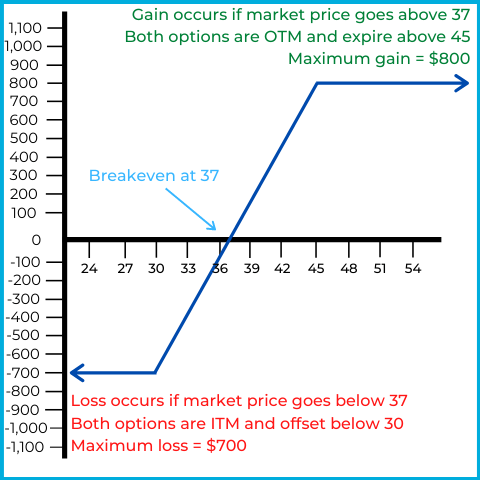
The horizontal axis represents the market price of ABC stock, while the vertical axis represents overall gain or loss.
- Maximum loss= $700
- Maximum gain = $800
- Breakeven = $37
- Option names = Short/bull/credit put spread
If XYZ’s market stays above $45
Both options are out of the money and expire worthless. The investor keeps the original net credit, which is $800 (maximum gain). This is why it’s a bull put spread: the investor prefers the stock to stay up so both puts expire.
If XYZ’s market price goes below $45, but stays above $30
The short put goes in the money and gains intrinsic value (which hurts the investor). At $37, the short put has $8 of intrinsic value ($45 − $37), which offsets the $8 net credit, so the position is at breakeven. Below $37, the investor has an overall loss. The long put remains out of the money as long as the market stays above $30.
If XYZ’s market price goes below $30
Both options are in the money. Below $30, losses on the short put are offset dollar-for-dollar by gains on the long put. The long put caps the downside risk.
What was the investor’s intent?
The investor was bullish on XYZ but wanted protection if the stock fell sharply. Buying the $30 put reduces the net credit to $800 (from $1,000). The investor collects less premium, but the maximum loss is capped if the market price falls below $30.
Math-based spread questions often focus on maximum gain, maximum loss, or breakeven. You may also see questions that test spread mechanics more generally. For example:
An investor goes long 1 CBA Sep 70 put at $15 and short 1 CBA Sep 50 put at $4 when the market price is $60. The market goes to $52 and the investor closes the contracts at intrinsic value. What is the gain or loss?
Answer = $700 gain
| Action | Result |
|---|---|
| Buy put | -$1,500 |
| Sell put | +$400 |
| Close long put | +$1,800 |
| Close short put | $0 |
| Total | +$700 |
Initially, the investor buys the long put for $15 and sells the short put for $4, creating a net debit of $11, or $1,100 total ($11 × 100 shares).
At $52, the long put is in the money (“put down”). To close the long put, the investor makes a closing sale at intrinsic value. Intrinsic value is $18 ($70 − $52), so the investor sells the long put for $1,800.
At $52, the short put is out of the money and has no intrinsic value. To close the short put, the investor makes a closing purchase at intrinsic value. Intrinsic value is $0, so the investor buys back the short put for $0.
We have one last topic to cover in this chapter. Spread investors look for a specific outcome depending on whether the strategy is a debit spread or a credit spread. Here are the key associations:
- Debit spreads = widen & exercise
- Credit spreads = narrow & expire
As discussed in the call spreads chapter, you can answer most exam questions on this topic by first identifying whether the spread is a debit or credit spread.
In a debit spread, the investor wants the spread between the option premiums to widen. For example:
Short 1 ZYX Jan 20 put @ $1
Long 1 ZYX Jan 25 put @ $3
Market price = $24
The spread between the premiums is currently $2 ($3 − $1). This is a bear put spread (the long put has the higher premium and higher strike), so the investor wants ZYX’s market price to fall.
If the market falls to $20, the long put’s premium will be at least $5 (its intrinsic value). At $20, the short put still has no intrinsic value. If the option is near expiration, the short put premium could be close to $0. Assume the long put premium is now $5 and the short put premium stays at $1. The premium spread is now $4 ($5 − $1), which is wider than the original $2. With a wider spread, the investor can close the contracts at a profit.
In a debit spread, the investor also prefers the options to exercise. Using the same example:
Short 1 ZYX Jan 20 put @ $1
Long 1 ZYX Jan 25 put @ $3
Market price = $24
If both options expire, the investor is left with the original $200 net debit, which is the maximum loss. That happens if ZYX’s market price stays at or above $25.
If ZYX’s market price falls below $25, the long put goes in the money, gains intrinsic value, and starts producing an overall return. Once the market price falls below $20, the short put also goes in the money and begins offsetting the long put’s gains.
If both options are in the money (below $20), the investor is at maximum gain. The long put drives the profit, and the short put caps it. Below $20, additional gains on the long put are negated by losses on the short put, but the investor still reaches maximum gain if both options are exercised.
For our last example, let’s look at credit spreads and how an exam question on this topic can be subtle:
An investor goes long 1 LMN Jun 110 put and short 1 LMN Jun 125 put. Which of the following outcomes is the investor hoping for?
A) Spread between the premiums to widen and both options exercised
B) Spread between the premiums to narrow and both options expire
C) Spread between the premiums to widen and both options expire
D) Spread between the premiums to narrow and both options exercised
Answer = B
Premiums aren’t provided, but you can still identify the dominant leg in a vertical put spread by looking at the higher strike price. The short put has the higher strike price (125), so it’s the dominant leg. That makes this a:
- Bull put spread
- Short put spread
- Credit put spread
Once you know it’s a credit spread, the preferred outcome is narrow & expire.
If LMN’s market price rises above $125, both options go out of the money and have no intrinsic value. As expiration approaches, both premiums tend toward $0, so the spread between them narrows.
When the market price is above the high strike price ($125), both options expire worthless, locking in the investor’s maximum gain. That’s why the investor prefers both options to expire.
Whether you remember the context or not, these are the primary test points:
- Debit spreads = widen / exercise
- Credit spreads = narrow / expire
There are many memory tricks for this topic. For example, some remember that credit, narrow, and expire all have six letters, so the six-letter words go together.
If you’re more of a visual learner, here’s a video combining all we’ve covered on put spreads: