



Combinations
Combinations are similar to straddles, but the two options have different strike prices and/or different expiration dates.
Here’s a quick refresher on a straddle:
Long 1 ABC Jan 70 call
Long 1 ABC Jan 70 put
A long straddle uses two long options (a call and a put) with the same strike price and the same expiration. Change either the strike or the expiration, and you no longer have a straddle - you have a long combination.
For example, different strike prices:
Long 1 ABC Jan 80 call
Long 1 ABC Jan 70 put
Different expirations:
Long 1 ABC Jan 70 call
Long 1 ABC Feb 70 put
Different strikes and expirations:
Long 1 ABC Jan 80 call
Long 1 ABC Feb 70 put
Bottom line: if it looks like a straddle but the strikes, expirations, or both don’t match, it’s a combination.
Long straddles profit in volatile markets and lose in flat markets. The investor profits as long as the gain on the call or the put is greater than the combined premiums paid. Long combinations work the same way.
Let’s work through some math-based combination questions.
An investor goes long 1 ABC Jan 80 call at $3 and long 1 ABC Jan 70 put at $2 when ABC"s market price is $75. What is the maximum gain?
Can you figure it out?
Maximum gain = unlimited
Like a long straddle, the long call provides unlimited upside if the stock rises. In a rising market, the put will expire, but the call’s value can keep increasing as ABC’s market price increases.
The call gives the right to buy ABC at $80. If the market price rises above $80, the investor can buy at $80 and sell at the higher market price.
How about maximum loss?
An investor goes long 1 ABC Jan 80 call at $3 and long 1 ABC Jan 70 put at $2 when the market price is $75. What is the maximum loss?
Maximum loss = $500 (premiums)
As with a long straddle, the most the investor can lose is the total premium paid: $3 + $2 = $5 per share, or $500 per contract set.
The key difference is where that maximum loss occurs.
- A long straddle has maximum loss when the market price is at the shared strike price at expiration.
- In this combination, both options expire worthless if ABC finishes at or between $70 and $80.
Why?
- The put is in the money only if ABC falls below $70.
- The call is in the money only if ABC rises above $80.
So this combination has a wider “dead zone” where both options can expire worthless, making it easier to realize the maximum loss.
Before we move on, this specific combination is known as a strangle.
A strangle is a combination where both options (long or short) are out of the money (have no intrinsic value) when the position is established.
Here’s the position again:
Long 1 ABC Jan 80 call @ $3
Long 1 ABC Jan 70 put @ $2
Market price = $75
At $75:
- The 80 call is out of the money (no intrinsic value).
- The 70 put is out of the money (no intrinsic value).
If the market stays at $75 through expiration, both options expire worthless:
- Exercising the call would mean buying at $80 when the market is $75.
- Exercising the put would mean selling at $70 when the market is $75.
A strangle is sometimes called a “cheap person’s straddle” because it typically costs less than a straddle (lower premiums), but the stock has to move farther for either option to gain intrinsic value.
Let’s find the breakevens.
An investor goes long 1 ABC Jan 80 call at $3 and long 1 ABC Jan 70 put at $2 when ABC’s market price is $75. What is the breakeven?
Breakevens = $65 and $85
Like a straddle, a combination has two breakevens - one on the downside and one on the upside.
First, add the premiums:
- $3 + $2 = $5 per share = $500 total
Then:
- Downside breakeven = put strike − total premium = $70 − $5 = $65
- Upside breakeven = call strike + total premium = $80 + $5 = $85
Interpretation:
- If ABC falls to $65, the put is worth $5 intrinsically ($70 − $65), which offsets the $5 premium paid.
- If ABC rises to $85, the call is worth $5 intrinsically ($85 − $80), which offsets the $5 premium paid.
To find the breakevens on a combination, add the premiums, subtract that amount from the put strike, and add that amount to the call strike.
Let’s use the payoff chart to summarize the big picture for this long combination. Here’s the position:
Long 1 ABC Jan 70 put @ $2
Long 1 ABC Jan 80 call @ $3
Here’s the payoff chart:
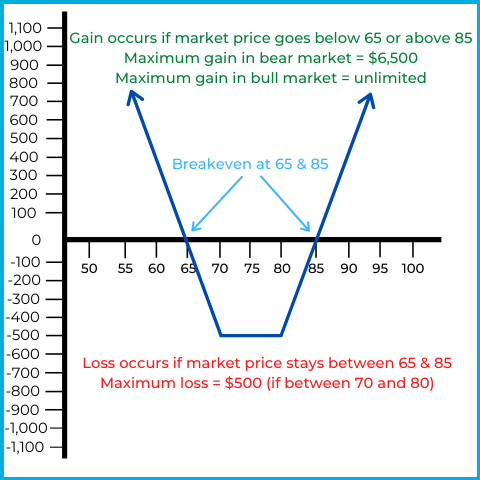
The horizontal axis represents the market price of ABC stock, while the vertical axis represents overall gain or loss.
As the chart shows:
- The maximum loss is $500, and it occurs when ABC finishes between $70 and $80. In that range, both options expire worthless.
- If ABC rises above $80 or falls below $70, one option becomes in the money and gains intrinsic value.
Breakeven points:
- At $85, the call has $5 of intrinsic value, offsetting the $5 total premium. Above $85, the position is profitable, with unlimited upside.
- At $65, the put has $5 of intrinsic value, offsetting the $5 total premium. Below $65, the position is profitable, with downside profit capped if the stock falls to $0.
If ABC fell to $0, the put would be worth $70 intrinsically, and the net gain would be $70 − $5 = $65 per share, or $6,500.
Let’s move on to short combinations.
Short straddles profit in flat markets and lose in volatile markets. If the market rises or falls too far, assignment losses can exceed the combined premiums received. Short combinations behave similarly.
Let’s go through some short combination questions.
An investor goes short 1 ABC Jan 40 call at $4 and short 1 ABC Jan 30 put at $3 when ABC’s market price is $35. What is the maximum gain?
Maximum gain = $700 (premiums)
As with any short option strategy, the maximum gain is the premium received.
- $4 + $3 = $7 per share = $700
The investor earns the maximum gain if both options expire worthless.
Compared to a short straddle, this short combination has a wider range where both options can expire:
- If ABC stays at or above $30, the put expires worthless.
- If ABC stays at or below $40, the call expires worthless.
So if ABC finishes between $30 and $40, both options expire worthless and the investor keeps the full premium.
How about the maximum loss?
An investor goes short 1 ABC Jan 40 call at $4 and short 1 ABC Jan 30 put at $3 when ABC’s market price is $35. What is the maximum loss?
Maximum loss = unlimited
Short straddles and short combinations both have unlimited risk because of the short (naked) call.
If ABC rises above $40:
- The call becomes in the money.
- The investor can be assigned and must sell shares at $40.
- Because the investor doesn’t own the shares, they must buy them in the market at the higher market price.
As the market price rises, the cost to buy shares keeps increasing, so the loss on the short call is unlimited.
The short put can also create large losses if the stock falls sharply, but the short call is what creates unlimited risk.
For our last question, let’s find the breakevens.
An investor goes short 1 ABC Jan 40 call at $4 and short 1 ABC Jan 30 put at $3 when ABC’s market price is $35. What is the breakeven?
Breakevens = $23 and $47
Short combinations also have two breakevens.
First, add the premiums received:
- $4 + $3 = $7 per share = $700
Then:
- Downside breakeven = put strike − total premium = $30 − $7 = $23
- Upside breakeven = call strike + total premium = $40 + $7 = $47
Interpretation:
- If ABC falls to $23, the put is $7 in the money ($30 − $23). Assignment forces the investor to buy at $30 when the shares are worth $23, creating a $7 loss per share, which offsets the $7 premium received.
- If ABC rises to $47, the call is $7 in the money ($47 − $40). Assignment forces the investor to sell at $40 after buying at $47, creating a $7 loss per share, which offsets the $7 premium received.
To find the breakevens on a combination (long or short), add the premiums, subtract that amount from the put strike, and add that amount to the call strike.