


Achievable logoAchievable logo
NCLEX
Sign in
Sign up
Purchase
Textbook
Practice exams
Support
How it works
Resources
Exam catalog
Mountain with a flag at the peak
Textbook
Introduction
1. Safe and effective care environment
2. Health promotion and maintenance
3. Psychosocial Integrity
4. Physiological Integrity
4.1 Basic care and comfort
4.2 Pharmacological and parenteral therapies
4.3 Reduction of risk potential
4.3.1 Diagnostic tests and lab values
4.3.2 Monitoring for complications of procedures
4.3.3 Changes in vital signs and neurological status
4.3.4 Electrolyte imbalances and fluid status
4.3.5 Medical equipment use and safety
4.3.6 Potential complications of devices and procedures
4.4 Physiological adaptation
Wrapping up
Achievable logoAchievable logo
4.3.6 Potential complications of devices and procedures
Achievable NCLEX
4. Physiological Integrity
4.3. Reduction of risk potential
Our NCLEX course is currently in development and is a work-in-progress.

Potential complications of devices and procedures

7 min read
Font
Discuss
Share
Feedback

Introduction

Medical devices and invasive procedures improve outcomes, but they also introduce predictable risks. On the Next generation NCLEX (NGN), learners are expected to recognize early warning signs, prioritize nursing actions, and prevent harm through vigilant monitoring and timely escalation.

This section integrates prior content on post-procedure monitoring, vital signs, electrolytes, and equipment safety, focusing on what can go wrong and how nurses respond first.

Learning objectives

By the end of this section, the learner should be able to:

  • Identify common complications associated with medical devices and procedures
  • Recognize early vs late clinical indicators
  • Prioritize immediate nursing actions
  • Apply NGN-style clinical judgment to device-related scenarios

Core concept: Devices bypass natural defenses

Any device that enters the body increases the risk of infection, bleeding, obstruction, or malfunction.

The nurse’s role is anticipation, not reaction.

Early vs late complications

Complications often follow predictable timelines. NGN questions frequently test whether the nurse recognizes when something is abnormal.

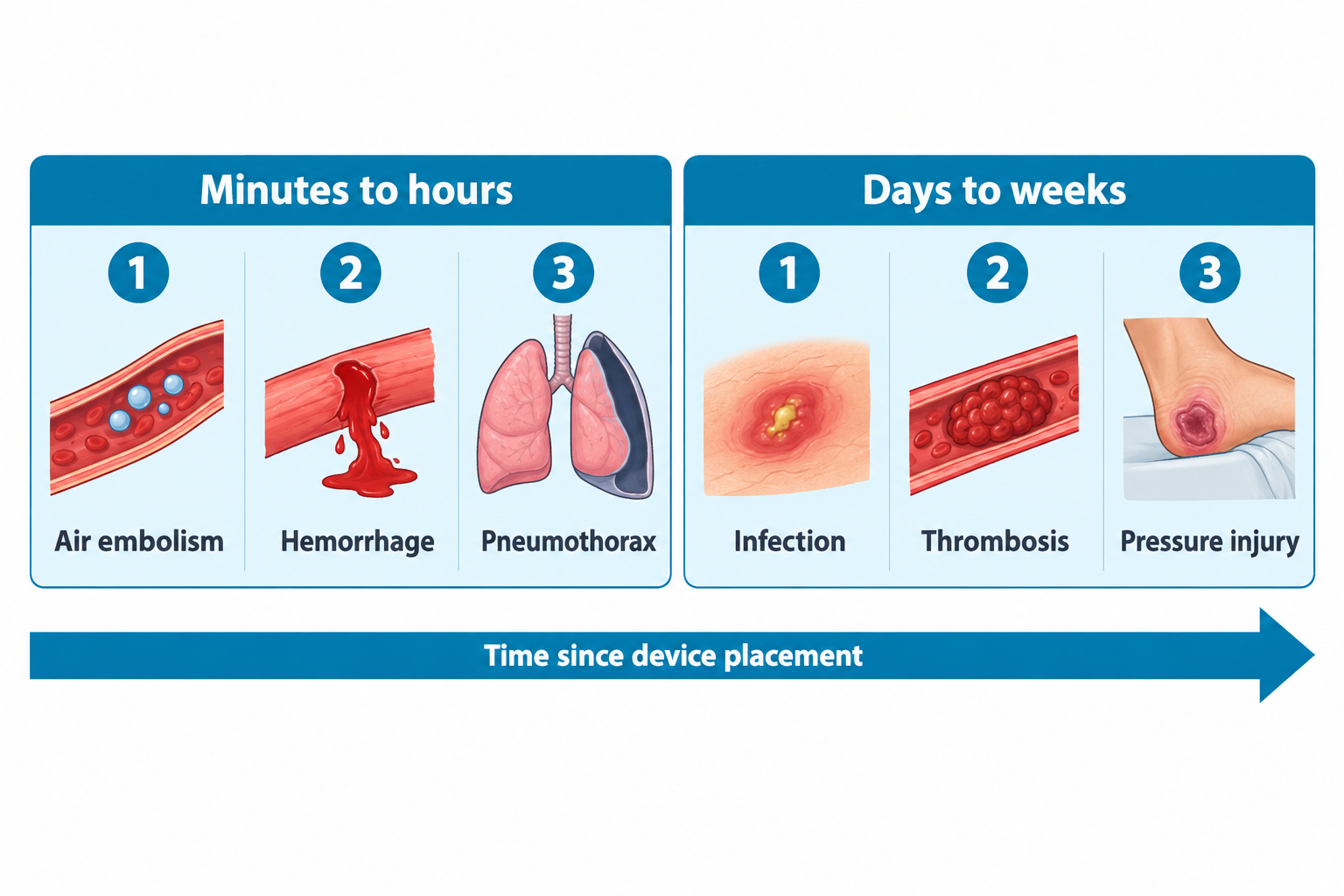
Early complications (minutes to hours)

  • Air embolism
  • Hemorrhage
  • Pneumothorax
  • Acute allergic reaction
  • Sedation-related respiratory depression

Late complications (days to weeks)

  • Device-associated infection
  • Thrombosis
  • Pressure injury
  • Device occlusion
  • Fistula formation
A two-panel timeline showing device-related complications. The 'Minutes to hours' panel depicts a blood vessel with air bubbles (air embolism), a vessel with blood pooling out (hemorrhage), and a pair of lungs with one side collapsed and darkened (pneumothorax). The 'Days to weeks' panel depicts inflamed skin with pus (infection), a blood vessel containing a clot (thrombosis), and a heel with a pressure ulcer (pressure injury). A bottom arrow labeled 'Time since device placement' spans both panels left to right.
Timeline of device-related complications: common early and late complications
Achievable

Infection-related complications

Common devices involved

  • Central venous catheters
  • Urinary catheters
  • Surgical drains
  • Endotracheal tubes

Early warning signs

  • Local redness, warmth, or drainage
  • Fever or hypothermia
  • Rising white blood cell count
  • Altered mental status in older adults

High-risk device-associated infections

Certain devices are strongly linked to specific infections that are frequently tested.

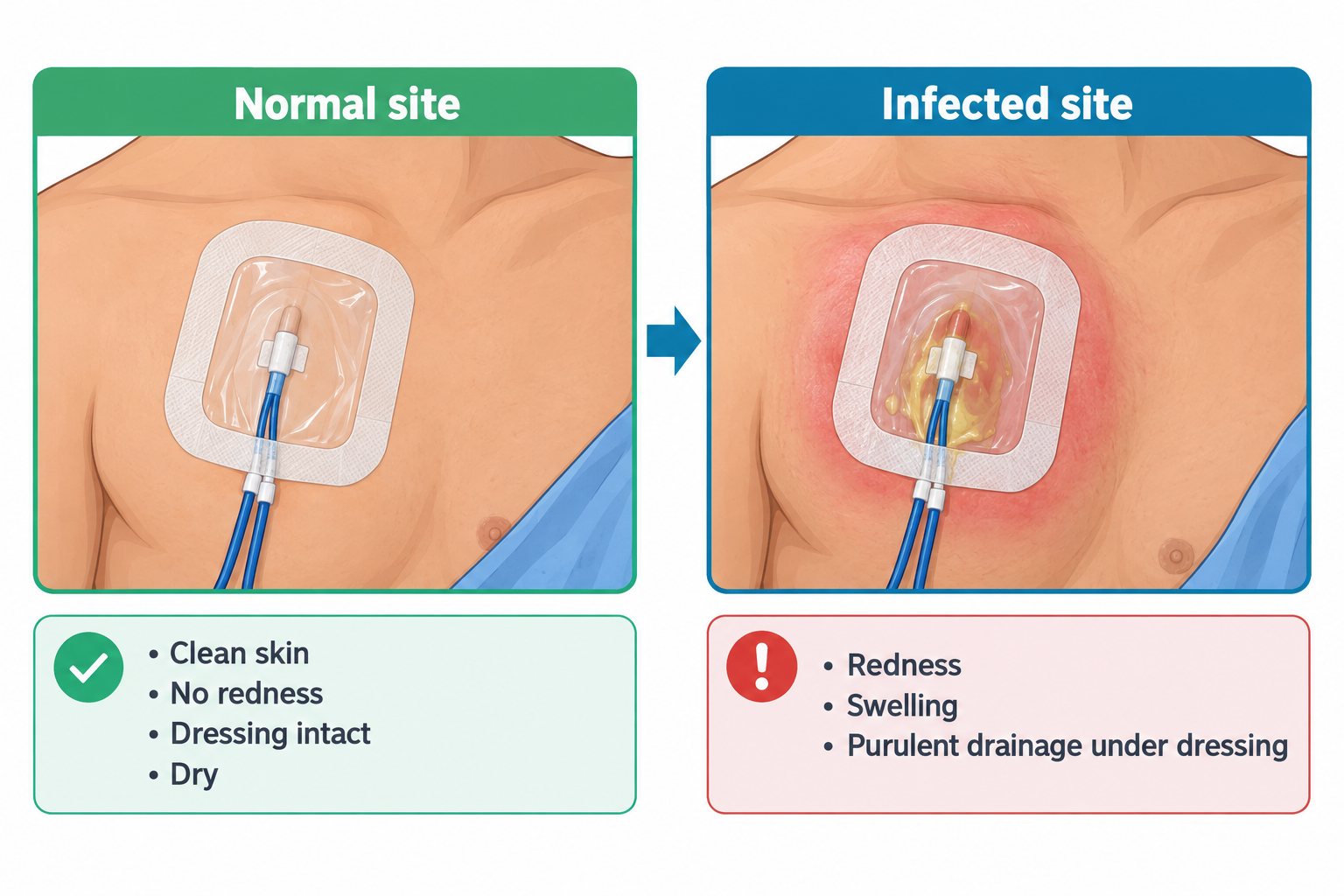
Central venous catheters → CLABSI risk

  • Monitor insertion site
  • Assess for unexplained fever
  • Maintain sterile dressing integrity
Side-by-side comparison of a central line exit site on the upper chest: the normal site shows a clean, dry, intact transparent occlusive dressing over the catheter insertion point with no surrounding redness, while the infected site shows the same type of dressing surrounded by erythema and swelling, with yellow purulent drainage visible under the dressing.
Central line dressing: a normal, clean, dry, intact occlusive dressing compared to an infected site with erythema, swelling, and purulent drainage
Achievable

Urinary catheters → CAUTI risk

  • Maintain closed system
  • Keep bag below bladder
  • Avoid dependent loops

Endotracheal tubes → ventilator-associated pneumonia (VAP)

  • Elevate HOB 30-45°
  • Perform oral care
  • Monitor secretions

Surgical drains → localized wound infection

  • Sudden change in drainage color
  • Foul odor
  • Increased pain at site

Complications during device removal

Insertion risks are commonly discussed. Removal risks are often overlooked.

Central line removal

  • Risk: Air embolism
  • Nursing action: Apply an occlusive dressing immediately after removal and position the client supine during removal to reduce the risk of air embolism (left lateral Trendelenburg is used if an air embolism occurs)

Chest tube removal

  • Risk: Tension pneumothorax
  • Nursing action: Apply occlusive dressing immediately

Foley catheter removal

  • Risk: Urinary retention
  • Nursing action: Monitor first void within 6-8 hours

Epidural catheter removal

  • Risk: Epidural hematoma (neurological deficit)
  • Nursing action: Assess sensation and motor function
Definitions
Device-associated infection
Infection occurring due to the presence of an indwelling device
Hematoma
Localized collection of blood outside blood vessels
Device dislodgement
Partial or complete movement of a device from its intended position

NGN insight: Confusion may be the first sign of infection in older adults, even before fever or other classic symptoms develop.

Bleeding and vascular complications

High-risk procedures

  • Central line insertion
  • Arterial line placement
  • Surgical drain removal
  • Cardiac catheterization

Key assessment findings

  • Oozing or frank bleeding
  • Expanding hematoma
  • Hypotension
  • Tachycardia

Air embolism

Risk factors

  • Central line disconnection
  • Improper priming of IV tubing
  • Line removal without occlusion

Clinical signs

  • Sudden dyspnea
  • Chest pain
  • Hypotension
  • Anxiety or confusion

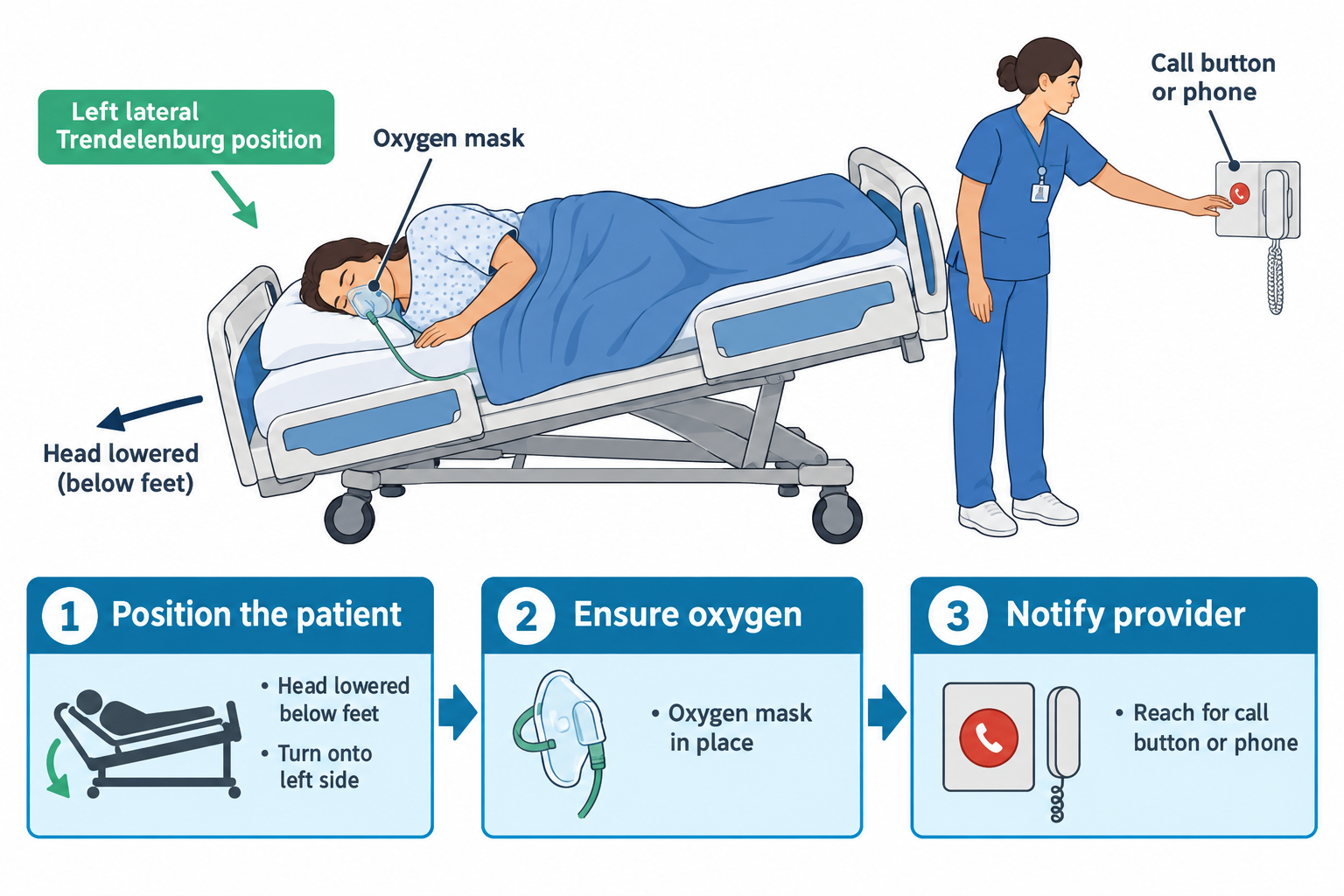
Medical emergency: Air embolism can cause rapid cardiovascular collapse.

Immediate nursing action: Place the client in the left lateral Trendelenburg position, administer oxygen as indicated, and notify the provider immediately.

A hospital bed tilted with the head end lowered below the feet, showing a patient lying on her side wearing an oxygen mask, labeled 'Left lateral Trendelenburg position,' 'Oxygen mask,' and 'Head lowered (below feet).' Beside the bed, a nurse reaches for a wall-mounted call button/phone labeled 'Call button or phone.' Below, three numbered steps summarize the emergency response: (1) Position the patient — head lowered below feet, turn onto left side; (2) Ensure oxygen — oxygen mask in place; (3) Notify provider — reach for call button or phone.
Recognizing and responding to an air embolism: left lateral Trendelenburg positioning, oxygen, and provider notification
Achievable

Obstruction and dislodgement

Affected devices

  • Feeding tubes
  • Chest tubes
  • Urinary catheters
  • Surgical drains

Warning signs

  • Sudden change in output
  • Increased pressure or pain
  • Alarms sounding
  • Absent expected drainage

A normally functioning chest tube drainage system shows tidaling (fluid rising and falling with respirations) along with expected drainage output; loss of tidaling or a sudden drop in drainage suggests obstruction and should be assessed immediately.

Tissue injury and pressure-related complications

Contributing factors

  • Prolonged device contact
  • Edema
  • Poor circulation
  • Reduced sensation

Assessment findings

  • Skin redness or breakdown
  • Pain or numbness
  • Swelling

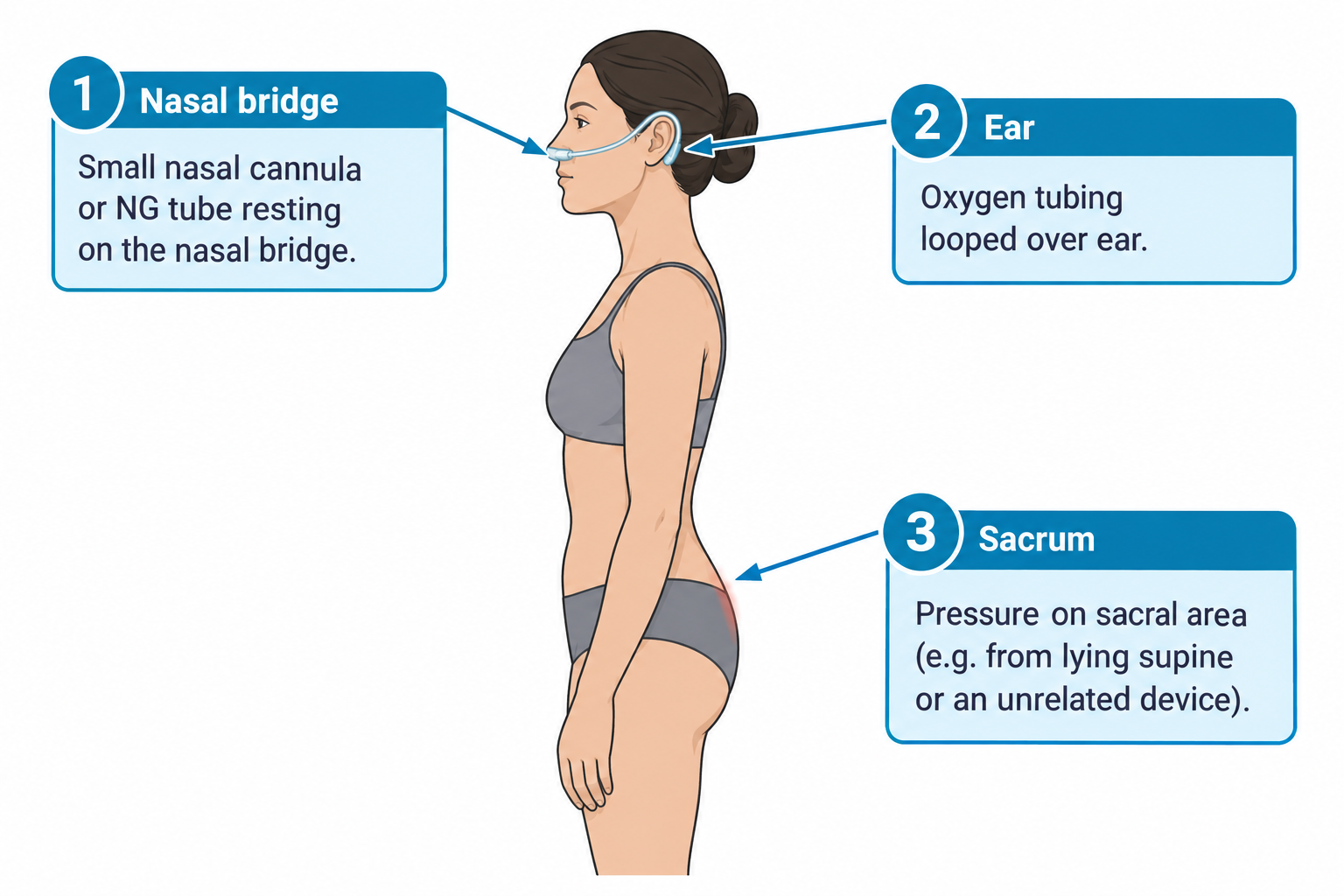
NGN tip: Medical devices are a common cause of hospital-acquired pressure injuries.

A side-view illustration of a woman with three numbered callouts pointing to common pressure injury sites from medical devices: the nasal bridge showing a nasal cannula resting on the nose, the ear showing oxygen tubing looped over it, and the sacrum showing a small area of redness at the lower back just above the buttocks indicating pressure injury risk.
Common device-related pressure injury sites: nasal bridge, ears, and sacrum
Achievable

Procedure-specific complications

Examples

  • Lumbar puncture: headache, CSF leak
  • Thoracentesis: pneumothorax
  • Endoscopy: bleeding, perforation
  • Biopsy: infection, hemorrhage

NGN insight: Focus on recognizing the most life-threatening complication, not every possible complication.

Putting it together: NGN prioritization

NGN integration

  • Sudden change = assess immediately
  • Device complication + abnormal vital signs = escalate immediately
  • Airway and circulation override device concerns
  • Devices increase risk while providing benefit
  • Early recognition prevents severe complications
  • Older adults present atypically
  • NGN rewards prioritization and trend analysis
  • The nurse is the final safety checkpoint

Sign up for free to take 5 quiz questions on this topic

Previous
Next  | 4.4.1 Medical emergencies
All rights reserved ©2016 - 2026 Achievable, Inc.

Potential complications of devices and procedures

Introduction

Medical devices and invasive procedures improve outcomes, but they also introduce predictable risks. On the Next generation NCLEX (NGN), learners are expected to recognize early warning signs, prioritize nursing actions, and prevent harm through vigilant monitoring and timely escalation.

This section integrates prior content on post-procedure monitoring, vital signs, electrolytes, and equipment safety, focusing on what can go wrong and how nurses respond first.

Learning objectives

By the end of this section, the learner should be able to:

  • Identify common complications associated with medical devices and procedures
  • Recognize early vs late clinical indicators
  • Prioritize immediate nursing actions
  • Apply NGN-style clinical judgment to device-related scenarios

Core concept: Devices bypass natural defenses

Any device that enters the body increases the risk of infection, bleeding, obstruction, or malfunction.

The nurse’s role is anticipation, not reaction.

Early vs late complications

Complications often follow predictable timelines. NGN questions frequently test whether the nurse recognizes when something is abnormal.

Early complications (minutes to hours)

  • Air embolism
  • Hemorrhage
  • Pneumothorax
  • Acute allergic reaction
  • Sedation-related respiratory depression

Late complications (days to weeks)

  • Device-associated infection
  • Thrombosis
  • Pressure injury
  • Device occlusion
  • Fistula formation

Infection-related complications

Common devices involved

  • Central venous catheters
  • Urinary catheters
  • Surgical drains
  • Endotracheal tubes

Early warning signs

  • Local redness, warmth, or drainage
  • Fever or hypothermia
  • Rising white blood cell count
  • Altered mental status in older adults

High-risk device-associated infections

Certain devices are strongly linked to specific infections that are frequently tested.

Central venous catheters → CLABSI risk

  • Monitor insertion site
  • Assess for unexplained fever
  • Maintain sterile dressing integrity

Urinary catheters → CAUTI risk

  • Maintain closed system
  • Keep bag below bladder
  • Avoid dependent loops

Endotracheal tubes → ventilator-associated pneumonia (VAP)

  • Elevate HOB 30-45°
  • Perform oral care
  • Monitor secretions

Surgical drains → localized wound infection

  • Sudden change in drainage color
  • Foul odor
  • Increased pain at site

Complications during device removal

Insertion risks are commonly discussed. Removal risks are often overlooked.

Central line removal

  • Risk: Air embolism
  • Nursing action: Apply an occlusive dressing immediately after removal and position the client supine during removal to reduce the risk of air embolism (left lateral Trendelenburg is used if an air embolism occurs)

Chest tube removal

  • Risk: Tension pneumothorax
  • Nursing action: Apply occlusive dressing immediately

Foley catheter removal

  • Risk: Urinary retention
  • Nursing action: Monitor first void within 6-8 hours

Epidural catheter removal

  • Risk: Epidural hematoma (neurological deficit)
  • Nursing action: Assess sensation and motor function
Definitions
Device-associated infection
Infection occurring due to the presence of an indwelling device
Hematoma
Localized collection of blood outside blood vessels
Device dislodgement
Partial or complete movement of a device from its intended position

NGN insight: Confusion may be the first sign of infection in older adults, even before fever or other classic symptoms develop.

Bleeding and vascular complications

High-risk procedures

  • Central line insertion
  • Arterial line placement
  • Surgical drain removal
  • Cardiac catheterization

Key assessment findings

  • Oozing or frank bleeding
  • Expanding hematoma
  • Hypotension
  • Tachycardia

Air embolism

Risk factors

  • Central line disconnection
  • Improper priming of IV tubing
  • Line removal without occlusion

Clinical signs

  • Sudden dyspnea
  • Chest pain
  • Hypotension
  • Anxiety or confusion

Medical emergency: Air embolism can cause rapid cardiovascular collapse.

Immediate nursing action: Place the client in the left lateral Trendelenburg position, administer oxygen as indicated, and notify the provider immediately.

Obstruction and dislodgement

Affected devices

  • Feeding tubes
  • Chest tubes
  • Urinary catheters
  • Surgical drains

Warning signs

  • Sudden change in output
  • Increased pressure or pain
  • Alarms sounding
  • Absent expected drainage

A normally functioning chest tube drainage system shows tidaling (fluid rising and falling with respirations) along with expected drainage output; loss of tidaling or a sudden drop in drainage suggests obstruction and should be assessed immediately.

Tissue injury and pressure-related complications

Contributing factors

  • Prolonged device contact
  • Edema
  • Poor circulation
  • Reduced sensation

Assessment findings

  • Skin redness or breakdown
  • Pain or numbness
  • Swelling

NGN tip: Medical devices are a common cause of hospital-acquired pressure injuries.

Procedure-specific complications

Examples

  • Lumbar puncture: headache, CSF leak
  • Thoracentesis: pneumothorax
  • Endoscopy: bleeding, perforation
  • Biopsy: infection, hemorrhage

NGN insight: Focus on recognizing the most life-threatening complication, not every possible complication.

Putting it together: NGN prioritization

NGN integration

  • Sudden change = assess immediately
  • Device complication + abnormal vital signs = escalate immediately
  • Airway and circulation override device concerns
Key points
  • Devices increase risk while providing benefit
  • Early recognition prevents severe complications
  • Older adults present atypically
  • NGN rewards prioritization and trend analysis
  • The nurse is the final safety checkpoint

More from Reduction of risk potential

  • Diagnostic tests and lab values
  • Monitoring for complications of procedures
  • Changes in vital signs and neurological status
  • Electrolyte imbalances and fluid status
  • Medical equipment use and safety