



Diagnostic tests and lab values
Introduction
Lab tests are like the body’s report card; they reveal infection, organ failure, acid-base imbalances, and more. As a nurse, you don’t just document the numbers, you interpret them, recognize red flags, and act fast when something’s off. NCLEX questions frequently ask you to evaluate critical lab values and choose the safest next step.
This section reviews commonly tested laboratory values, their normal reference ranges, clinical significance, and appropriate nursing interventions, along with the diagnostic procedures and monitoring skills tested alongside them.
Learning objectives
By the end of this section, you should be able to:
- Identify normal reference ranges for CBC, BMP, LFTs, and ABGs
- Interpret lab abnormalities and link them to common disease states
- Recognize critical values that require immediate action
- Apply nursing interventions for abnormal diagnostic findings
- Describe the nurse’s role before, during, and after common diagnostic procedures such as ECG, point-of-care testing, and maternal/fetal monitoring
Complete blood count (CBC)
| Component | Normal range | Meaning |
| WBC | 4,500-11,000 /mm³ | ↑ = infection, ↓ = leukopenia; increased infection risk |
| Hemoglobin (Hgb) | 12-16 g/dL (female) | ↓ = anemia or bleeding |
| Hemoglobin (Hgb) | 14-18 g/dL (male) | ↓ = anemia or bleeding |
| Hematocrit (Hct) | 37-47% (female) | Mirrors Hgb changes |
| Hematocrit (Hct) | 42-52% (male) | Mirrors Hgb changes |
| Platelets | 150,000-400,000 /mm³ | ↓ = bleeding risk, ↑ = clotting risk |
Basic metabolic panel (BMP)
| Electrolyte | Normal range | Clinical significance |
| Sodium (Na⁺) | 135-145 mEq/L | ↓ = fluid overload or sodium loss, ↑ = dehydration |
| Potassium (K⁺) | 3.5-5.0 mEq/L | ↓ or ↑ = cardiac arrhythmias |
| Calcium (Ca²⁺) | 8.5-10.5 mg/dL | ↓ = paresthesias, tetany, muscle cramps |
| Magnesium (Mg²⁺) | 1.5-2.5 mEq/L | ↓ = ↑ reflexes, seizures; ↑ = ↓ reflexes |
| BUN | 10-20 mg/dL | ↑ = kidney dysfunction or dehydration |
| Creatinine | 0.6-1.3 mg/dL | ↑ = impaired kidney function |
| Glucose (fasting) | 70-99 mg/dL | ↑ = hyperglycemia, ↓ = hypoglycemia |
| CO₂ (bicarbonate) | 22-28 mEq/L | Acid-base balance (paired with ABG) |
Arterial blood gases (ABGs)
| Value | Normal range | Significance |
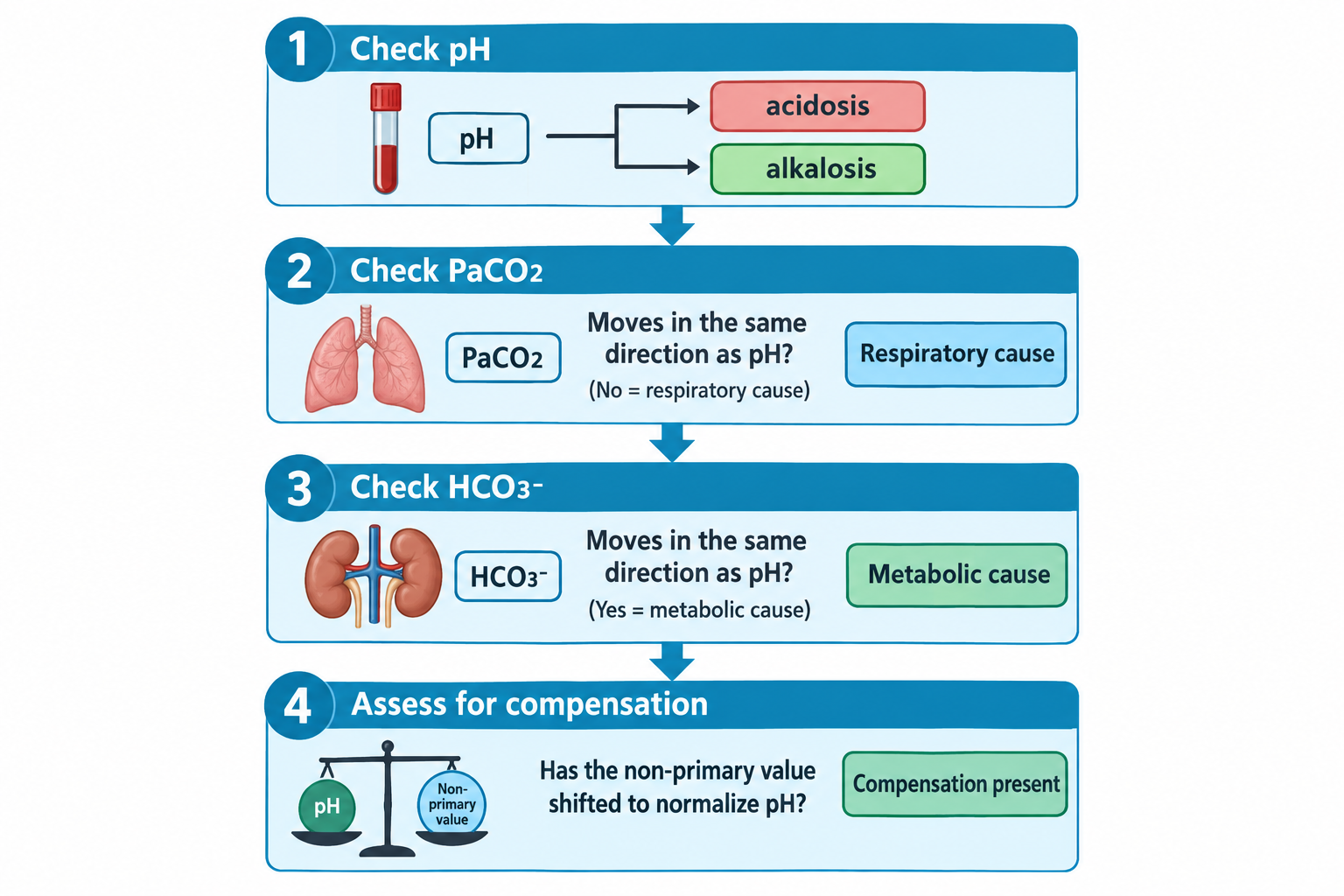
| pH | 7.35-7.45 | ↓ = acidosis, ↑ = alkalosis |
| PaCO₂ | 35-45 mmHg | Respiratory indicator: ↓ = alkalosis, ↑ = acidosis |
| HCO₃⁻ (bicarb) | 22-26 mEq/L | Metabolic indicator: ↓ = acidosis, ↑ = alkalosis |
| PaO₂ | 80-100 mmHg | Oxygenation status |
| SaO₂ | >95% | Hemoglobin saturation with oxygen |
Quick interpretation:
- ↓ pH + ↑ PaCO₂ = Respiratory acidosis (e.g., COPD exacerbation, sedative overdose)
- ↓ pH + ↓ HCO₃⁻ = Metabolic acidosis (e.g., diabetic ketoacidosis, renal failure)
- ↑ pH + ↓ PaCO₂ = Respiratory alkalosis (e.g., anxiety, hyperventilation)
- ↑ pH + ↑ HCO₃⁻ = Metabolic alkalosis (e.g., prolonged vomiting, diuretic therapy)
Liver function tests (LFTs)
| Test | Normal range | Clinical significance |
| AST/ALT | 10-40 IU/L | Liver damage (e.g., hepatitis, alcohol use) |
| Bilirubin (total) | 0.1-1.2 mg/dL | Jaundice, bile duct obstruction, liver dysfunction |
| Albumin | 3.5-5.0 g/dL | Low in liver disease, malnutrition, or protein loss |
| Ammonia | 15-45 mcg/dL | ↑ in hepatic encephalopathy |
| PT | 11-13 sec | ↑ with liver disease, warfarin therapy |
| INR | 0.8-1.1 (normal) | Therapeutic range for most warfarin indications: 2.0-3.0 |
| aPTT | 25-45 sec | ↑ with liver disease, heparin therapy |
Critical values: Know when to act
| Lab | Critical value | Nursing action |
| Potassium | <2.5 or >6.5 mEq/L | Place on cardiac monitor and notify the provider |
| Sodium | <120 or >160 mEq/L | Risk of seizures or coma. Implement seizure precautions as indicated and notify the provider |
| Glucose | <50 or >400 mg/dL | Hypoglycemia = administer glucose or dextrose; hyperglycemia = administer insulin as ordered |
| INR | >4 | Increased bleeding risk; notify the provider and anticipate intervention |
| WBC | <2,000 or >30,000/mm³ | Low (neutropenia) = implement neutropenic precautions and assess for infection; high (marked leukocytosis) = assess for severe infection, sepsis, or leukemia. Notify the provider for either |
| Platelets | <50,000 /mm³ | Risk of spontaneous bleeding; institute bleeding precautions and notify the provider |
| pH (ABG) | <7.25 or >7.55 | Indicates a critical acid-base disturbance; assess respiratory status, support ABCs, and notify the provider |
Example: Interpreting an ABG
A 64-year-old client with pneumonia has the following ABG results:
- pH 7.28
- PaCO₂ 52 mmHg
- HCO₃⁻ 25 mEq/L
Answer: The nurse identifies respiratory acidosis, assesses the client’s respiratory status, administers oxygen as prescribed, encourages deep breathing, and notifies the provider.
Rationale: The low pH with an elevated PaCO₂ and normal HCO₃⁻ indicates uncompensated respiratory acidosis, likely caused by hypoventilation associated with pneumonia.
Diagnostic procedures and nursing care
Lab values describe what’s happening inside the body, but the exam also tests procedures that gather diagnostic information directly - the heart’s electrical activity, a bedside glucose reading, or a fetus’s well-being. For each one, know the nurse’s role before, during, and after the test.
Electrocardiogram (ECG): Records the heart’s electrical activity to identify arrhythmias, ischemia, and electrolyte-related conduction changes. Have the client lie still with the chest exposed for electrode placement, and explain that the procedure is painless and takes only a few minutes.
Point-of-care testing (POCT): Bedside tests (e.g., capillary glucose, INR, blood gas analyzers) give results the nurse can act on immediately. Follow facility policy for calibration and quality control, and verify the client’s identity before testing to avoid acting on a mismatched result.
Nonstress test (NST): Monitors fetal heart rate response to fetal movement. A reactive NST shows at least two fetal heart rate accelerations of 15 beats/min lasting 15 seconds within a 20-minute period; a nonreactive NST doesn’t meet these criteria and warrants further evaluation, such as a biophysical profile.
Amniocentesis: A needle aspirates amniotic fluid for genetic or fetal lung-maturity testing. The nurse obtains informed consent, monitors maternal vital signs and fetal heart rate before and after the procedure, and instructs the client to report contractions, leaking fluid, fever, or decreased fetal movement afterward.
Ultrasound: Uses sound waves to visualize fetal growth, placental location, and amniotic fluid volume. A full bladder may improve visualization for an early transabdominal scan; no special bladder preparation is needed for a transvaginal ultrasound.