


Achievable logoAchievable logo
CCMA
Sign in
Sign up
Purchase
Textbook
Practice exams
Support
How it works
Resources
Exam catalog
Mountain with a flag at the peak
Textbook
Introduction
1. Medical assistant
2. Electronic records
3. Medical terminology and anatomy
4. The fundamentals of infection control
5. Introduction to vital signs
6. The patient interview and history
7. The physical examination
8. Appointment scheduling
9. Insurance billing
10. Diagnostic coding and the ICD-10-CM System
11. Procedural coding
12. Medical billing and reimbursement essentials
13. Assisting with medical specialties
14. Assisting with the musculoskeletal system
15. Assisting with the cardiovascular system
16. Assisting with the respiratory system
17. Assisting with the nervous system
18. Anatomy and physiology of the urinary system
19. Assisting in obstetrics and gynecology
20. Assisting in endocrinology
21. Assisting in ophthalmology & otolaryngology
22. Assisting in gastroenterology
23. Assisting in the immune & lymphatic systems
24. Assisting in pediatrics: the developmental stages and care
25. The medical assistant’s role in caring for the older patient
26. The role of the medical assistant in physical therapy examination and assessment
27. Preparing for minor surgery: room, solutions, and supplies
27.1 Assisting in surgery
27.2 Surgical instruments: cutting and grasping
27.3 Surgical instruments: retracting, probing, and specialty
27.4 Drapes and sutures
27.5 Specialty instruments, needles, and wound closure
27.6 Autoclave loading/unloading, chemical sterilization, and professional responsibilities
27.7 Surgical asepsis, instrument care, and the utility room
27.8 The autoclave process: operation, wrapping, and quality assurance
27.9 Dressings, bandages, and professional conduct
27.10 Introduction to minor office surgery and technology
27.11 Specialized procedures and preoperative preparation
27.12 Sterile technique and intraoperative assistance
27.13 Completing surgery and postoperative care
27.14 Wound care and healing
28. Introduction to the clinical laboratory
29. Urinalysis
30. Blood collection
31. Analysis of blood
32. Electrocardiography and heart structure
33. The principles of pharmacology
34. Essential calculations and measurement systems
35. Solid, liquid, & solutions medication doses
36. Administering medications
37. Metabolism and core nutrient roles
38. Medical emergencies in the healthcare setting
Achievable logoAchievable logo
27.14 Wound care and healing
Achievable CCMA
27. Preparing for minor surgery: room, solutions, and supplies

Wound care and healing

5 min read
Font
Discuss
Share
Feedback
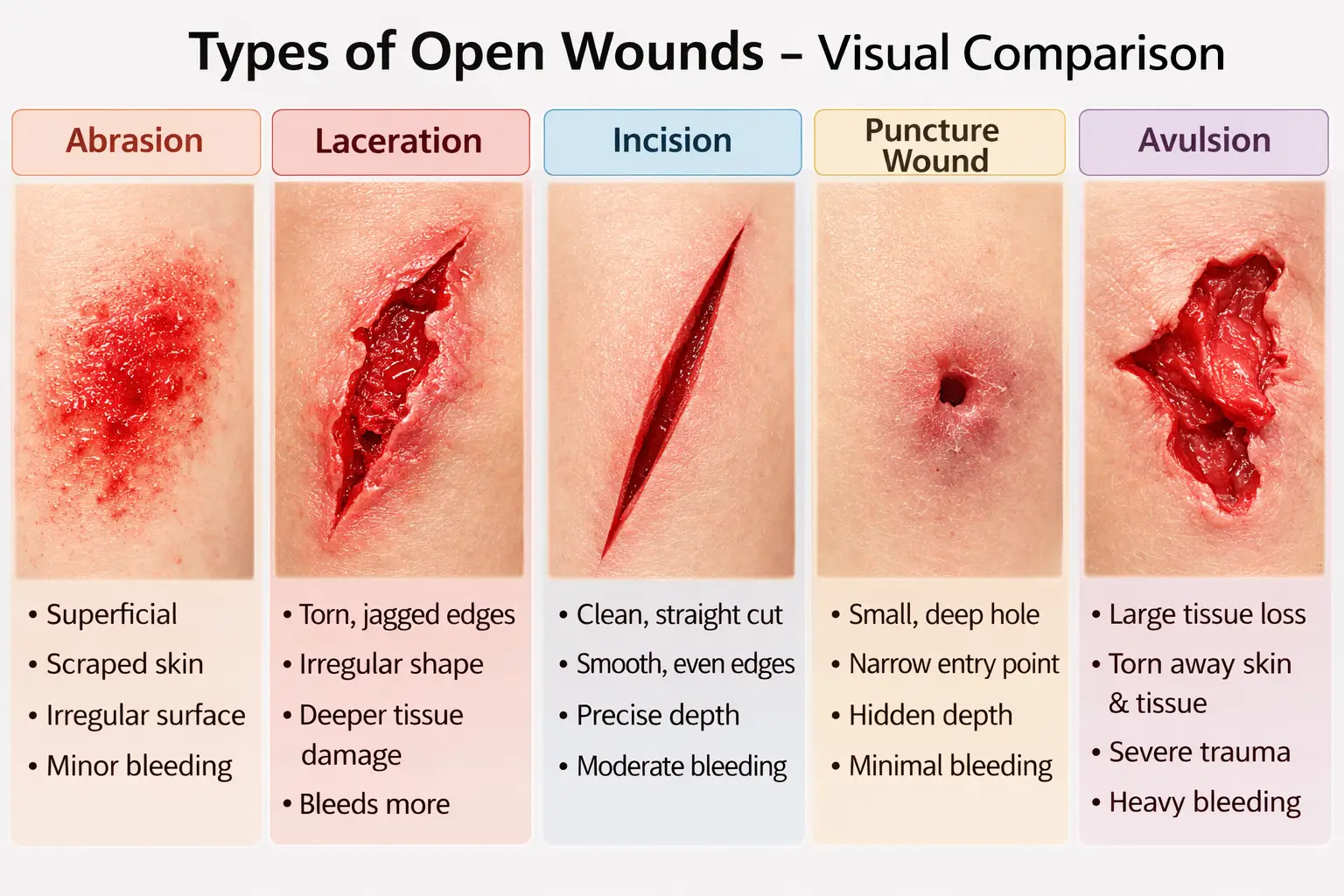
Four types of open wounds shown: incised, lacerated, puncture, and perforated.
Types of open wounds
Achievable

Wound care

A wound can be intentional (e.g., from a surgical incision) or accidental, and it may be open or closed. An open wound has an outward opening; the skin is broken, exposing the underlying tissues. A closed or nonpenetrating wound does not have an outward opening, but the underlying tissues are damaged, as in a hematoma, contusion, or bruise. Closed wounds usually are the result of some type of blunt trauma to the body. An aseptic (i.e., clean) wound is not infected with pathogens. Septic wounds are infected with pathogens.

Open wounds may be classified according to the appearance of their openings. An incised wound has a clean edge and is made with a cutting instrument. An incised wound may be the result of surgery, an accident, or a knife wound. A lacerated wound has torn or mangled tissues and is made by a dull or blunt instrument. A penetrating or puncture wound is caused by a sharp, slender object, such as a needle or an ice pick, passing through the skin into the underlying tissues. A perforated wound is a penetrating wound that passes through to a body organ or cavity, such as a gunshot wound.

Wound healing

Phase Timeframe Hallmark events
Hemostasis Immediate Vessels contract; platelets and fibrin seal the wound
Inflammatory 1-4 days Macrophages clear debris; edema, redness, heat, pain
Proliferation 5-20 days New tissue forms; wound contracts and seals
Remodeling Day 21 onward Collagen builds and strengthens scar tissue

All wounds go through a healing or repair process that has four phases. Hemostasis is the first phase. Blood vessels contract to control hemorrhage, and blood platelets form a network that acts as a glue to plug the wound. After a cascade of chemical reactions, fibrin is released into the wound and clotting begins. Fibrin continues to collect red blood cells (RBCs), and the clot dries into a scab.

The second, or inflammatory, phase focuses on destroying bacteria and removing debris. Special white blood cells (WBCs), called macrophages, arrive to clear away bacteria and dead tissue. This phase usually lasts about 1 to 4 days. During this phase, edema, erythema (redness), heat, and pain can occur.

The third phase, proliferation, encompasses wound healing and new growth; this lasts 5 to 20 days. During this phase, the tissues repair themselves. New cells form, and the wound continues to contract and seal. If the wound is a clean surgical incision, complete contraction usually occurs and a cicatrix forms.

The final phase, the remodeling phase, extends from day 21 onward. Clean, shallow wounds may contract in the first two stages; large or mangled wounds require the time and cellular activity of this final phase to build a bridge of new tissue to close the gap of the wound. The cells produce a fibrous protein substance called collagen (i.e., connective tissue) that gives the wounded tissues strength and forms scar tissue. Scar tissue is not true skin; it usually is very strong, but it lacks the elasticity of normal skin tissue. There is no blood supply or nerves in scar tissue.

Several factors influence the healing process. People who are young, in good general health, and have adequate nutrition heal more rapidly. Adequate protection and rest of the injured area also enhance the healing process. Destruction or reinjury during the second phase can delay healing and increase scarring. Wounds are susceptible to infection because the normal skin barrier is broken. If debris is present in a wound as the result of the breakdown of various cellular components, this dead (i.e., necrotic) tissue acts as a culture medium for bacterial growth. Suppuration (i.e., pus) contains necrotic tissue, bacteria, dead WBCs, and other products of tissue breakdown. Necrotic tissue must be removed; debris removal is called debridement, which may occur naturally or may be performed surgically.

Scope of practice: What a medical assistant may perform is set by state law and board rule and delegated by the supervising provider - there is no single national list. Sharp or surgical debridement is performed by the provider and is outside the medical assistant’s role; which wound-care tasks a medical assistant may perform is decided by the state’s rules and the provider’s delegation. See Standards of care for the full scope-of-practice framework.

Sometimes the provider may prefer no dressing or bandage on small wounds. This is called open wound healing. There are some advantages to open wound healing:

  • Air can circulate freely around the wound.
  • The wound is not irritated or rubbed by a dressing.
  • The wound stays dry, which inhibits bacterial growth, reducing the chance of infection.
  • Sutures stay dry and hold together better.
  • Any preexisting infection remains localized and is not spread by the dressing or bandage.

Sign up for free to take 10 quiz questions on this topic

Previous
Next  | 28.1 Introduction to the clinical laboratory
All rights reserved ©2016 - 2026 Achievable, Inc.

Wound care and healing

Wound care

A wound can be intentional (e.g., from a surgical incision) or accidental, and it may be open or closed. An open wound has an outward opening; the skin is broken, exposing the underlying tissues. A closed or nonpenetrating wound does not have an outward opening, but the underlying tissues are damaged, as in a hematoma, contusion, or bruise. Closed wounds usually are the result of some type of blunt trauma to the body. An aseptic (i.e., clean) wound is not infected with pathogens. Septic wounds are infected with pathogens.

Open wounds may be classified according to the appearance of their openings. An incised wound has a clean edge and is made with a cutting instrument. An incised wound may be the result of surgery, an accident, or a knife wound. A lacerated wound has torn or mangled tissues and is made by a dull or blunt instrument. A penetrating or puncture wound is caused by a sharp, slender object, such as a needle or an ice pick, passing through the skin into the underlying tissues. A perforated wound is a penetrating wound that passes through to a body organ or cavity, such as a gunshot wound.

Wound healing

Phase Timeframe Hallmark events
Hemostasis Immediate Vessels contract; platelets and fibrin seal the wound
Inflammatory 1-4 days Macrophages clear debris; edema, redness, heat, pain
Proliferation 5-20 days New tissue forms; wound contracts and seals
Remodeling Day 21 onward Collagen builds and strengthens scar tissue

All wounds go through a healing or repair process that has four phases. Hemostasis is the first phase. Blood vessels contract to control hemorrhage, and blood platelets form a network that acts as a glue to plug the wound. After a cascade of chemical reactions, fibrin is released into the wound and clotting begins. Fibrin continues to collect red blood cells (RBCs), and the clot dries into a scab.

The second, or inflammatory, phase focuses on destroying bacteria and removing debris. Special white blood cells (WBCs), called macrophages, arrive to clear away bacteria and dead tissue. This phase usually lasts about 1 to 4 days. During this phase, edema, erythema (redness), heat, and pain can occur.

The third phase, proliferation, encompasses wound healing and new growth; this lasts 5 to 20 days. During this phase, the tissues repair themselves. New cells form, and the wound continues to contract and seal. If the wound is a clean surgical incision, complete contraction usually occurs and a cicatrix forms.

The final phase, the remodeling phase, extends from day 21 onward. Clean, shallow wounds may contract in the first two stages; large or mangled wounds require the time and cellular activity of this final phase to build a bridge of new tissue to close the gap of the wound. The cells produce a fibrous protein substance called collagen (i.e., connective tissue) that gives the wounded tissues strength and forms scar tissue. Scar tissue is not true skin; it usually is very strong, but it lacks the elasticity of normal skin tissue. There is no blood supply or nerves in scar tissue.

Several factors influence the healing process. People who are young, in good general health, and have adequate nutrition heal more rapidly. Adequate protection and rest of the injured area also enhance the healing process. Destruction or reinjury during the second phase can delay healing and increase scarring. Wounds are susceptible to infection because the normal skin barrier is broken. If debris is present in a wound as the result of the breakdown of various cellular components, this dead (i.e., necrotic) tissue acts as a culture medium for bacterial growth. Suppuration (i.e., pus) contains necrotic tissue, bacteria, dead WBCs, and other products of tissue breakdown. Necrotic tissue must be removed; debris removal is called debridement, which may occur naturally or may be performed surgically.

Scope of practice: What a medical assistant may perform is set by state law and board rule and delegated by the supervising provider - there is no single national list. Sharp or surgical debridement is performed by the provider and is outside the medical assistant’s role; which wound-care tasks a medical assistant may perform is decided by the state’s rules and the provider’s delegation. See Standards of care for the full scope-of-practice framework.

Sometimes the provider may prefer no dressing or bandage on small wounds. This is called open wound healing. There are some advantages to open wound healing:

  • Air can circulate freely around the wound.
  • The wound is not irritated or rubbed by a dressing.
  • The wound stays dry, which inhibits bacterial growth, reducing the chance of infection.
  • Sutures stay dry and hold together better.
  • Any preexisting infection remains localized and is not spread by the dressing or bandage.

More from Preparing for minor surgery: room, solutions, and supplies

  • Assisting in surgery
  • Surgical instruments: cutting and grasping
  • Surgical instruments: retracting, probing, and specialty
  • Drapes and sutures
  • Specialty instruments, needles, and wound closure