


Achievable logoAchievable logo
CCMA
Sign in
Sign up
Purchase
Textbook
Practice exams
Support
How it works
Exam catalog
Mountain with a flag at the peak
Textbook
1. Medical assistant
2. Electronic records
3. Medical terminology and anatomy
4. The fundamentals of infection control
5. Introduction to vital signs
6. The patient interview and history
7. The physical examination
8. Appointment scheduling
9. Insurance billing
10. Diagnostic coding and the ICD-10-CM System
11. Procedural coding
12. Medical billing and reimbursement essentials
13. Assisting with medical specialties
14. Assisting with the musculoskeletal system
15. Assisting with the cardiovascular system
16. Assisting with the respiratory system
17. Assisting with the nervous system
18. Anatomy and physiology of the urinary system
19. Assisting in obstetrics and gynecology
20. Assisting in endocrinology
21. Assisting in ophthalmology & otolaryngology
22. Assisting in gastroenterology
23. Assisting in the immune & lymphatic systems
24. Assisting in pediatrics: the developmental stages and care
25. The medical assistant’s role in caring for the older patient
26. The role of the medical assistant in physical therapy examination and assessment
27. Preparing for minor surgery: room, solutions, and supplies
27.1 Assisting in surgery
27.2 Surgical instruments: cutting and grasping
27.3 Drapes and sutures
27.4 Autoclave loading/unloading, chemical sterilization, and professional responsibilities
27.5 Surgical asepsis, instrument care, and the utility room
27.6 The autoclave process: operation, wrapping, and quality assurance
27.7 Dressings, bandages, and professional conduct
27.8 Introduction to minor office surgery and technology
27.9 Specialized procedures and preoperative preparation
27.10 Sterile technique and intraoperative assistance
27.11 Completing surgery and postoperative care
28. Introduction to the clinical laboratory
29. Urinalysis
30. Blood collection
31. Analysis of blood
32. Electrocardiography and heart structure
33. The principles of pharmacology
34. Essential calculations and measurement systems
35. Solid, liquid, & solutions medication doses
36. Administering medications
37. Metabolism and core nutrient roles
38. Medical emergencies in the healthcare setting
Achievable logoAchievable logo
27.6 The autoclave process: operation, wrapping, and quality assurance
Achievable CCMA
27. Preparing for minor surgery: room, solutions, and supplies
Our CCMA course is currently in development and is a work-in-progress.

The autoclave process: operation, wrapping, and quality assurance

10 min read
Font
Discuss
Share
Feedback

Autoclave

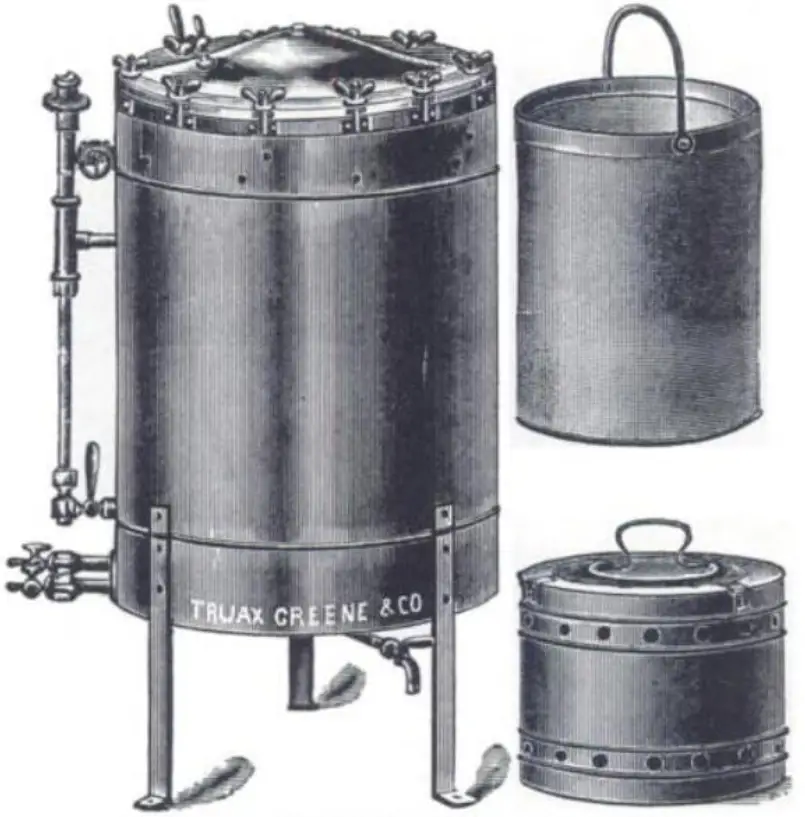
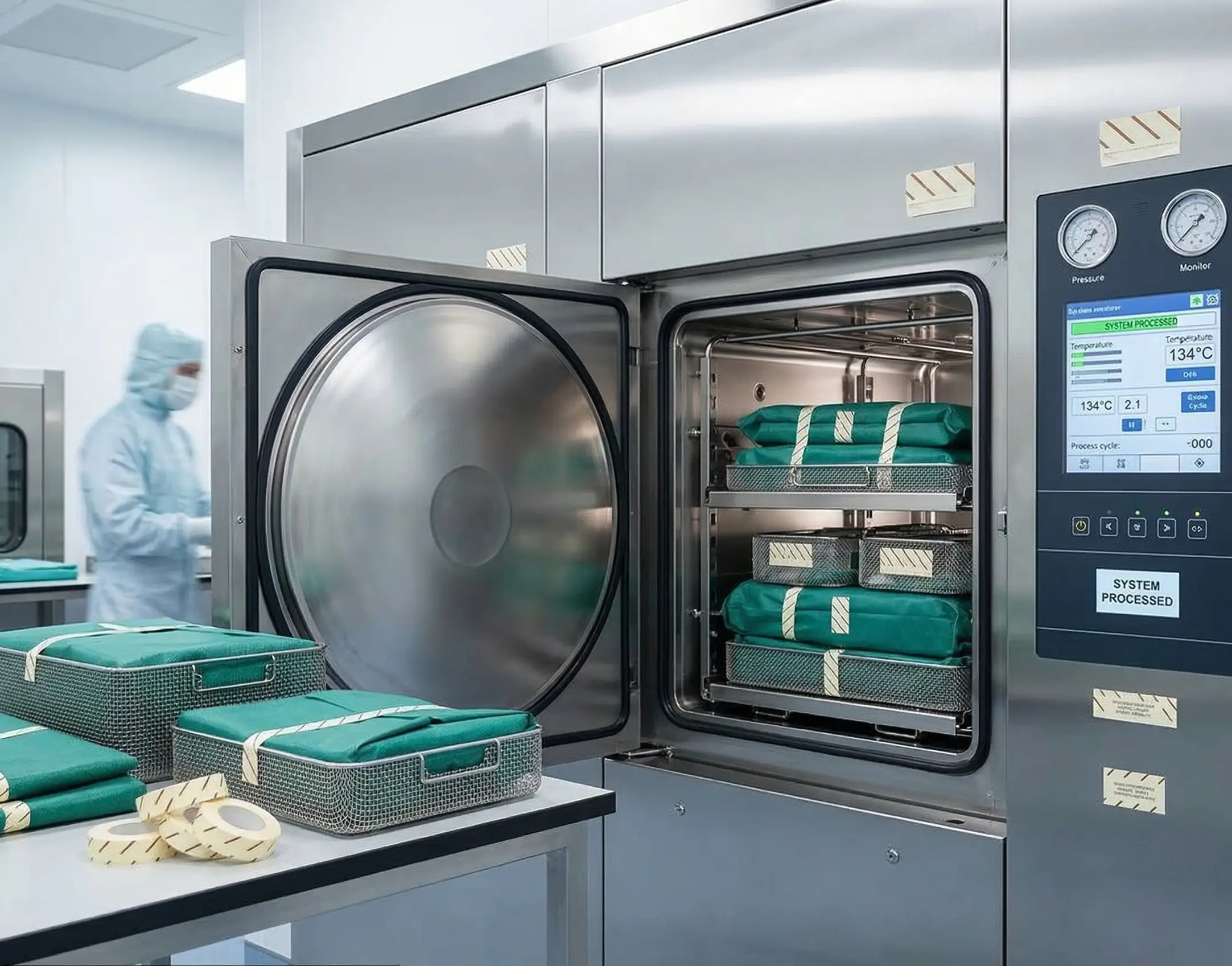
Sterilization can be achieved with moist heat, dry heat, ultraviolet or ionizing radiation, gas, or chemicals. Medical facilities typically use the autoclave method, which uses moist heat and pressure to achieve sterilization. Steam under pressure in the autoclave is an excellent method of sterilization because it kills all pathogens and spores.

Pressurized steam is fast, convenient, and dependable. The pressure allows for heat higher than the boiling point. Steam from a pot of boiling water on a stove is about 212°F (100°C). We know that spores can survive temperatures of up to 240°F (115°C) for 4 hours. In an autoclave, the steam is contained within a chamber and is under 15 pounds per square inch (psi) of pressure. This pressure allows the steam to reach 250°F (121°C). No organism can last at that temperature for more than 15 minutes. When steam enters the autoclave chamber, it simultaneously heats and wets the object, coagulating the proteins present in all living organisms. When the cycle is complete and the chamber has cooled, the steam condenses and explodes the cells of microorganisms, thus destroying them. The steam moisture must come in contact with all surfaces being sterilized to be effective. Steam under pressure is capable of much faster penetration of fabrics and textiles than dry heat, but its use has definite limitations if the proper techniques are not followed.

Steam autoclave used for sterilizing medical instruments
Steam autoclave
Wikimedia Commons
/
Public Domain

The recommended temperature for sterilization in an autoclave is 250° to 255°F (121° to 123°C). Follow the guidelines that come with the autoclave; in general, unwrapped items are sterilized for 20 minutes, small wrapped items for 30 minutes, and large or tightly wrapped items for 40 minutes. Processing time starts after the autoclave reaches normal operating conditions of 250°F (121°C) and 15 pounds per square inch (psi) pressure. There are different autoclave cycles for different materials; ambulatory care facilities do not autoclave liquids or dressing material, so the most used cycle will be the gravity cycle, which is used to sterilize stainless steel instruments. In the gravity (“fast exhaust”) cycle, the autoclave fills with steam and is held at a set temperature for a set period. When the cycle is complete, a valve opens, and the chamber rapidly returns to atmospheric pressure. Drying time may be added to the end of the cycle.

Incorrect operation of an autoclave may result in superheated steam. If steam is brought to too high a temperature, it is literally dried out, and the advantage of a higher heat is diminished. Wet steam is another cause of incomplete sterilization. Wet steam results from failing to preheat the chamber, which causes excessive condensation in the interior of the chamber. Condensation is necessary, but too much prevents the sterilization process from being completed properly. It can be compared with taking a hot shower in a cold bathroom, which results in heavily steamed mirrors, walls, and towels. If packs become too saturated to dry during the drying cycle, they pick up and absorb bacteria from the air or any surface on which they are placed after removal from the autoclave. Placing cold instruments in a hot chamber also increases condensation. Other causes of wet steam include opening the door too wide at the end of the cycle or allowing a rush of cold air into the chamber. Overfilling the water reservoir may produce this same effect.

The main cause of incomplete sterilization in the autoclave is the presence of residual air.

Without the complete elimination of air, an adequately high temperature cannot be reached. Air and steam do not mix. Because air is heavier than steam, it pools wherever possible. One-tenth of 1% (0.1%) of residual air trapped around an instrument prevents complete sterilization. This is especially dangerous in older autoclaves that do not have a chamber thermometer separate from the pressure gauge. Adequate chamber pressure does not guarantee a proper chamber temperature.

Wrapping materials

Maintaining the sterility of the autoclaved package depends completely on the wrapper and method of wrapping. The wrapping material must be permeable to steam but impervious to contaminants. Acceptable wrapping materials for autoclaving should allow the steam to penetrate and prevent pathogens from entering during storage and handling. A wrapper should not be used if it is torn or has a hole in it.

The types of wrapping material used for instruments that are to be autoclaved are disposable double-ply autoclave paper and peel-apart polypropylene bags. Multiple layers of autoclave paper are recommended to maintain the integrity of sterilization during handling and storage of autoclaved instrument packs. Double-layered autoclave paper provides multiple layers of protection; this shields surgical instruments from contamination and saves time because wrapping is done only once.

Wrapping instruments

The method used to wrap instruments for autoclave sterilization must allow the pack to be opened without becoming contaminated. The rules for protecting package contents include the following:

  • Discard autoclave paper that is torn or has holes.
  • Wrap all hinged instruments in the open position to allow full steam penetration of the joint.
  • Place a gauze square around the tips of sharp instruments to prevent them from piercing the wrapping material.
  • If a number of instruments are to be placed on a stainless-steel tray for wrapping, first, place a double-folded towel on the tray, and then position the instruments. This helps to protect them.
  • Polypropylene is a plastic capable of withstanding autoclaving, but it is resistant to heat transfer. Therefore, materials in a polypropylene pan take longer to autoclave than the same materials in a stainless-steel pan.
  • When using sterilizing bags, insert the handles of the instruments into the end of the bag to be opened first to ensure that the grasping end of the instrument can be reached easily when the bag is opened.
  • When using two-ply autoclave paper, use specialized autoclave tape to seal the package.
  • Label each pack according to the instrument contents and sterilization date, and write your initials. Use a permanent marker; never use a ballpoint pen.

Whether you are wrapping one item or many items together on a tray as a surgical pack, the procedure is the same; be sure the wrapper is large enough to cover the items to be sterilized.

Sterile autoclave tape used to verify sterilization
Sterile autoclave tape

Sterilization indicators

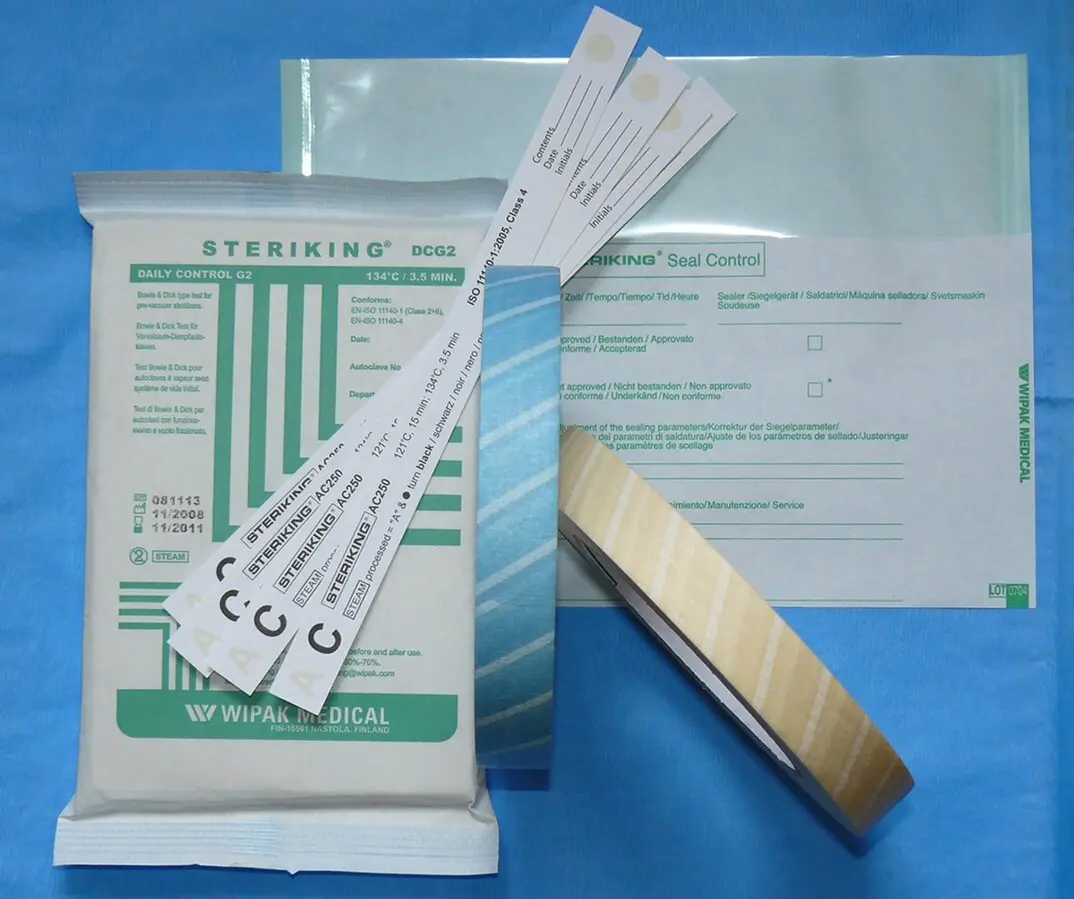
Sterilization is achieved only when steam reaches the optimum temperature for a designated length of time and has penetrated to the center of the articles. Sterilization indicators must be used routinely to determine whether all microorganisms have been destroyed. The two basic types of sterilization indicators are chemical indicators (e.g., autoclave tape) and biological indicators.

Autoclave indicators used to confirm sterilization
Autoclave indicators
Wikimedia Commons
/
CC BY-SA 3.0

Autoclave tape, a commonly used sterilization indicator, contains a chemical dye that changes color when exposed to steam. The tape is not an absolute indication that the proper sterilization time, temperature, and steam have been maintained. It merely indicates that a high temperature was reached while the article was in the autoclave. The tape strip must completely change color (colors vary by manufacturer) or reveal the word autoclaved to show effective operation. The main function of autoclave tape, besides holding the wrapping material together, is to verify at a glance that the package was autoclaved. Other chemical indicators are placed inside the instrument packages to verify steam and heat penetration of the wrapping. Some instruments are autoclaved unwrapped, such as stainless-steel vaginal specula. A chemical indicator should be placed in the autoclave with unwrapped instruments in an area most difficult for steam to access, such as under the tray or between the instruments.

The healthcare facility should have a policy for how frequently the autoclave is tested using biologic sterilization indicators. The Centers for Disease Control and Prevention (CDC) recommends that this procedure should be performed weekly. Spore strip indicators have been replaced by rapid-readout biologic indicators that use ampules of Bacillus stearothermophilus, which are destroyed at 250°F (121°C). The ampule is placed in the center of the largest pack that is autoclaved in the facility to determine the accuracy of the autoclave and autoclave procedures in destroying all microbes. On completion of the cycle, the ampule is sent to a laboratory for analysis of any type of microbial growth. If tests show that microbes are present in the sample, then a report is sent to the facility notifying it that the autoclave, or possibly its sterilization procedures, are not effective in achieving sterilization. Results from the biologic indicator testing must be documented. Failed tests must be investigated and the causes resolved.

Quality assurance records for office sterilization

Every office should have specific protocols for quality assurance evaluations of the autoclave, including regular maintenance. This is done at specified intervals, depending on the volume and frequency of autoclave use. A log must be kept of the type of control test done, when it was performed, and the testing results. If the testing results indicate that sterilization was inadequate, a report must be made and filed. The report should identify the nature of the problem and how and when it was corrected. The report also should contain proof of correction by indicating the date and time of a first, subsequent, and successful sterilization run.

Autoclave sterilization

  • Uses moist heat and pressure (steam at 15 psi, 250°F/121°C)
  • Kills all pathogens and spores in 15 minutes at correct conditions
  • Effective only if steam contacts all surfaces; gravity cycle common for instruments

Autoclave operation and limitations

  • Unwrapped: 20 min; small wrapped: 30 min; large/tightly wrapped: 40 min (at 250°F/121°C, 15 psi)
  • Incomplete sterilization causes:
    • Residual air (main cause)
    • Superheated or wet steam (from improper preheating, overfilling, or cold instruments)
  • Adequate chamber temperature, not just pressure, is essential

Wrapping materials

  • Must be permeable to steam, impervious to contaminants
  • Acceptable: double-ply autoclave paper, peel-apart polypropylene bags
  • Double-layered paper provides extra protection and efficiency

Wrapping instruments

  • Discard damaged wrapping material
  • Hinged instruments: wrap open for steam penetration
  • Gauze on sharp tips to prevent punctures
  • Polypropylene pans require longer autoclaving than stainless steel
  • Use autoclave tape to seal and label with contents, date, initials (permanent marker only)

Sterilization indicators

  • Chemical indicators (autoclave tape): color change shows exposure to steam, not full sterilization
  • Biological indicators: ampules of Bacillus stearothermophilus, test for destruction of all microbes
    • CDC recommends weekly biological testing
    • Place indicator in center of largest pack
  • Document and investigate failed tests

Quality assurance records

  • Maintain protocols for regular autoclave maintenance and testing
  • Keep logs of control tests, results, and corrective actions
  • File reports for inadequate sterilization, including proof of correction and dates

Sign up for free to take 20 quiz questions on this topic

Previous
Next  | 27.7 Dressings, bandages, and professional conduct
All rights reserved ©2016 - 2026 Achievable, Inc.

The autoclave process: operation, wrapping, and quality assurance

Autoclave

Sterilization can be achieved with moist heat, dry heat, ultraviolet or ionizing radiation, gas, or chemicals. Medical facilities typically use the autoclave method, which uses moist heat and pressure to achieve sterilization. Steam under pressure in the autoclave is an excellent method of sterilization because it kills all pathogens and spores.

Pressurized steam is fast, convenient, and dependable. The pressure allows for heat higher than the boiling point. Steam from a pot of boiling water on a stove is about 212°F (100°C). We know that spores can survive temperatures of up to 240°F (115°C) for 4 hours. In an autoclave, the steam is contained within a chamber and is under 15 pounds per square inch (psi) of pressure. This pressure allows the steam to reach 250°F (121°C). No organism can last at that temperature for more than 15 minutes. When steam enters the autoclave chamber, it simultaneously heats and wets the object, coagulating the proteins present in all living organisms. When the cycle is complete and the chamber has cooled, the steam condenses and explodes the cells of microorganisms, thus destroying them. The steam moisture must come in contact with all surfaces being sterilized to be effective. Steam under pressure is capable of much faster penetration of fabrics and textiles than dry heat, but its use has definite limitations if the proper techniques are not followed.

The recommended temperature for sterilization in an autoclave is 250° to 255°F (121° to 123°C). Follow the guidelines that come with the autoclave; in general, unwrapped items are sterilized for 20 minutes, small wrapped items for 30 minutes, and large or tightly wrapped items for 40 minutes. Processing time starts after the autoclave reaches normal operating conditions of 250°F (121°C) and 15 pounds per square inch (psi) pressure. There are different autoclave cycles for different materials; ambulatory care facilities do not autoclave liquids or dressing material, so the most used cycle will be the gravity cycle, which is used to sterilize stainless steel instruments. In the gravity (“fast exhaust”) cycle, the autoclave fills with steam and is held at a set temperature for a set period. When the cycle is complete, a valve opens, and the chamber rapidly returns to atmospheric pressure. Drying time may be added to the end of the cycle.

Incorrect operation of an autoclave may result in superheated steam. If steam is brought to too high a temperature, it is literally dried out, and the advantage of a higher heat is diminished. Wet steam is another cause of incomplete sterilization. Wet steam results from failing to preheat the chamber, which causes excessive condensation in the interior of the chamber. Condensation is necessary, but too much prevents the sterilization process from being completed properly. It can be compared with taking a hot shower in a cold bathroom, which results in heavily steamed mirrors, walls, and towels. If packs become too saturated to dry during the drying cycle, they pick up and absorb bacteria from the air or any surface on which they are placed after removal from the autoclave. Placing cold instruments in a hot chamber also increases condensation. Other causes of wet steam include opening the door too wide at the end of the cycle or allowing a rush of cold air into the chamber. Overfilling the water reservoir may produce this same effect.

The main cause of incomplete sterilization in the autoclave is the presence of residual air.

Without the complete elimination of air, an adequately high temperature cannot be reached. Air and steam do not mix. Because air is heavier than steam, it pools wherever possible. One-tenth of 1% (0.1%) of residual air trapped around an instrument prevents complete sterilization. This is especially dangerous in older autoclaves that do not have a chamber thermometer separate from the pressure gauge. Adequate chamber pressure does not guarantee a proper chamber temperature.

Wrapping materials

Maintaining the sterility of the autoclaved package depends completely on the wrapper and method of wrapping. The wrapping material must be permeable to steam but impervious to contaminants. Acceptable wrapping materials for autoclaving should allow the steam to penetrate and prevent pathogens from entering during storage and handling. A wrapper should not be used if it is torn or has a hole in it.

The types of wrapping material used for instruments that are to be autoclaved are disposable double-ply autoclave paper and peel-apart polypropylene bags. Multiple layers of autoclave paper are recommended to maintain the integrity of sterilization during handling and storage of autoclaved instrument packs. Double-layered autoclave paper provides multiple layers of protection; this shields surgical instruments from contamination and saves time because wrapping is done only once.

Wrapping instruments

The method used to wrap instruments for autoclave sterilization must allow the pack to be opened without becoming contaminated. The rules for protecting package contents include the following:

  • Discard autoclave paper that is torn or has holes.
  • Wrap all hinged instruments in the open position to allow full steam penetration of the joint.
  • Place a gauze square around the tips of sharp instruments to prevent them from piercing the wrapping material.
  • If a number of instruments are to be placed on a stainless-steel tray for wrapping, first, place a double-folded towel on the tray, and then position the instruments. This helps to protect them.
  • Polypropylene is a plastic capable of withstanding autoclaving, but it is resistant to heat transfer. Therefore, materials in a polypropylene pan take longer to autoclave than the same materials in a stainless-steel pan.
  • When using sterilizing bags, insert the handles of the instruments into the end of the bag to be opened first to ensure that the grasping end of the instrument can be reached easily when the bag is opened.
  • When using two-ply autoclave paper, use specialized autoclave tape to seal the package.
  • Label each pack according to the instrument contents and sterilization date, and write your initials. Use a permanent marker; never use a ballpoint pen.

Whether you are wrapping one item or many items together on a tray as a surgical pack, the procedure is the same; be sure the wrapper is large enough to cover the items to be sterilized.

Sterilization indicators

Sterilization is achieved only when steam reaches the optimum temperature for a designated length of time and has penetrated to the center of the articles. Sterilization indicators must be used routinely to determine whether all microorganisms have been destroyed. The two basic types of sterilization indicators are chemical indicators (e.g., autoclave tape) and biological indicators.

Autoclave tape, a commonly used sterilization indicator, contains a chemical dye that changes color when exposed to steam. The tape is not an absolute indication that the proper sterilization time, temperature, and steam have been maintained. It merely indicates that a high temperature was reached while the article was in the autoclave. The tape strip must completely change color (colors vary by manufacturer) or reveal the word autoclaved to show effective operation. The main function of autoclave tape, besides holding the wrapping material together, is to verify at a glance that the package was autoclaved. Other chemical indicators are placed inside the instrument packages to verify steam and heat penetration of the wrapping. Some instruments are autoclaved unwrapped, such as stainless-steel vaginal specula. A chemical indicator should be placed in the autoclave with unwrapped instruments in an area most difficult for steam to access, such as under the tray or between the instruments.

The healthcare facility should have a policy for how frequently the autoclave is tested using biologic sterilization indicators. The Centers for Disease Control and Prevention (CDC) recommends that this procedure should be performed weekly. Spore strip indicators have been replaced by rapid-readout biologic indicators that use ampules of Bacillus stearothermophilus, which are destroyed at 250°F (121°C). The ampule is placed in the center of the largest pack that is autoclaved in the facility to determine the accuracy of the autoclave and autoclave procedures in destroying all microbes. On completion of the cycle, the ampule is sent to a laboratory for analysis of any type of microbial growth. If tests show that microbes are present in the sample, then a report is sent to the facility notifying it that the autoclave, or possibly its sterilization procedures, are not effective in achieving sterilization. Results from the biologic indicator testing must be documented. Failed tests must be investigated and the causes resolved.

Quality assurance records for office sterilization

Every office should have specific protocols for quality assurance evaluations of the autoclave, including regular maintenance. This is done at specified intervals, depending on the volume and frequency of autoclave use. A log must be kept of the type of control test done, when it was performed, and the testing results. If the testing results indicate that sterilization was inadequate, a report must be made and filed. The report should identify the nature of the problem and how and when it was corrected. The report also should contain proof of correction by indicating the date and time of a first, subsequent, and successful sterilization run.

Key points

Autoclave sterilization

  • Uses moist heat and pressure (steam at 15 psi, 250°F/121°C)
  • Kills all pathogens and spores in 15 minutes at correct conditions
  • Effective only if steam contacts all surfaces; gravity cycle common for instruments

Autoclave operation and limitations

  • Unwrapped: 20 min; small wrapped: 30 min; large/tightly wrapped: 40 min (at 250°F/121°C, 15 psi)
  • Incomplete sterilization causes:
    • Residual air (main cause)
    • Superheated or wet steam (from improper preheating, overfilling, or cold instruments)
  • Adequate chamber temperature, not just pressure, is essential

Wrapping materials

  • Must be permeable to steam, impervious to contaminants
  • Acceptable: double-ply autoclave paper, peel-apart polypropylene bags
  • Double-layered paper provides extra protection and efficiency

Wrapping instruments

  • Discard damaged wrapping material
  • Hinged instruments: wrap open for steam penetration
  • Gauze on sharp tips to prevent punctures
  • Polypropylene pans require longer autoclaving than stainless steel
  • Use autoclave tape to seal and label with contents, date, initials (permanent marker only)

Sterilization indicators

  • Chemical indicators (autoclave tape): color change shows exposure to steam, not full sterilization
  • Biological indicators: ampules of Bacillus stearothermophilus, test for destruction of all microbes
    • CDC recommends weekly biological testing
    • Place indicator in center of largest pack
  • Document and investigate failed tests

Quality assurance records

  • Maintain protocols for regular autoclave maintenance and testing
  • Keep logs of control tests, results, and corrective actions
  • File reports for inadequate sterilization, including proof of correction and dates

More from Preparing for minor surgery: room, solutions, and supplies

  • Assisting in surgery
  • Surgical instruments: cutting and grasping
  • Drapes and sutures
  • Autoclave loading/unloading, chemical sterilization, and professional responsibilities
  • Surgical asepsis, instrument care, and the utility room