


Achievable logoAchievable logo
CCMA
Sign in
Sign up
Purchase
Textbook
Practice exams
Support
How it works
Exam catalog
Mountain with a flag at the peak
Textbook
1. Medical assistant
2. Electronic records
3. Medical terminology and anatomy
4. The fundamentals of infection control
5. Introduction to vital signs
6. The patient interview and history
7. The physical examination
8. Appointment scheduling
9. Insurance billing
10. Diagnostic coding and the ICD-10-CM System
11. Procedural coding
12. Medical billing and reimbursement essentials
13. Assisting with medical specialties
14. Assisting with the musculoskeletal system
15. Assisting with the cardiovascular system
16. Assisting with the respiratory system
17. Assisting with the nervous system
18. Anatomy and physiology of the urinary system
19. Assisting in obstetrics and gynecology
20. Assisting in endocrinology
21. Assisting in ophthalmology & otolaryngology
22. Assisting in gastroenterology
23. Assisting in the immune & lymphatic systems
24. Assisting in pediatrics: the developmental stages and care
25. The medical assistant’s role in caring for the older patient
26. The role of the medical assistant in physical therapy examination and assessment
27. Preparing for minor surgery: room, solutions, and supplies
27.1 Assisting in surgery
27.2 Surgical instruments: cutting and grasping
27.3 Drapes and sutures
27.4 Autoclave loading/unloading, chemical sterilization, and professional responsibilities
27.5 Surgical asepsis, instrument care, and the utility room
27.6 The autoclave process: operation, wrapping, and quality assurance
27.7 Dressings, bandages, and professional conduct
27.8 Introduction to minor office surgery and technology
27.9 Specialized procedures and preoperative preparation
27.10 Sterile technique and intraoperative assistance
27.11 Completing surgery and postoperative care
28. Introduction to the clinical laboratory
29. Urinalysis
30. Blood collection
31. Analysis of blood
32. Electrocardiography and heart structure
33. The principles of pharmacology
34. Essential calculations and measurement systems
35. Solid, liquid, & solutions medication doses
36. Administering medications
37. Metabolism and core nutrient roles
38. Medical emergencies in the healthcare setting
Achievable logoAchievable logo
27.2 Surgical instruments: cutting and grasping
Achievable CCMA
27. Preparing for minor surgery: room, solutions, and supplies
Our CCMA course is currently in development and is a work-in-progress.

Surgical instruments: cutting and grasping

10 min read
Font
Discuss
Share
Feedback

Surgical instruments

The medical assistant must know which instruments are used for each procedure and should be able to identify and understand the function of the surgical instruments that the provider prefers. Instruments have clearly identifiable parts and can be visually differentiated from one another. The basic components are the handle, the closing mechanism, and the part that comes in contact with the patient, commonly called the jaws. Many instruments can have either straight or curved tips, depending on the operator’s preference and the task to be performed.

Instruments have either ring handles (finger rings), or spring handles; these sometimes are called thumb-handled or thumb grasp instruments. Scissors are an example of a ring-handled instrument; forceps (tweezers) have spring handles. Some instruments have a hinge-type mechanism called a box lock.

Ratchets resemble gears and are located just below or next to the ring handle. They are used to lock an instrument into position. Most ratchets can be closed at three or more positions, depending on the thickness of the tissue or materials being grasped.

The inner surfaces of the jaws on some instruments have ridged teeth, called serrations; both ring-handled and thumb-type instruments may have them. These serrations may be crisscross, horizontal, or lengthwise. Serrations prevent small blood vessels and tissue from slipping out of the jaws of the instrument.

Instrument tips or jaws may be plain tipped or toothed. Tissue forceps usually are toothed instruments and are identified by the number of intermeshing teeth (e.g., 1 × 2, 2 × 3, 3 × 4). Allis tissue forceps are used to grasp delicate, soft tissues, so the teeth are finer, shallower, and more rounded. Other forceps have teeth that are sharper and deeper. Still, others have sharp, hooklike, single or double teeth, such as a tenaculum. Toothed instruments commonly have ratchets for locking into towels or human tissues. Instrument tips may be either straight or curved, depending on their use.

An instrument can be named for its use (e.g., splinter forceps, for removing splinters) or after the person or people who developed it (e.g., Foerster sponge forceps). Many general instruments are identified by the part of the body on which they are used (e.g., rectal speculum and nasal speculum).

Thousands of surgical instruments have multiple names. The same instrument may have two or three different names, depending on the provider identifying it or the part of the country in which the practice is located. For example, a request for a clamp or forceps might be made when the provider wants a Kelly hemostat. It is important to learn the provider’s preferred terminology. Learn to recognize the distinctive parts of instruments and the reasons for each part, and you will quickly build a working knowledge of hundreds of instruments.

Classification of surgical instruments

Surgical instruments are generally classified according to their use, and most belong to one of four groups:

  • Cutting and dissecting
  • Grasping and clamping
  • Retracting
  • Probing and dilating

Cutting and dissecting instruments

Cutting and dissecting instruments, which are used for cutting, incising, scraping, punching, and puncturing, include scissors, scalpels, chisels, elevators, curettes, punches, drills, and needles. Instruments with a sharp blade or surface can cut, scrape, or dissect.

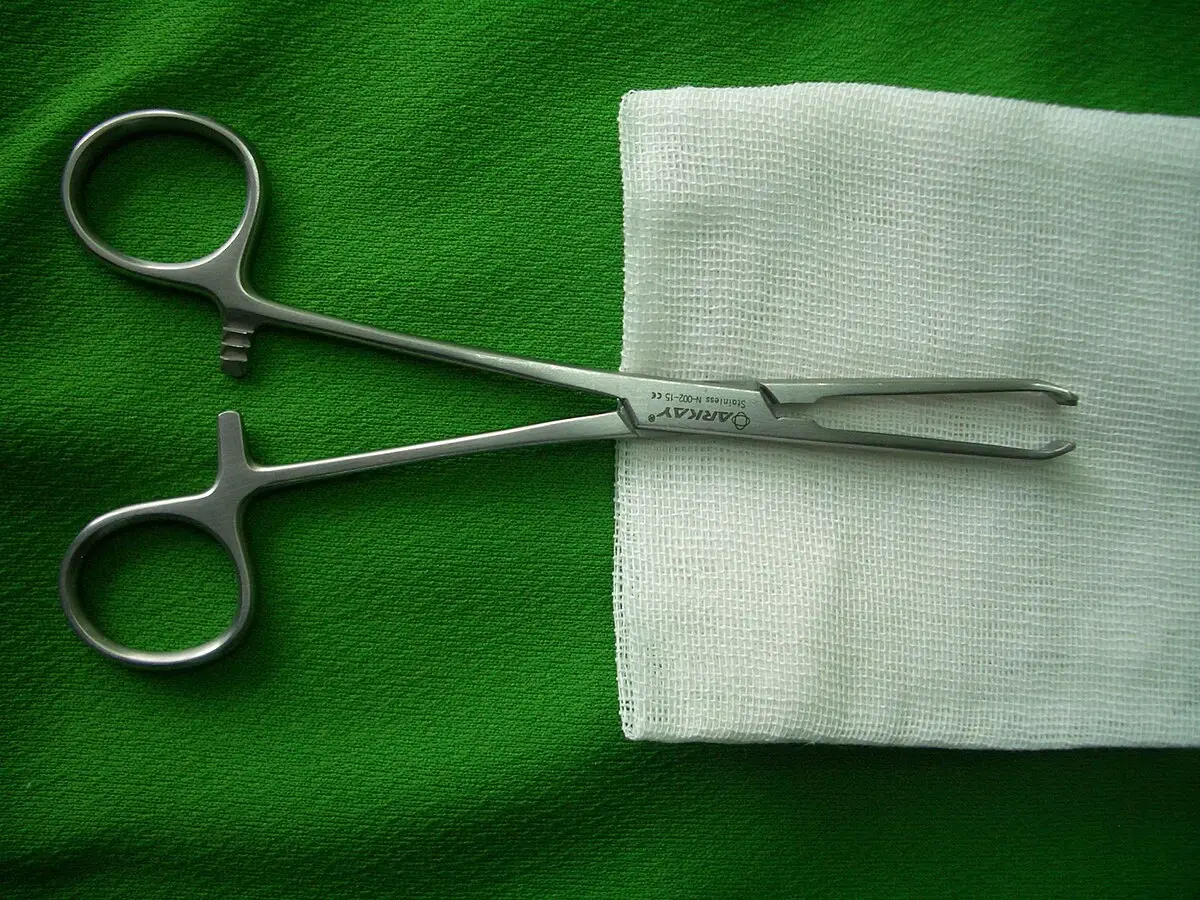
Toothed jaws of Allis tissue forceps shown in close view
Toothed jaws, and teeth of allis tissue forceps
Wikimedia Commons
/
CC0 (Creative Commons Zero)

Most scalpels used in minor procedures are disposable, with different handle sizes and types of blades already attached to the handles. However, stainless steel, reusable scalpel handles can also be used. A variety of blades can be used, which must be attached to the handle using forceps and sterile technique. After the procedure, the handles are sterilized, and the blades are discarded in a sharps container. Once used, disposable scalpel/blade units are also discarded in a sharps container.

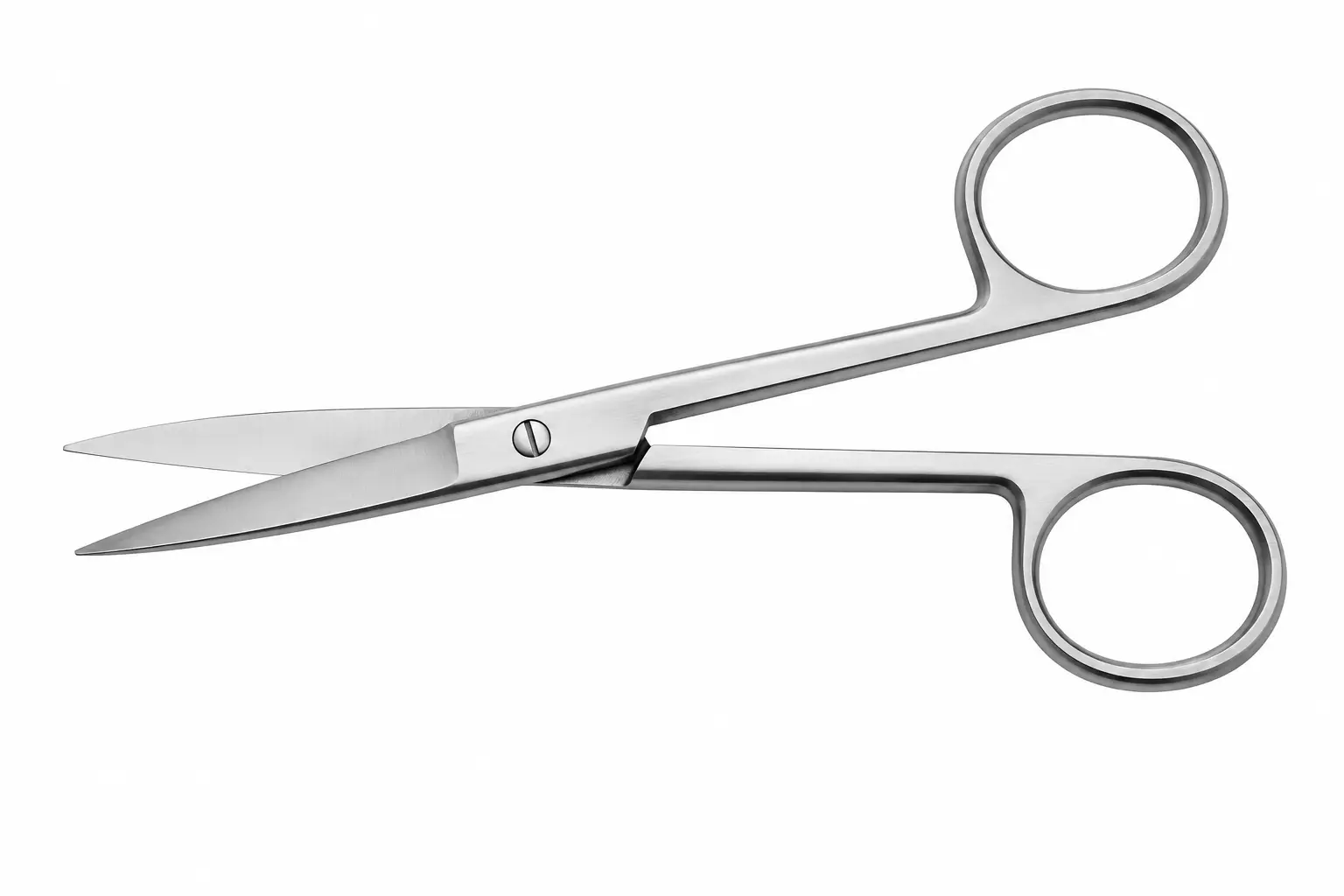
Various types of operating scissors used in surgical procedures
Surgical scissors
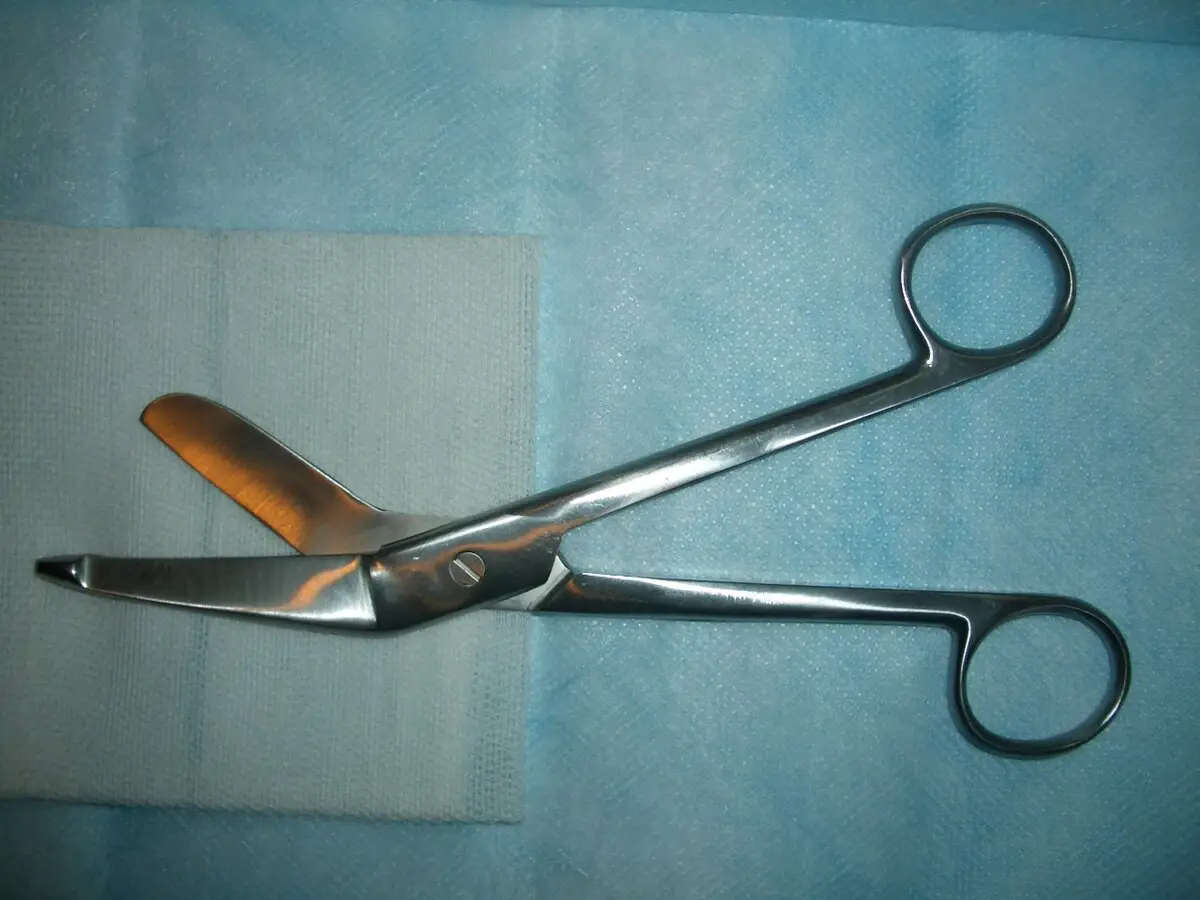
Scalpel scissors used in surgical procedures
Scalpel scissors
Wikimedia Commons
/
CC0 (Creative Commons Zero)
Suture scissors used to cut suture material
Suture scissors
Wikimedia Commons
/
Public Domain

Scissors

Instrument Description
Lister bandage scissors
  • Blunt probe tip
  • Easily inserted under bandages with relative safety
  • Used to remove bandages and dressings
Operating scissors
  • 5 to 6 inches long
  • Curved or straight blade tips
  • Used to cut and dissect tissue
Suture scissors
  • Blade has beak or hook to slide under sutures
  • Used to remove sutures

Scalpels

  • Handles: No. 3 is the standard handle; No. 3L and No. 7 are used in deeper cavities.
  • Blades: No. 15 is commonly used; Nos. 10, 11, and 12 are used for specialty incisions.

Grasping and clamping instruments

Clamping instruments are used for many different tasks. Many have a sharp tooth or teeth and are used to retract, hold, and manipulate fascia. The most common clamping instruments are hemostats, which originally were designed to stop bleeding or to clamp severed blood vessels. Some clamping instruments are used to grasp other instruments or sterilized materials. Sometimes hemostats and other clamping instruments are used interchangeably.

Grasping and clamping instruments

Instrument Description
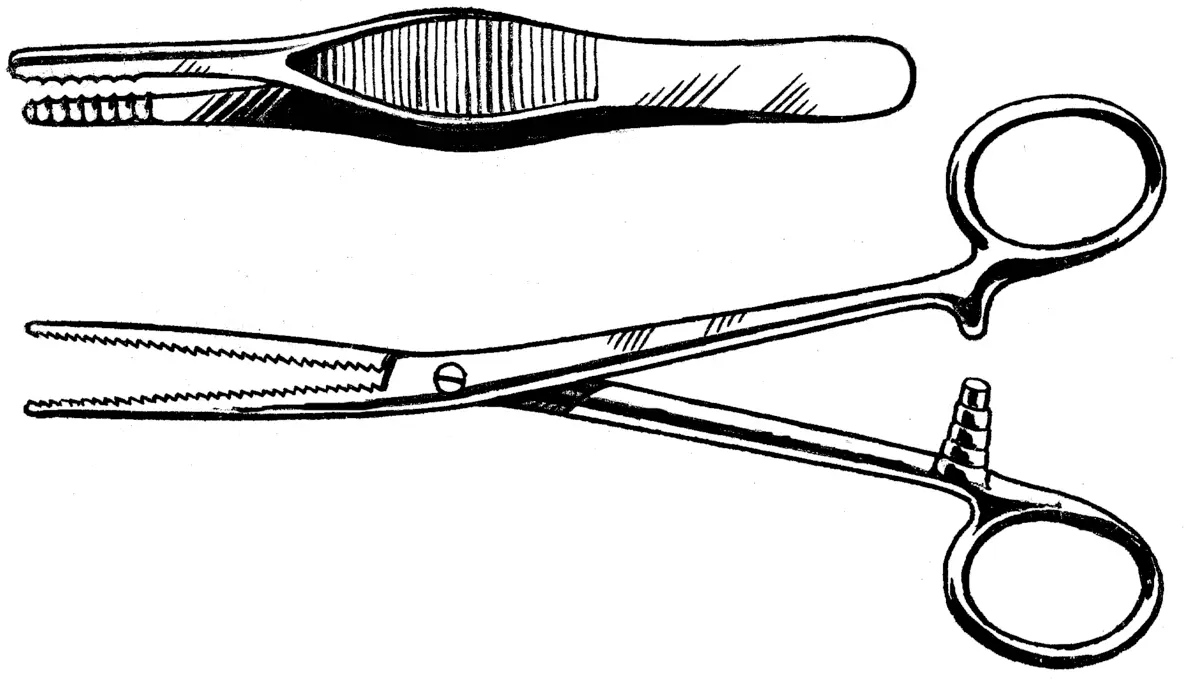
Hemostatic forceps
  • Jaws may be fully or partly serrated, without teeth
  • May be curved or straight
  • Used to clamp small vessels or hold tissue
  • Mosquito forceps (4 inches) are smaller and used for very small vessels
  • Kelly forceps (6 to 7 inches) are larger
Needle holder
  • 4 to 7 inches long
  • Jaws are shorter and stronger than hemostat jaws
  • Jaws may be serrated or may have a groove in the center
  • Used to grasp a suture needle firmly
Splinter forceps
  • Design and construction vary
  • Fine tip for foreign object retrieval
Plain thumb (dressing) forceps
  • Manufactured in lengths from 4 to 12 inches
  • Varying types of serrated jaws but no teeth
  • Used to insert packing into or remove objects from deep cavities
Towel clamp
  • Various lengths from 3 to 6½ inches
  • May have sharp or atraumatic (dull-edged) tips
  • Used to hold drapes in place during surgery
Allis tissue forceps
  • Available in different lengths and jaw widths
  • Used to grasp tissue, muscle, or skin surrounding a wound
Toothed tissue forceps
  • Manufactured in 4- to 18-inch lengths
  • Pincher grip
  • Used to grasp tissue, muscle, or skin surrounding a wound
Foerster sponge forceps
  • Used to hold gauze squares to sponge the surgical site
  • Used as transfer forceps to arrange items on a sterile tray
  • Straight or curved, with or without serrations
Bozeman sponge forceps
  • Designed to hold sponges or dressings
  • Capable of reaching the cervix through the vagina
  • Used to swab the area or apply medication
Tenaculum forceps
  • Very sharp, pointed tips
  • Used to hold tissue (e.g., the cervix) while a tissue specimen is obtained or to lift the cervix so that the fornix can be seen
Forceps used in medical and surgical procedures displayed
Forceps
Wikimedia Commons
/
Public Domain
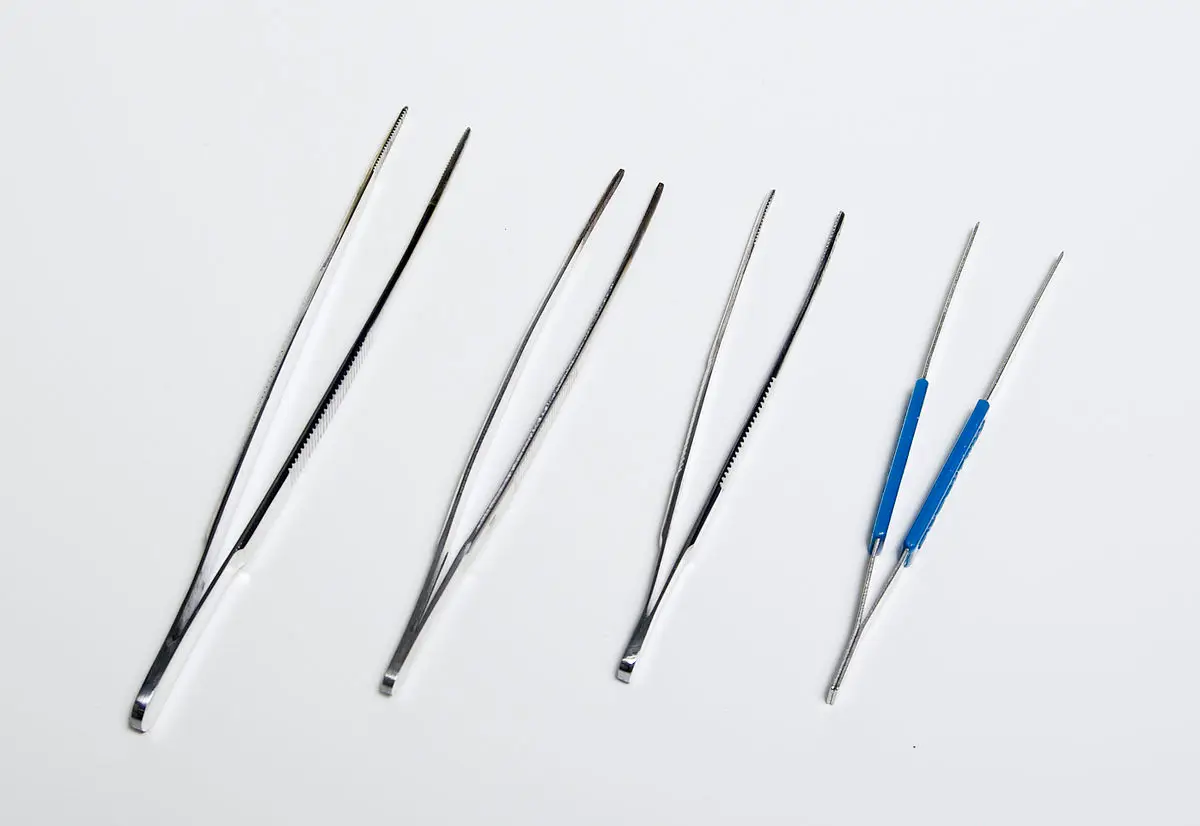
Small tweezers used in clinical procedures
Small tweezers
Wikimedia Commons
/
CC BY-SA 3.0
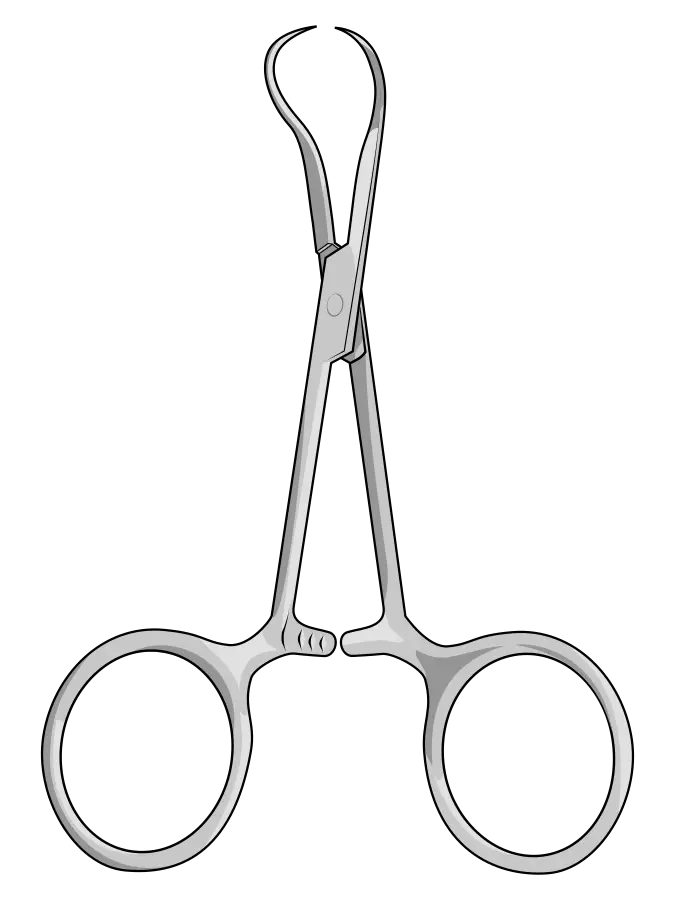
Backhaus towel clamp used in surgical draping
Backhaus clamp
Wikimedia Commons
/
CC BY-SA 3.0

Surgical instruments: Parts and Identification

  • Main parts: handle, closing mechanism, jaws (tips)
  • Handle types: ring (finger rings) or spring (thumb-handled)
  • Ratchets: gear-like locks for holding position
  • Serrations: ridged teeth on jaws to prevent tissue slippage
  • Tips: plain or toothed; straight or curved; specialized for task
  • Naming: by use, developer, or body part; terminology may vary regionally

Classification of surgical instruments

  • Four main groups:
    • Cutting and dissecting
    • Grasping and clamping
    • Retracting
    • Probing and dilating

Cutting and dissecting instruments

  • Used for cutting, incising, scraping, puncturing
  • Examples: scissors, scalpels, chisels, curettes, punches, drills, needles
  • Scalpels: No. 3 handle standard; No. 15 blade common; Nos. 10, 11, 12 for specialty
  • Scissors:
    • Lister bandage: blunt tip, removes dressings
    • Operating: curved/straight, cuts tissue
    • Suture: hook/beak tip, removes sutures

Grasping and clamping instruments

  • Used to hold, retract, or manipulate tissue/materials
  • Hemostatic forceps: clamp vessels/tissue; mosquito (small), Kelly (large)
  • Needle holder: strong jaws, holds suture needle
  • Splinter forceps: fine tip, retrieves foreign objects
  • Plain thumb forceps: serrated, no teeth, packs/removes items from cavities
  • Towel clamp: holds drapes, sharp or dull tips
  • Allis tissue forceps: grasp tissue/muscle/skin, various sizes
  • Toothed tissue forceps: pincher grip, grasp tissue/muscle/skin
  • Foerster sponge forceps: holds gauze/sponges, arranges sterile items
  • Bozeman sponge forceps: holds sponges, reaches cervix, applies medication
  • Tenaculum forceps: sharp tips, holds/lifts tissue (e.g., cervix)

Retractors

  • Hold tissue away from incision/wound
  • Senn retractor: flat (blunt) end and three-prong (sharp/dull) end
  • Used for small incisions or securing skin edges

Probes and dilators

  • Probes: search for foreign bodies, trace wound tracts
  • Trocars and obturators: withdraw fluids, drain/irrigate cavities
  • Specula: dilate orifices/cavities (e.g., vaginal speculum), may have light source

Specialty instruments: Gynecologic instruments

  • Placenta forceps: remove uterine tissue
  • Endocervical curette: small, scrapes endocervix
  • Uterine curette: spoon-shaped, removes polyps/secretions/placental tissue
  • Schroeder uterine vulsellum forceps: sharp tips, hold/lift cervix
  • Hegar uterine dilators: sets, dilate cervix
  • Uterine sounds: check patency of cervical os/urethral meatus

Sign up for free to take 16 quiz questions on this topic

Previous
Next  | 27.3 Drapes and sutures
All rights reserved ©2016 - 2026 Achievable, Inc.

Surgical instruments: cutting and grasping

Surgical instruments

The medical assistant must know which instruments are used for each procedure and should be able to identify and understand the function of the surgical instruments that the provider prefers. Instruments have clearly identifiable parts and can be visually differentiated from one another. The basic components are the handle, the closing mechanism, and the part that comes in contact with the patient, commonly called the jaws. Many instruments can have either straight or curved tips, depending on the operator’s preference and the task to be performed.

Instruments have either ring handles (finger rings), or spring handles; these sometimes are called thumb-handled or thumb grasp instruments. Scissors are an example of a ring-handled instrument; forceps (tweezers) have spring handles. Some instruments have a hinge-type mechanism called a box lock.

Ratchets resemble gears and are located just below or next to the ring handle. They are used to lock an instrument into position. Most ratchets can be closed at three or more positions, depending on the thickness of the tissue or materials being grasped.

The inner surfaces of the jaws on some instruments have ridged teeth, called serrations; both ring-handled and thumb-type instruments may have them. These serrations may be crisscross, horizontal, or lengthwise. Serrations prevent small blood vessels and tissue from slipping out of the jaws of the instrument.

Instrument tips or jaws may be plain tipped or toothed. Tissue forceps usually are toothed instruments and are identified by the number of intermeshing teeth (e.g., 1 × 2, 2 × 3, 3 × 4). Allis tissue forceps are used to grasp delicate, soft tissues, so the teeth are finer, shallower, and more rounded. Other forceps have teeth that are sharper and deeper. Still, others have sharp, hooklike, single or double teeth, such as a tenaculum. Toothed instruments commonly have ratchets for locking into towels or human tissues. Instrument tips may be either straight or curved, depending on their use.

An instrument can be named for its use (e.g., splinter forceps, for removing splinters) or after the person or people who developed it (e.g., Foerster sponge forceps). Many general instruments are identified by the part of the body on which they are used (e.g., rectal speculum and nasal speculum).

Thousands of surgical instruments have multiple names. The same instrument may have two or three different names, depending on the provider identifying it or the part of the country in which the practice is located. For example, a request for a clamp or forceps might be made when the provider wants a Kelly hemostat. It is important to learn the provider’s preferred terminology. Learn to recognize the distinctive parts of instruments and the reasons for each part, and you will quickly build a working knowledge of hundreds of instruments.

Classification of surgical instruments

Surgical instruments are generally classified according to their use, and most belong to one of four groups:

  • Cutting and dissecting
  • Grasping and clamping
  • Retracting
  • Probing and dilating

Cutting and dissecting instruments

Cutting and dissecting instruments, which are used for cutting, incising, scraping, punching, and puncturing, include scissors, scalpels, chisels, elevators, curettes, punches, drills, and needles. Instruments with a sharp blade or surface can cut, scrape, or dissect.

Most scalpels used in minor procedures are disposable, with different handle sizes and types of blades already attached to the handles. However, stainless steel, reusable scalpel handles can also be used. A variety of blades can be used, which must be attached to the handle using forceps and sterile technique. After the procedure, the handles are sterilized, and the blades are discarded in a sharps container. Once used, disposable scalpel/blade units are also discarded in a sharps container.

Scissors

Instrument Description
Lister bandage scissors
  • Blunt probe tip
  • Easily inserted under bandages with relative safety
  • Used to remove bandages and dressings
Operating scissors
  • 5 to 6 inches long
  • Curved or straight blade tips
  • Used to cut and dissect tissue
Suture scissors
  • Blade has beak or hook to slide under sutures
  • Used to remove sutures

Scalpels

  • Handles: No. 3 is the standard handle; No. 3L and No. 7 are used in deeper cavities.
  • Blades: No. 15 is commonly used; Nos. 10, 11, and 12 are used for specialty incisions.

Grasping and clamping instruments

Clamping instruments are used for many different tasks. Many have a sharp tooth or teeth and are used to retract, hold, and manipulate fascia. The most common clamping instruments are hemostats, which originally were designed to stop bleeding or to clamp severed blood vessels. Some clamping instruments are used to grasp other instruments or sterilized materials. Sometimes hemostats and other clamping instruments are used interchangeably.

Grasping and clamping instruments

Instrument Description
Hemostatic forceps
  • Jaws may be fully or partly serrated, without teeth
  • May be curved or straight
  • Used to clamp small vessels or hold tissue
  • Mosquito forceps (4 inches) are smaller and used for very small vessels
  • Kelly forceps (6 to 7 inches) are larger
Needle holder
  • 4 to 7 inches long
  • Jaws are shorter and stronger than hemostat jaws
  • Jaws may be serrated or may have a groove in the center
  • Used to grasp a suture needle firmly
Splinter forceps
  • Design and construction vary
  • Fine tip for foreign object retrieval
Plain thumb (dressing) forceps
  • Manufactured in lengths from 4 to 12 inches
  • Varying types of serrated jaws but no teeth
  • Used to insert packing into or remove objects from deep cavities
Towel clamp
  • Various lengths from 3 to 6½ inches
  • May have sharp or atraumatic (dull-edged) tips
  • Used to hold drapes in place during surgery
Allis tissue forceps
  • Available in different lengths and jaw widths
  • Used to grasp tissue, muscle, or skin surrounding a wound
Toothed tissue forceps
  • Manufactured in 4- to 18-inch lengths
  • Pincher grip
  • Used to grasp tissue, muscle, or skin surrounding a wound
Foerster sponge forceps
  • Used to hold gauze squares to sponge the surgical site
  • Used as transfer forceps to arrange items on a sterile tray
  • Straight or curved, with or without serrations
Bozeman sponge forceps
  • Designed to hold sponges or dressings
  • Capable of reaching the cervix through the vagina
  • Used to swab the area or apply medication
Tenaculum forceps
  • Very sharp, pointed tips
  • Used to hold tissue (e.g., the cervix) while a tissue specimen is obtained or to lift the cervix so that the fornix can be seen
Key points

Surgical instruments: Parts and Identification

  • Main parts: handle, closing mechanism, jaws (tips)
  • Handle types: ring (finger rings) or spring (thumb-handled)
  • Ratchets: gear-like locks for holding position
  • Serrations: ridged teeth on jaws to prevent tissue slippage
  • Tips: plain or toothed; straight or curved; specialized for task
  • Naming: by use, developer, or body part; terminology may vary regionally

Classification of surgical instruments

  • Four main groups:
    • Cutting and dissecting
    • Grasping and clamping
    • Retracting
    • Probing and dilating

Cutting and dissecting instruments

  • Used for cutting, incising, scraping, puncturing
  • Examples: scissors, scalpels, chisels, curettes, punches, drills, needles
  • Scalpels: No. 3 handle standard; No. 15 blade common; Nos. 10, 11, 12 for specialty
  • Scissors:
    • Lister bandage: blunt tip, removes dressings
    • Operating: curved/straight, cuts tissue
    • Suture: hook/beak tip, removes sutures

Grasping and clamping instruments

  • Used to hold, retract, or manipulate tissue/materials
  • Hemostatic forceps: clamp vessels/tissue; mosquito (small), Kelly (large)
  • Needle holder: strong jaws, holds suture needle
  • Splinter forceps: fine tip, retrieves foreign objects
  • Plain thumb forceps: serrated, no teeth, packs/removes items from cavities
  • Towel clamp: holds drapes, sharp or dull tips
  • Allis tissue forceps: grasp tissue/muscle/skin, various sizes
  • Toothed tissue forceps: pincher grip, grasp tissue/muscle/skin
  • Foerster sponge forceps: holds gauze/sponges, arranges sterile items
  • Bozeman sponge forceps: holds sponges, reaches cervix, applies medication
  • Tenaculum forceps: sharp tips, holds/lifts tissue (e.g., cervix)

Retractors

  • Hold tissue away from incision/wound
  • Senn retractor: flat (blunt) end and three-prong (sharp/dull) end
  • Used for small incisions or securing skin edges

Probes and dilators

  • Probes: search for foreign bodies, trace wound tracts
  • Trocars and obturators: withdraw fluids, drain/irrigate cavities
  • Specula: dilate orifices/cavities (e.g., vaginal speculum), may have light source

Specialty instruments: Gynecologic instruments

  • Placenta forceps: remove uterine tissue
  • Endocervical curette: small, scrapes endocervix
  • Uterine curette: spoon-shaped, removes polyps/secretions/placental tissue
  • Schroeder uterine vulsellum forceps: sharp tips, hold/lift cervix
  • Hegar uterine dilators: sets, dilate cervix
  • Uterine sounds: check patency of cervical os/urethral meatus

More from Preparing for minor surgery: room, solutions, and supplies

  • Assisting in surgery
  • Drapes and sutures
  • Autoclave loading/unloading, chemical sterilization, and professional responsibilities
  • Surgical asepsis, instrument care, and the utility room
  • The autoclave process: operation, wrapping, and quality assurance