



Riemann sums & area
In the previous section, areas were easy to find because the regions were simple geometric shapes. Now, let’s consider regions under curved graphs, such as , over an interval . Before learning how to find the exact area, it helps to start with an approximation.
A common approach is to break the interval into smaller pieces, approximate the region with rectangles (or trapezoids), and add up their areas. This method is called a Riemann sum approximation.
Riemann sums to estimate area
There are 3 main types of Riemann approximations: left, right, and midpoint Riemann sums. All three use rectangles.
Another common approximation is the Trapezoidal rule, which uses trapezoids. It isn’t technically a Riemann sum, but it follows the same “partition and add” process.
Here are the steps to finding a Riemann sum:
- Divide the interval into subintervals, where each subinterval has equal width :
-
On each subinterval, choose a point to evaluate the function (this choice depends on which type of Riemann sum you’re using).
-
Multiply the function value by the width to get the area of a rectangle.
For a trapezoid, is the height of each trapezoid while the function values are the bases.- Note: If the function value is negative, the rectangle lies below the -axis, so its contribution is negative. That’s expected here because we’re approximating net signed area, which accounts for both positive and negative values.
-
Add the signed areas together.
Examples
Estimate the area under with subintervals on the interval using a:
Estimate the area using a right, left, midpoint, and trapezoidal sum.
a) Right Riemann sum
b) Left Riemann sum
c) Midpoint Riemann sum
d) Trapezoidal sum
a) Right Riemann sum
- Divide the interval into subintervals, each with equal width:
This initial step is the same for all of the sums.
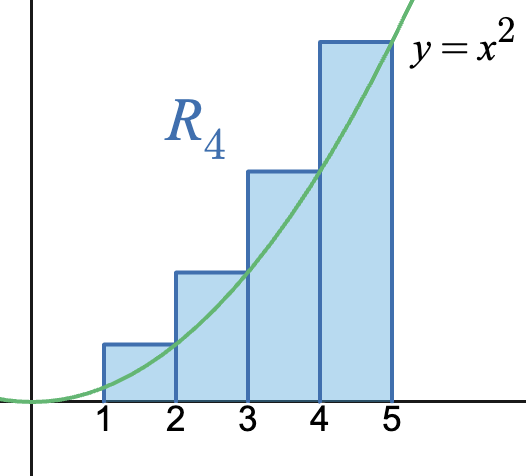
- Since and this is a right Riemann sum, use the right endpoint of each subinterval to set the rectangle height.
The right endpoints are and the function values are:
- Then the right Riemann sum is
b) Left Riemann sum
- Just as in part a),
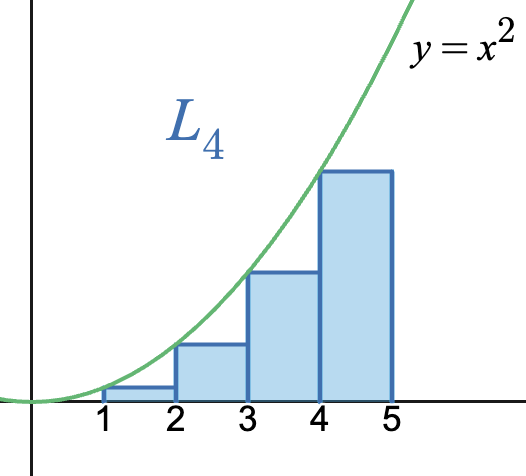
- For a left Riemann sum, use the left endpoint of each subinterval to set the rectangle height.
The left endpoints are and the function values are:
- Then the left Riemann sum is
c) Midpoint Riemann sum
- Just as in the previous parts,
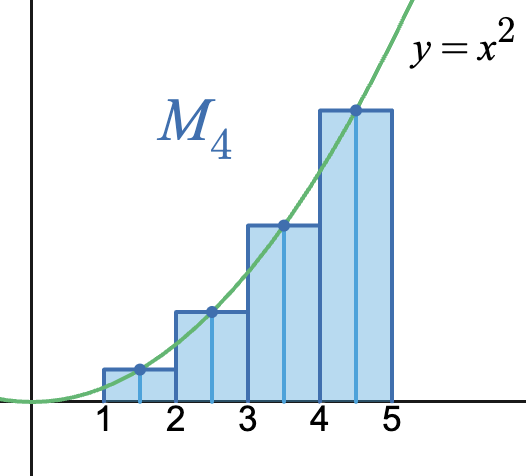
- The 4 rectangles correspond to these 4 subintervals:
The four subintervals each have width one, spanning the interval from one to five.
- For a midpoint sum, the height of each rectangle is the function value at the midpoint of each subinterval.
The midpoint is found by averaging the endpoints. For example,
- Midpoint of
The midpoints of each subinterval in this example are and the function values are:
- Then the midpoint Riemann sum is
d) Trapezoidal sum
The area of a trapezoid is
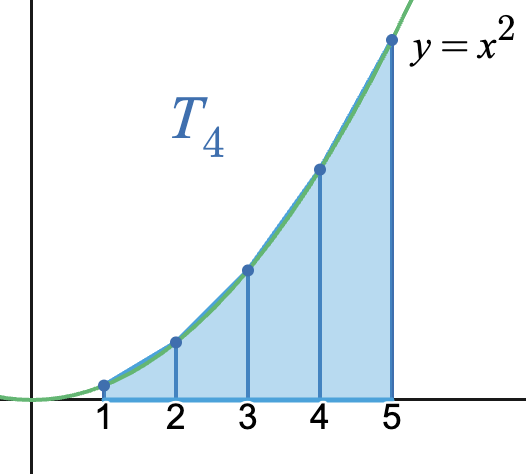
Here, the trapezoids are oriented sideways:
- The height of each trapezoid is
- The parallel bases have lengths given by the function values at the endpoints of each subinterval
For the leftmost trapezoid, the lengths of the parallel bases are and .
For the trapezoid next to it, the parallel bases are and .
Notice that when you add the trapezoid areas, interior function values, like , appear in two adjacent trapezoids, so they get counted twice. Only the endpoint values, and , are counted once.
Then for the graph shown above, the trapezoid sum is
A trapezoidal sum is always the mean of the left and right Riemann sums, provided the same number of subintervals are used to estimate the area.
Interpreting Riemann sum estimates
Riemann sums either overestimate or underestimate the actual area under the curve. A quick sketch such as the ones shown for the graph of above helps confirm whether the rectangles sit above or below the curve on each subinterval.
The estimate depends on whether the function is increasing or decreasing (for left and right sums) and whether it is concave up or concave down (for trapezoidal sums).
Unequal widths
On some AP exam problems, the subinterval widths may be different, so you won’t be using only one value of . These problems are often given with a table.
The rate of water flowing into a tank is modeled by a continuous, strictly increasing function g of t. Refer to the textbook to view the table of values.
The rate of water, in gallons per minute, flowing into a tank can be modeled by function , which is continuous and strictly increasing on the interval . Select values are given below:
a) Will a left or right Riemann sum underestimate the actual change in the amount of water?
b) Approximate the net change in the amount of water after seconds using a left Riemann sum with the subintervals and . Include units.
c) Using the same subintervals, find the right Riemann sum. Include units.
d) Using the same subintervals, find the trapezoidal sum. Include units.
Solutions
a) Underestimation
Because is strictly increasing, the left-endpoint rectangles lie below the curve on each subinterval. That means a left Riemann sum gives an underestimate of the actual net change. A right Riemann sum uses right endpoints, so its rectangles lie above the curve, giving an overestimate.
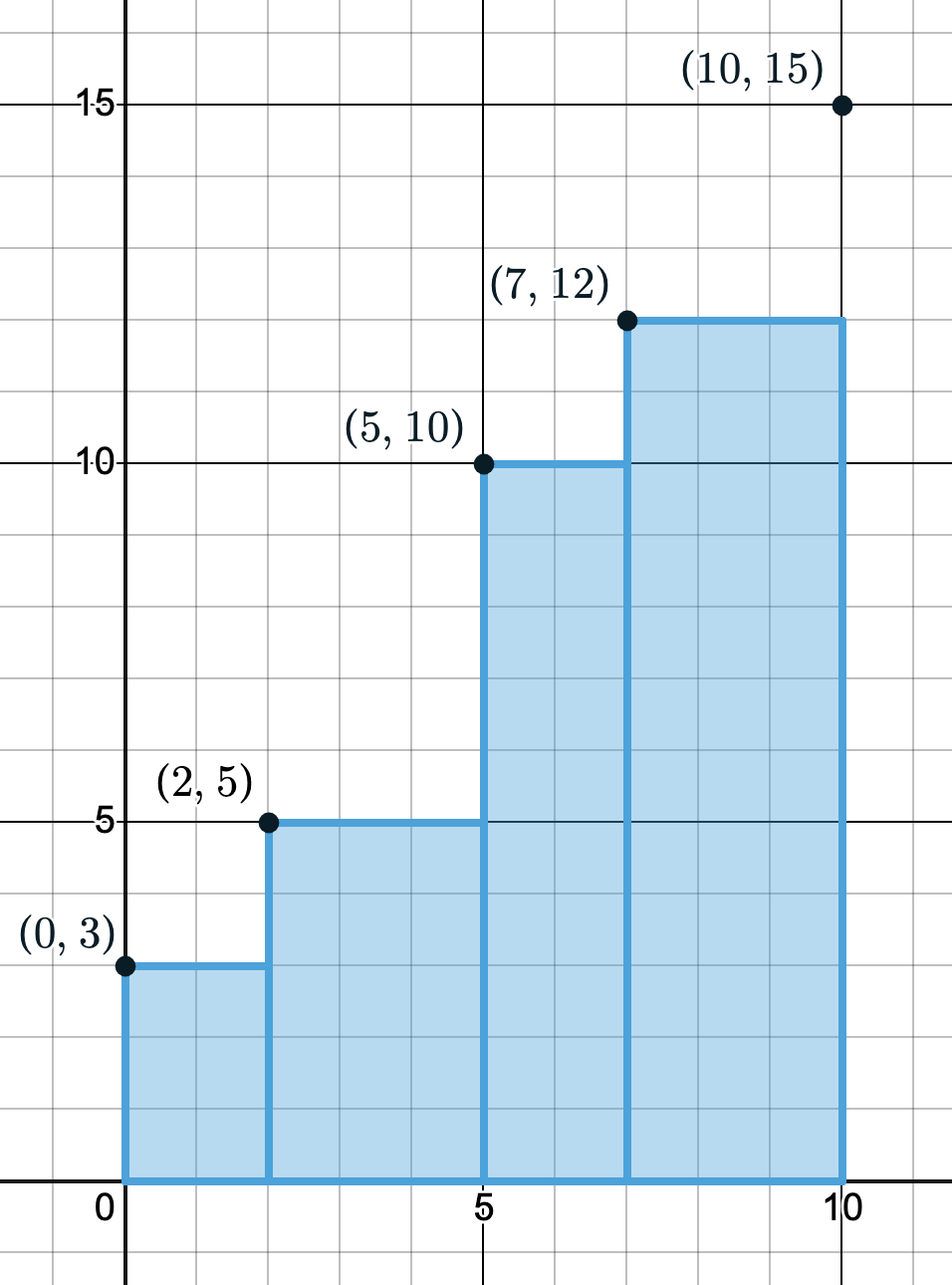
b) Left Riemann sum
The rectangles can be made as shown in the image below. The units come from multiplying the units of by the units of , so the result is in gallons.
Use the left endpoint for the height of each rectangle, and the subinterval length for the width. Add the four areas together.
Use the left endpoint of each subinterval for the height, and use the subinterval length for the width:
-
On : width , height
-
On : width , height
-
On : width , height
-
On : width , height
So the approximate net change is:
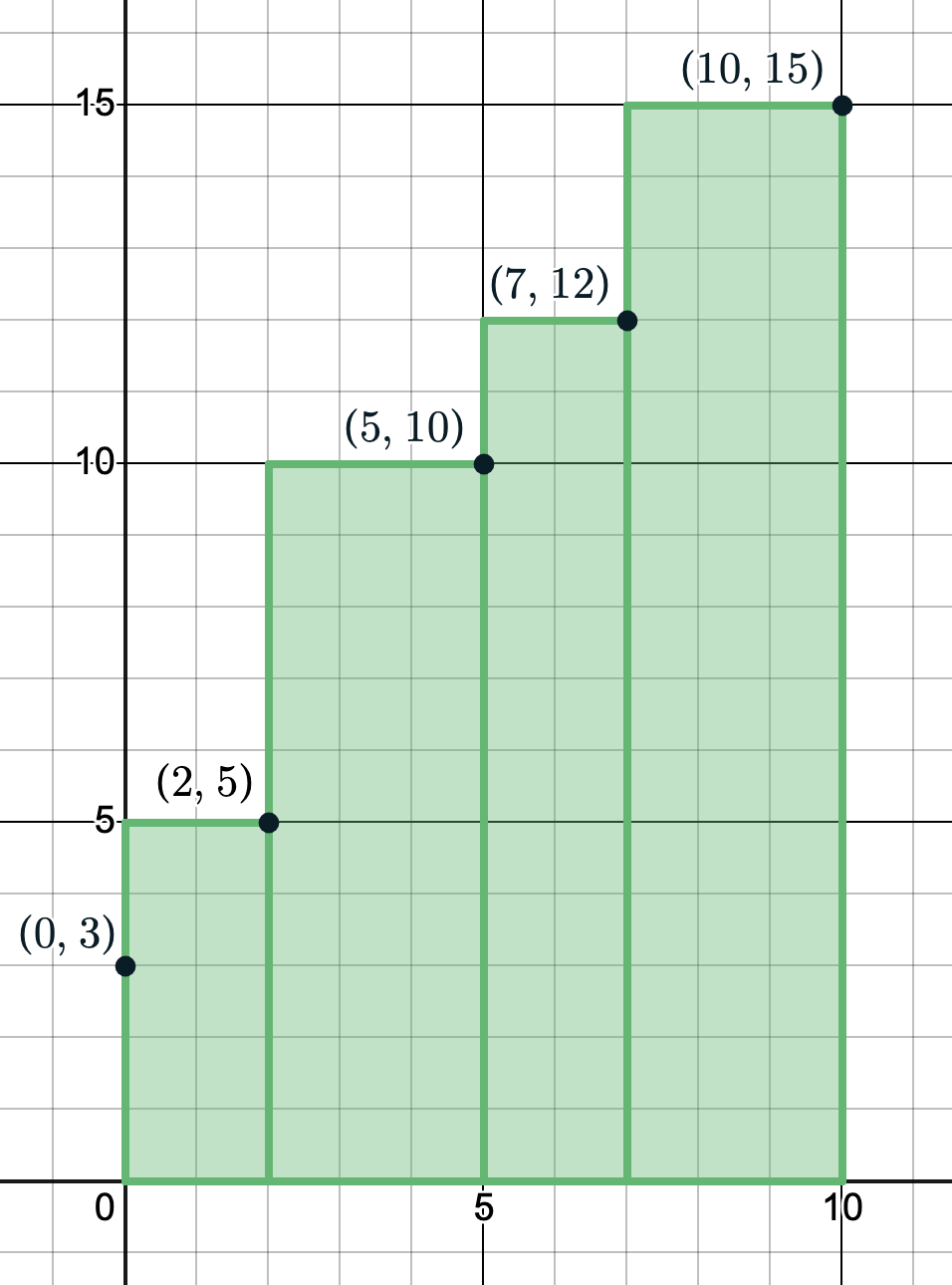
c) Right Riemann sum
Now use the right endpoint of each subinterval for the height:
The approximate net change is:
d) Trapezoidal sum
Calculate the area of each trapezoid separately and add them. The height of each trapezoid is the subinterval width, while the parallel bases are the function values.
On :
- Height
- Bases: and
Then
On :
- Height
- Bases: and
Then
On :
- Height
- Bases: and
Then
On :
- Height
- Bases: and
Then
Adding these together, the approximate net change is: