



Definite integrals
From approximations to integrals
A definite integral calculates the exact net signed area under a curve by taking the limit of a right Riemann sum as the number of rectangles () approaches infinity.
As , the width of each rectangle () approaches , turning an approximation into an exact value.
Anatomy of an integral
The integral symbol replaces the limit and summation, while replaces the width .
-
(limits of integration): is the lower bound (start) and is the upper bound (end) on the -axis.
-
(integrand): The function that determines the height of the region.
-
(variable of integration): Identifies the variable we are integrating with respect to, representing . Always include this at the end.
To convert between Riemann sums and definite integrals, map the structural components directly:
Examples
Express the limit of the Riemann sum as a definite integral
Solution
To convert this to a definite integral, match the components of the limit form.
1. Identify to find :
The term outside the function is the width:
Since , we know:
2. Identify and find the lower bound ():
Since , the sample point is
This matches the expression in the limit , meaning .
3. Find the upper bound ():
Since and the total interval width is , then
4. Identify the function :
Since is being squared, the outer matching function is:
Bringing it all together on the interval , the definite integral represented by the limit is:
Definite integral to limit
Next, the process is reversed.
Express the definite integral as the limit of a Riemann sum
Solution
In this integral, , , and .
1. Find :
2. Write the sample point :
3. Substitute into :
4. Write in limit form:
Evaluating a definite integral
When a problem asks you to evaluate a definite integral, it’s asking for the net signed area of from to .
Later, you’ll learn techniques for evaluating definite integrals when the integrand is more complicated. For now, the next examples use simple geometric areas.
Examples
- Evaluate
Solution
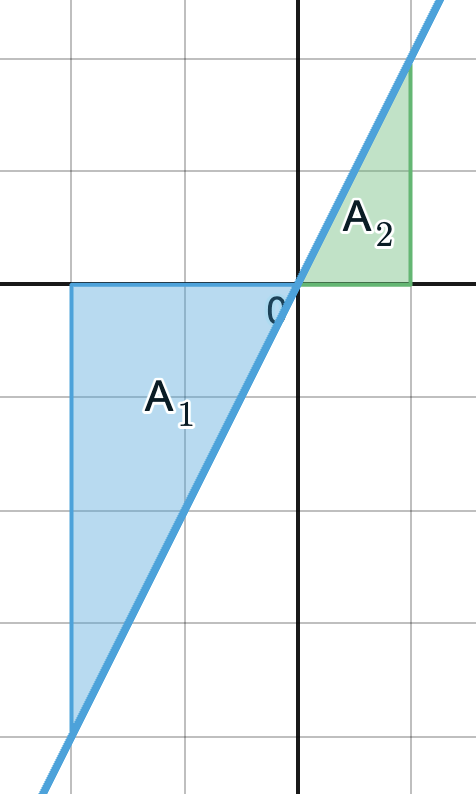
Evaluating this integral gives the net signed area between and the -axis from to , as shown in the graph below.
The region labeled is below the -axis (so it contributes negative area), and is above the -axis (so it contributes positive area).
is a triangle with base length and height with signed area:
is a triangle with base length and height with signed area:
The integral gives the net signed area, which is the sum of the areas:
Try one with an absolute value function:
- Evaluate
The region between and the -axis from to consists of two congruent triangles, both above the -axis:
- one from to
- one from to
Each triangle has base length and height . So the total area is
Therefore