


In the 1st part of AP Calculus, you were given functions (modeling contexts such as position, population, cost, etc.) and your task was to find the rate of change using derivatives.
The 2nd part reverses this - given the rate of change of a quantity like its speed, growth rate, etc., you can figure out exactly how much the quantity has changed. For example:
1. Suppose water is flowing into a bucket at a steady rate of 3 liters per minute. How much water will be in the bucket after 4 minutes?
This calculation is straightforward when the rate is constant - it’s just 3×4=12 liters. This total change (in the amount of water) is called the accumulation of change.
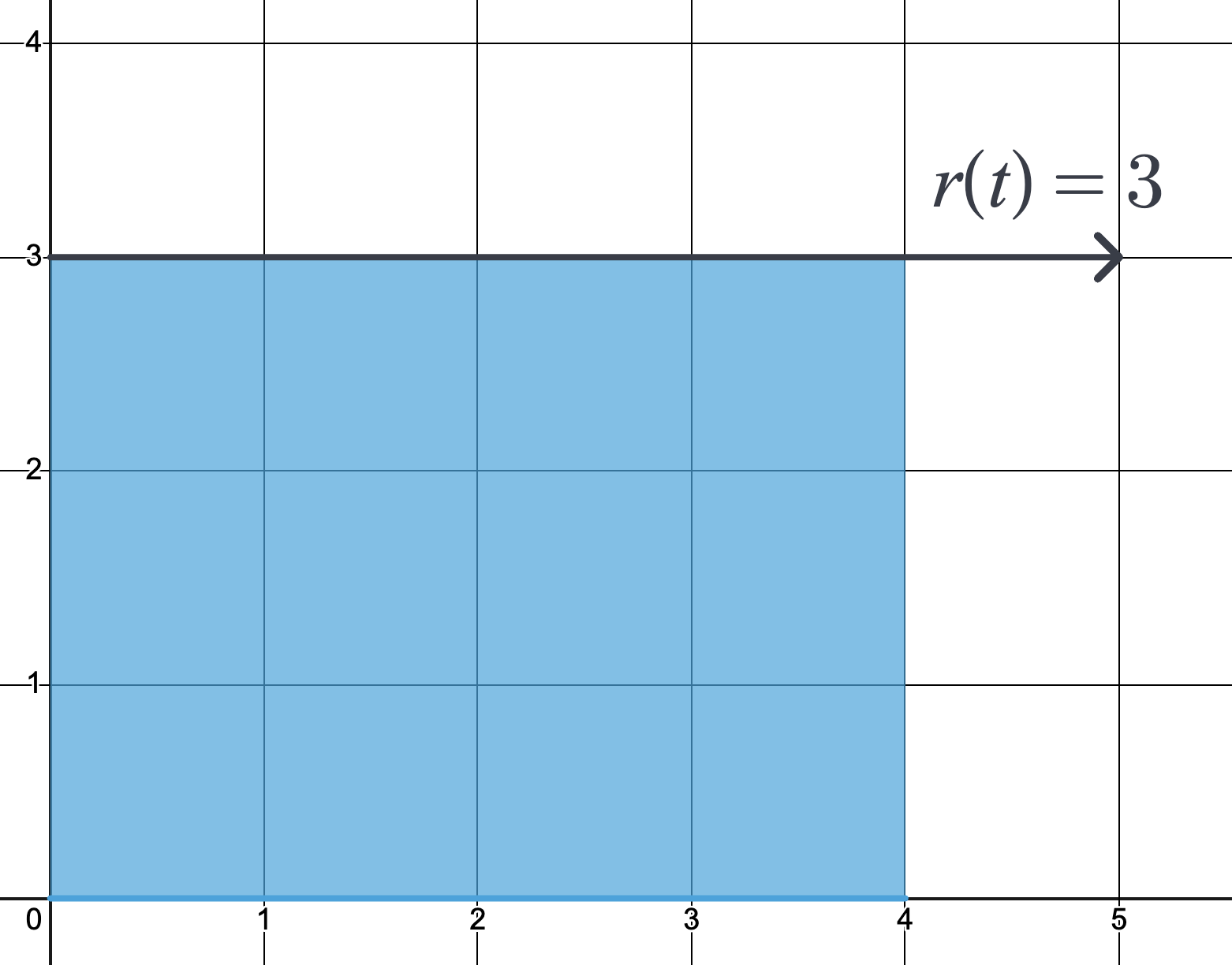
The graph of the rate function r(t)=3 is a horizontal line. Visually, the quantity 3×4 represents the area of a rectangle between the horizontal line and the x-axis from t=0 to t=4.
Figure 6.1.1 Basic area graph
The units are that of the width times that of the height, or
minL×min=L
So while multiplying a rate by a time, we can also think of the accumulated change as the area under the rate graph.
But what if the rate were not constant? The same idea still applies. The accumulation of change can be found by finding the area under the graph of the rate of change function.
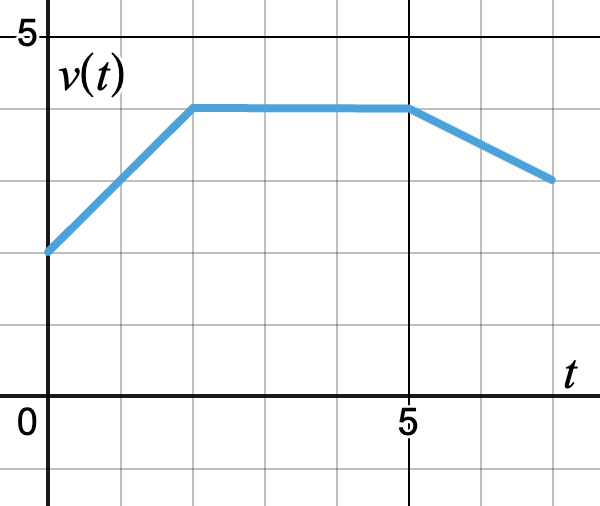
2. A particle’s velocity, in meters per second, is modeled by v(t) and shown in the graph below.
Figure 6.1.2 Graph of velocity
a) How far is the particle from its starting position after 3 seconds?
b) How far has the particle traveled between t=2 and t=7 seconds?
Solutions
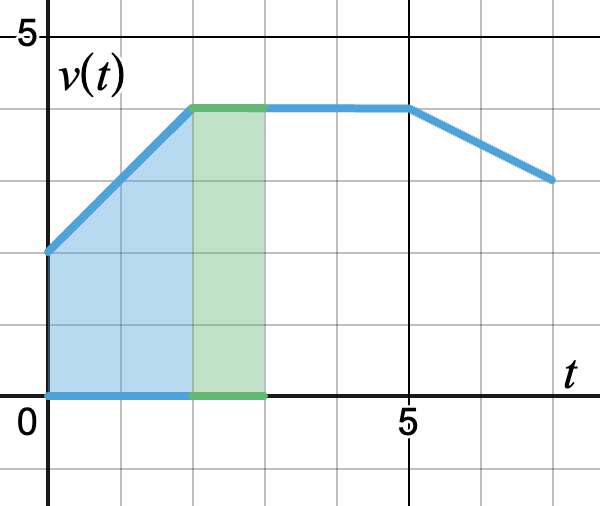
a) The distance traveled after 3 seconds is the area under the graph from t=0 to t=3 as shown in the image below
Figure 6.1.3 Part (a) shaded
The shaded region consists of a trapezoid, in blue, and a rectangle, in green. The total area, or distance the particle travels, is
A=21⋅2(2+4)+1(4)
=10 meters
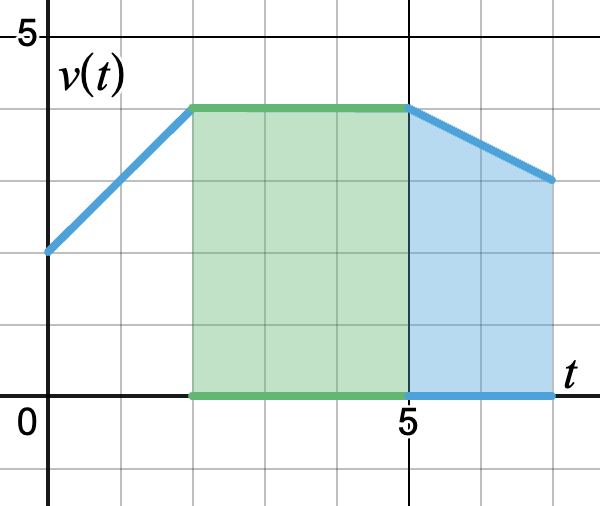
b) The distance traveled from 2 to 7 seconds is the area under the curve as shown:
Figure 6.1.4 Part (b) shaded
The shaded regions consists of a rectangle, in green, and a trapezoid, in blue. The distance the particle travels is
A=3(4)+21⋅2(4+3)
=19 meters
Area “under” a curve
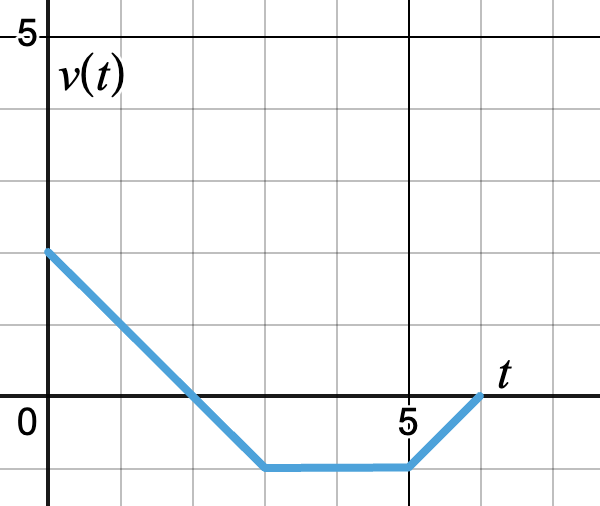
When we discuss the “area under a curve” in calculus, what is actually meant is the area between the graph of a function and the x-axis over a certain interval. When the function is below the x-axis, the accumulation of change is negative. Consider the velocity graph below, with the units of velocity as meters per second:
Figure 6.1.5 Negative velocity
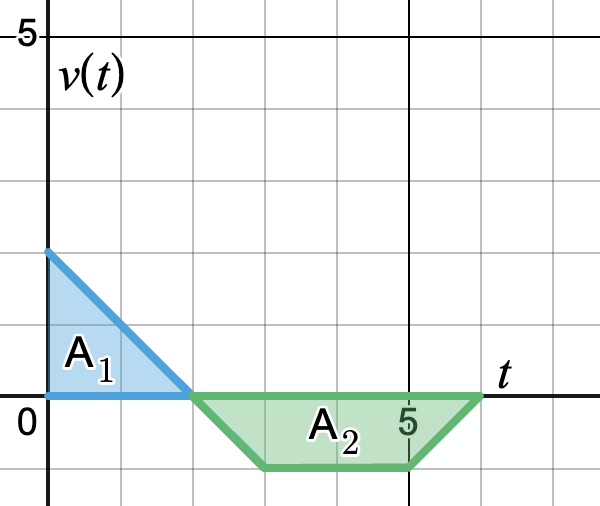
Recall from section 4.2.1 that the sign of the velocity tells you which direction the object travels. The area can be split up into 2 sections, with the triangle in blue as the region above the x-axis and the trapezoid in green as the region below the x-axis.
Figure 6.1.6 Signed area
The particle travels right (positive velocity) from over the interval 0<t<2 seconds for a total distance of
A1=21(2)(2)
=2 meters
At t=2 seconds, it then changes direction and travels left (negative velocity) over the interval 2<t<6 seconds for a distance of
A2=21⋅(1)(4+2)
=3 meters
Because the trapezoid is under the x-axis, the signed area is negative. This is important for finding the displacement - since the particle travels 2 meters to the right and 3 meters to the left, it ends up 1 meter to the left of its starting position. Finding the net signed area gives the displacement
2+(−3)=−1
which shows that it indeed ends up 1 meter to the left of its starting position.
On the other hand, to find the total distance, sum the absolute values of the displacements in each region. So the total distance traveled is
∣2∣+∣−3∣=5 meters
Examples
1. A container is slowly leaking liquid throughout the day, but it’s also being refilled at certain times. The rate at which the liquid is entering or leaving the container (in liters per hour) varies over time and is recorded in the graph below as function R(t), where positive values represent liquid being added and negative values represent leakage.
Figure 6.1.7 Graph of R(t)
How much water has the container gained or lost in the first 5 hours?
Note: The curve between the points (1,−1) and (3,−1) is a semi-circle.
Solution
(spoiler)
Multiplying the rate by the time to find the area in each region gives the change in the amount of water, in liters.
The region can be split into the geometric shapes A1 through A5 as shown:
Figure 6.1.8 Shaded areas
Regions A1 to A4 are all below the x-axis so will have negative signed areas.
A1 is a triangle with signed area
A1=21(1)(−1)
=−21
A2 is a rectangle with signed area
A2=(2)(−1)=−2
A3 is a semi-circle with a radius of 1 and signed area of
A3=−21π(1)2
=−2π
A4 is a trapezoid with a height of 1 and one base length of 1, but in order to find the length of the top base, we need the x-intercept of the line between the points (4,−1) and (5,2). Do not assume graphs are drawn to scale or rely on appearances such as it looking “about halfway.”
Using algebra, the equation of the line between the two points is
y=3x−13
Then the x-intercept is when y=0, or (313,0).
This means the top base has length 131 and the signed area is
A4=−21(1+131)
=−67
A5 is a triangle above the x-axis, with height 2 and length 32. The signed area is
A5=21⋅32⋅(2)
=32
Then the net signed area, or the accumulation of change, found by adding areas A1 through A6 is
A=−21−2−2π−67+32
=−2π−3
≈−4.6 liters
Since the value is negative, it means the container has lost approximately 4.6 liters over the first 5 hours.
2. The temperature in a room is affected by a heating and cooling system that turns on and off during the day. Let T(t) be the temperature of the room at time t.
The graph below shows its derivative, T′(t), the rate of the change in temperature (in °C per hour) at time t, with t=0 corresponding to 12 AM midnight.
Figure 6.1.9 Graph of T'(t)
What is the change in room temperature between 1 AM and 6 AM?
Solution
(spoiler)
The region can be split into the geometric shapes A1 through A4 as shown:
Figure 6.1.10 Shaded areas
A1 is a triangle with signed area
A1=21(1)(−1)
=−0.5
A2 is a trapezoid with a height of 1, one base length of 2, and the other base length that can be found with the equation of the line between the two points (3,−1) and (4,1), which is
y=2x−7
The x-intercept of this line is (3.5,0), so the longer base length of the trapezoid is 2.5. Then the signed area A2 is
A2=21(−1)(2+2.5)
=−2.25
A3 is a triangle with signed area
A3=21(0.5)(1)
=0.25
Lastly, A4 can be found by subtracting the area of the semicircle from the area of the rectangle that has its base along x=4 to x=6.
The rectangle’s height is 1, so the area is 2. The semi-circle has a radius of 1, so its area is 0.5π(1)2=0.5π.
Then
A4=2−0.5π
The net signed area found by adding up the values of A1 to A4 is
−0.5−2.25+0.25+(2−0.5π)
≈−2.1
This means that overall the room was cooler at 6 AM than it was at 1 AM by 2.1°C.
Sign up for free to take 5 quiz questions on this topic