



Triangles
A triangle is a shape with three sides and three angles. The sum of its interior angles is always .
Triangles are often classified by:
- their side lengths
- their angle measures
Here is a table of the triangle types you’ll see most often.
| Triangle type | Image | Description |
|---|---|---|
| Equilateral triangle | 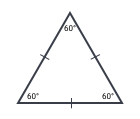 |
All side lengths are equal, and all angles are . |
| Right triangle | 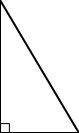 |
One angle is . |
| Isosceles triangle | 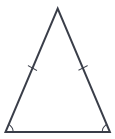 |
Two side lengths are equal, and the angles opposite those sides are equal. |
| Isosceles right triangle | 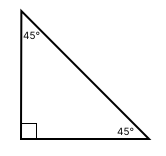 |
The angles are always , , and , while the side lengths follow the ratio . |
| Scalene triangle |  |
There are no equal side lengths or angles. |
Example: The question below is from 2021 AMC 12A
Two angles of an isosceles triangle measure and . What is the sum of the three possible values of ?
A.
B.
C.
D.
E.
Answer: D.
Area
There are three common ways to find the area of a triangle.
- The base-height formula works when you know (or can find) a base and the corresponding height.
- The coordinate formula works when the vertices are given on the coordinate plane.
- Heron’s formula works when you know all three side lengths.
This first equation is easiest to remember by thinking of a triangle as half of a rectangle with the same base and height.
When a triangle is plotted on the coordinate plane, you can use the three coordinate pairs to find the area like this.
This is the simplest version of the shoelace formula, which can be used to find the area of any simple polygon.
The last method is called Heron’s Formula. Instead of using a height, you use the lengths of the three sides.
Pythagorean theorem
A right triangle has one angle that is . That matters for two common reasons:
- For area, the two legs can serve as the base and height.
- For side lengths, knowing two sides lets you find the third.
The Pythagorean Theorem relates the legs and the hypotenuse of a right triangle.
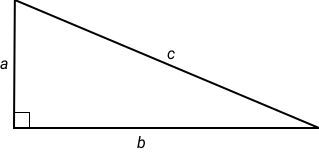
Pythagorean triples
Pythagorean triples are sets of three integers that satisfy the Pythagorean theorem.
The most common Pythagorean triples are listed below. Memorizing these can save time and reduce arithmetic mistakes. Also remember: any multiple of a triple is still a right triangle. For example, side lengths form a triangle scaled by .
Common right triangles
Two special right triangles show up constantly. If you know their side ratios, you can often skip the Pythagorean Theorem.
- A triangle is half of a square.
- A triangle is half of an equilateral triangle.
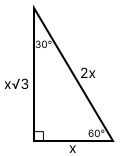
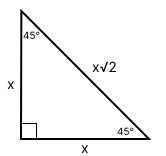
Equilateral triangles
An equilateral triangle has all sides equal and all angles equal. Since triangle angles sum to , each angle must be .
A useful fact is the height of an equilateral triangle: it equals half the base multiplied by . You can see why by dropping an altitude and splitting the equilateral triangle into two congruent triangles.
Another common connection: a regular hexagon can be divided into six equilateral triangles that meet at the center.
Use your knowledge of equilateral triangles and their relationship to triangles to solve the problem below. One approach is to view the equilateral triangle as two mirrored triangles. In that setup, the relevant vertices lie at the center of the circle, and the hypotenuse of either triangle is the radius of the circle.
Example: The question below is from 2017 AMC 10A
Sides and of equilateral triangle are tangent to a circle at points and respectively. What fraction of the area of lies outside the circle?
A.
B.
C.
D.
E.
Answer: E.
Angle bisector theorem
An angle bisector is a line segment drawn from a vertex to the opposite side that splits the vertex angle into two equal angles. It does not necessarily split the triangle into two equal areas.
In the diagram below, angle is split into two equal angles. The Angle Bisector Theorem describes the side-length ratios created on the opposite side.
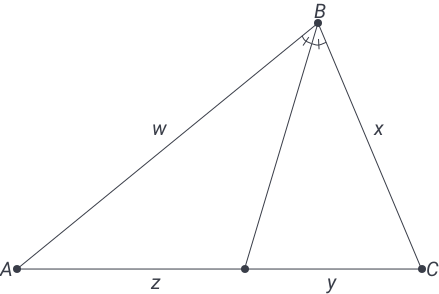
The theorem says that the bisector divides the opposite side into two segments whose lengths are proportional to the two adjacent sides. In other words, the ratio of the left side to the left segment of the base equals the ratio of the right side to the right segment of the base.
Inradius
Any triangle can have a circle inscribed inside it (a circle tangent to all three sides). The inradius is the radius of that circle, and the incenter is the center point of the circle.
You can use this formula to find the inradius of a triangle.
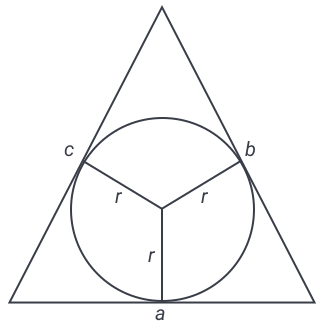
The area of a triangle can also be found using the inradius and the perimeter.
Important terms
Trigonometry
Trigonometry is a large topic focused on relationships between angles and side lengths in triangles. It’s mainly relevant for AMC 12 problems, so you can find the trigonometry chapter in the Advanced Unit of the course.