Achievable logoAchievable logo
AMC
Sign in
Sign up
Purchase
Textbook
Practice exams
Support
How it works
Exam catalog
Mountain with a flag at the peak
Textbook
Introduction
1. Algebra
2. Geometry
2.1 Triangles
2.2 Circles
2.3 Lines and angles
2.4 Quadrilaterals and polygons
2.5 Area and perimeter
2.6 Volume and surface area
2.7 Coordinate geometry
3. Number theory
4. Counting and probability
5. Intermediate topics (AMC 10/12)
6. Advanced topics (AMC 12)
7. General approaches
8. Practical strategies
Wrapping up
Achievable logoAchievable logo
2.2 Circles
Achievable AMC
2. Geometry

Circles

8 min read
Font
Discuss
Share
Feedback

This chapter applies to all AMC 8/10/12 test takers.

The two most important measurements of a circle are its area and circumference. Before using the formulas, make sure these definitions are clear.

The radius is the distance from the center of the circle to any point on the circle.

The diameter is the distance across the circle passing through the center.

The circumference is the perimeter, or total distance around the circle.

The area of a circle is the space enclosed by the circle and is expressed in square units.
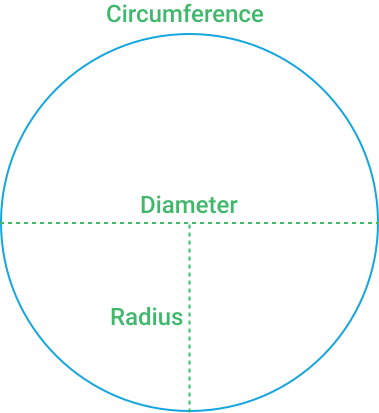
Circle with labels

Area=πr2

Circumference=2πr=dπ

A quick way to keep these straight: area is measured in square units, so its formula includes a square (r2). Circumference is a length, so it doesn’t.

Equation for circle

You can describe a circle on the coordinate plane with an equation. In the formula below:

  • (h,k) is the center of the circle.
  • r is the radius.
  • (x,y) represents any point on the circle.

(x−h)2+(y−k)2=r2

Chords, secants, and tangents

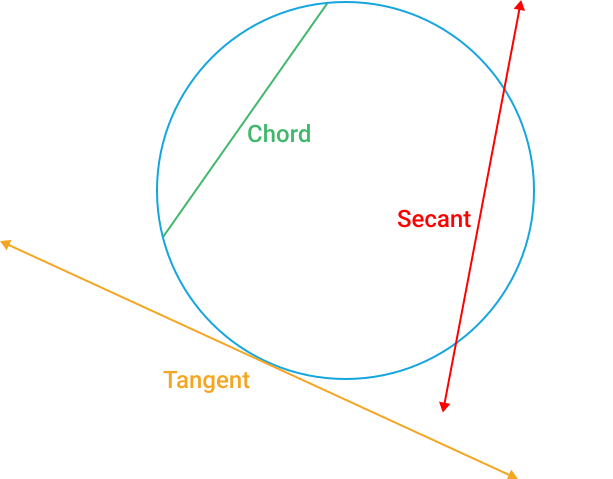
Chord secant tangent

Chords are line segments that start and end on the circle.

  • Any chord lies inside the circle except at its endpoints.
  • The longest possible chord is the diameter. It passes through the center.

Chords are also tied to angle facts you’ll use often:

  • An inscribed angle subtended by a chord is half the angle formed at the center of the circle that reaches the same endpoints.
  • Inscribed angles that subtend the same arc are equal (their location on the circle doesn’t matter).
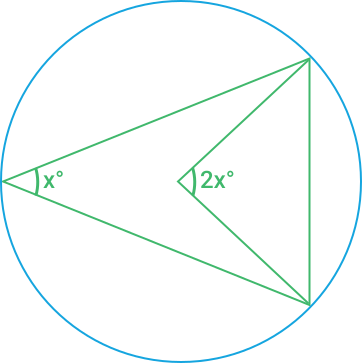
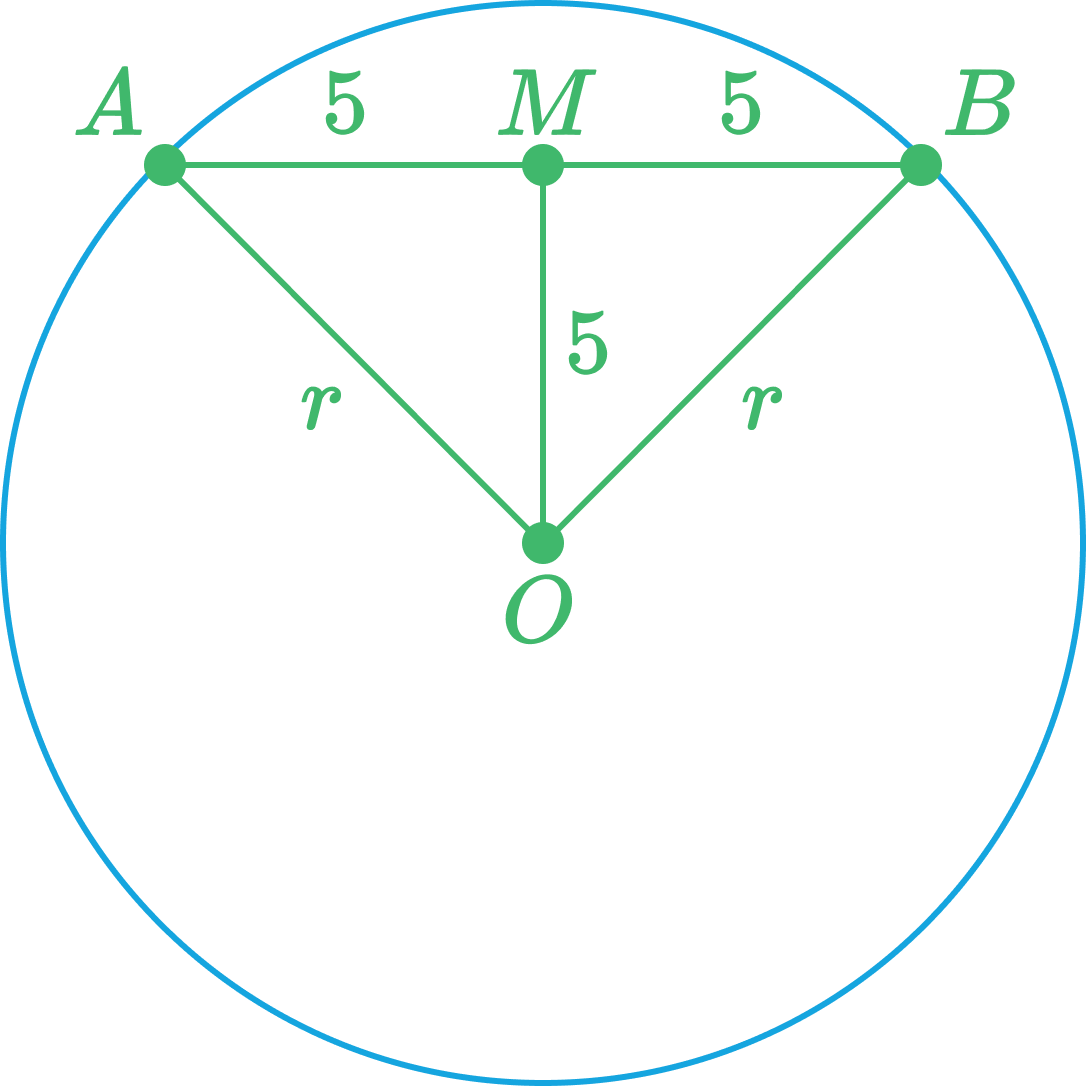
Circle example

Example: The question below is from 2018 AMC 12B

A circle has a chord of length 10, and the distance from the center of the circle to the chord is 5. What is the area of the circle?
A. 25π
B. 50π
C. 75π
D. 100π
E. 125π

(spoiler)

Answer: B. 50π

Circle problem example

A secant line intersects the circle at two points. Unlike a chord, it’s an infinite line rather than a segment.

A tangent is a line that touches the circle at exactly one point.

Cyclic quadrilaterals

A cyclic quadrilateral is any four-sided polygon whose vertices all lie on a circle. In other words, each vertex of the quadrilateral lies on the circle.

This kind of quadrilateral is especially useful because it has several reliable properties.
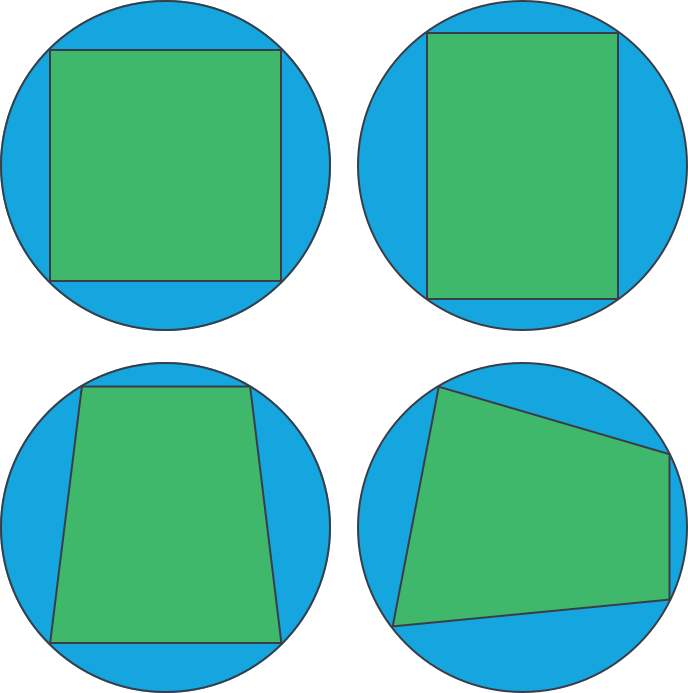
Cyclic quadrilaterals

Ptolemy’s Theorem says that in a cyclic quadrilateral, the product of the diagonals equals the sum of the products of the two pairs of opposite sides. The diagram and formula below show the relationship.
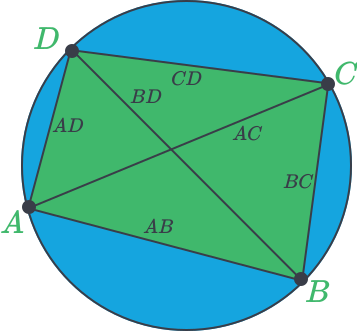
AC(BD)=AB(CD)+BC(AD)

Cyclic quadrilaterals

Example: The question below is from 2004 AMC 11B

In triangleABC we have AB=7, AC=8, BC=9. Point D is on the circumscribed circle of the triangle so that AD bisects angle BAC. What is the value of CDAD​?
A. 89​
B. 35​
C. 2
D. 717​
E. 25​

(spoiler)

Answer: B. 35​

You can use Brahmagupta’s Formula to find the area of a cyclic quadrilateral when the side lengths are known. Let a,b,c, and d be the side lengths, and let s be half the perimeter (the semiperimeter).

Area(s−a)(s−b)(s−c)(s−d)​

S=2a+b+c+d​

Here are a few more important properties of cyclic quadrilaterals to keep in mind.

  • Pairs of opposite angles must add up to 180 degrees.
  • All sides must be less than the diameter.
  • The quadrilateral reaches its maximum area when it is a square.

Intersecting chords theorem

The intersecting chords theorem states that when two chords intersect inside a circle, the product of the two segments of one chord equals the product of the two segments of the other chord.
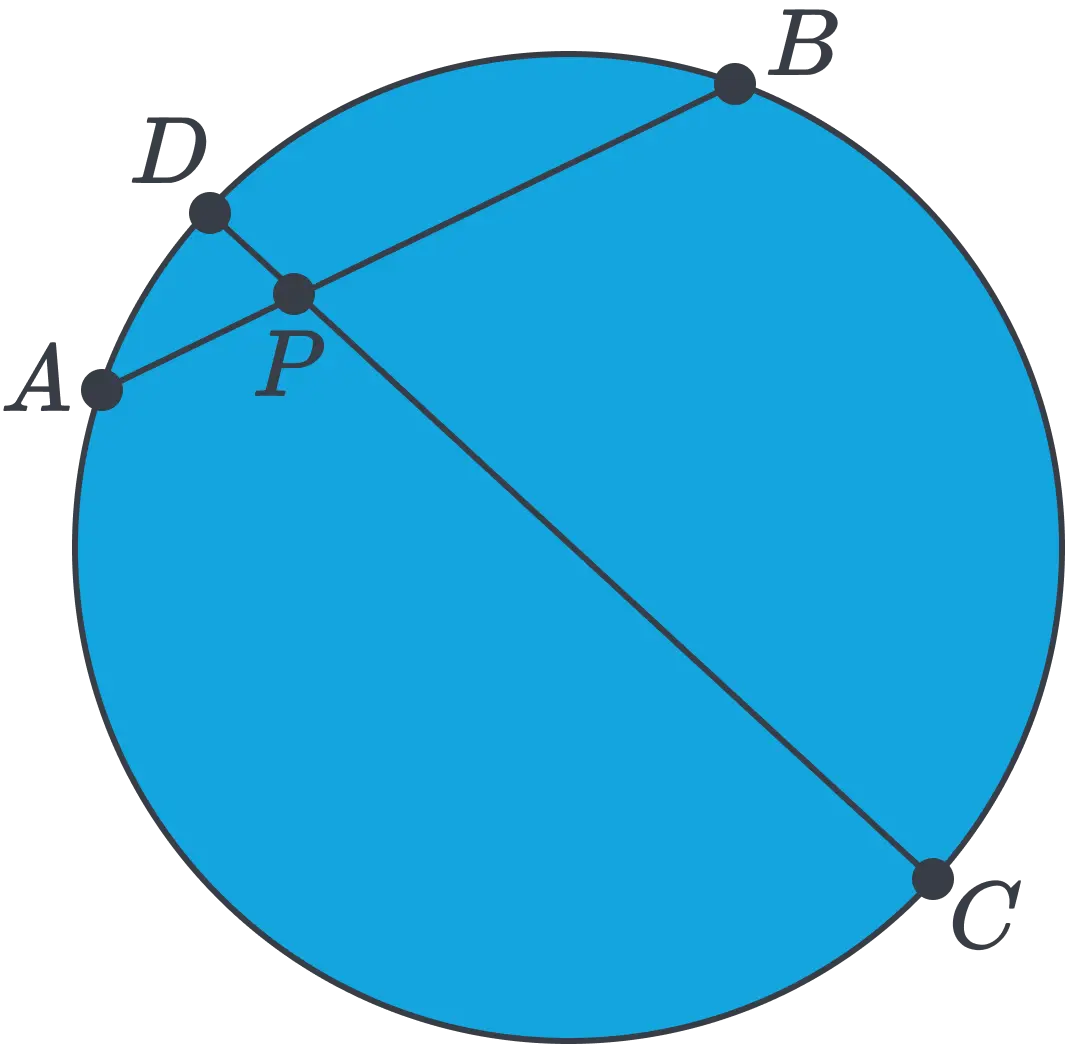
AP(BP)=CP(DP)

Intersecting chords theorem

Example: The question below is from 2020 AMC 12B

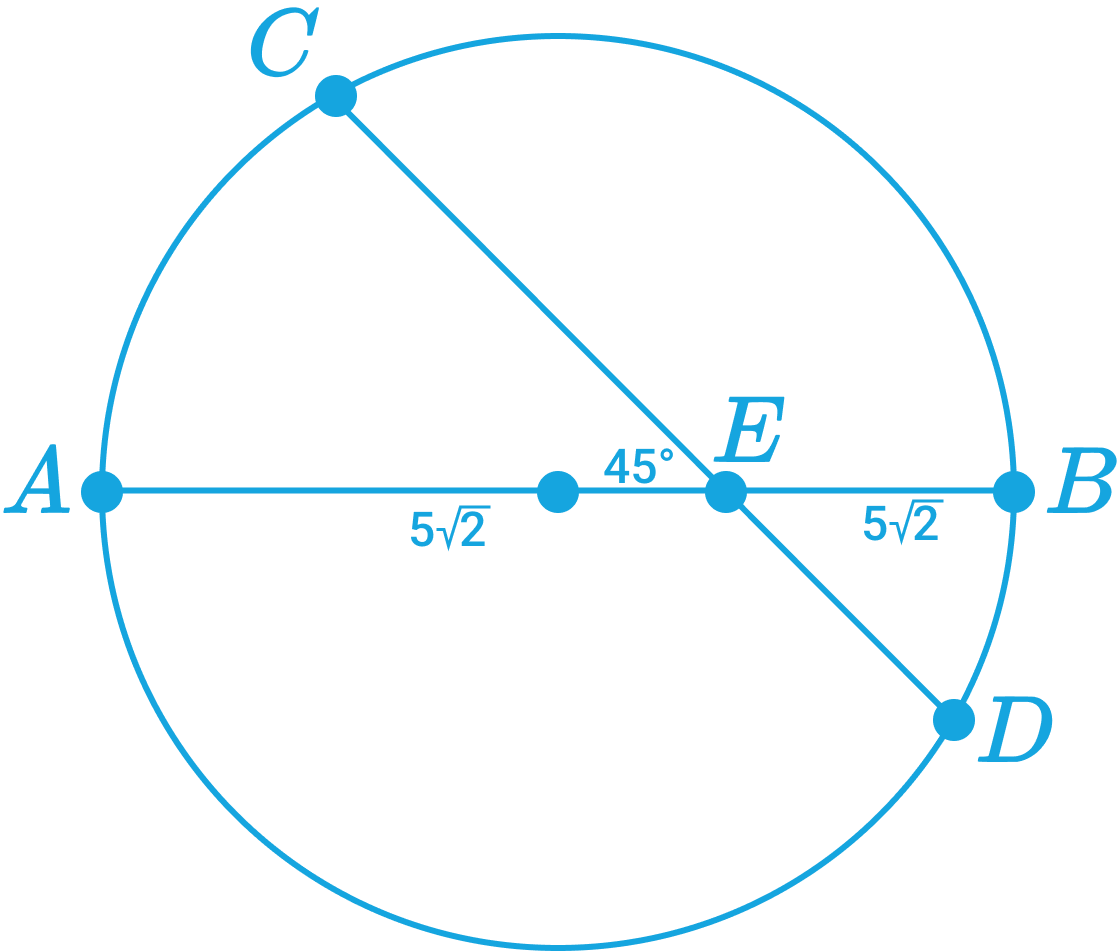
LetAB be a diameter in a circle of radius 52​. Let CD be a chord in the circle that intersects AB at a point E such that BE=25​ and ∠AEC=45∘. What is CE2+DE2?\

Circle diagram

A. 96
B. 98
C. 445​
D. 702​
E. 100

(spoiler)

Answer: E. 100

Sector area, arc length, and interior angle

For a sector (a “slice” of a circle), three ratios match:

  • sector area compared to the circle’s area
  • arc length compared to the circle’s circumference
  • central angle compared to 360∘

πr2sector area​=2πrarc length​=360∘interior angle​

Example: The question below is from 2002 AMC 12A

A45∘ arc of circle A is equal in length to a 30∘arc of circle B. What is the ratio of circle A’s area and circle B’s area?
A. 94​
B. 32​
C. 65​
D. 23​
E. 49​

(spoiler)

Answer: A. 94​

Common themes

  • Circle diagrams may not be perfectly drawn to scale, so rely on the algebraic relationships rather than the picture.
  • A circumscribed right triangle’s hypotenuse must be equal in distance to the diameter of the circle.
  • The sum of opposite angles of ANY cyclic quadrilateral must add up to 180∘. Just solve for the sum of the interior angles and divide by half of the sides to find the sum of any opposite pairs.
  • Any point outside of the circle can be described by the intersection of two unique tangent lines to the circle.
  • If opposite angles of a quadrilateral sum up to 180∘, the quadrilateral must be cyclic.

Circle basics: area and circumference\

  • Radius: center to any point on circle; diameter: across circle through center
  • Area formula: A=πr2 (square units)
  • Circumference formulas: C=2πr=πd (length units)

Equation for circle\

  • Standard form: (x−h)2+(y−k)2=r2
    • (h,k): center; r: radius; (x,y): any point on circle

Chords, secants, and tangents\

  • Chord: segment with endpoints on circle; diameter = longest chord
  • Secant: line intersecting circle at two points (extends infinitely)
  • Tangent: line touching circle at exactly one point
  • Inscribed angle = half central angle subtending same arc; inscribed angles subtending same arc are equal

Cyclic quadrilaterals\

  • All vertices lie on a circle
  • Opposite angles sum to 180∘
  • Ptolemy’s Theorem: AC⋅BD=AB⋅CD+BC⋅AD
  • Brahmagupta’s Formula: Area=(s−a)(s−b)(s−c)(s−d)​, s=2a+b+c+d​

Intersecting chords theorem\

  • If chords AB and CD intersect at P: AP⋅BP=CP⋅DP

Sector area, arc length, and interior angle\

  • Proportional ratios: πr2sector area​=2πrarc length​=360∘central angle​

Common themes\

  • Diagrams may not be to scale; trust algebraic relationships
  • Right triangle inscribed in circle: hypotenuse = diameter
  • Opposite angles of cyclic quadrilateral sum to 180∘
  • Quadrilateral with opposite angles summing to 180∘ is cyclic
  • Any external point defines two unique tangents to the circle

Sign up for free to take 6 quiz questions on this topic

Previous
Next  | 2.3 Lines and angles
All rights reserved ©2016 - 2026 Achievable, Inc.

Circles

This chapter applies to all AMC 8/10/12 test takers.

The two most important measurements of a circle are its area and circumference. Before using the formulas, make sure these definitions are clear.

The radius is the distance from the center of the circle to any point on the circle.

The diameter is the distance across the circle passing through the center.

The circumference is the perimeter, or total distance around the circle.

The area of a circle is the space enclosed by the circle and is expressed in square units.

Circle with labels

Area=πr2

Circumference=2πr=dπ

A quick way to keep these straight: area is measured in square units, so its formula includes a square (r2). Circumference is a length, so it doesn’t.

Equation for circle

You can describe a circle on the coordinate plane with an equation. In the formula below:

  • (h,k) is the center of the circle.
  • r is the radius.
  • (x,y) represents any point on the circle.

(x−h)2+(y−k)2=r2

Chords, secants, and tangents

Chord secant tangent

Chords are line segments that start and end on the circle.

  • Any chord lies inside the circle except at its endpoints.
  • The longest possible chord is the diameter. It passes through the center.

Chords are also tied to angle facts you’ll use often:

  • An inscribed angle subtended by a chord is half the angle formed at the center of the circle that reaches the same endpoints.
  • Inscribed angles that subtend the same arc are equal (their location on the circle doesn’t matter).

Circle example

Example: The question below is from 2018 AMC 12B

A circle has a chord of length 10, and the distance from the center of the circle to the chord is 5. What is the area of the circle?
A. 25π
B. 50π
C. 75π
D. 100π
E. 125π

(spoiler)

Answer: B. 50π

Circle problem example

A secant line intersects the circle at two points. Unlike a chord, it’s an infinite line rather than a segment.

A tangent is a line that touches the circle at exactly one point.

Cyclic quadrilaterals

A cyclic quadrilateral is any four-sided polygon whose vertices all lie on a circle. In other words, each vertex of the quadrilateral lies on the circle.

This kind of quadrilateral is especially useful because it has several reliable properties.

Cyclic quadrilaterals

Ptolemy’s Theorem says that in a cyclic quadrilateral, the product of the diagonals equals the sum of the products of the two pairs of opposite sides. The diagram and formula below show the relationship.

AC(BD)=AB(CD)+BC(AD)

Cyclic quadrilaterals

Example: The question below is from 2004 AMC 11B

In triangleABC we have AB=7, AC=8, BC=9. Point D is on the circumscribed circle of the triangle so that AD bisects angle BAC. What is the value of CDAD​?
A. 89​
B. 35​
C. 2
D. 717​
E. 25​

(spoiler)

Answer: B. 35​

You can use Brahmagupta’s Formula to find the area of a cyclic quadrilateral when the side lengths are known. Let a,b,c, and d be the side lengths, and let s be half the perimeter (the semiperimeter).

Area(s−a)(s−b)(s−c)(s−d)​

S=2a+b+c+d​

Here are a few more important properties of cyclic quadrilaterals to keep in mind.

  • Pairs of opposite angles must add up to 180 degrees.
  • All sides must be less than the diameter.
  • The quadrilateral reaches its maximum area when it is a square.

Intersecting chords theorem

The intersecting chords theorem states that when two chords intersect inside a circle, the product of the two segments of one chord equals the product of the two segments of the other chord.

AP(BP)=CP(DP)

Intersecting chords theorem

Example: The question below is from 2020 AMC 12B

LetAB be a diameter in a circle of radius 52​. Let CD be a chord in the circle that intersects AB at a point E such that BE=25​ and ∠AEC=45∘. What is CE2+DE2?\

Circle diagram

A. 96
B. 98
C. 445​
D. 702​
E. 100

(spoiler)

Answer: E. 100

Sector area, arc length, and interior angle

For a sector (a “slice” of a circle), three ratios match:

  • sector area compared to the circle’s area
  • arc length compared to the circle’s circumference
  • central angle compared to 360∘

πr2sector area​=2πrarc length​=360∘interior angle​

Example: The question below is from 2002 AMC 12A

A45∘ arc of circle A is equal in length to a 30∘arc of circle B. What is the ratio of circle A’s area and circle B’s area?
A. 94​
B. 32​
C. 65​
D. 23​
E. 49​

(spoiler)

Answer: A. 94​

Common themes

  • Circle diagrams may not be perfectly drawn to scale, so rely on the algebraic relationships rather than the picture.
  • A circumscribed right triangle’s hypotenuse must be equal in distance to the diameter of the circle.
  • The sum of opposite angles of ANY cyclic quadrilateral must add up to 180∘. Just solve for the sum of the interior angles and divide by half of the sides to find the sum of any opposite pairs.
  • Any point outside of the circle can be described by the intersection of two unique tangent lines to the circle.
  • If opposite angles of a quadrilateral sum up to 180∘, the quadrilateral must be cyclic.
Key points

Circle basics: area and circumference\

  • Radius: center to any point on circle; diameter: across circle through center
  • Area formula: A=πr2 (square units)
  • Circumference formulas: C=2πr=πd (length units)

Equation for circle\

  • Standard form: (x−h)2+(y−k)2=r2
    • (h,k): center; r: radius; (x,y): any point on circle

Chords, secants, and tangents\

  • Chord: segment with endpoints on circle; diameter = longest chord
  • Secant: line intersecting circle at two points (extends infinitely)
  • Tangent: line touching circle at exactly one point
  • Inscribed angle = half central angle subtending same arc; inscribed angles subtending same arc are equal

Cyclic quadrilaterals\

  • All vertices lie on a circle
  • Opposite angles sum to 180∘
  • Ptolemy’s Theorem: AC⋅BD=AB⋅CD+BC⋅AD
  • Brahmagupta’s Formula: Area=(s−a)(s−b)(s−c)(s−d)​, s=2a+b+c+d​

Intersecting chords theorem\

  • If chords AB and CD intersect at P: AP⋅BP=CP⋅DP

Sector area, arc length, and interior angle\

  • Proportional ratios: πr2sector area​=2πrarc length​=360∘central angle​

Common themes\

  • Diagrams may not be to scale; trust algebraic relationships
  • Right triangle inscribed in circle: hypotenuse = diameter
  • Opposite angles of cyclic quadrilateral sum to 180∘
  • Quadrilateral with opposite angles summing to 180∘ is cyclic
  • Any external point defines two unique tangents to the circle

More from Geometry

  • Triangles
  • Lines and angles
  • Quadrilaterals and polygons
  • Area and perimeter
  • Volume and surface area