


Achievable logoAchievable logo
AMC
Sign in
Sign up
Purchase
Textbook
Practice exams
Support
How it works
Exam catalog
Mountain with a flag at the peak
Textbook
Introduction
1. Algebra
2. Geometry
2.1 Triangles
2.2 Circles
2.3 Lines and angles
2.4 Quadrilaterals and polygons
2.5 Area and perimeter
2.6 Volume and surface area
2.7 Coordinate geometry
3. Number theory
4. Counting and probability
5. Intermediate topics (AMC 10/12)
6. Advanced topics (AMC 12)
7. General approaches
8. Practical strategies
Wrapping up
Achievable logoAchievable logo
2.5 Area and perimeter
Achievable AMC
2. Geometry

Area and perimeter

5 min read
Font
Discuss
Share
Feedback

This chapter applies to all AMC 8/10/12 test takers.

This chapter focuses on formulas for the area and perimeter of common polygons. Circles and triangles have their own dedicated chapters, so the emphasis here is on quadrilaterals and other polygons with four or more sides. For each shape, you’ll see the standard area and perimeter formulas, along with a few useful extensions for less common cases.

Quadrilaterals

Here is a table of area and perimeter formulas for common quadrilaterals. Notice a common pattern: most area formulas (except for the kite) are essentially “base (or average of bases) times height.” Also notice that the second area formula for a rhombus matches the kite area formula. That’s because every rhombus is a type of kite, but not every kite is a rhombus.

Shape Area Perimeter
Square s2 4s
Rectangle lw 2(l+w)
Parallelogram bh 2(a+b)
Rhombus bh or 21​(d1​d2​) 4s
Trapezoid 21​(b1​+b2​)h Sum of all sides
Kite 21​(d1​d2​) 2a+2b

In harder AMC problems, you may run into irregular quadrilaterals. Brahmagupta’s formula finds the area of any cyclic quadrilateral (a quadrilateral whose vertices lie on a circle). In this formula, a,b,c,d are the side lengths, and s is the semiperimeter (half the sum of the side lengths).

A=(s−a)(s−b)(s−c)(s−d)​

where s=2a+b+c+d​

Example: The question below is from 2022 AMC 10A

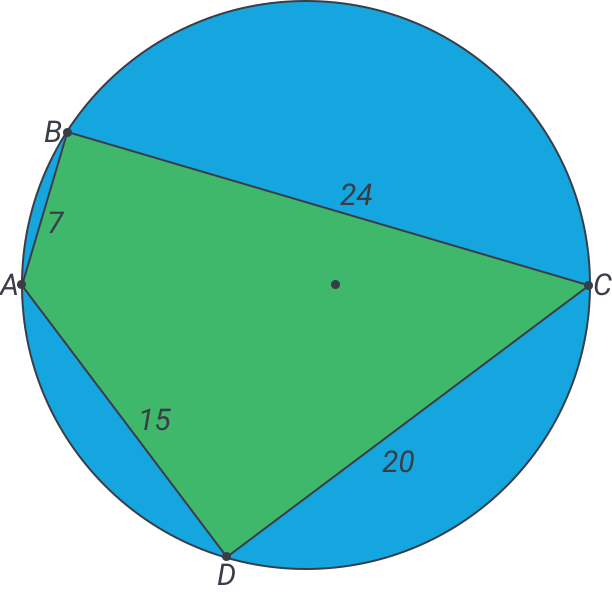
QuadrilateralABCD with side lengths AB=7,BC=24,CD=20,DA=15 is inscribed in a circle. The area interior to the circle but exterior to the quadrilateral can be written in the form caπ−b​, where a,b, and c are positive integers such that a and c have no common prime factor. What is a+b+c?

Quadrilateral abcd inscribed in a circle

A. 260
B. 855
C. 1235
D. 1565
E. 1997

(spoiler)

Answer: D. 1565

The area of the circle is 156.25π, or 625π/4. If you’re not sure where this comes from, use the fact that AC is the hypotenuse of right triangle ACD, so AC is the diameter of the circle.

Next, apply Brahmagupta’s formula to the cyclic quadrilateral to find that its area is 234.

The desired region is the area inside the circle but outside the quadrilateral, so subtract:

  • circle area minus quadrilateral area

This simplifies to (625π−936)/4.

Now match this to caπ−b​, so a=625, b=936, and c=4. Therefore,

a+b+c=625+936+4=1565.

Regular polygons

Below are a few key area formulas for commonly used regular polygons. A regular hexagon shows up often in AMC problems (after the equilateral triangle and the square). Its area is (233​​)s2. One way to remember why this works is to split a regular hexagon into 6 equilateral triangles. Each triangle has area (43​​)s2, so the total area is 6⋅(43​​)s2=(233​​)s2.

The regular octagon also has a useful area formula:

  • A=2(1+2​)s2Because all sides are equal, the perimeter of any regular polygon is the side length multiplied by the number of sides.

As the number of sides in a regular polygon increases, the polygon (which is cyclic) more closely approximates the circle it is inscribed in.

Example: The question below is from 2022 AMC 10A

A bowl is formed by attaching four regular hexagons of side1 to a square of side 1. The edges of the adjacent hexagons coincide, as shown in the figure. What is the area of the octagon obtained by joining the top eight vertices of the four hexagons, situated on the rim of the bowl?

Hexagon bowl A. 6
B. 7
C. 5+22​
D. 8
E. 9

(spoiler)

Answer: B. 7

The key observation is that this octagon is not regular.

  • The sides formed by the hexagons have length 1.
  • The sides formed by the corner triangles have length 2​.

Now place the octagon inside a 3 by 3 square. The difference between the square and the octagon is made up of four congruent isosceles right triangles, one in each corner.

Each triangle has area 1/2, so the total area removed is 4⋅(1/2)=2. Therefore, the octagon’s area is:

  • 9−2=7

Common themes

  • Look for hidden, simpler shapes inside more complex shapes.
  • Do not forget that the height of a shape is the perpendicular distance to the top from the base, which is not always equivalent to a side length.
  • Never assume a shape is regular or drawn to scale unless it is directly stated or it is provable with information other than just its appearance.

Quadrilaterals

  • Standard area formulas:
    • Square: s2
    • Rectangle: lw
    • Parallelogram: bh
    • Rhombus: bh or 21​(d1​d2​)
    • Trapezoid: 21​(b1​+b2​)h
    • Kite: 21​(d1​d2​)
  • Perimeter formulas:
    • Square: 4s
    • Rectangle: 2(l+w)
    • Parallelogram: 2(a+b)
    • Rhombus: 4s
    • Trapezoid: sum of all sides
    • Kite: 2a+2b
  • Brahmagupta’s formula for cyclic quadrilaterals:
    • A=(s−a)(s−b)(s−c)(s−d)​
    • s=2a+b+c+d​

Regular polygons

  • Area formulas:
    • Regular hexagon: A=(233​​)s2
    • Regular octagon: A=2(1+2​)s2
  • Perimeter: number of sides × side length
  • As sides increase, regular polygon approaches a circle

Common themes

  • Identify hidden or simpler shapes within complex figures
  • Height is always the perpendicular distance from base to top, not necessarily a side
  • Do not assume regularity or scale from appearance alone; rely on given or provable information

Sign up for free to take 6 quiz questions on this topic

Previous
Next  | 2.6 Volume and surface area
All rights reserved ©2016 - 2026 Achievable, Inc.

Area and perimeter

This chapter applies to all AMC 8/10/12 test takers.

This chapter focuses on formulas for the area and perimeter of common polygons. Circles and triangles have their own dedicated chapters, so the emphasis here is on quadrilaterals and other polygons with four or more sides. For each shape, you’ll see the standard area and perimeter formulas, along with a few useful extensions for less common cases.

Quadrilaterals

Here is a table of area and perimeter formulas for common quadrilaterals. Notice a common pattern: most area formulas (except for the kite) are essentially “base (or average of bases) times height.” Also notice that the second area formula for a rhombus matches the kite area formula. That’s because every rhombus is a type of kite, but not every kite is a rhombus.

Shape Area Perimeter
Square s2 4s
Rectangle lw 2(l+w)
Parallelogram bh 2(a+b)
Rhombus bh or 21​(d1​d2​) 4s
Trapezoid 21​(b1​+b2​)h Sum of all sides
Kite 21​(d1​d2​) 2a+2b

In harder AMC problems, you may run into irregular quadrilaterals. Brahmagupta’s formula finds the area of any cyclic quadrilateral (a quadrilateral whose vertices lie on a circle). In this formula, a,b,c,d are the side lengths, and s is the semiperimeter (half the sum of the side lengths).

A=(s−a)(s−b)(s−c)(s−d)​

where s=2a+b+c+d​

Example: The question below is from 2022 AMC 10A

QuadrilateralABCD with side lengths AB=7,BC=24,CD=20,DA=15 is inscribed in a circle. The area interior to the circle but exterior to the quadrilateral can be written in the form caπ−b​, where a,b, and c are positive integers such that a and c have no common prime factor. What is a+b+c?

Quadrilateral abcd inscribed in a circle

A. 260
B. 855
C. 1235
D. 1565
E. 1997

(spoiler)

Answer: D. 1565

The area of the circle is 156.25π, or 625π/4. If you’re not sure where this comes from, use the fact that AC is the hypotenuse of right triangle ACD, so AC is the diameter of the circle.

Next, apply Brahmagupta’s formula to the cyclic quadrilateral to find that its area is 234.

The desired region is the area inside the circle but outside the quadrilateral, so subtract:

  • circle area minus quadrilateral area

This simplifies to (625π−936)/4.

Now match this to caπ−b​, so a=625, b=936, and c=4. Therefore,

a+b+c=625+936+4=1565.

Regular polygons

Below are a few key area formulas for commonly used regular polygons. A regular hexagon shows up often in AMC problems (after the equilateral triangle and the square). Its area is (233​​)s2. One way to remember why this works is to split a regular hexagon into 6 equilateral triangles. Each triangle has area (43​​)s2, so the total area is 6⋅(43​​)s2=(233​​)s2.

The regular octagon also has a useful area formula:

  • A=2(1+2​)s2Because all sides are equal, the perimeter of any regular polygon is the side length multiplied by the number of sides.

As the number of sides in a regular polygon increases, the polygon (which is cyclic) more closely approximates the circle it is inscribed in.

Example: The question below is from 2022 AMC 10A

A bowl is formed by attaching four regular hexagons of side1 to a square of side 1. The edges of the adjacent hexagons coincide, as shown in the figure. What is the area of the octagon obtained by joining the top eight vertices of the four hexagons, situated on the rim of the bowl?

Hexagon bowl A. 6
B. 7
C. 5+22​
D. 8
E. 9

(spoiler)

Answer: B. 7

The key observation is that this octagon is not regular.

  • The sides formed by the hexagons have length 1.
  • The sides formed by the corner triangles have length 2​.

Now place the octagon inside a 3 by 3 square. The difference between the square and the octagon is made up of four congruent isosceles right triangles, one in each corner.

Each triangle has area 1/2, so the total area removed is 4⋅(1/2)=2. Therefore, the octagon’s area is:

  • 9−2=7

Common themes

  • Look for hidden, simpler shapes inside more complex shapes.
  • Do not forget that the height of a shape is the perpendicular distance to the top from the base, which is not always equivalent to a side length.
  • Never assume a shape is regular or drawn to scale unless it is directly stated or it is provable with information other than just its appearance.
Key points

Quadrilaterals

  • Standard area formulas:
    • Square: s2
    • Rectangle: lw
    • Parallelogram: bh
    • Rhombus: bh or 21​(d1​d2​)
    • Trapezoid: 21​(b1​+b2​)h
    • Kite: 21​(d1​d2​)
  • Perimeter formulas:
    • Square: 4s
    • Rectangle: 2(l+w)
    • Parallelogram: 2(a+b)
    • Rhombus: 4s
    • Trapezoid: sum of all sides
    • Kite: 2a+2b
  • Brahmagupta’s formula for cyclic quadrilaterals:
    • A=(s−a)(s−b)(s−c)(s−d)​
    • s=2a+b+c+d​

Regular polygons

  • Area formulas:
    • Regular hexagon: A=(233​​)s2
    • Regular octagon: A=2(1+2​)s2
  • Perimeter: number of sides × side length
  • As sides increase, regular polygon approaches a circle

Common themes

  • Identify hidden or simpler shapes within complex figures
  • Height is always the perpendicular distance from base to top, not necessarily a side
  • Do not assume regularity or scale from appearance alone; rely on given or provable information

More from Geometry

  • Triangles
  • Circles
  • Lines and angles
  • Quadrilaterals and polygons
  • Volume and surface area