Achievable logoAchievable logo
AMC
Sign in
Sign up
Purchase
Textbook
Practice exams
Support
How it works
Exam catalog
Mountain with a flag at the peak
Textbook
Introduction
1. Algebra
2. Geometry
2.1 Triangles
2.2 Circles
2.3 Lines and angles
2.4 Quadrilaterals and polygons
2.5 Area and perimeter
2.6 Volume and surface area
2.7 Coordinate geometry
3. Number theory
4. Counting and probability
5. Intermediate topics (AMC 10/12)
6. Advanced topics (AMC 12)
7. General approaches
8. Practical strategies
Wrapping up
Achievable logoAchievable logo
2.4 Quadrilaterals and polygons
Achievable AMC
2. Geometry

Quadrilaterals and polygons

8 min read
Font
Discuss
Share
Feedback

This chapter applies to all AMC 8/10/12 test takers.

This chapter focuses on shapes with four or more sides.

  • A quadrilateral is a polygon with exactly four sides.
  • A polygon can have any number of sides (including triangles).

Since triangles are covered in a separate chapter, the focus here is on quadrilaterals and other polygons.

You’ll want to be comfortable with:

  • How interior and exterior angles relate
  • How to find area, perimeter, and diagonals for common shapes

Most of this chapter is about definitions and classification. A more detailed discussion of area formulas appears in the area and perimeter chapter. Near the end, we’ll also point out a few AMC-style strategies that come up often with these shapes.

Quadrilaterals

Every quadrilateral has four sides. The diagram below shows how common quadrilaterals are categorized. If one shape appears inside another category, it satisfies the larger category’s definition too.

For example, a square is both a rectangle and a rhombus. That also makes it a parallelogram, and (of course) a quadrilateral.

We’ll define each shape below, starting with parallelograms.
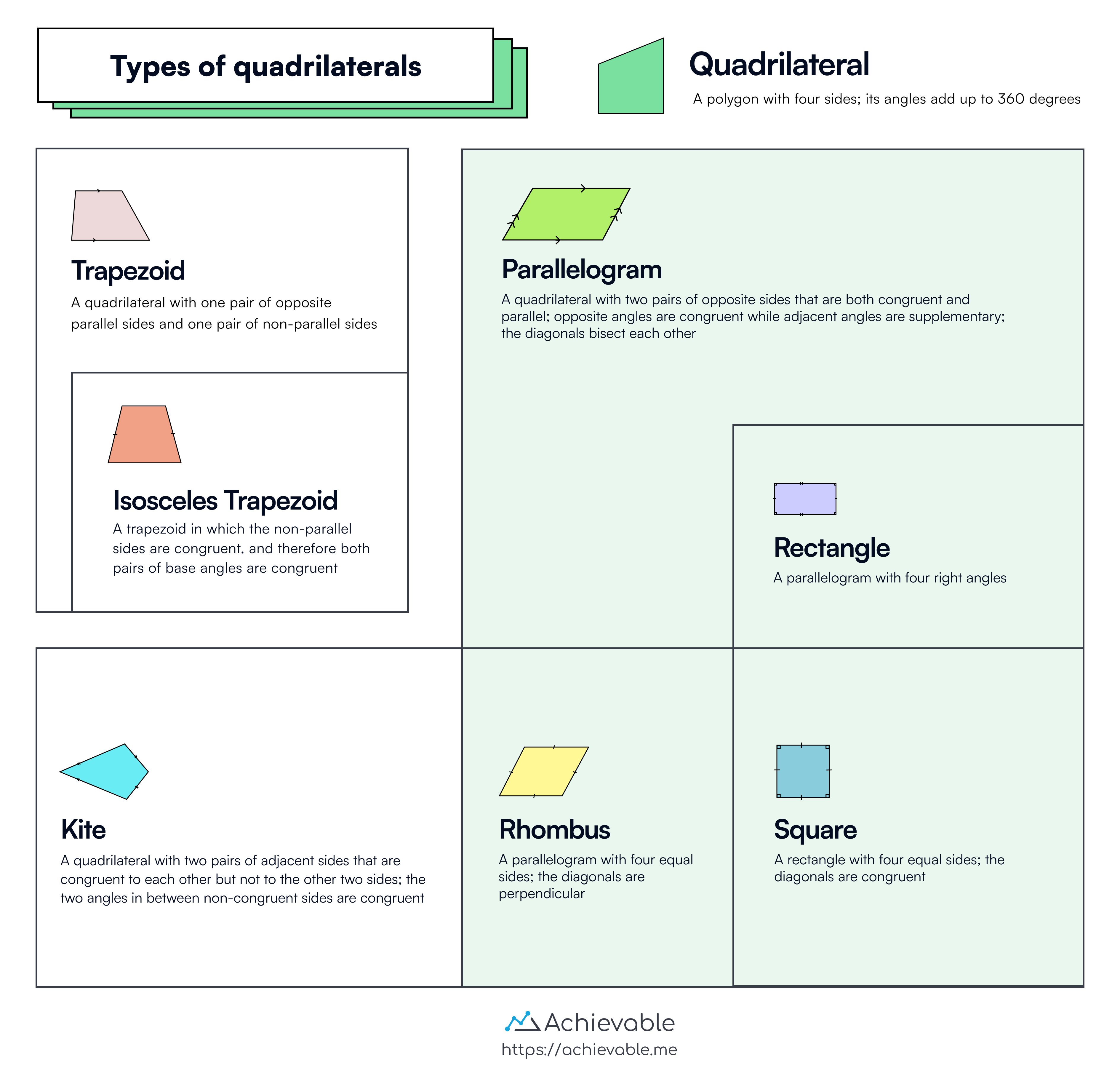
Types of quadrilaterals

A parallelogram is a quadrilateral with both pairs of opposite sides parallel. This gives you several useful facts:

  • Opposite angles are equal.
  • Adjacent angles are supplementary (they add to 180).
  • Since all quadrilaterals have interior angles summing to 360, knowing one angle lets you find the other three.
  • The diagonals intersect at the center of the shape (they bisect each other).
  • The area is base times height.

A rhombus is a parallelogram with all sides the same length. In addition to the parallelogram properties:

  • Its diagonals intersect at the center.
  • Its diagonals are perpendicular.

A rectangle is a parallelogram with all angles equal. That forces every angle to be 90 degrees.

A square is both a rectangle and a rhombus: all sides are equal and all angles are 90 degrees. The diagonal of a square is always the side length times sqrt2.

A trapezoid has exactly one pair of parallel sides. To find its area, multiply the height by the average of the two parallel bases.

An isosceles trapezoid is a trapezoid where the two non-parallel (tilted) sides have the same length. The same area formula applies, but the symmetry often makes angle and length relationships easier to use. This shape has two pairs of equal angles, and the equal angles are adjacent (not opposite).

The most flexible of these common categories is the kite. A kite has two pairs of adjacent equal sides, but it doesn’t need any parallel sides. Its diagonals are perpendicular. You can find the area by multiplying the diagonal lengths and dividing by two.

There is also the irregular quadrilateral, which is any quadrilateral that doesn’t fit the categories above. These usually don’t have equal sides or equal angles. You can often find the area by splitting the shape into simpler pieces, or by using Brahmagupta’s formula (found in this chapter) if it is a cyclic quadrilateral.

The problem below involves an irregular quadrilateral. One way to approach it is to sketch possibilities from the answer choices and use the idea that a side can’t be so long that the remaining sides can’t “reach” to close the quadrilateral.

Example: The question below is from 2023 AMC 10A

A quadrilateral has all integer sides lengths, a perimeter of 26, and one side of length 4. What is the greatest possible length of one side of this quadrilateral?
A. 9
B. 10
C. 11
D. 12
E. 13

(spoiler)

Answer: D. 12

Polygons

This section focuses on regular polygons with five or more sides.

A regular polygon has:

  • All sides the same length
  • All interior angles the same measure

For example, a seven-sided regular polygon has seven equal sides and seven equal angles. As the number of sides increases, a regular polygon looks more and more like a circle, and its interior angles get larger.

Sides Name Interior angle Figure
5 Pentagon 108° Regular pentagon with 5 sides
6 Hexagon 120° Regular hexagon with 6 sides
8 Octagon 135° Regular octagon with 8 sides
10 Decagon 144° Regular decagon with 10 sides

Example: The question below is from 2014 AMC 10B

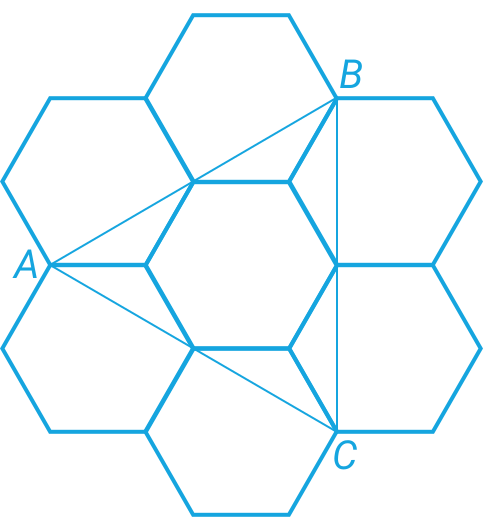
Six regular hexagons surround a regular hexagon of side length 1 as shown. What is the area of △ABC?

Hexagons surround regular hexagon and triangle abc

A. 23​
B. 33​
C. 1+32​
D. 2+23​
E. 3+23​

(spoiler)

Answer: E. 3+23​

This problem becomes straightforward once you see how △ABC is built from familiar pieces.

  • The area of △ABC is made up of one full hexagon plus 6 small triangles.
  • Each of those triangles is equivalent to 1/6th of a hexagon.

So the 6 triangles together have the same area as one hexagon, making the total area equal to two hexagons.

To find the area of one hexagon, you can:

  • Split it into 6 equilateral triangles of side length 1, or
  • Split it into two trapezoids and add their areas

Since △ABC has the area of two hexagons, the final answer is twice the area of one hexagon.

Sum of interior angles for an n-sided shape

The sum of the interior angles of any polygon is (n−2)×180, where n is the number of sides.

For instance, a pentagon (5 sides) has interior angles with a sum of (n−2)×180=540.

This is especially useful for irregular polygons. One quick observation is that the sum of interior angles must always be a multiple of 180.

Example: The question below is from 2017 AMC 12A

Claire adds the degree measures of the interior angles of a convex polygon and arrives at a sum of 2017. She then discovers that she forgot to include one angle. What is the degree measure of the forgotten angle?
A. 37
B. 63
C. 117
D. 143
E. 163

(spoiler)

Answer: D. 143

Only this answer choice makes the total a multiple of 180.

2017+143=2160=12(180)

Common themes

  • All regular shapes are symmetrical along multiple diagonals.
  • The average interior angle increases as the number of sides increases.
  • Always draw out diagrams to help you reason through a question.
  • A regular hexagon is made up of six equilateral triangles.
  • You can deconstruct parallelograms into four triangles that meet in the center by drawing both diagonals.
  • Projecting a diagram onto a coordinate plane may be helpful with certain problems.
  • The number of diagonals in a polygon is found by taking the number of sides and plugging it into this formula: 2n(n−3)​.

Quadrilaterals

  • Quadrilateral: polygon with exactly four sides
  • Parallelogram: both pairs of opposite sides parallel
    • Opposite angles equal, adjacent angles supplementary
    • Diagonals bisect each other; area = base × height
  • Rhombus: parallelogram with all sides equal
    • Diagonals are perpendicular and bisect each other
  • Rectangle: parallelogram with all angles 90°
  • Square: rectangle and rhombus; all sides equal, all angles 90°
    • Diagonal = side × 2​
  • Trapezoid: exactly one pair of parallel sides
    • Area = height × (average of parallel bases)
  • Isosceles trapezoid: non-parallel sides equal; two pairs of equal adjacent angles
  • Kite: two pairs of adjacent equal sides; diagonals perpendicular
    • Area = (product of diagonals) ÷ 2
  • Irregular quadrilateral: no equal sides/angles; area often found by splitting into simpler shapes

Polygons

  • Regular polygon: all sides and all angles equal
  • As number of sides increases, shape approaches a circle; interior angles increase
  • Examples:
    • Pentagon (5 sides): interior angle 108°
    • Hexagon (6 sides): interior angle 120°
    • Octagon (8 sides): interior angle 135°
    • Decagon (10 sides): interior angle 144°

Sum of Interior Angles

  • Formula: (n−2)×180 for n-sided polygon
    • Example: pentagon sum = 540
  • Useful for both regular and irregular polygons

Common Themes

  • Regular shapes: symmetrical along multiple diagonals
  • Average interior angle increases with more sides
  • Diagrams aid problem-solving
  • Regular hexagon = 6 equilateral triangles
  • Parallelogram can be divided into 4 triangles by diagonals
  • Coordinate plane projections can simplify problems
  • Number of diagonals: 2n(n−3)​ for n-sided polygon

Sign up for free to take 6 quiz questions on this topic

Previous
Next  | 2.5 Area and perimeter
All rights reserved ©2016 - 2026 Achievable, Inc.

Quadrilaterals and polygons

This chapter applies to all AMC 8/10/12 test takers.

This chapter focuses on shapes with four or more sides.

  • A quadrilateral is a polygon with exactly four sides.
  • A polygon can have any number of sides (including triangles).

Since triangles are covered in a separate chapter, the focus here is on quadrilaterals and other polygons.

You’ll want to be comfortable with:

  • How interior and exterior angles relate
  • How to find area, perimeter, and diagonals for common shapes

Most of this chapter is about definitions and classification. A more detailed discussion of area formulas appears in the area and perimeter chapter. Near the end, we’ll also point out a few AMC-style strategies that come up often with these shapes.

Quadrilaterals

Every quadrilateral has four sides. The diagram below shows how common quadrilaterals are categorized. If one shape appears inside another category, it satisfies the larger category’s definition too.

For example, a square is both a rectangle and a rhombus. That also makes it a parallelogram, and (of course) a quadrilateral.

We’ll define each shape below, starting with parallelograms.

Types of quadrilaterals

A parallelogram is a quadrilateral with both pairs of opposite sides parallel. This gives you several useful facts:

  • Opposite angles are equal.
  • Adjacent angles are supplementary (they add to 180).
  • Since all quadrilaterals have interior angles summing to 360, knowing one angle lets you find the other three.
  • The diagonals intersect at the center of the shape (they bisect each other).
  • The area is base times height.

A rhombus is a parallelogram with all sides the same length. In addition to the parallelogram properties:

  • Its diagonals intersect at the center.
  • Its diagonals are perpendicular.

A rectangle is a parallelogram with all angles equal. That forces every angle to be 90 degrees.

A square is both a rectangle and a rhombus: all sides are equal and all angles are 90 degrees. The diagonal of a square is always the side length times sqrt2.

A trapezoid has exactly one pair of parallel sides. To find its area, multiply the height by the average of the two parallel bases.

An isosceles trapezoid is a trapezoid where the two non-parallel (tilted) sides have the same length. The same area formula applies, but the symmetry often makes angle and length relationships easier to use. This shape has two pairs of equal angles, and the equal angles are adjacent (not opposite).

The most flexible of these common categories is the kite. A kite has two pairs of adjacent equal sides, but it doesn’t need any parallel sides. Its diagonals are perpendicular. You can find the area by multiplying the diagonal lengths and dividing by two.

There is also the irregular quadrilateral, which is any quadrilateral that doesn’t fit the categories above. These usually don’t have equal sides or equal angles. You can often find the area by splitting the shape into simpler pieces, or by using Brahmagupta’s formula (found in this chapter) if it is a cyclic quadrilateral.

The problem below involves an irregular quadrilateral. One way to approach it is to sketch possibilities from the answer choices and use the idea that a side can’t be so long that the remaining sides can’t “reach” to close the quadrilateral.

Example: The question below is from 2023 AMC 10A

A quadrilateral has all integer sides lengths, a perimeter of 26, and one side of length 4. What is the greatest possible length of one side of this quadrilateral?
A. 9
B. 10
C. 11
D. 12
E. 13

(spoiler)

Answer: D. 12

Polygons

This section focuses on regular polygons with five or more sides.

A regular polygon has:

  • All sides the same length
  • All interior angles the same measure

For example, a seven-sided regular polygon has seven equal sides and seven equal angles. As the number of sides increases, a regular polygon looks more and more like a circle, and its interior angles get larger.

Sides Name Interior angle Figure
5 Pentagon 108° Regular pentagon with 5 sides
6 Hexagon 120° Regular hexagon with 6 sides
8 Octagon 135° Regular octagon with 8 sides
10 Decagon 144° Regular decagon with 10 sides

Example: The question below is from 2014 AMC 10B

Six regular hexagons surround a regular hexagon of side length 1 as shown. What is the area of △ABC?

Hexagons surround regular hexagon and triangle abc

A. 23​
B. 33​
C. 1+32​
D. 2+23​
E. 3+23​

(spoiler)

Answer: E. 3+23​

This problem becomes straightforward once you see how △ABC is built from familiar pieces.

  • The area of △ABC is made up of one full hexagon plus 6 small triangles.
  • Each of those triangles is equivalent to 1/6th of a hexagon.

So the 6 triangles together have the same area as one hexagon, making the total area equal to two hexagons.

To find the area of one hexagon, you can:

  • Split it into 6 equilateral triangles of side length 1, or
  • Split it into two trapezoids and add their areas

Since △ABC has the area of two hexagons, the final answer is twice the area of one hexagon.

Sum of interior angles for an n-sided shape

The sum of the interior angles of any polygon is (n−2)×180, where n is the number of sides.

For instance, a pentagon (5 sides) has interior angles with a sum of (n−2)×180=540.

This is especially useful for irregular polygons. One quick observation is that the sum of interior angles must always be a multiple of 180.

Example: The question below is from 2017 AMC 12A

Claire adds the degree measures of the interior angles of a convex polygon and arrives at a sum of 2017. She then discovers that she forgot to include one angle. What is the degree measure of the forgotten angle?
A. 37
B. 63
C. 117
D. 143
E. 163

(spoiler)

Answer: D. 143

Only this answer choice makes the total a multiple of 180.

2017+143=2160=12(180)

Common themes

  • All regular shapes are symmetrical along multiple diagonals.
  • The average interior angle increases as the number of sides increases.
  • Always draw out diagrams to help you reason through a question.
  • A regular hexagon is made up of six equilateral triangles.
  • You can deconstruct parallelograms into four triangles that meet in the center by drawing both diagonals.
  • Projecting a diagram onto a coordinate plane may be helpful with certain problems.
  • The number of diagonals in a polygon is found by taking the number of sides and plugging it into this formula: 2n(n−3)​.
Key points

Quadrilaterals

  • Quadrilateral: polygon with exactly four sides
  • Parallelogram: both pairs of opposite sides parallel
    • Opposite angles equal, adjacent angles supplementary
    • Diagonals bisect each other; area = base × height
  • Rhombus: parallelogram with all sides equal
    • Diagonals are perpendicular and bisect each other
  • Rectangle: parallelogram with all angles 90°
  • Square: rectangle and rhombus; all sides equal, all angles 90°
    • Diagonal = side × 2​
  • Trapezoid: exactly one pair of parallel sides
    • Area = height × (average of parallel bases)
  • Isosceles trapezoid: non-parallel sides equal; two pairs of equal adjacent angles
  • Kite: two pairs of adjacent equal sides; diagonals perpendicular
    • Area = (product of diagonals) ÷ 2
  • Irregular quadrilateral: no equal sides/angles; area often found by splitting into simpler shapes

Polygons

  • Regular polygon: all sides and all angles equal
  • As number of sides increases, shape approaches a circle; interior angles increase
  • Examples:
    • Pentagon (5 sides): interior angle 108°
    • Hexagon (6 sides): interior angle 120°
    • Octagon (8 sides): interior angle 135°
    • Decagon (10 sides): interior angle 144°

Sum of Interior Angles

  • Formula: (n−2)×180 for n-sided polygon
    • Example: pentagon sum = 540
  • Useful for both regular and irregular polygons

Common Themes

  • Regular shapes: symmetrical along multiple diagonals
  • Average interior angle increases with more sides
  • Diagrams aid problem-solving
  • Regular hexagon = 6 equilateral triangles
  • Parallelogram can be divided into 4 triangles by diagonals
  • Coordinate plane projections can simplify problems
  • Number of diagonals: 2n(n−3)​ for n-sided polygon

More from Geometry

  • Triangles
  • Circles
  • Lines and angles
  • Area and perimeter
  • Volume and surface area