



Lines and angles
Many AMC problems use angle relationships as a key step toward the solution. We’ll look at polygon angle properties later, but first it helps to get comfortable with angles formed by lines. Here are a few core rules to keep in mind.
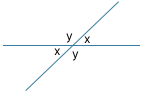
Opposite angles are always equal
When two lines intersect, they form two pairs of opposite (vertical) angles. Each pair of opposite angles has the same measure. In the diagram below, the top-left angle equals the bottom-right angle, and the top-right angle equals the bottom-left angle.
Supplementary and complementary angles
When two angles share a side and sit next to each other, they form a larger angle. The measure of the larger angle equals the sum of the two smaller angles.
In the diagram below, what must angles and add up to?

A straight line measures in total, so in this example, .
Now look at the diagram below. What do you think and must sum to? Since the larger angle is , the two smaller angles must add to .
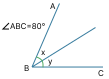
When angles add up to , they’re called supplementary angles. When two angles add up to a right angle (), they’re called complementary angles. When angles go all the way around a point (like slices of a pie that complete a full turn), their measures add up to .
Example: The question below is from 2012 AMC 10
Mary divides a circle into sectors. The central angles of these sectors, measured in degrees, are all integers and they form an arithmetic sequence. What is the degree measure of the smallest possible sector angle?
A.
B.
C.
D.
E.
Answer: C.
Parallel and perpendicular lines
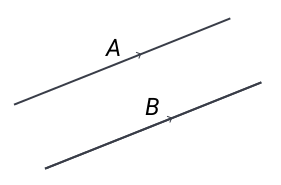
Parallel lines have the same slope, so they never intersect.
Ways to know if lines are parallel
- Explicitly denoted using this symbol:
- If the lines have the same slope, e.g.: and
- If the lines are opposite sides of a parallelogram
- The lines have similar arrows drawn on them like in the diagram above
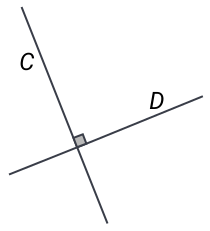
Perpendicular lines intersect at 90 degrees.
Ways to know if lines are perpendicular
- Explicitly denoted using this symbol:
- If the lines have slopes that are reciprocal and of the opposite sign, e.g.: and
- If the lines are adjacent sides of a rectangle or square
- If the angle between the lines is given to be , sometimes shown as a little square box like in the figure above
Transversals
You’ll often use parallel and perpendicular line facts together with transversals. A transversal is a line that cuts through two or more other lines.
What happens when a transversal intersects a line?
When a transversal cuts through a line, it creates equal opposite angles.
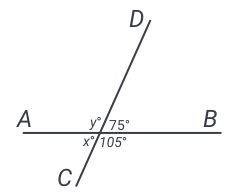
In the figure above, is and is .
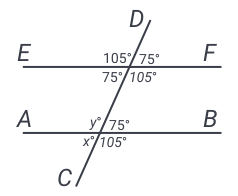
What happens when a transversal intersects parallel lines?
If we add in a parallel line (), the transversal creates matching angles at each intersection. In the figure below, the angles formed by and match the angles formed by and - as if the angle pattern were copied and shifted upward along .
What happens when a transversal intersects perpendicular lines?
When a transversal cuts through perpendicular lines, it can form a right triangle.
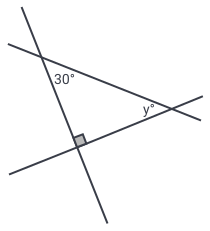
The interior angles of any triangle add up to . In the figure above, two angles are given, so you can find the third angle by subtraction: .
Example: The question below is from 2022 AMC 10A
Let be a scalene triangle. Point lies on so that bisects The line through perpendicular to intersects the line through parallel to at point Suppose and What is
A.
B.
C.
D.
E.
Answer: C.