


Achievable logoAchievable logo
NCLEX
Sign in
Sign up
Purchase
Textbook
Practice exams
Support
How it works
Exam catalog
Mountain with a flag at the peak
Textbook
Introduction
1. Safe and effective care environment
1.1 Management of care
1.2 Safety and infection control
1.2.1 Standard precautions and transmission-based precautions
1.2.2 Surgical asepsis and sterile technique
1.2.3 Use of safety devices
1.2.4 Hazardous materials and emergency response
1.2.5 Incident reporting and error prevention
1.2.6 Safe handling of equipment and radiation precautions
1.2.7 Isolation and infection prevention
2. Health promotion and maintenance
3. Psychosocial Integrity
4. Physiological Integrity
Wrapping up
Achievable logoAchievable logo
1.2.6 Safe handling of equipment and radiation precautions
Achievable NCLEX
1. Safe and effective care environment
1.2. Safety and infection control
Our NCLEX course is currently in development and is a work-in-progress.

Safe handling of equipment and radiation precautions

5 min read
Font
Discuss
Share
Feedback

Introduction

Every beep, cord, and machine in the hospital carries both power and risk. A frayed wire, a miscalibrated pump, or a misplaced radiation source can cause harm faster than an infection. NCLEX evaluates whether you can recognize hazards, use protective equipment, and act immediately when devices fail. Safe handling is the foundation of safe care.

Learning objectives

By the end of this section, you should be able to:

  • Inspect and handle hospital equipment safely to prevent electrical, mechanical, and thermal injury.
  • Apply core principles of radiation protection when caring for clients receiving therapy or diagnostics.
  • Identify and report malfunctioning equipment following institutional protocols.

Equipment safety

Healthcare technology saves lives, but when misused or neglected, it can injure clients and staff. Every nurse is responsible for environmental awareness and proper equipment management.

Inspection and maintenance

  • Check cords, plugs, and casings for cracks, fraying, or exposed wiring before use
  • Ensure grounding pins are intact; never remove or bypass them
  • Verify that monitors, beds, infusion pumps, and defibrillators are functional and calibrated
  • Remove defective items from service, tag as “Do Not Use,” and notify maintenance or biomedical engineering
  • Avoid using extension cords or overloading outlets; plug directly into grounded wall sockets
  • Keep electrical equipment away from water sources and wet surfaces

Use and positioning

  • Confirm oxygen and suction function at the start of each shift.
  • Lock wheels on beds, stretchers, and wheelchairs before transfers.
  • Keep tubing, lines, and cords free from tangles or tripping hazards.
  • Maintain equipment at client’s side only if alarms are active and audible. Never silence without cause

Response steps to malfunction

  1. Stop using it immediately and ensure client safety
  2. Switch to backup manual devices if necessary (e.g., manual bag ventilation)
  3. Notify the charge nurse and biomedical staff
  4. Document the malfunction and resulting interventions

Radiation precautions

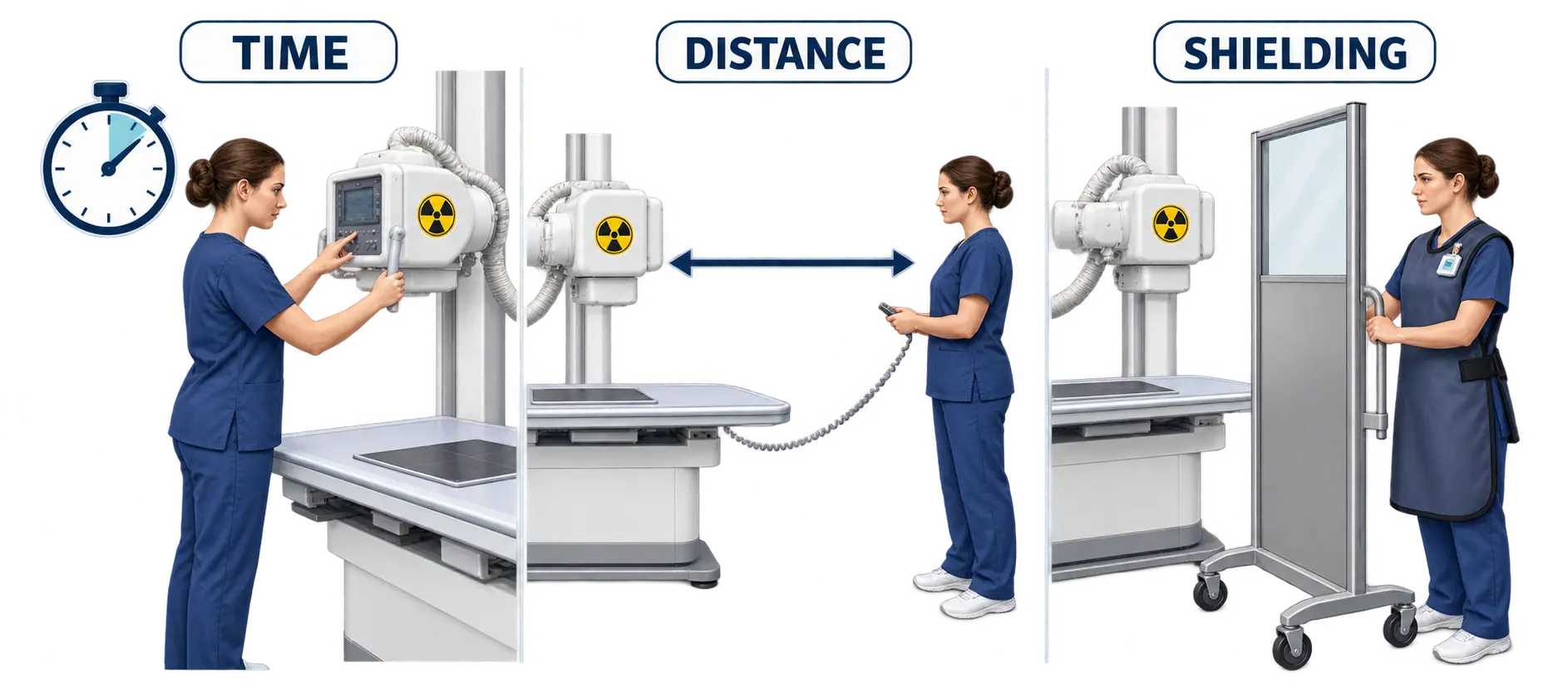
Radiation may be therapeutic (cancer implants, radiotherapy) or diagnostic (X-rays, CT scans). Nurses minimize radiation exposure by following three core principles: time, distance, and shielding.

Time:

  • Limit duration of exposure; rotate care among staff
  • Cluster tasks to minimize time near radiation sources

Distance:

  • Maintain at least 6 feet from unshielded sources when possible
  • Use remote monitoring when available

Shielding:

  • Wear lead aprons, gloves, and thyroid shields
  • Use lead containers for transporting radioactive isotopes
  • Stand behind protective barriers during procedures
alt_text
///////Caption: Time, Distance, and Shielding minimize radiation exposure
Illustration type: Three-panel infographic.
Illustration note: Illustrate the three radiation safety principles with icons for clustered care (Time), maintaining distance (Distance), and lead apron/barrier (Shielding).///////

Radiation safety principles

  • Time: Limit exposure.
  • Distance: Maximize space from the source.
  • Shielding: Use protective barriers and lead PPE.
Definitions
Cluster care
A nursing strategy that involves combining multiple care activities into a single visit to a client’s room to minimize disruptions and conserve resources.
Electrical hazard
Any condition where current may travel outside intended pathways, risking shock or burn.
Grounding pin
A metal extension on plugs that directs stray current safely into the earth.
Brachytherapy
Placement of small balls of radioactive material directly inside or near a tumor for localized treatment.
Dosimeter badge
A personal device that records cumulative radiation exposure over time.

Special precautions for internal radiation (brachytherapy):

  • Assign the client to a private room with radiation warning signage
  • Keep the door closed and limit visitor time (not more than 30 minutes/day, >6 feet distance)
  • Prohibit pregnant staff from providing care
  • Save all linens and trash in the room until the implant is removed or decayed
  • Use long-handled forceps and a lead container for dislodged sources. Never handle directly
alt_text
///////Caption: Internal radiation requires additional safety precautions.
Illustration type: Clinical room illustration.
  • Illustration note: Private room with radiation warning sign, visitor standing behind the recommended distance, nurse wearing dosimeter and lead apron, long-handled forceps and lead container available for emergencies…///////

Nursing interventions

Routine practice:

  • Inspect all equipment before each use and during rounds
  • Educate staff and clients not to handle unfamiliar machinery
  • Keep power cords and IV lines out of walkways
  • Turn off and unplug equipment before cleaning or servicing.

During radiation exposure:

  • Post warning signs outside client rooms
  • Use lead aprons or portable shields for bedside care
  • Organize tasks to reduce repeated room entries
  • Educate family members about visitation limits

Clinical vignette

A nurse enters the room of a client receiving internal radiation therapy.

(spoiler)

Nursing action: The nurse checks her dosimeter badge, wears a lead apron, and clusters care by performing vital signs, medication administration, and repositioning in one visit to minimize exposure time. She maintains an appropriate distance whenever possible and reinforces visitor restrictions before leaving the room.

Client education

  • Explain the purpose of radiation precautions to reduce fear.
  • Teach visitors to maintain proper distance and time limits.
  • Encourage clients not to tamper with equipment or radiation implants.
  • Remind clients to report frayed cords, sparks, or unusual equipment noises.

Common pitfalls on the NCLEX

  • Using electrical devices near water or wet surfaces.
  • Attempting to repair equipment personally.
  • Forgetting to tag malfunctioning devices as “Do Not Use.”
  • Allowing pregnant staff to care for radiation clients.
  • Disposing of radiation implants in regular trash.
  • Standing close to unshielded radiation sources for extended periods.
  • Inspect and tag defective equipment before it harms anyone.
  • Radiation safety depends on time, distance, and shielding.
  • Never silence alarms permanently—investigate the cause.
  • Cluster care to limit radiation exposure.
  • Safety begins with awareness—small lapses lead to large risks.

Sign up for free to take 5 quiz questions on this topic

Previous
Next  | 1.2.7 Isolation and infection prevention
All rights reserved ©2016 - 2026 Achievable, Inc.

Safe handling of equipment and radiation precautions

Introduction

Every beep, cord, and machine in the hospital carries both power and risk. A frayed wire, a miscalibrated pump, or a misplaced radiation source can cause harm faster than an infection. NCLEX evaluates whether you can recognize hazards, use protective equipment, and act immediately when devices fail. Safe handling is the foundation of safe care.

Learning objectives

By the end of this section, you should be able to:

  • Inspect and handle hospital equipment safely to prevent electrical, mechanical, and thermal injury.
  • Apply core principles of radiation protection when caring for clients receiving therapy or diagnostics.
  • Identify and report malfunctioning equipment following institutional protocols.

Equipment safety

Healthcare technology saves lives, but when misused or neglected, it can injure clients and staff. Every nurse is responsible for environmental awareness and proper equipment management.

Inspection and maintenance

  • Check cords, plugs, and casings for cracks, fraying, or exposed wiring before use
  • Ensure grounding pins are intact; never remove or bypass them
  • Verify that monitors, beds, infusion pumps, and defibrillators are functional and calibrated
  • Remove defective items from service, tag as “Do Not Use,” and notify maintenance or biomedical engineering
  • Avoid using extension cords or overloading outlets; plug directly into grounded wall sockets
  • Keep electrical equipment away from water sources and wet surfaces

Use and positioning

  • Confirm oxygen and suction function at the start of each shift.
  • Lock wheels on beds, stretchers, and wheelchairs before transfers.
  • Keep tubing, lines, and cords free from tangles or tripping hazards.
  • Maintain equipment at client’s side only if alarms are active and audible. Never silence without cause

Response steps to malfunction

  1. Stop using it immediately and ensure client safety
  2. Switch to backup manual devices if necessary (e.g., manual bag ventilation)
  3. Notify the charge nurse and biomedical staff
  4. Document the malfunction and resulting interventions

Radiation precautions

Radiation may be therapeutic (cancer implants, radiotherapy) or diagnostic (X-rays, CT scans). Nurses minimize radiation exposure by following three core principles: time, distance, and shielding.

Time:

  • Limit duration of exposure; rotate care among staff
  • Cluster tasks to minimize time near radiation sources

Distance:

  • Maintain at least 6 feet from unshielded sources when possible
  • Use remote monitoring when available

Shielding:

  • Wear lead aprons, gloves, and thyroid shields
  • Use lead containers for transporting radioactive isotopes
  • Stand behind protective barriers during procedures
alt_text
///////Caption: Time, Distance, and Shielding minimize radiation exposure
Illustration type: Three-panel infographic.
Illustration note: Illustrate the three radiation safety principles with icons for clustered care (Time), maintaining distance (Distance), and lead apron/barrier (Shielding).///////

Radiation safety principles

  • Time: Limit exposure.
  • Distance: Maximize space from the source.
  • Shielding: Use protective barriers and lead PPE.
Definitions
Cluster care
A nursing strategy that involves combining multiple care activities into a single visit to a client’s room to minimize disruptions and conserve resources.
Electrical hazard
Any condition where current may travel outside intended pathways, risking shock or burn.
Grounding pin
A metal extension on plugs that directs stray current safely into the earth.
Brachytherapy
Placement of small balls of radioactive material directly inside or near a tumor for localized treatment.
Dosimeter badge
A personal device that records cumulative radiation exposure over time.

Special precautions for internal radiation (brachytherapy):

  • Assign the client to a private room with radiation warning signage
  • Keep the door closed and limit visitor time (not more than 30 minutes/day, >6 feet distance)
  • Prohibit pregnant staff from providing care
  • Save all linens and trash in the room until the implant is removed or decayed
  • Use long-handled forceps and a lead container for dislodged sources. Never handle directly
alt_text
///////Caption: Internal radiation requires additional safety precautions.
Illustration type: Clinical room illustration.
  • Illustration note: Private room with radiation warning sign, visitor standing behind the recommended distance, nurse wearing dosimeter and lead apron, long-handled forceps and lead container available for emergencies…///////

Nursing interventions

Routine practice:

  • Inspect all equipment before each use and during rounds
  • Educate staff and clients not to handle unfamiliar machinery
  • Keep power cords and IV lines out of walkways
  • Turn off and unplug equipment before cleaning or servicing.

During radiation exposure:

  • Post warning signs outside client rooms
  • Use lead aprons or portable shields for bedside care
  • Organize tasks to reduce repeated room entries
  • Educate family members about visitation limits

Clinical vignette

A nurse enters the room of a client receiving internal radiation therapy.

(spoiler)

Nursing action: The nurse checks her dosimeter badge, wears a lead apron, and clusters care by performing vital signs, medication administration, and repositioning in one visit to minimize exposure time. She maintains an appropriate distance whenever possible and reinforces visitor restrictions before leaving the room.

Client education

  • Explain the purpose of radiation precautions to reduce fear.
  • Teach visitors to maintain proper distance and time limits.
  • Encourage clients not to tamper with equipment or radiation implants.
  • Remind clients to report frayed cords, sparks, or unusual equipment noises.

Common pitfalls on the NCLEX

  • Using electrical devices near water or wet surfaces.
  • Attempting to repair equipment personally.
  • Forgetting to tag malfunctioning devices as “Do Not Use.”
  • Allowing pregnant staff to care for radiation clients.
  • Disposing of radiation implants in regular trash.
  • Standing close to unshielded radiation sources for extended periods.
Key points
  • Inspect and tag defective equipment before it harms anyone.
  • Radiation safety depends on time, distance, and shielding.
  • Never silence alarms permanently—investigate the cause.
  • Cluster care to limit radiation exposure.
  • Safety begins with awareness—small lapses lead to large risks.

More from Safety and infection control

  • Standard precautions and transmission-based precautions
  • Surgical asepsis and sterile technique
  • Use of safety devices
  • Hazardous materials and emergency response
  • Incident reporting and error prevention