



Incident reporting and error prevention
Introduction
No system is perfect, and even the best nurses make mistakes. In healthcare, what matters is what happens next. An error that is recognized, reported, and analyzed can save hundreds of lives down the line. NCLEX tests whether you understand that reporting is not about blame: it’s about building safer systems.
Learning objectives
By the end of this section, you should be able to:
- Identify what qualifies as an incident and how to report it.
- Understand the nurse’s ethical and legal responsibilities in error prevention.
- Recognize how effective communication and documentation improve safety.
- Apply strategies to prevent future errors through vigilance and teamwork.
Incident reporting
Incident reporting is the formal documentation of any unexpected event that could or did harm a client, staff member, or visitor. Different institutions may call this document an incident, event, irregular occurrence, or variance report, but the terms are interchangeable: each names the same nonpunitive quality-improvement tool. These reports are tools for quality improvement, not punishment. This reflects a just culture: a fair, nonpunitive approach that distinguishes ordinary human error, at-risk behavior, and reckless conduct, and that focuses on fixing systems rather than blaming individuals. Nonpunitive does not mean consequence-free: ordinary human error is managed by fixing the system and supporting the nurse, while reckless conduct still carries individual accountability.
When to report
- Medication errors (wrong dose, time, route, or client)
- Near misses that could have caused harm but did not
- Falls, burns, needle sticks, equipment failures, or client elopements
- Breaches in confidentiality or professional conduct
- Unsafe or impaired staff practice, such as suspected substance misuse, improper care, or unsafe staffing patterns, that puts clients at risk
- Any event outside routine care or policy
If you observe unsafe practice by a colleague, your first duty is to protect the client; then escalate what you observed through the chain of command per policy. Reporting a colleague’s unsafe practice is a professional obligation, not disloyalty.
How to report
- Complete the report immediately after ensuring safety.
- Use objective, factual language only.
- Include date, time, location, individuals involved, and interventions performed.
- Do not include the words “incident report filed” in the client’s chart. Documentation in the chart should reflect only the client’s condition and care given.
- Submit the report per institutional policy to the charge nurse, risk management, or safety officer.
Understanding systems and root cause analysis (RCA)
When an incident is reported, leadership does not simply ask, “Who made the mistake?” Instead, they ask, “What allowed this to happen?”
This is the foundation of Root cause analysis (RCA): a structured process used to identify underlying system problems that contributed to an error.
RCA examines:
- Staffing levels and workload
- Communication breakdowns
- Look-alike/sound-alike medications
- Equipment design flaws
- Environmental factors (lighting, interruptions)
- Policy gaps
The goal is to identify and correct system vulnerabilities rather than assign individual blame.
Root cause analysis process
- Incident occurs
- Investigation begins
- Contributing factors are identified
- System improvements are implemented
- Safer care results
The Swiss cheese model of error
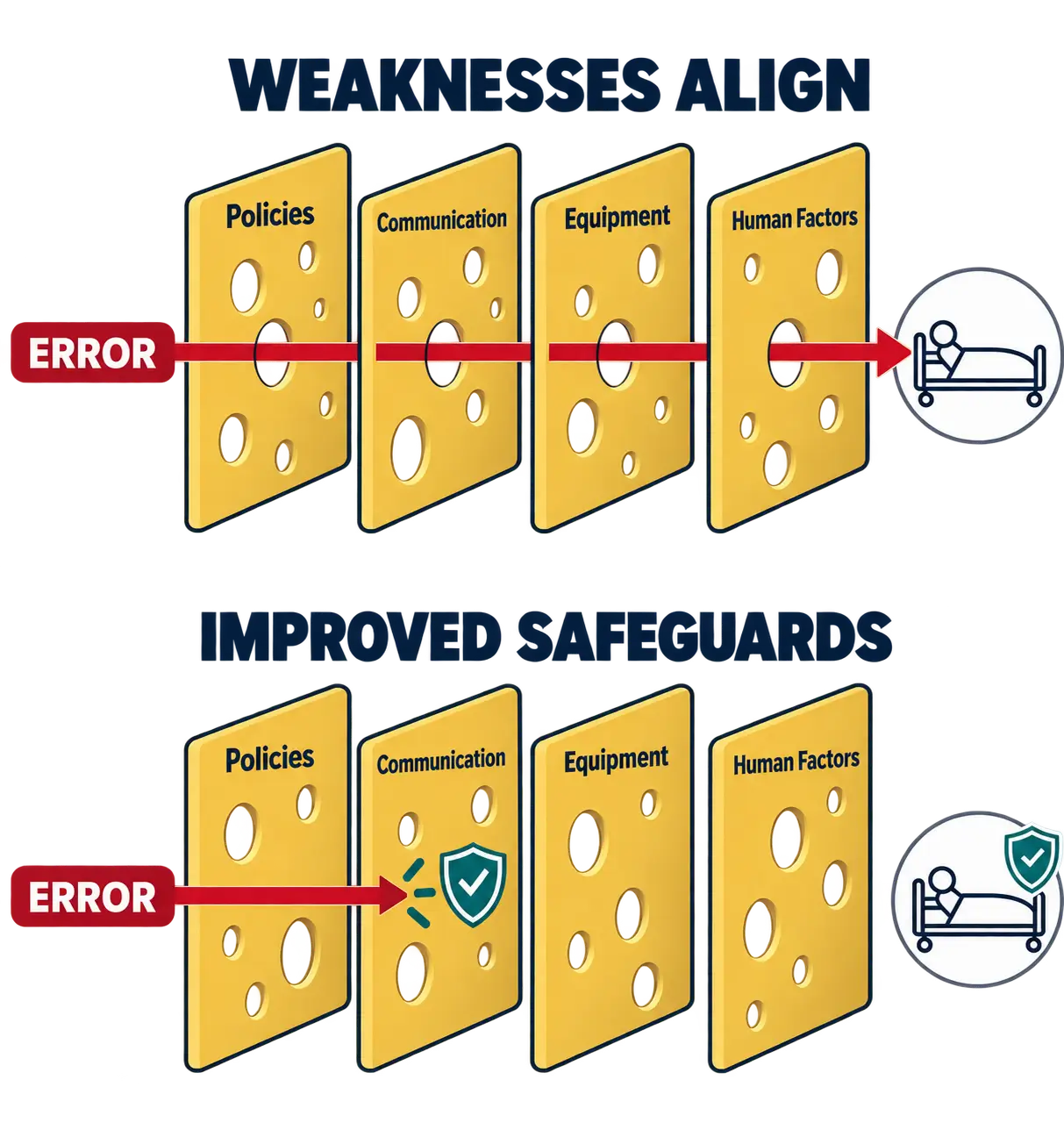
Healthcare systems use multiple layers of protection, such as policies, double-checks, alarms, and barcode scanning. Each layer may contain weaknesses. When those weaknesses align, an error can reach the client.
Strong safety systems reduce this risk by:
- Double-checking high-risk medications
- Reducing interruptions
- Standardizing procedures
- Promoting team communication
Errors rarely result from one careless act; they usually occur when multiple system safeguards fail.
Error prevention
The goal of incident reporting is not perfection; it’s prevention. Errors most often arise from systems, not individuals. Nurses prevent harm by anticipating risk, communicating clearly, and double-checking their work. The strategies below - medication safety, communication, and environmental vigilance - put that prevention mindset into daily practice, catching problems before they become incidents you have to report.
Medication safety
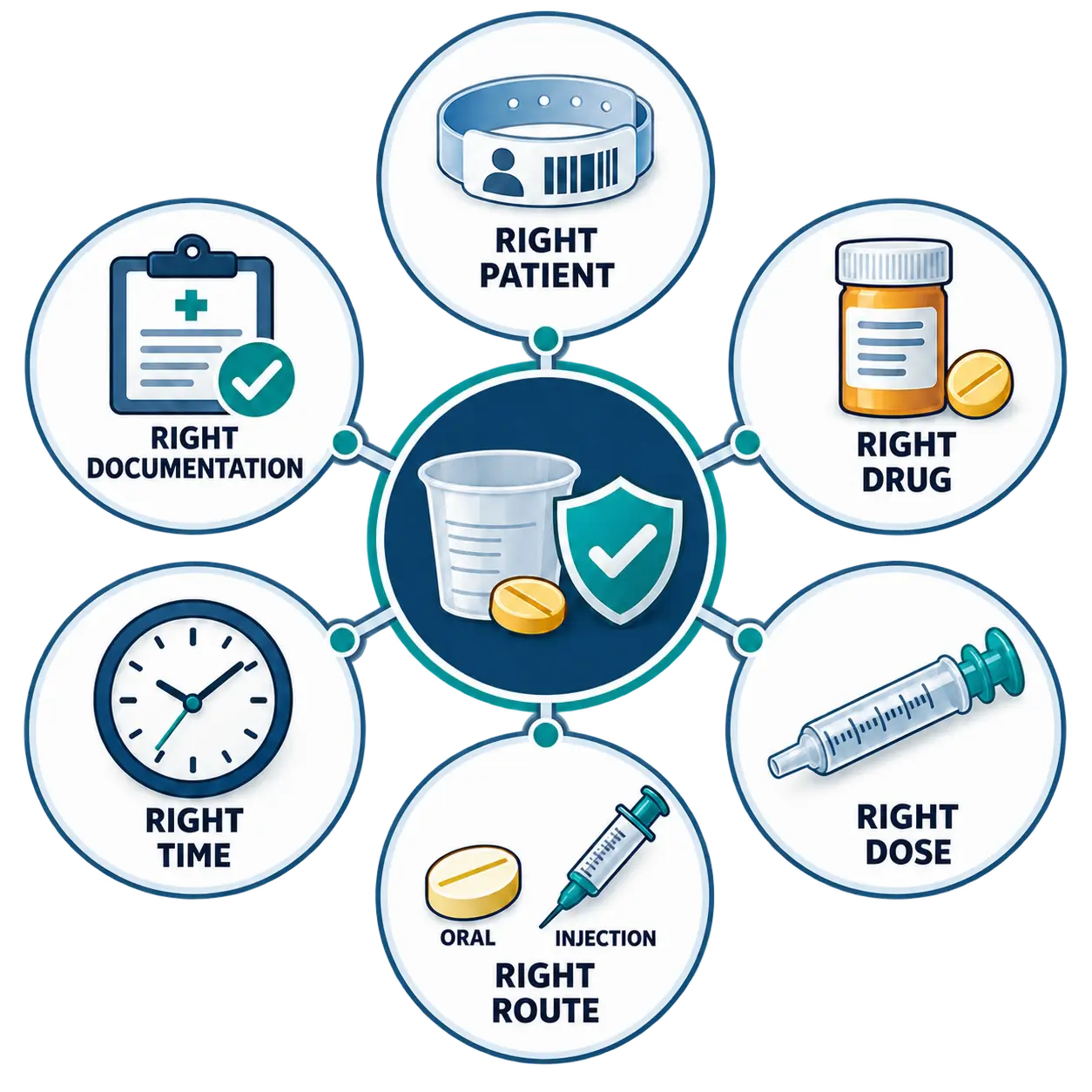
Follow the six rights of medication administration:
- Right client
- Right drug
- Right dose
- Right route
- Right time
- Right documentation
Also:
- Avoid interruptions during medication preparation.
- Use barcode scanning and two client identifiers such as name and date of birth.
- Clarify ambiguous or illegible orders.
- Report and analyze near misses because they reveal system weaknesses.
Communication
- Use SBAR (situation, background, assessment, recommendation) for concise handoffs
- Read back verbal and telephone orders
- Encourage a “speak-up” culture where all staff can report unsafe conditions without fear
Environmental vigilance
- Check equipment before use; tag faulty items as “Do not use”
- Keep hallways clear, side rails secured, and call lights within reach
- Ensure alarms are active, audible, and not silenced
Nursing interventions
When an incident occurs:
- Ensure client safety first; assess and stabilize
- Notify the primary health care provider and charge nurse immediately
- Document facts objectively in the client’s chart
- Complete the incident report per policy
- Monitor the client and update the plan of care if needed
In ongoing practice:
- Follow policies and protocols strictly
- Encourage open communication during shift handoffs
- Participate in root cause analysis (RCA) after reported events
- Support a culture of transparency; “report early, not quietly”
Clinical vignette
During a medication pass, a nurse administers 20 mg instead of 10 mg of morphine.
Nursing action: The nurse immediately recognizes the error, assesses the client’s respiratory status, notifies the primary health care provider, administers naloxone as ordered, documents the client’s condition and interventions objectively, completes an incident report, and participates in identifying system factors that contributed to the error (similar drug packaging, lighting issues).
Later, the team discusses system changes to prevent recurrence.
Client education
- Explain that error reporting improves care and client safety.
- Reassure clients that disclosure of mistakes is part of professional accountability.
- Encourage clients to participate actively; ask questions, verify medications, and report unusual symptoms.