


Achievable logoAchievable logo
NCLEX
Sign in
Sign up
Purchase
Textbook
Practice exams
Support
How it works
Resources
Exam catalog
Mountain with a flag at the peak
Textbook
Introduction
1. Safe and effective care environment
2. Health promotion and maintenance
3. Psychosocial Integrity
4. Physiological Integrity
4.1 Basic care and comfort
4.1.1 Assistive devices and mobility aids
4.1.2 Comfort measures
4.1.3 Nutrition and hydration support
4.1.4 Elimination support
4.1.5 Rest, sleep, and pain management
4.1.6 Non-pharmacological therapies
4.2 Pharmacological and parenteral therapies
4.3 Reduction of risk potential
4.4 Physiological adaptation
Wrapping up
Achievable logoAchievable logo
4.1.3 Nutrition and hydration support
Achievable NCLEX
4. Physiological Integrity
4.1. Basic care and comfort
Our NCLEX course is currently in development and is a work-in-progress.

Nutrition and hydration support

9 min read
Font
Discuss
Share
Feedback

Introduction

A spoonful of nutrition is more than a comfort; it’s a clinical intervention. Whether helping a client sip water after surgery or managing parenteral nutrition (PN), including total parenteral nutrition (TPN), nurses play a key role in maintaining hydration, preventing malnutrition, and spotting subtle warning signs like weight loss or dry mucous membranes. In the NCLEX, expect questions about swallowing safety, intake monitoring, and complications of both dehydration and fluid overload.

NGN insight: Nutrition and hydration are vital signs in disguise. When they’re off, something else usually is too.

Learning objectives

By the end of this section, you should be able to:

  • Identify signs of adequate and inadequate hydration
  • Recognize common dietary modifications and their indications
  • Safely assist clients with feeding and monitor intake/output (I&O)
  • Recognize complications of enteral and parenteral nutrition
  • Apply nursing interventions that support safe nutrition and fluid balance

Hydration: assessment and management

Hydration affects every system. Adequate hydration supports tissue perfusion and normal brain, kidney, cardiovascular, and skin function. Both dehydration and fluid overload are common in hospitalized clients, especially older adults, surgical clients, or those with chronic disease.

Signs of dehydration

  • Dry mucous membranes and decreased skin turgor (less reliable in older adults)
  • Concentrated urine, low output (<30 mL/hr)
  • Hypotension, tachycardia
  • Confusion or lethargy
  • Elevated BUN and hematocrit; serum sodium may be elevated, normal, or low depending on the underlying cause of dehydration

Signs of fluid overload

  • Edema (especially periorbital, sacral, pedal)
  • Weight gain
  • Hypertension
  • Crackles in lungs (pulmonary edema)
  • Jugular vein distention (JVD)
  • Low serum sodium (dilutional hyponatremia)
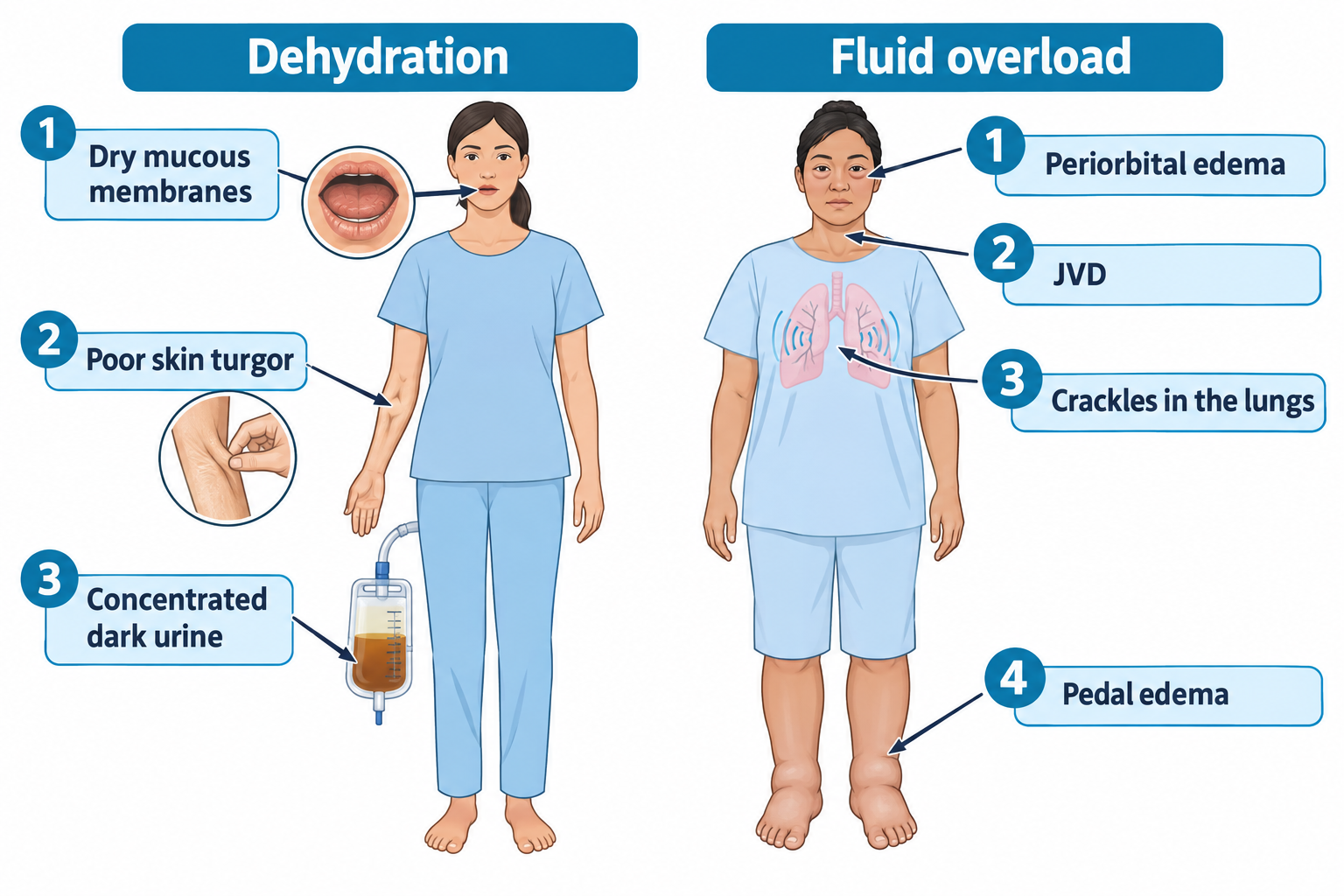
Two illustrated figures compare assessment findings in dehydration versus fluid overload. The dehydration figure has callouts to the mouth showing dry mucous membranes, a pinched forearm showing poor skin turgor, and a urine bag showing concentrated dark urine. The fluid overload figure has callouts to puffy eyes for periorbital edema, the neck for jugular venous distension (JVD), an overlay of lungs with sound waves for crackles, and swollen feet for pedal edema.
Assessment findings in dehydration vs fluid overload
Achievable

Nursing interventions

  • Encourage oral fluids unless restricted.
  • Monitor daily weights for fluid status (best indicator of fluid volume changes).
  • Record I&O every shift.
  • Use IV fluids as ordered for volume support.
  • Elevate edematous limbs and monitor for respiratory distress.
Definitions
I&O (intake and output)
Measurement of all fluids a client consumes and excretes
Hypovolemia
Low circulating blood volume, often due to dehydration or bleeding
Hypervolemia
Excess fluid in circulation, often due to IV overload, kidney failure, or heart failure

Nutrition support

Nutrition isn’t just calories; it supports wound healing, immune function, tissue repair, energy production, and recovery.

At-risk populations:

  • Older adults
  • Clients with cancer or chronic illness
  • Clients on NPO or restricted diets
  • Stroke or neuromuscular disorders with swallowing difficulties

Nutritional assessment

Before starting or adjusting nutrition support, assess the client’s baseline nutritional status:

  • Body mass index (BMI): a screening measure calculated as weight in kilograms divided by height in meters squared.

BMI=height (m)2weight (kg)​

For adults, BMI is categorized as underweight (<18.5), normal (18.5-24.9), overweight (25-29.9), or obese (≥30). These fixed cutoffs apply to adults; for children and adolescents, BMI is interpreted by age- and sex-specific percentiles.

  • Calorie counts: initiate when malnutrition or inadequate intake is suspected, tracking every food and beverage the client consumes over 24-72 hours to calculate actual caloric intake against estimated needs.
  • Food-medication interactions: screen the client’s diet against current medications, such as vitamin K-rich foods (leafy greens) reducing warfarin’s effectiveness, or tyramine-rich foods (aged cheese, cured meats) triggering a hypertensive crisis in clients taking MAOIs.

Dietary modifications

Diet Indications
Clear liquid GI surgery, early post-op, N/V
Full liquid Transition from clear liquids to soft solids
Mechanical soft Chewing/swallowing issues
Pureed Severe dysphagia, post-stroke
Low sodium Heart failure, hypertension
Low fiber (low residue) Short-term management of selected GI conditions, bowel preparation, or during acute flares when prescribed
Consistent carbohydrate diet Used to support blood glucose management
Renal diet Chronic kidney disease (low Na, K, phosphorus)
High-protein Wound healing, burns, severe protein deficiency, increased metabolic demand

Assisting with feeding

Clients with physical or cognitive limitations may need assistance with eating. Safety and dignity go hand in hand.

Swallowing safety

  • Sit client upright (90°) during meals.
  • Use thickened liquids if recommended for dysphagia.
  • Keep suction equipment readily available when aspiration risk is high.
  • Assess swallowing ability before oral intake after anesthesia or stroke.
  • Monitor for coughing, choking, wet voice = aspiration signs.
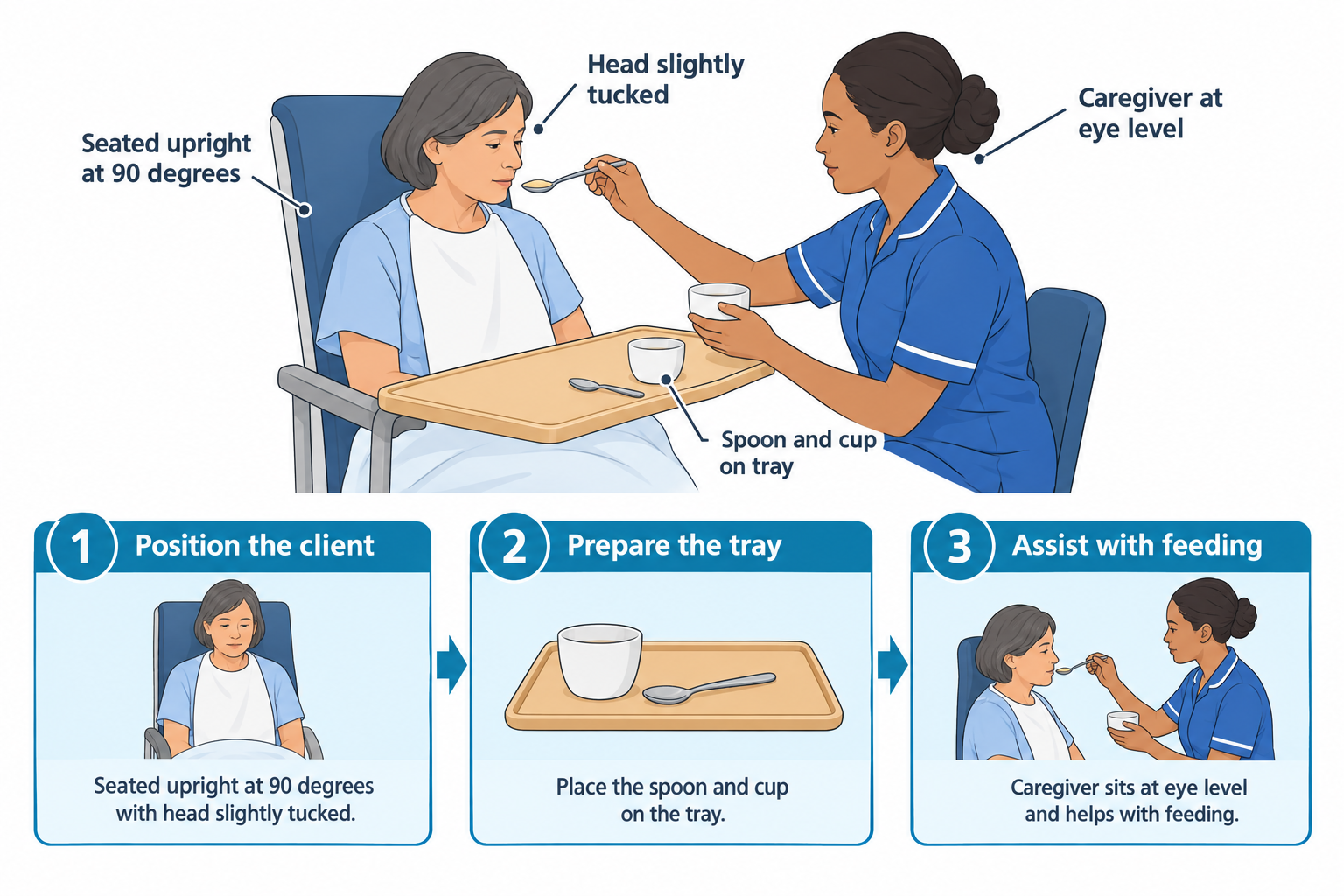
An older female client sits upright at 90 degrees in a chair with her head slightly tucked while a caregiver in blue scrubs sits at eye level and feeds her from a spoon, with a cup and spoon resting on a tray attached to the chair. Below, three numbered steps show: 1) positioning the client upright with head tucked, 2) preparing a tray with a cup and spoon, and 3) the caregiver assisting with feeding at eye level.
Safe feeding position for clients with dysphagia
Achievable

Feeding interventions

  • Offer small bites and allow unhurried meals.
  • Encourage independence with adaptive utensils.
  • Document percentage of food eaten and fluid intake.
  • Notify the speech-language pathologist or dietitian when swallowing or nutritional concerns are identified.

Enteral feeding (via tube)

NGT, PEG, or jejunostomy tubes are used when clients can’t eat orally.

Key points:

  • Check gastric residual volume only as indicated before bolus gastric feedings, but not for jejunal feeding tubes.
  • Elevate HOB 30-45° during and after feeding.
  • Flush with water to maintain tube patency.
  • Monitor for diarrhea, aspiration, dislodgement.
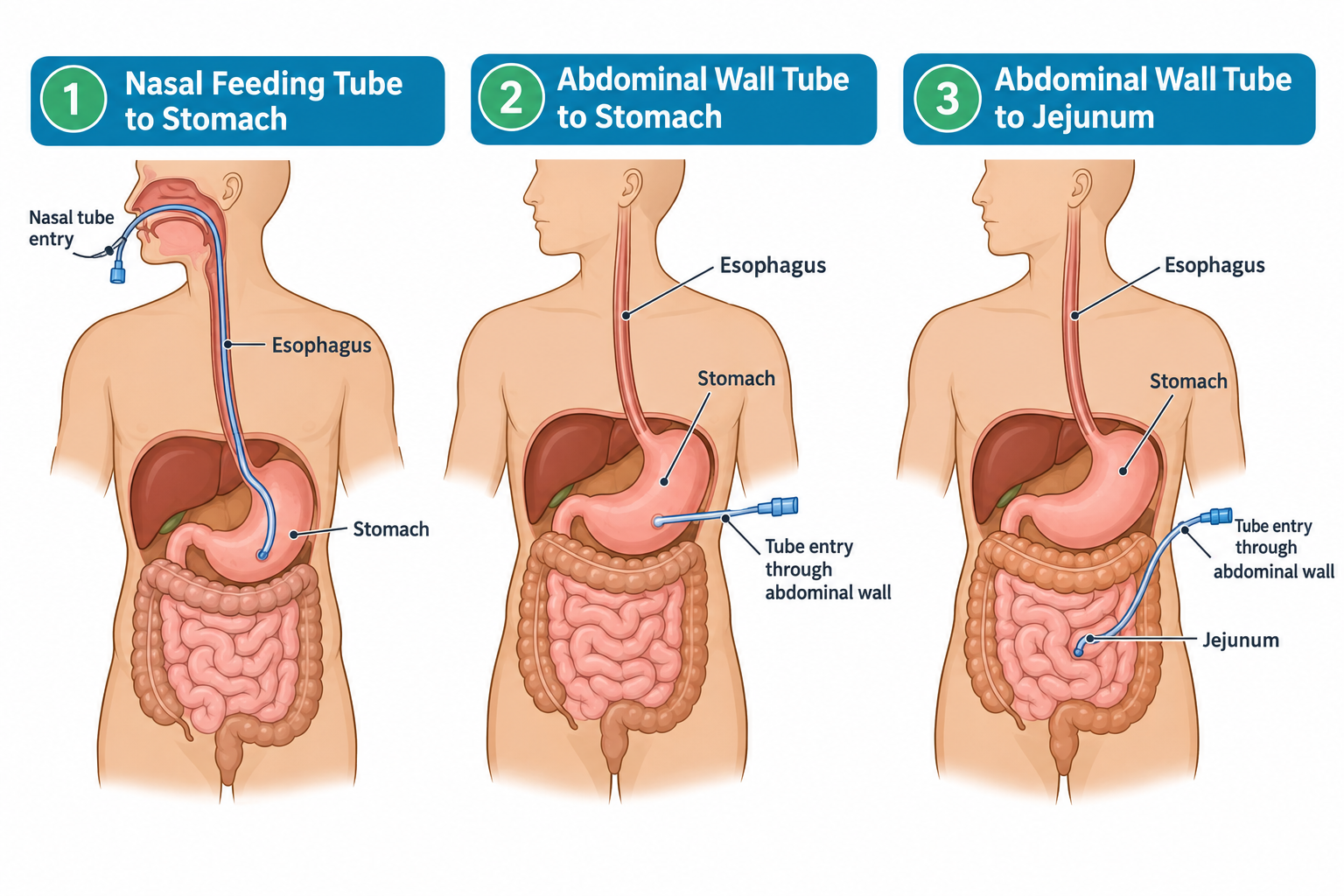
Three cutaway torso diagrams comparing feeding tube placements: an NG tube entering through the nose and passing down the esophagus into the stomach; a PEG-type tube entering directly through the abdominal wall into the stomach; and a jejunostomy tube entering through the abdominal wall and threading into the jejunum, with esophagus, stomach, and jejunum labeled in each panel.
Common enteral feeding tubes: NG tube, PEG tube, jejunostomy tube
Achievable

Parenteral nutrition (TPN)

Total parenteral nutrition (TPN) is one form of parenteral nutrition (PN). TPN is IV nutrition for clients with nonfunctional GI tracts.

Key considerations:

  • Requires a central line.
  • Use a dedicated line (no piggybacking).
  • Monitor blood glucose, electrolytes, and for infection.
  • Change tubing and bag every 24 hours.

NGN tip: Do not discontinue TPN abruptly, particularly when it has been infusing continuously. Abrupt discontinuation may cause hypoglycemia. If a new bag is unavailable, administer D10W as prescribed or according to facility protocol until PN can be resumed.

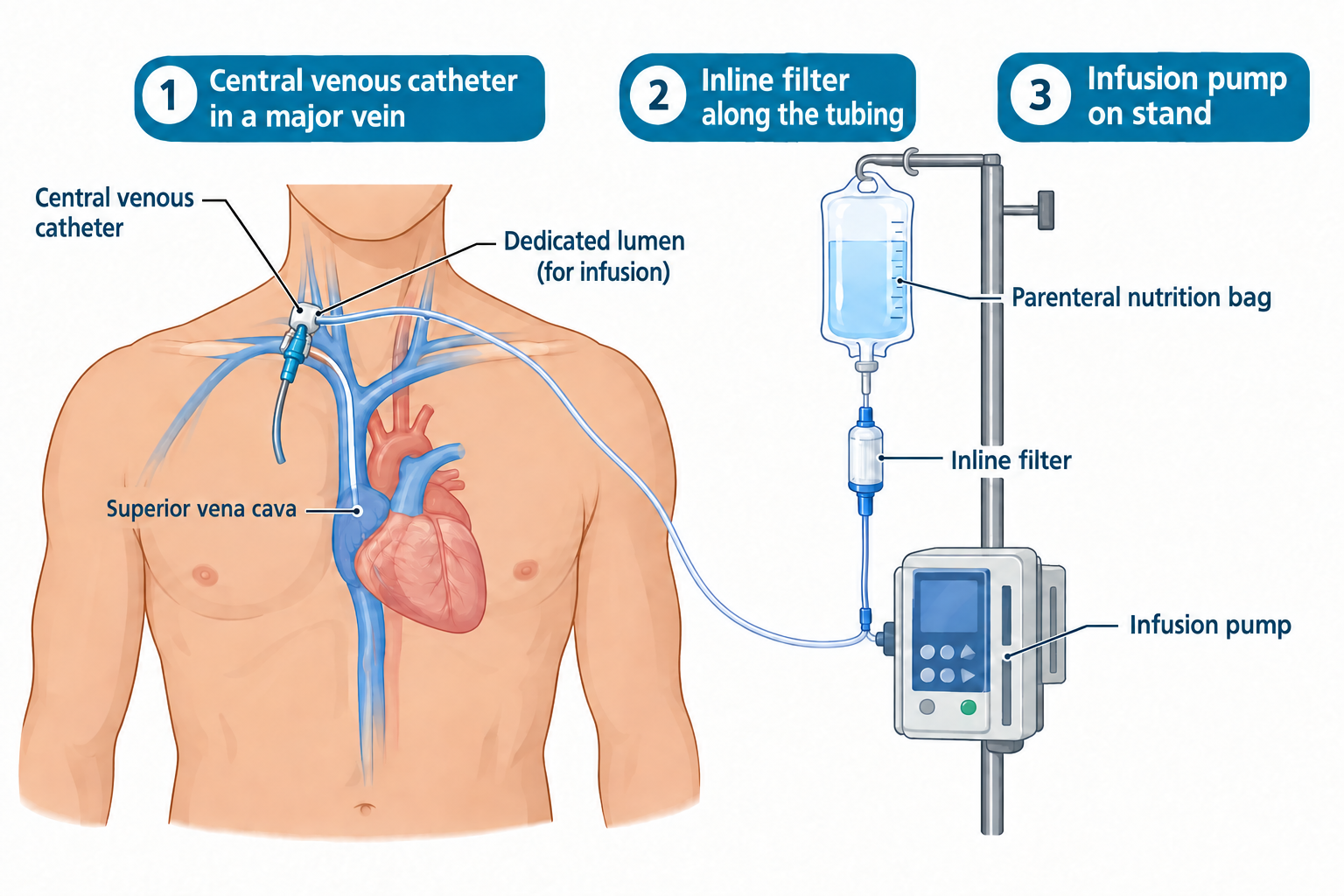
A three-panel diagram of safe parenteral nutrition administration. Panel 1 shows a central venous catheter inserted into a chest vein and threaded to the superior vena cava near the heart, with a dedicated lumen labeled for infusion. Panel 2 shows an IV fluid bag connected through an inline filter along the tubing. Panel 3 shows the tubing continuing to an infusion pump mounted on an IV pole stand.
Safe administration of parenteral nutrition
Achievable

Example: Calculating BMI

A client weighs 70 kg and is 1.75 m tall. What is the client’s BMI, and how would you classify it?

BMI=1.75270​=3.062570​=22.9

Answer: a BMI of 22.9 kg/m² falls within the normal weight range (18.5-24.9).

Client education

  • Encourage small, frequent meals.
  • Emphasize hydration, especially in hot weather or illness.
  • Report early signs of aspiration (coughing, choking).
  • Caregivers should learn safe feeding techniques for home.
  • Follow dietary restrictions carefully (renal, diabetic, cardiac).
  • Daily weights are the best indicator of fluid balance.
  • Elevate HOB during meals or tube feedings to prevent aspiration.
  • Assess gag reflex before oral intake after anesthesia or stroke.
  • Thickened liquids and feeding assistance reduce choking risk.
  • Monitor labs closely for TPN clients—especially glucose and electrolytes.

Sign up for free to take 5 quiz questions on this topic

Previous
Next  | 4.1.4 Elimination support
All rights reserved ©2016 - 2026 Achievable, Inc.

Nutrition and hydration support

Introduction

A spoonful of nutrition is more than a comfort; it’s a clinical intervention. Whether helping a client sip water after surgery or managing parenteral nutrition (PN), including total parenteral nutrition (TPN), nurses play a key role in maintaining hydration, preventing malnutrition, and spotting subtle warning signs like weight loss or dry mucous membranes. In the NCLEX, expect questions about swallowing safety, intake monitoring, and complications of both dehydration and fluid overload.

NGN insight: Nutrition and hydration are vital signs in disguise. When they’re off, something else usually is too.

Learning objectives

By the end of this section, you should be able to:

  • Identify signs of adequate and inadequate hydration
  • Recognize common dietary modifications and their indications
  • Safely assist clients with feeding and monitor intake/output (I&O)
  • Recognize complications of enteral and parenteral nutrition
  • Apply nursing interventions that support safe nutrition and fluid balance

Hydration: assessment and management

Hydration affects every system. Adequate hydration supports tissue perfusion and normal brain, kidney, cardiovascular, and skin function. Both dehydration and fluid overload are common in hospitalized clients, especially older adults, surgical clients, or those with chronic disease.

Signs of dehydration

  • Dry mucous membranes and decreased skin turgor (less reliable in older adults)
  • Concentrated urine, low output (<30 mL/hr)
  • Hypotension, tachycardia
  • Confusion or lethargy
  • Elevated BUN and hematocrit; serum sodium may be elevated, normal, or low depending on the underlying cause of dehydration

Signs of fluid overload

  • Edema (especially periorbital, sacral, pedal)
  • Weight gain
  • Hypertension
  • Crackles in lungs (pulmonary edema)
  • Jugular vein distention (JVD)
  • Low serum sodium (dilutional hyponatremia)

Nursing interventions

  • Encourage oral fluids unless restricted.
  • Monitor daily weights for fluid status (best indicator of fluid volume changes).
  • Record I&O every shift.
  • Use IV fluids as ordered for volume support.
  • Elevate edematous limbs and monitor for respiratory distress.
Definitions
I&O (intake and output)
Measurement of all fluids a client consumes and excretes
Hypovolemia
Low circulating blood volume, often due to dehydration or bleeding
Hypervolemia
Excess fluid in circulation, often due to IV overload, kidney failure, or heart failure

Nutrition support

Nutrition isn’t just calories; it supports wound healing, immune function, tissue repair, energy production, and recovery.

At-risk populations:

  • Older adults
  • Clients with cancer or chronic illness
  • Clients on NPO or restricted diets
  • Stroke or neuromuscular disorders with swallowing difficulties

Nutritional assessment

Before starting or adjusting nutrition support, assess the client’s baseline nutritional status:

  • Body mass index (BMI): a screening measure calculated as weight in kilograms divided by height in meters squared.

BMI=height (m)2weight (kg)​

For adults, BMI is categorized as underweight (<18.5), normal (18.5-24.9), overweight (25-29.9), or obese (≥30). These fixed cutoffs apply to adults; for children and adolescents, BMI is interpreted by age- and sex-specific percentiles.

  • Calorie counts: initiate when malnutrition or inadequate intake is suspected, tracking every food and beverage the client consumes over 24-72 hours to calculate actual caloric intake against estimated needs.
  • Food-medication interactions: screen the client’s diet against current medications, such as vitamin K-rich foods (leafy greens) reducing warfarin’s effectiveness, or tyramine-rich foods (aged cheese, cured meats) triggering a hypertensive crisis in clients taking MAOIs.

Dietary modifications

Diet Indications
Clear liquid GI surgery, early post-op, N/V
Full liquid Transition from clear liquids to soft solids
Mechanical soft Chewing/swallowing issues
Pureed Severe dysphagia, post-stroke
Low sodium Heart failure, hypertension
Low fiber (low residue) Short-term management of selected GI conditions, bowel preparation, or during acute flares when prescribed
Consistent carbohydrate diet Used to support blood glucose management
Renal diet Chronic kidney disease (low Na, K, phosphorus)
High-protein Wound healing, burns, severe protein deficiency, increased metabolic demand

Assisting with feeding

Clients with physical or cognitive limitations may need assistance with eating. Safety and dignity go hand in hand.

Swallowing safety

  • Sit client upright (90°) during meals.
  • Use thickened liquids if recommended for dysphagia.
  • Keep suction equipment readily available when aspiration risk is high.
  • Assess swallowing ability before oral intake after anesthesia or stroke.
  • Monitor for coughing, choking, wet voice = aspiration signs.

Feeding interventions

  • Offer small bites and allow unhurried meals.
  • Encourage independence with adaptive utensils.
  • Document percentage of food eaten and fluid intake.
  • Notify the speech-language pathologist or dietitian when swallowing or nutritional concerns are identified.

Enteral feeding (via tube)

NGT, PEG, or jejunostomy tubes are used when clients can’t eat orally.

Key points:

  • Check gastric residual volume only as indicated before bolus gastric feedings, but not for jejunal feeding tubes.
  • Elevate HOB 30-45° during and after feeding.
  • Flush with water to maintain tube patency.
  • Monitor for diarrhea, aspiration, dislodgement.

Parenteral nutrition (TPN)

Total parenteral nutrition (TPN) is one form of parenteral nutrition (PN). TPN is IV nutrition for clients with nonfunctional GI tracts.

Key considerations:

  • Requires a central line.
  • Use a dedicated line (no piggybacking).
  • Monitor blood glucose, electrolytes, and for infection.
  • Change tubing and bag every 24 hours.

NGN tip: Do not discontinue TPN abruptly, particularly when it has been infusing continuously. Abrupt discontinuation may cause hypoglycemia. If a new bag is unavailable, administer D10W as prescribed or according to facility protocol until PN can be resumed.

Example: Calculating BMI

A client weighs 70 kg and is 1.75 m tall. What is the client’s BMI, and how would you classify it?

BMI=1.75270​=3.062570​=22.9

Answer: a BMI of 22.9 kg/m² falls within the normal weight range (18.5-24.9).

Client education

  • Encourage small, frequent meals.
  • Emphasize hydration, especially in hot weather or illness.
  • Report early signs of aspiration (coughing, choking).
  • Caregivers should learn safe feeding techniques for home.
  • Follow dietary restrictions carefully (renal, diabetic, cardiac).
Key points
  • Daily weights are the best indicator of fluid balance.
  • Elevate HOB during meals or tube feedings to prevent aspiration.
  • Assess gag reflex before oral intake after anesthesia or stroke.
  • Thickened liquids and feeding assistance reduce choking risk.
  • Monitor labs closely for TPN clients—especially glucose and electrolytes.

More from Basic care and comfort

  • Assistive devices and mobility aids
  • Comfort measures
  • Elimination support
  • Rest, sleep, and pain management
  • Non-pharmacological therapies