


Achievable logoAchievable logo
NCLEX
Sign in
Sign up
Purchase
Textbook
Practice exams
Support
How it works
Exam catalog
Mountain with a flag at the peak
Textbook
Introduction
1. Safe and effective care environment
2. Health promotion and maintenance
3. Psychosocial Integrity
4. Physiological Integrity
4.1 Basic care and comfort
4.1.1 Assistive devices and mobility aids
4.1.2 Comfort measures
4.1.3 Nutrition and hydration support
4.1.4 Elimination support
4.1.5 Rest, sleep, and pain management
4.1.6 Non-pharmacological therapies
4.2 Pharmacological and parenteral therapies
4.3 Reduction of risk potential
4.4 Physiological adaptation
Wrapping up
Achievable logoAchievable logo
4.1.5 Rest, sleep, and pain management
Achievable NCLEX
4. Physiological Integrity
4.1. Basic care and comfort
Our NCLEX course is currently in development and is a work-in-progress.

Rest, sleep, and pain management

7 min read
Font
Discuss
Share
Feedback

Introduction

Rest and sleep aren’t luxuries; they’re essential to healing, immune function, and mental clarity. Nurses often find themselves at the crossroads of biology and environment, helping clients whose sleep is disrupted by pain, anxiety, illness, noise, or other environmental factors.

On the NCLEX, you’ll be tested on how to assess, promote, and protect rest and sleep, as well as how to manage pain effectively and ethically.

NGN insight:
Restorative care means treating more than the disease. It means restoring peace, comfort, and control.

Learning objectives

By the end of this section, you should be able to:

  • Assess and document sleep patterns and disturbances
  • Implement interventions to promote rest and prevent sleep disruption
  • Evaluate pain using age- and condition-appropriate tools
  • Administer and monitor nonpharmacologic and pharmacologic pain interventions

Sleep and rest in clinical care

Sleep physiology

Sleep occurs in stages that cycle throughout the night, including REM (rapid eye movement) and non-REM stages. Sleep disruption impairs immune function, cognition, and healing.

Factors affecting sleep

Factor Impact
Pain Major disruptor of both sleep quality and quantity
Environment Noise, light, and temperature can inhibit rest
Anxiety/depression Mental health issues alter sleep cycles
Medications Steroids, caffeine, diuretics, and some antidepressants may disrupt sleep
Age Older adults have lighter, more fragmented sleep

Nursing assessment

  • Ask about the client’s usual sleep routine, sleep disturbances, and factors that interfere with sleep during admission.
  • Use validated sleep assessment tools, such as the Pittsburgh Sleep Quality Index, when appropriate.
  • Observe rest patterns during hospitalization.

Interventions to promote rest

  • Group care tasks to avoid frequent nighttime interruptions.
  • Reduce environmental noise and adjust lighting.
  • Encourage bedtime routines and relaxation strategies (warm bath, reading, guided breathing).
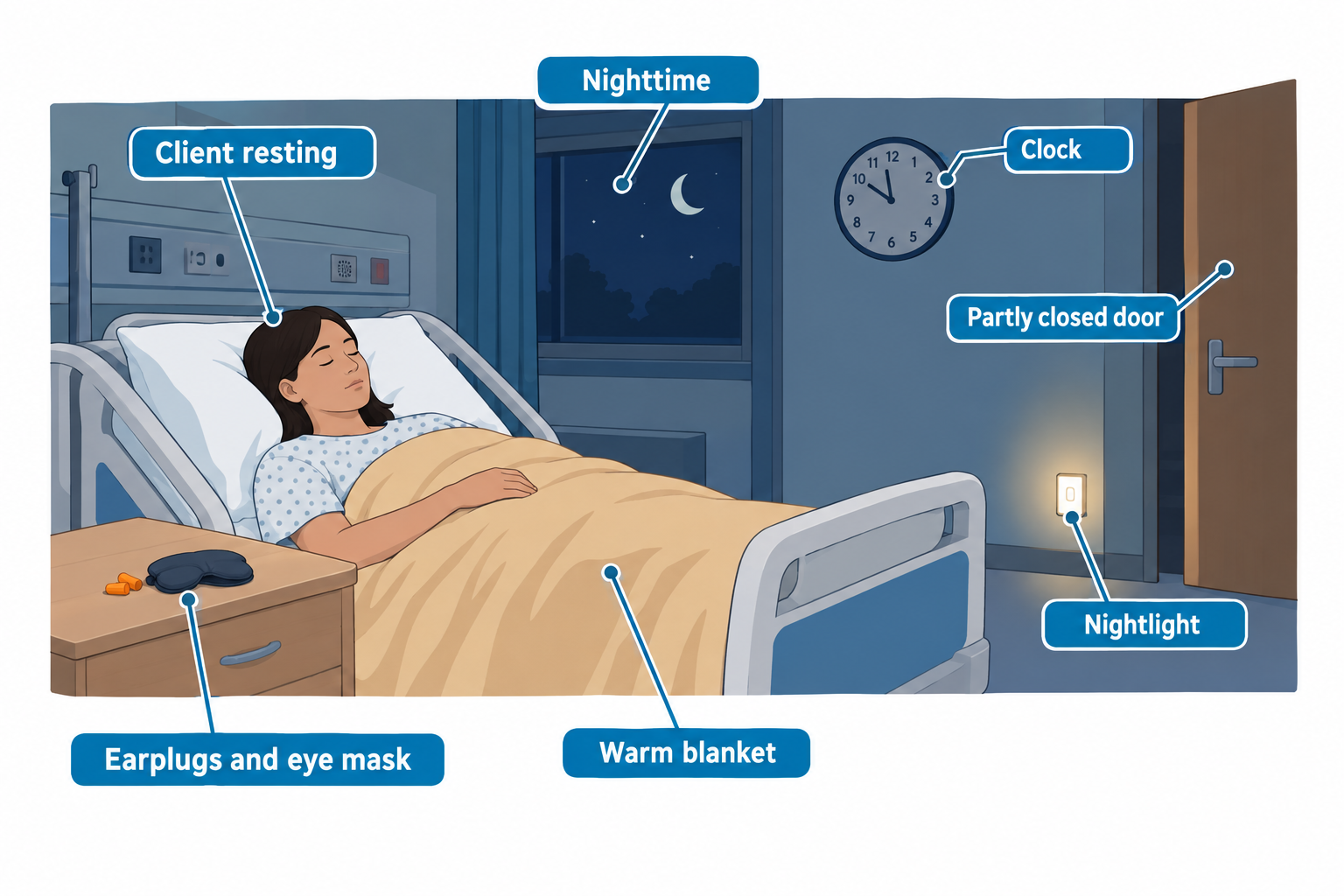
  • Offer comfort measures such as a warm blanket or a caffeine-free beverage, if appropriate and permitted by facility policy.
  • Provide earplugs, sleep masks, and calming music.
alt_text
//////Caption: Promoting Restful Sleep in the Hospital OR Sleep Hygiene and Rest-Promoting Nursing Interventions
Type: Nursing care illustration/ Sequential clinical illustration (hospital room scene)
Illustrating a nurse promoting restful sleep in a hospitalized client by: Dimming room lights, Closing curtains/blinds, Reducing environmental noise, Grouping nighttime care activities, Offering a warm blanket, Providing earplugs and a sleep mask, Encouraging relaxation (e.g., deep breathing or calming music)///////

Pain assessment and management

Pain is subjective. The client’s self-report is the most reliable indicator of pain. Nurses should use appropriate assessment tools to guide pain management and evaluate the client’s response to treatment.

Types of pain

Type Description
Acute Sudden, short-term (e.g., post-surgical)
Chronic Long-term, often over 6 months (e.g., arthritis)
Neuropathic Burning, tingling (e.g., diabetic neuropathy)
Nociceptive Sharp, localized (somatic); dull (visceral)

Pain assessment tools

Tool Population
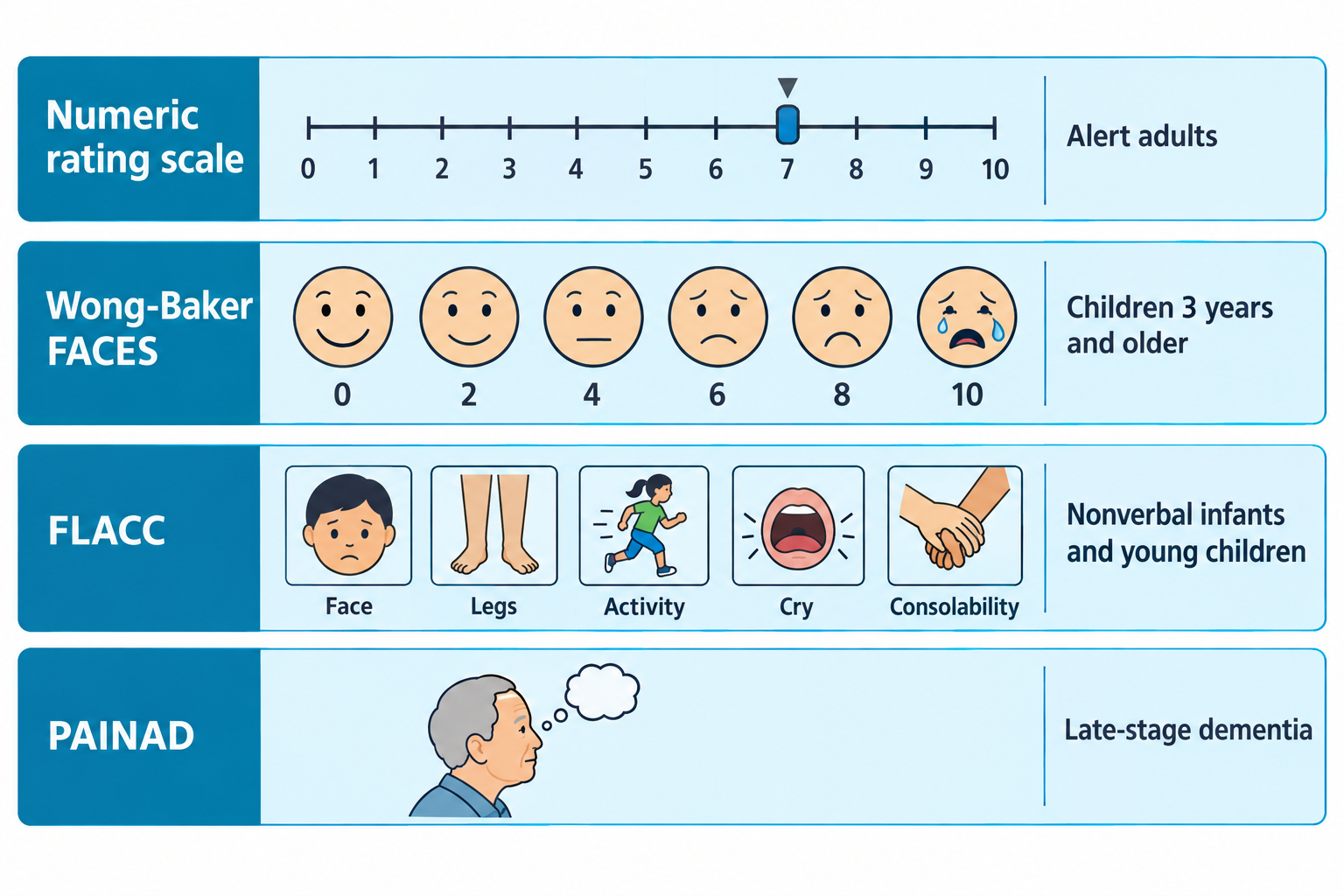
Numeric rating scale (0–10) Alert adults
Wong-Baker FACES scale Children (generally ages 3 years and older) and clients with the cognitive ability to understand and self-report using the visual scale
FLACC scale (Face, Legs, Activity, Cry, Consolability) Nonverbal infants, young children, and selected nonverbal clients
PAINAD (Pain Assessment in Advanced Dementia) Late-stage dementia clients
alt_text
////////////Caption: Common Pain Assessment Scales OR Choosing the Right Pain Assessment Tool
Type: Side-by-side comparison chart/ Comparison infographic
Description: Common pain assessment tools and the client populations for which they are most appropriate.
Illustration notes: Show the four commonly used pain assessment tools; Numeric Rating Scale (0–10), Wong-Baker FACES Pain Rating Scale, FLACC Scale (Face, Legs, Activity, Cry, Consolability), PAINAD (Pain Assessment in Advanced Dementia). Include the appropriate patient population for each tool. Include age/clinical indication icons///////////////
Definitions
FLACC scale
Behavioral pain tool used in nonverbal or preverbal clients
PAINAD
Assesses pain in individuals with dementia who cannot self-report
Breakthrough pain
A flare-up of pain that occurs despite scheduled pain medication

Pain management interventions

Nonpharmacological strategies

  • Repositioning: Reduces pressure and improves circulation
  • Massage or heat/cold therapy: Relieves muscle tension (heat) or reduces pain and inflammation (cold)
  • Distraction: TV, music, talking
  • Guided imagery or breathing: Decreases sympathetic nervous system activation
  • Spiritual support or prayer (client-directed)
alt_text
//////////OPTIONALCaption: Multimodal Pain Management
Type: Concept diagram / infographic
Illustrate that effective pain management combines both nonpharmacologic and pharmacologic interventions.
Nonpharmacologic (Repositioning, Heat/cold therapy, Massage, Guided imagery, Deep breathing, Music/distraction, Spiritual support)
Pharmacologic: (Non-opioids, Opioids, Adjuvant medications, PCA pumps)
Include a central message such as: Best pain control is achieved by combining appropriate nonpharmacologic and pharmacologic interventions whenever possible./////////////
NGN tip:
Nonpharmacologic measures should be offered with medication, not instead of it, unless pain is mild.

Pharmacologic interventions

Type Examples Nursing Considerations
Non-opioids Acetaminophen, NSAIDs Monitor for liver or GI issues
Opioids Morphine, hydromorphone Assess sedation level and respiratory status
Adjuvants Gabapentin, antidepressants Used for neuropathic pain
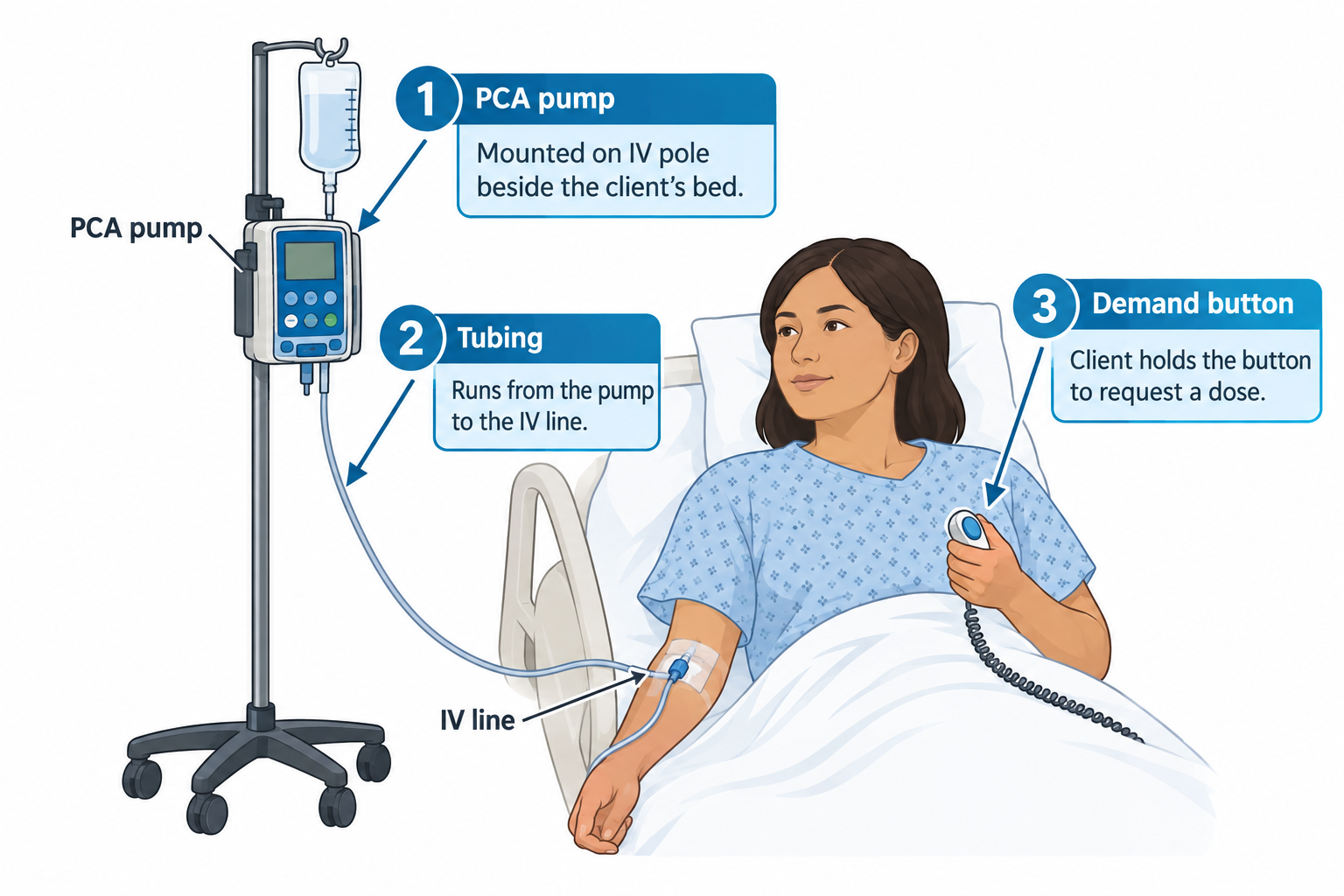
PCA pumps Client-controlled devices Monitor settings, educate client use
alt_text
//////////OPTIONALCaption: Patient-Controlled Analgesia (PCA) Pump
Type: Labeled medical device illustration
Illustration note: Show: PCA pump connected to IV tubing, Client holding the PCA demand button, Basic labeled components (pump, tubing, IV line, demand button/////////////
NGN tip:
Always reassess pain after the intervention using the same assessment tool whenever possible. Reassess at the appropriate time based on the medication route, expected onset of the intervention, and facility policy. Document the client’s response and adjust the plan of care as needed.

Clinical vignette: Mr. Lee, 72, is post-op day 1 after hip replacement. He reports pain 7/10 and hasn’t slept due to discomfort. He declines opioids, citing past drowsiness.

Nursing action: Assess the current pain level and location. Explore the client’s reason for declining opioids and discuss alternative pain management options. Offer scheduled acetaminophen and repositioning. Elevate the leg with a pillow for comfort. Provide a quiet environment and implement relaxation techniques. Reassess pain in 30 minutes and document.

Client education

  • Pain control promotes healing. Don’t wait until pain is unbearable
  • Use pain medication before activity (e.g., physical therapy)
  • Non-drug methods can be powerful when combined with medication
  • Report side effects (constipation, nausea, drowsiness)
  • Create a nightly routine to improve sleep quality

Common pitfalls on NCLEX

  • Ignoring pain report because patient “looks fine”
  • Waiting until pain is severe before offering intervention
  • Relying on VS alone to assess pain
  • Giving opioids without checking respiratory rate
  • Interrupting rest repeatedly for non-urgent care tasks
  • Pain is whatever the patient says it is
  • Use pain scales appropriate to age and cognition
  • Sleep hygiene matters — group care to protect rest
  • Reassess pain 30–60 min after intervention
  • Combine drug and non-drug interventions for best results

Sign up for free to take 5 quiz questions on this topic

Previous
Next  | 4.1.6 Non-pharmacological therapies
All rights reserved ©2016 - 2026 Achievable, Inc.

Rest, sleep, and pain management

Introduction

Rest and sleep aren’t luxuries; they’re essential to healing, immune function, and mental clarity. Nurses often find themselves at the crossroads of biology and environment, helping clients whose sleep is disrupted by pain, anxiety, illness, noise, or other environmental factors.

On the NCLEX, you’ll be tested on how to assess, promote, and protect rest and sleep, as well as how to manage pain effectively and ethically.

NGN insight:
Restorative care means treating more than the disease. It means restoring peace, comfort, and control.

Learning objectives

By the end of this section, you should be able to:

  • Assess and document sleep patterns and disturbances
  • Implement interventions to promote rest and prevent sleep disruption
  • Evaluate pain using age- and condition-appropriate tools
  • Administer and monitor nonpharmacologic and pharmacologic pain interventions

Sleep and rest in clinical care

Sleep physiology

Sleep occurs in stages that cycle throughout the night, including REM (rapid eye movement) and non-REM stages. Sleep disruption impairs immune function, cognition, and healing.

Factors affecting sleep

Factor Impact
Pain Major disruptor of both sleep quality and quantity
Environment Noise, light, and temperature can inhibit rest
Anxiety/depression Mental health issues alter sleep cycles
Medications Steroids, caffeine, diuretics, and some antidepressants may disrupt sleep
Age Older adults have lighter, more fragmented sleep

Nursing assessment

  • Ask about the client’s usual sleep routine, sleep disturbances, and factors that interfere with sleep during admission.
  • Use validated sleep assessment tools, such as the Pittsburgh Sleep Quality Index, when appropriate.
  • Observe rest patterns during hospitalization.

Interventions to promote rest

  • Group care tasks to avoid frequent nighttime interruptions.
  • Reduce environmental noise and adjust lighting.
  • Encourage bedtime routines and relaxation strategies (warm bath, reading, guided breathing).
  • Offer comfort measures such as a warm blanket or a caffeine-free beverage, if appropriate and permitted by facility policy.
  • Provide earplugs, sleep masks, and calming music.
alt_text
//////Caption: Promoting Restful Sleep in the Hospital OR Sleep Hygiene and Rest-Promoting Nursing Interventions
Type: Nursing care illustration/ Sequential clinical illustration (hospital room scene)
Illustrating a nurse promoting restful sleep in a hospitalized client by: Dimming room lights, Closing curtains/blinds, Reducing environmental noise, Grouping nighttime care activities, Offering a warm blanket, Providing earplugs and a sleep mask, Encouraging relaxation (e.g., deep breathing or calming music)///////

Pain assessment and management

Pain is subjective. The client’s self-report is the most reliable indicator of pain. Nurses should use appropriate assessment tools to guide pain management and evaluate the client’s response to treatment.

Types of pain

Type Description
Acute Sudden, short-term (e.g., post-surgical)
Chronic Long-term, often over 6 months (e.g., arthritis)
Neuropathic Burning, tingling (e.g., diabetic neuropathy)
Nociceptive Sharp, localized (somatic); dull (visceral)

Pain assessment tools

Tool Population
Numeric rating scale (0–10) Alert adults
Wong-Baker FACES scale Children (generally ages 3 years and older) and clients with the cognitive ability to understand and self-report using the visual scale
FLACC scale (Face, Legs, Activity, Cry, Consolability) Nonverbal infants, young children, and selected nonverbal clients
PAINAD (Pain Assessment in Advanced Dementia) Late-stage dementia clients
alt_text
////////////Caption: Common Pain Assessment Scales OR Choosing the Right Pain Assessment Tool
Type: Side-by-side comparison chart/ Comparison infographic
Description: Common pain assessment tools and the client populations for which they are most appropriate.
Illustration notes: Show the four commonly used pain assessment tools; Numeric Rating Scale (0–10), Wong-Baker FACES Pain Rating Scale, FLACC Scale (Face, Legs, Activity, Cry, Consolability), PAINAD (Pain Assessment in Advanced Dementia). Include the appropriate patient population for each tool. Include age/clinical indication icons///////////////
Definitions
FLACC scale
Behavioral pain tool used in nonverbal or preverbal clients
PAINAD
Assesses pain in individuals with dementia who cannot self-report
Breakthrough pain
A flare-up of pain that occurs despite scheduled pain medication

Pain management interventions

Nonpharmacological strategies

  • Repositioning: Reduces pressure and improves circulation
  • Massage or heat/cold therapy: Relieves muscle tension (heat) or reduces pain and inflammation (cold)
  • Distraction: TV, music, talking
  • Guided imagery or breathing: Decreases sympathetic nervous system activation
  • Spiritual support or prayer (client-directed)
alt_text
//////////OPTIONALCaption: Multimodal Pain Management
Type: Concept diagram / infographic
Illustrate that effective pain management combines both nonpharmacologic and pharmacologic interventions.
Nonpharmacologic (Repositioning, Heat/cold therapy, Massage, Guided imagery, Deep breathing, Music/distraction, Spiritual support)
Pharmacologic: (Non-opioids, Opioids, Adjuvant medications, PCA pumps)
Include a central message such as: Best pain control is achieved by combining appropriate nonpharmacologic and pharmacologic interventions whenever possible./////////////
NGN tip:
Nonpharmacologic measures should be offered with medication, not instead of it, unless pain is mild.

Pharmacologic interventions

Type Examples Nursing Considerations
Non-opioids Acetaminophen, NSAIDs Monitor for liver or GI issues
Opioids Morphine, hydromorphone Assess sedation level and respiratory status
Adjuvants Gabapentin, antidepressants Used for neuropathic pain
PCA pumps Client-controlled devices Monitor settings, educate client use
alt_text
//////////OPTIONALCaption: Patient-Controlled Analgesia (PCA) Pump
Type: Labeled medical device illustration
Illustration note: Show: PCA pump connected to IV tubing, Client holding the PCA demand button, Basic labeled components (pump, tubing, IV line, demand button/////////////
NGN tip:
Always reassess pain after the intervention using the same assessment tool whenever possible. Reassess at the appropriate time based on the medication route, expected onset of the intervention, and facility policy. Document the client’s response and adjust the plan of care as needed.

Clinical vignette: Mr. Lee, 72, is post-op day 1 after hip replacement. He reports pain 7/10 and hasn’t slept due to discomfort. He declines opioids, citing past drowsiness.

Nursing action: Assess the current pain level and location. Explore the client’s reason for declining opioids and discuss alternative pain management options. Offer scheduled acetaminophen and repositioning. Elevate the leg with a pillow for comfort. Provide a quiet environment and implement relaxation techniques. Reassess pain in 30 minutes and document.

Client education

  • Pain control promotes healing. Don’t wait until pain is unbearable
  • Use pain medication before activity (e.g., physical therapy)
  • Non-drug methods can be powerful when combined with medication
  • Report side effects (constipation, nausea, drowsiness)
  • Create a nightly routine to improve sleep quality

Common pitfalls on NCLEX

  • Ignoring pain report because patient “looks fine”
  • Waiting until pain is severe before offering intervention
  • Relying on VS alone to assess pain
  • Giving opioids without checking respiratory rate
  • Interrupting rest repeatedly for non-urgent care tasks
Key points
  • Pain is whatever the patient says it is
  • Use pain scales appropriate to age and cognition
  • Sleep hygiene matters — group care to protect rest
  • Reassess pain 30–60 min after intervention
  • Combine drug and non-drug interventions for best results

More from Basic care and comfort

  • Assistive devices and mobility aids
  • Comfort measures
  • Nutrition and hydration support
  • Elimination support
  • Non-pharmacological therapies