



Surgical asepsis and sterile technique
Introduction
When nursing crosses the threshold from “clean” care to invasive procedures, sterile technique becomes nonoptional. Medical asepsis (clean technique) reduces the number and spread of microorganisms, while surgical asepsis (sterile technique) eliminates all microorganisms, including spores, from a defined field, and it’s required for invasive procedures. Surgical asepsis, the practice of creating and maintaining a microorganism-free field, is a frontline defense against hospital-acquired infections. On the NCLEX, you’ll be tested on when to use it, how to maintain it, and what breaks it.
Learning objectives
By the end of this section, you should be able to:
- Distinguish medical asepsis (clean technique) from surgical asepsis (sterile technique)
- List and apply the principles of sterile technique in real-world nursing tasks
- Set up and maintain a sterile field, including pouring sterile solutions and adding sterile items
- Identify breaches in sterility and the correct corrective steps
Principles of sterile technique
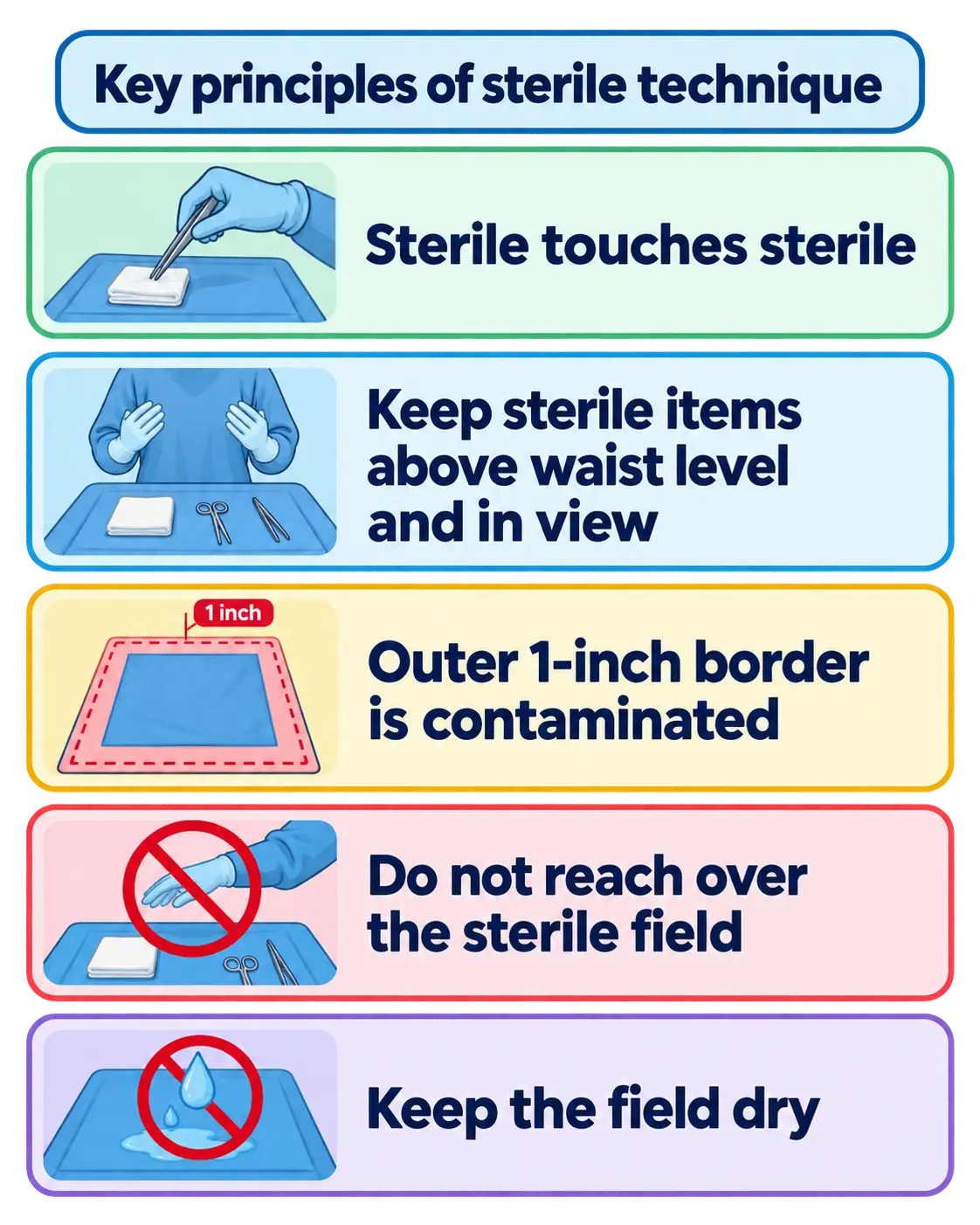
- Only sterile items may touch other sterile items; if the line of sterility is crossed, contamination results
- Items below waist level or outside the nurse’s vision are considered contaminated
- The outer 1-inch border of a sterile field is considered contaminated once exposed
- Avoid reaching over or turning your back on a sterile field
- Moisture can permit microbial travel by capillary action. Dryness is required
- Once sterility is in doubt, the object or field must be considered contaminated
Setting up and maintaining the field
Knowing the principles is only half the skill; the NCLEX also tests the mechanics of building a field and keeping it intact. A few rules cover most of what’s asked:
- Open the outer wrapper away from you first. Open the flap farthest from your body first, then the side flaps, and pull the nearest flap toward you last, so your arm never crosses over the exposed sterile surface.
- Add sterile items from a few inches above the field. Drop items onto the field from a short height without letting your hands or the unsterile outer packaging pass over the sterile boundary.
- Pour sterile solutions carefully. First pour off a small amount into a waste receptacle to clear the bottle’s lip, then pour into the sterile container from a few inches above it. Holding the bottle slightly above the receptacle keeps the nonsterile lip from touching the sterile container, and never reach across the field while pouring.
- Keep the field dry and in view. A wet field wicks microorganisms upward by capillary action, and a field left unattended or out of sight can no longer be trusted; cover it or discard and remake it.
When to use surgical asepsis
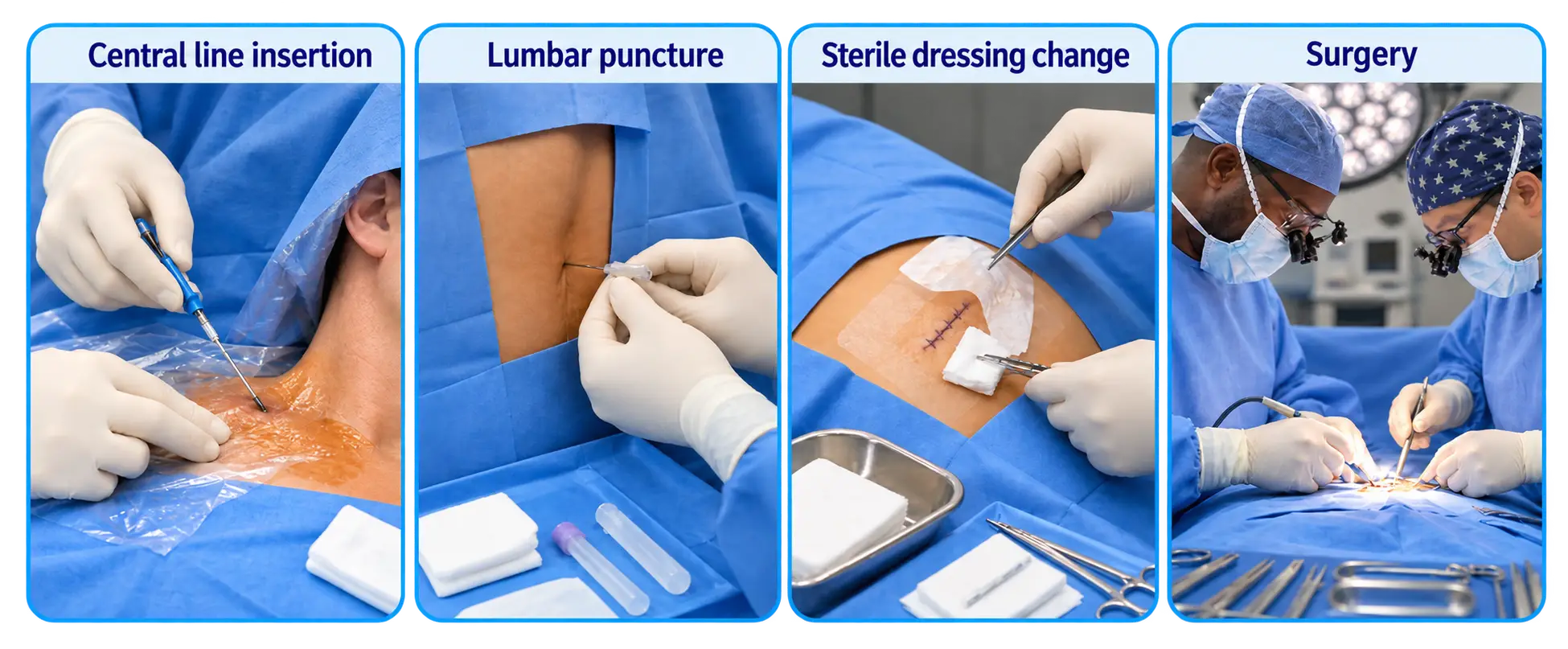
Sterile technique is required whenever the procedure breaks skin or mucous membranes, when entering sterile body cavities, or on open wound sites.
Examples include: insertion of central lines, urinary catheters, sterile dressing changes, and surgical procedures.
Clinical vignette: You are preparing to change a central line dressing. You inspect all sterile packages for intact seals and expiration dates, open them away from your body, set up a sterile field, don sterile gloves, and begin the procedure. Midway, you realize a forceps has fallen outside the 1-inch sterile border. You discard it, obtain a new sterile instrument, and continue because any item that crosses the line of sterility must be removed immediately to protect the sterile field.
Watching the whole field, not just your own hands
On the NCLEX, the nurse is often the person responsible for the field, not just a set of hands working in it. Strict sterile technique matters most for immunocompromised clients - such as those with neutropenia or receiving chemotherapy - whose weakened defenses make even a small breach dangerous; the precautions that protect these clients in isolation are covered in Isolation and infection prevention. You’re also expected to watch and evaluate whether others perform aseptic technique correctly: if a colleague contaminates an item or crosses the line of sterility, speak up and have the contaminated item removed and replaced rather than assuming the field is still intact.
Client education
- Explain to clients that sterile supplies must not be touched.
- Clarify the difference between “clean” technique at home and “sterile” technique in hospital.
- Reassure clients that these steps prevent infection and protect vulnerable clients.