


Achievable logoAchievable logo
GRE
Sign in
Sign up
Purchase
Textbook
Practice exams
Support
How it works
Resources
Exam catalog
Mountain with a flag at the peak
Textbook
Welcome
1. Vocabulary approach
2. Quantitative reasoning
2.1 Quant intro
2.2 Arithmetic & algebra
2.3 Statistics and data interpretation
2.4 Geometry
2.4.1 Angles
2.4.2 Triangle basics
2.4.3 Sum of interior angles
2.4.4 Pythagorean theorem
2.4.5 Right triangles (45-45-90)
2.4.6 Right triangles (30-60-90)
2.4.7 Triangle inequality theorem
2.4.8 Coordinate plane
2.4.9 Equation for a line
2.4.10 Graphing inequalities
2.4.11 Graphing parabolas
2.4.12 Graphing circles
2.4.13 Parallel and perpendicular lines
2.4.14 Quadrilaterals
2.4.15 Circles
2.4.16 3D shapes
2.4.17 Polygons
2.4.18 Regular polygons
2.4.19 Shaded region problems
2.5 Strategies
3. Verbal reasoning
4. Analytical writing
Wrapping up
Achievable logoAchievable logo
2.4.12 Graphing circles
Achievable GRE
2. Quantitative reasoning
2.4. Geometry

Graphing circles

5 min read
Font
Discuss
Share
Feedback

Just as there’s an equation for a straight line, there’s also an equation for a circle. The circle equation is a little more involved than y=mx+b, but it follows a clear idea: every point on the circle is the same distance from the center.

A circle can be described by

(x−a)2+(y−b)2=r2

where:

  • a and b are the x- and y-coordinates of the center, (a,b)
  • r is the radius
  • (x,y) represents any point on the circle

Please note: you don’t substitute the center coordinates for x and y. The variables x and y represent the infinitely many points on the circle. The center coordinates replace only a and b.

If the center of the circle is at the origin, (0,0), the equation simplifies because a=0 and b=0. For example, a circle centered at the origin with radius 2 has equation x2+y2=4. Try using the circle equation to solve the problem below.

(x−a)2+(y−b)2=r2

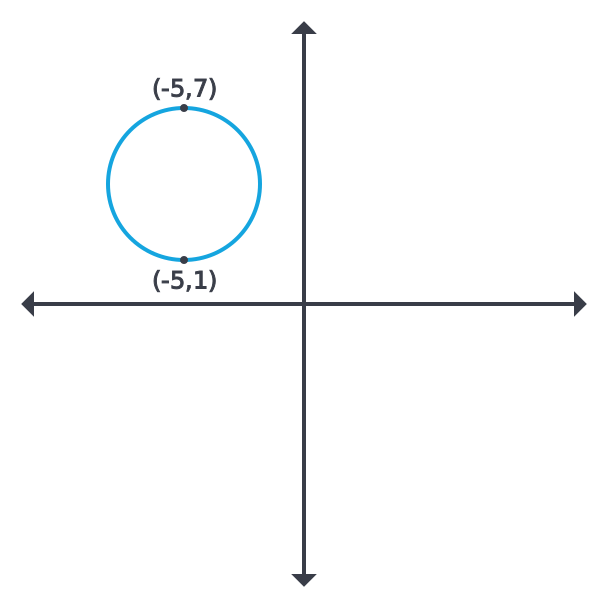
Which of the following equations represents the circle drawn below? The two points represent the highest and lowest points of the circle.

circle graphed in a coordinate plane quadrant with two labeled points

Answers:
A. (x+5)2+(y−4)2=36
B. (x+5)2+(y−4)2=3
C. (x−5)2+(y+4)2=9
D. (x+5)2+(y−4)2=9
E. (x−5)2+(y+4)2=36

(spoiler)

Correct Answer: D. (x+5)2+(y−4)2=9

Start by finding the coordinates of the center of the circle. Even though the center isn’t labeled, you can find it by taking the midpoint between the highest and lowest points. That midpoint must be (−5,4) because those values are the averages of the two x-coordinates and the two y-coordinates.

Next, find the radius. The radius is the distance from the center to any point on the circle, including either the top or bottom point. Here, the radius is 3 because the center’s y-coordinate, 4, is 3 units away from both 7 and 1.

With center (−5,4) and radius 3, substitute into the circle equation. Remember: a and b are the center coordinates.

(x−(−5))2+(y−4)2=r2

(x+5)2+(y−4)2=32

(x+5)2+(y−4)2=9

Circles tangent to a line

A line is tangent to a circle when it touches the circle at exactly one point. The key fact: the radius drawn to that point of tangency is perpendicular to the line.

That makes the radius the shortest distance from the center to the line — the perpendicular distance. So if you know a circle’s center and the line it’s tangent to, you can find the radius:

radius = perpendicular distance from the center to the line

Distance from a point to a line

To find that distance, first write the line in standard form:

ax+by+c=0

Then the distance from the point (x0​,y0​) to the line is:

d=a2+b2​∣ax0​+by0​+c∣​

The absolute value bars keep the distance positive.

Let’s use this to find the equation of the circle centered at (5,0) that is tangent to the line x=y.

First, rewrite x=y in standard form: x−y=0. So a=1, b=−1, and c=0.

Now apply the formula with (x0​,y0​)=(5,0):

d=12+(−1)2​∣1(5)+(−1)(0)+0∣​=2​5​

That distance is the radius, so r=2​5​, which means:

r2=225​=12.5

Substituting the center (5,0) and r2=12.5 into the circle equation:

(x−5)2+y2=12.5

Remember that the circle equation uses r2, not r — so you never have to simplify 2​5​ itself.

Check it with a 45-45-90 triangle

The line y=x cuts a 45° angle through the origin. Drop a perpendicular from (5,0) to that line and you form a 45-45-90 triangle: the origin, the point (5,0), and the foot of the perpendicular.

The hypotenuse runs from the origin to (5,0), so its length is 5. In a 45-45-90 triangle each leg is the hypotenuse divided by 2​, so each leg is 2​5​ — the same distance the formula gave.

Shortest distance between two circles

When two circles don’t overlap, the shortest path from one to the other runs along the line joining their centers.

Start with the distance between the centers, then subtract each radius — those are the gaps taken up by the circles themselves:

d=(distance between centers)−r1​−r2​

For example, consider these two circles:

Circle A: (x−2)2+(y−3)2=4

Circle B: (x−2)2+(y−15)2=9

Both centers share x=2, so they line up vertically. The centers are (2,3) and (2,15), which are 15−3=12 units apart.

Circle A has r1​=4​=2, and Circle B has r2​=9​=3.

d=12−2−3=7

When the centers don’t share an x- or y-coordinate, find the distance between them with the Pythagorean theorem: treat the horizontal and vertical gaps as the legs of a right triangle, and the center-to-center distance is the hypotenuse.

Circle equation basics

  • Standard form: (x−a)2+(y−b)2=r2
    • (a,b) = center coordinates
    • r = radius
    • (x,y) = any point on circle
  • Only substitute center values for a, b — never for x, y
  • Centered at origin simplifies to x2+y2=r2

Finding a circle’s equation from graph points

  • Center = midpoint of highest/lowest (or other opposite) points
  • Radius = distance from center to any point on circle
  • Substitute center and r2 into standard equation

Circles tangent to a line

  • Tangent line touches circle at exactly one point
  • Radius to point of tangency is perpendicular to the line
  • Radius = perpendicular distance from center to the line

Distance from a point to a line

  • Write line in standard form: ax+by+c=0
  • Formula: d=a2+b2​∣ax0​+by0​+c∣​
  • Absolute value ensures positive distance
  • Use resulting d as radius; plug r2 into circle equation (no need to simplify radicals)

Shortest distance between two circles

  • Applies when circles don’t overlap
  • Shortest path lies along line connecting the two centers
  • Formula: d=(distance between centers)−r1​−r2​
  • If centers don’t share an x- or y-coordinate, use Pythagorean theorem to find center-to-center distance

Sign up for free to take 2 quiz questions on this topic

All rights reserved ©2016 - 2026 Achievable, Inc.

Graphing circles

Just as there’s an equation for a straight line, there’s also an equation for a circle. The circle equation is a little more involved than y=mx+b, but it follows a clear idea: every point on the circle is the same distance from the center.

A circle can be described by

(x−a)2+(y−b)2=r2

where:

  • a and b are the x- and y-coordinates of the center, (a,b)
  • r is the radius
  • (x,y) represents any point on the circle

Please note: you don’t substitute the center coordinates for x and y. The variables x and y represent the infinitely many points on the circle. The center coordinates replace only a and b.

If the center of the circle is at the origin, (0,0), the equation simplifies because a=0 and b=0. For example, a circle centered at the origin with radius 2 has equation x2+y2=4. Try using the circle equation to solve the problem below.

(x−a)2+(y−b)2=r2

Which of the following equations represents the circle drawn below? The two points represent the highest and lowest points of the circle.

circle graphed in a coordinate plane quadrant with two labeled points

Answers:
A. (x+5)2+(y−4)2=36
B. (x+5)2+(y−4)2=3
C. (x−5)2+(y+4)2=9
D. (x+5)2+(y−4)2=9
E. (x−5)2+(y+4)2=36

(spoiler)

Correct Answer: D. (x+5)2+(y−4)2=9

Start by finding the coordinates of the center of the circle. Even though the center isn’t labeled, you can find it by taking the midpoint between the highest and lowest points. That midpoint must be (−5,4) because those values are the averages of the two x-coordinates and the two y-coordinates.

Next, find the radius. The radius is the distance from the center to any point on the circle, including either the top or bottom point. Here, the radius is 3 because the center’s y-coordinate, 4, is 3 units away from both 7 and 1.

With center (−5,4) and radius 3, substitute into the circle equation. Remember: a and b are the center coordinates.

(x−(−5))2+(y−4)2=r2

(x+5)2+(y−4)2=32

(x+5)2+(y−4)2=9

Circles tangent to a line

A line is tangent to a circle when it touches the circle at exactly one point. The key fact: the radius drawn to that point of tangency is perpendicular to the line.

That makes the radius the shortest distance from the center to the line — the perpendicular distance. So if you know a circle’s center and the line it’s tangent to, you can find the radius:

radius = perpendicular distance from the center to the line

Distance from a point to a line

To find that distance, first write the line in standard form:

ax+by+c=0

Then the distance from the point (x0​,y0​) to the line is:

d=a2+b2​∣ax0​+by0​+c∣​

The absolute value bars keep the distance positive.

Let’s use this to find the equation of the circle centered at (5,0) that is tangent to the line x=y.

First, rewrite x=y in standard form: x−y=0. So a=1, b=−1, and c=0.

Now apply the formula with (x0​,y0​)=(5,0):

d=12+(−1)2​∣1(5)+(−1)(0)+0∣​=2​5​

That distance is the radius, so r=2​5​, which means:

r2=225​=12.5

Substituting the center (5,0) and r2=12.5 into the circle equation:

(x−5)2+y2=12.5

Remember that the circle equation uses r2, not r — so you never have to simplify 2​5​ itself.

Check it with a 45-45-90 triangle

The line y=x cuts a 45° angle through the origin. Drop a perpendicular from (5,0) to that line and you form a 45-45-90 triangle: the origin, the point (5,0), and the foot of the perpendicular.

The hypotenuse runs from the origin to (5,0), so its length is 5. In a 45-45-90 triangle each leg is the hypotenuse divided by 2​, so each leg is 2​5​ — the same distance the formula gave.

Shortest distance between two circles

When two circles don’t overlap, the shortest path from one to the other runs along the line joining their centers.

Start with the distance between the centers, then subtract each radius — those are the gaps taken up by the circles themselves:

d=(distance between centers)−r1​−r2​

For example, consider these two circles:

Circle A: (x−2)2+(y−3)2=4

Circle B: (x−2)2+(y−15)2=9

Both centers share x=2, so they line up vertically. The centers are (2,3) and (2,15), which are 15−3=12 units apart.

Circle A has r1​=4​=2, and Circle B has r2​=9​=3.

d=12−2−3=7

When the centers don’t share an x- or y-coordinate, find the distance between them with the Pythagorean theorem: treat the horizontal and vertical gaps as the legs of a right triangle, and the center-to-center distance is the hypotenuse.

Key points

Circle equation basics

  • Standard form: (x−a)2+(y−b)2=r2
    • (a,b) = center coordinates
    • r = radius
    • (x,y) = any point on circle
  • Only substitute center values for a, b — never for x, y
  • Centered at origin simplifies to x2+y2=r2

Finding a circle’s equation from graph points

  • Center = midpoint of highest/lowest (or other opposite) points
  • Radius = distance from center to any point on circle
  • Substitute center and r2 into standard equation

Circles tangent to a line

  • Tangent line touches circle at exactly one point
  • Radius to point of tangency is perpendicular to the line
  • Radius = perpendicular distance from center to the line

Distance from a point to a line

  • Write line in standard form: ax+by+c=0
  • Formula: d=a2+b2​∣ax0​+by0​+c∣​
  • Absolute value ensures positive distance
  • Use resulting d as radius; plug r2 into circle equation (no need to simplify radicals)

Shortest distance between two circles

  • Applies when circles don’t overlap
  • Shortest path lies along line connecting the two centers
  • Formula: d=(distance between centers)−r1​−r2​
  • If centers don’t share an x- or y-coordinate, use Pythagorean theorem to find center-to-center distance

More from Geometry

  • Angles
  • Triangle basics
  • Sum of interior angles
  • Pythagorean theorem
  • Right triangles (45-45-90)