



Quadrilaterals
There are four main quadrilaterals you’ll see on the GRE: squares, rectangles, rhombuses, and trapezoids.
The definitions of these quadrilaterals can feel confusing because some categories include others. For example, every square is a rectangle, but not every rectangle is a square. In this lesson, you’ll look at each type and the key properties and formulas you’ll use on the GRE.
Rectangles
You probably already know what a rectangle is, but it helps to state the definition and properties precisely.
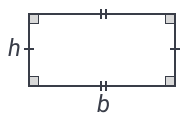
In a rectangle:
- Opposite sides are parallel and congruent.
- The two diagonals are congruent.
The perimeter of a rectangle is the sum of all four sides. Since opposite sides are equal, you can write it as .
The area of a rectangle is base times height: .
Squares
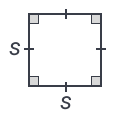
A square is a special rectangle where all four sides have the same length .
Since all sides are the same, the perimeter of a square is .
Since the base and height are both , the area of a square is .
Rhombuses
You may not have seen a rhombus before, but it shows up often on the GRE.
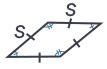
A rhombus has four equal side lengths (like a square), but it doesn’t have to have right angles. If you “tilt” a square, the side lengths stay the same, but the angles change. You end up with:
- Two congruent acute angles
- Two congruent obtuse angles
Since all sides are equal in length, the perimeter of a rhombus is .
There are two common ways to find the area of a rhombus.
The first uses base and height, like a rectangle: . Here, the height is the perpendicular (inside) distance from the base to the opposite side. It is not usually the length of a side.
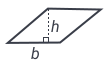
The second uses the diagonals. If the diagonals have lengths and , then the area is .
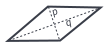
Note that among all rhombuses with the same side length, the square has the greatest area. As the rhombus tilts farther away from 90-degree interior angles, its area decreases.
Parallelograms
Parallelograms are quadrilaterals with two pairs of opposite sides that are both parallel and equal in length. The opposite interior angles in a parallelogram are also equal.
Because the definition of a parallelogram is broad, it includes several other quadrilaterals: squares, rectangles, and rhombuses are all parallelograms. Some trapezoids may also be parallelograms, depending on their shape.
There aren’t any special formulas to memorize just for parallelograms, since it’s a general category.
The key idea is this: if a shape is described as a parallelogram, you only need to determine two adjacent sides and two adjacent angles. The opposite sides and opposite angles will match them.
Trapezoids
Trapezoids can be confusing because different sources use different definitions. Since this is a GRE course, we’ll use the ETS definition: a quadrilateral in which at least one pair of opposite sides is parallel is a trapezoid. Be aware that other definitions vary. Some require exactly one pair of parallel opposite sides, and some definitions are even broader.

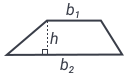
The parallel sides are called the bases. They don’t have to be drawn as the “top” and “bottom” of the figure; the formulas still work if the trapezoid is rotated.
The perimeter of a trapezoid is the sum of all four sides. Since all four sides could be different lengths, there’s no shortcut formula.
The area of a trapezoid is the average of the two bases times the height:
.
Here, the height is the perpendicular (inside) distance from one base to the other, and it usually is not the length of a side.
Example quadrilateral question
Now that you know the fundamentals, let’s try a question.
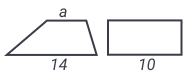
The area of the trapezoid is greater than the area of the rectangle. Both shapes have the same height.
Quantity A:
Quantity B:
Try it, then check your answer.
Answer: D. The relationship cannot be determined
Start with the area formulas.
- Trapezoid:
- Rectangle:
You’re told the trapezoid’s area is greater than the rectangle’s area, and both shapes have the same height . Set up an inequality:
So . You’re comparing to , but could be , , , , and so on. The problem also doesn’t say must be an integer. Since could be less than, equal to, or greater than , the relationship cannot be determined, so the answer is D.