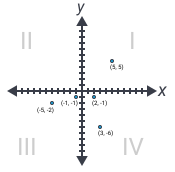

Coordinate plane
The coordinate plane is a grid you use to plot points and draw lines. It always has the same structure, even if you’re only shown part of it. The figure below shows the main components: the axes, the origin, and the four quadrants.

The Roman numerals label the four quadrants of the plane. The origin is the point where the x-axis and y-axis meet.
The axes tell you how far left or right, and how far up or down, a point is located:
- The x-axis works like a number line with 0 in the center.
- Left of 0 is negative.
- Right of 0 is positive.
- The y-axis also has 0 in the center.
- Above 0 is positive.
- Below 0 is negative.
The intersection of the two axes at their 0 values is the origin.
Any point on the graph can be represented by an ordered pair
For example, the point has an -value of and a -value of , so it’s located in Quadrant I (that’s Roman numeral I, not a lowercase L).

In the next chapter, you’ll see how a simple equation, , can represent a straight line on the coordinate plane.
Coordinate plane example question
This question is basic, but it’s an important building block for more difficult ones.
Which of the following points are NOT located in Quadrant III?
Select all that apply.
A. (3, -6)
B. (-1, -1)
C. (5, 5)
D. (2, -1)
E. (-5. -2)
Give it a try!
Correct choices:
- A. (3, -6)
- C. (5, 5)
- D. (2, -1)
Here they are plotted on the coordinate plane: