


Achievable logoAchievable logo
CMA Part 1
Sign in
Sign up
Purchase
Textbook
Practice exams
Support
How it works
Exam catalog
Mountain with a flag at the peak
Textbook
1. External financial reporting decisions
2. Planning, budgeting, and forecasting
3. Performance management
4. Cost management
5. Internal control
6. Technology and analytics
Achievable logoAchievable logo
2.5.1.10 Operational budget
Achievable CMA Part 1
2. Planning, budgeting, and forecasting
2.5. Annual profit plan and supporting schedules
2.5.1. Operational budgets
Our CMA Part 1 course is currently in development and is a work-in-progress.

Operational budget

4 min read
Font
Discuss
Share
Feedback

Learning outcome statements

The learning outcome statements relevant for this section are:

  1. prepare an operational (operating) budget

The operational budget

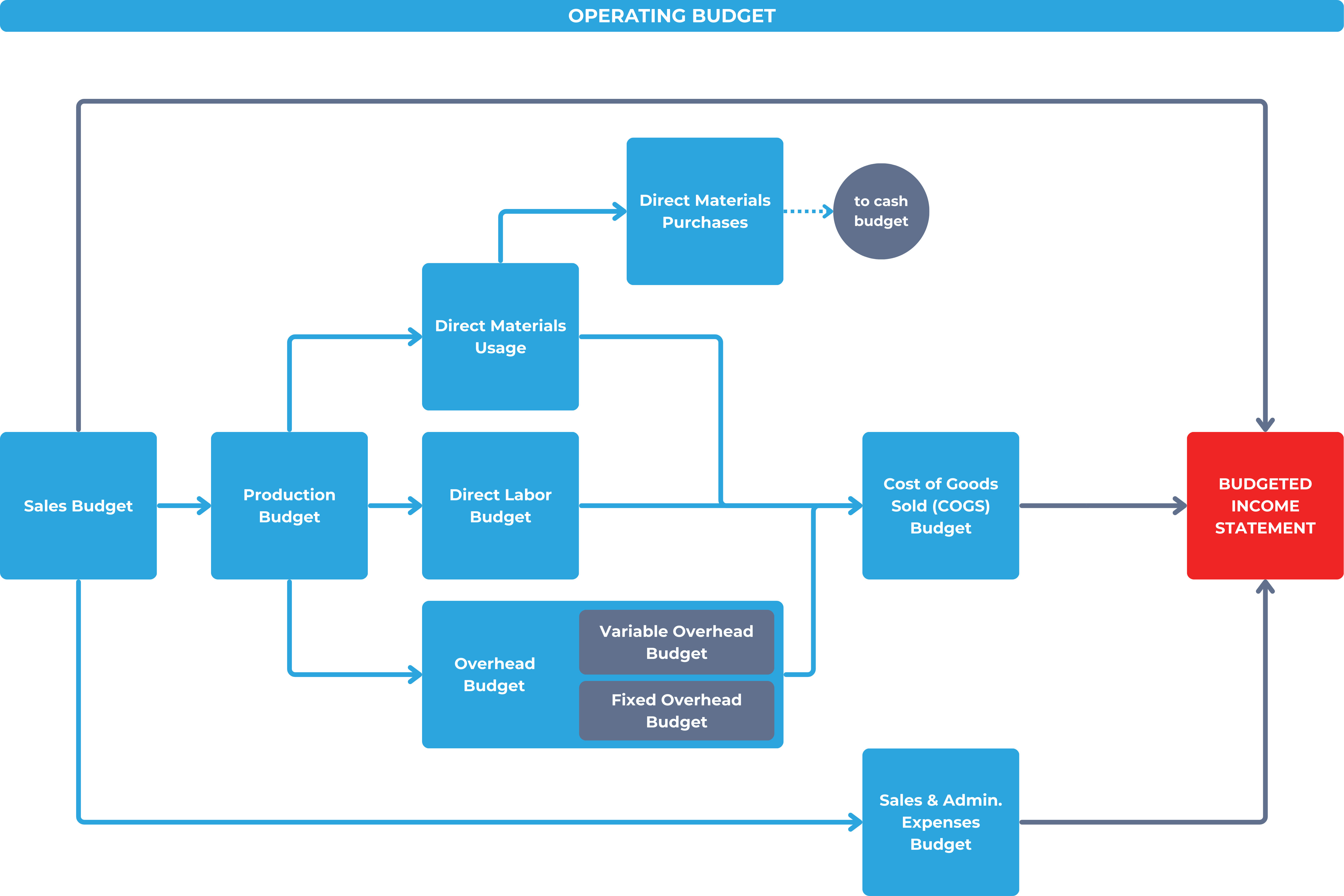
The operational budget serves as the culmination of all individual budgets, combining forecasts for sales, production, direct materials, direct labor, overhead, and selling and administrative expenses. Together, these budgets form a cohesive financial plan that reflects expected business performance over the budget period.

Operating budget - the budgeted income statement

As discussed previously, the operational budget is a static budget, meaning it is prepared based on predetermined estimates that do not adjust for actual activity levels during the budget period. While this approach provides a clear target for the organization to work toward, it may not reflect the impact of fluctuating demand or production changes. Flexible budgeting, which adjusts for changes in activity, is covered separately.

The operational budget is crucial for decision-making and financial planning as it provides a comprehensive view of the organization’s projected operational success. It allows management to make informed decisions about resource allocation, cost control, and performance benchmarks. Importantly, the operational budget’s end result should closely mirror the actual income statement, meaning that any anticipated income and expenses not covered by previous budgets, such as expected gains from non-operational sources or unique expenses, should also be budgeted separately to provide a complete financial picture.

Components and structure of the operational budget

Each component budget directly contributes to the operational budget, with the budgeted income statement as the final output. The operational budget follows this sequence:

  1. Sales budget: Establishes forecasted sales revenue, which is foundational to all downstream budgets.
  2. Production budget: Ensures sufficient production to meet sales demand while maintaining inventory levels.
  3. Direct materials budget: Calculates the materials needed for production based on projected inventory requirements and purchases.
  4. Direct labor budget: Projects labor costs and hours needed for production targets.
  5. Overhead budget: Covers variable and fixed overhead costs related to production.
  6. Selling and administrative expense budget: Projects costs outside of production that support business operations and sales activities.

Budgeted income statement

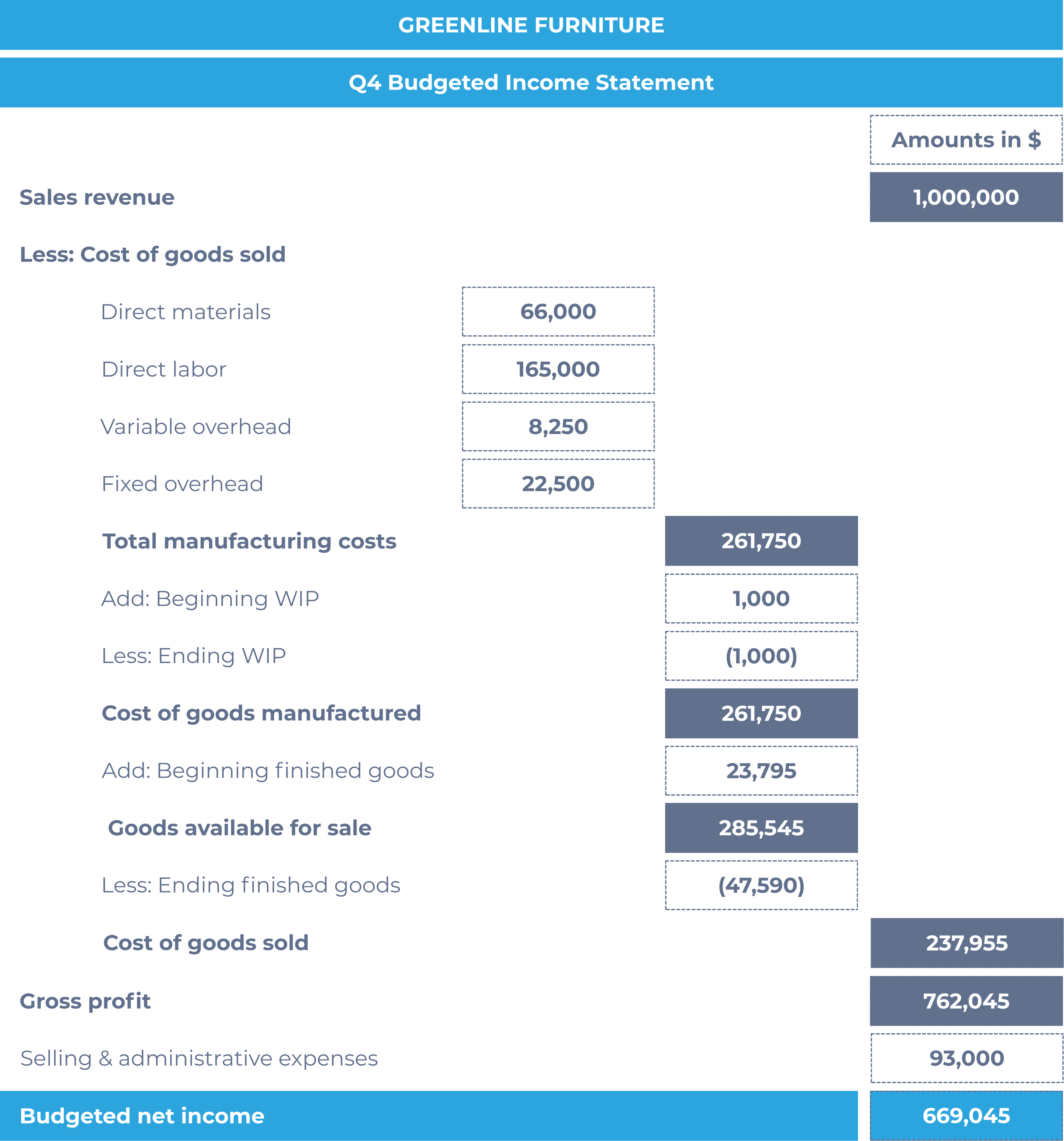
The final step in the operational budget is the preparation of the budgeted income statement. This proforma statement brings together projected revenues and costs to estimate net income. Here is the budgeted income statement for GreenLine Furniture, integrating all individual budgets prepared so far:

Budgeted income statement

Importance of budgeting for other income and expenses

To ensure the budgeted income statement accurately reflects the anticipated actual income statement, any additional income or expenses not captured in the primary operational budgets should also be forecasted. This might include:

  • Other income: Gains from non-operational sources, such as interest income, dividends, or gains on asset sales.
  • Other expenses: Unexpected costs, such as interest expense on loans or one-time charges, that impact the bottom line.

By preparing budgets for these additional items, GreenLine Furniture can create a more precise projection of its financial performance, supporting effective planning and resource allocation.

Operational budget overview

  • Combines all individual budgets into a unified financial plan
  • Functions as a static budget (does not adjust for actual activity)
  • Guides decision-making, resource allocation, and cost control

Components and structure

  • Sales Budget: projects sales revenue, foundation for other budgets
  • Production Budget: plans production to meet sales and inventory needs
  • Direct Materials Budget: estimates materials required and purchases
  • Direct Labor Budget: forecasts labor hours and costs
  • Overhead Budget: includes variable and fixed production overhead
  • Selling & Administrative Expense Budget: projects non-production costs

Budgeted income statement

  • Final output of the operational budget process
  • Integrates all projected revenues and expenses
  • Estimates net income for the budget period

Other income and expenses

  • Must budget for non-operational income (e.g., interest, asset sales)
  • Include other expenses (e.g., interest expense, one-time charges)
  • Ensures complete and accurate financial projections

Sign up for free to take 7 quiz questions on this topic

Previous
Next  | 2.5.2 Financial budgets
All rights reserved ©2016 - 2026 Achievable, Inc.

Operational budget

Learning outcome statements

The learning outcome statements relevant for this section are:

  1. prepare an operational (operating) budget

The operational budget

The operational budget serves as the culmination of all individual budgets, combining forecasts for sales, production, direct materials, direct labor, overhead, and selling and administrative expenses. Together, these budgets form a cohesive financial plan that reflects expected business performance over the budget period.

As discussed previously, the operational budget is a static budget, meaning it is prepared based on predetermined estimates that do not adjust for actual activity levels during the budget period. While this approach provides a clear target for the organization to work toward, it may not reflect the impact of fluctuating demand or production changes. Flexible budgeting, which adjusts for changes in activity, is covered separately.

The operational budget is crucial for decision-making and financial planning as it provides a comprehensive view of the organization’s projected operational success. It allows management to make informed decisions about resource allocation, cost control, and performance benchmarks. Importantly, the operational budget’s end result should closely mirror the actual income statement, meaning that any anticipated income and expenses not covered by previous budgets, such as expected gains from non-operational sources or unique expenses, should also be budgeted separately to provide a complete financial picture.

Components and structure of the operational budget

Each component budget directly contributes to the operational budget, with the budgeted income statement as the final output. The operational budget follows this sequence:

  1. Sales budget: Establishes forecasted sales revenue, which is foundational to all downstream budgets.
  2. Production budget: Ensures sufficient production to meet sales demand while maintaining inventory levels.
  3. Direct materials budget: Calculates the materials needed for production based on projected inventory requirements and purchases.
  4. Direct labor budget: Projects labor costs and hours needed for production targets.
  5. Overhead budget: Covers variable and fixed overhead costs related to production.
  6. Selling and administrative expense budget: Projects costs outside of production that support business operations and sales activities.

Budgeted income statement

The final step in the operational budget is the preparation of the budgeted income statement. This proforma statement brings together projected revenues and costs to estimate net income. Here is the budgeted income statement for GreenLine Furniture, integrating all individual budgets prepared so far:

Importance of budgeting for other income and expenses

To ensure the budgeted income statement accurately reflects the anticipated actual income statement, any additional income or expenses not captured in the primary operational budgets should also be forecasted. This might include:

  • Other income: Gains from non-operational sources, such as interest income, dividends, or gains on asset sales.
  • Other expenses: Unexpected costs, such as interest expense on loans or one-time charges, that impact the bottom line.

By preparing budgets for these additional items, GreenLine Furniture can create a more precise projection of its financial performance, supporting effective planning and resource allocation.

Key points

Operational budget overview

  • Combines all individual budgets into a unified financial plan
  • Functions as a static budget (does not adjust for actual activity)
  • Guides decision-making, resource allocation, and cost control

Components and structure

  • Sales Budget: projects sales revenue, foundation for other budgets
  • Production Budget: plans production to meet sales and inventory needs
  • Direct Materials Budget: estimates materials required and purchases
  • Direct Labor Budget: forecasts labor hours and costs
  • Overhead Budget: includes variable and fixed production overhead
  • Selling & Administrative Expense Budget: projects non-production costs

Budgeted income statement

  • Final output of the operational budget process
  • Integrates all projected revenues and expenses
  • Estimates net income for the budget period

Other income and expenses

  • Must budget for non-operational income (e.g., interest, asset sales)
  • Include other expenses (e.g., interest expense, one-time charges)
  • Ensures complete and accurate financial projections

More from Operational budgets

  • Introduction
  • Sales budget
  • Production budget
  • Direct materials budget
  • Direct labor budget