



Production budget
Learning outcome statements
The learning outcome statements relevant for this section are:
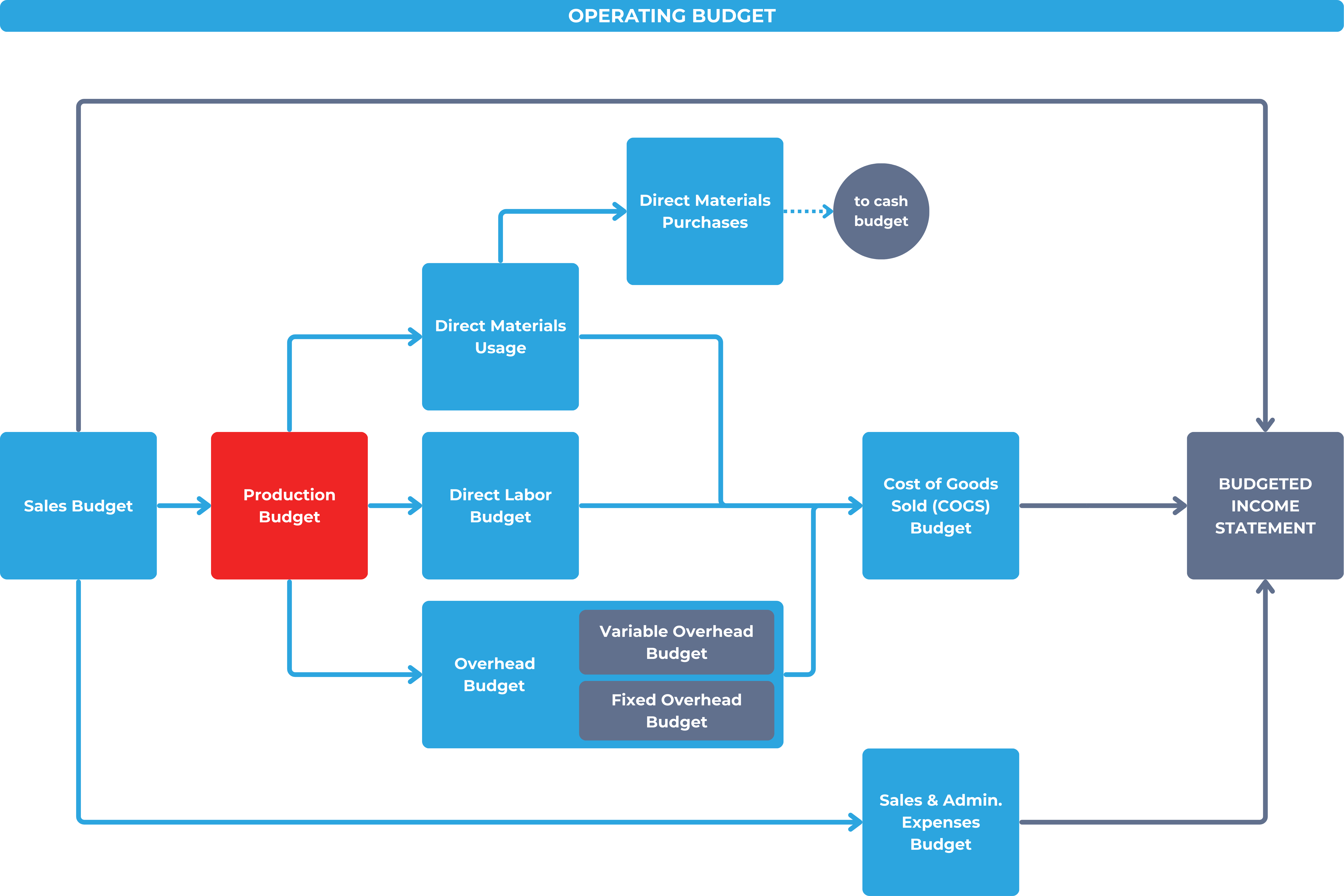
- explain the relationship between the sales budget and the production budget
- identify the role that inventory levels play in the preparation of a production budget and define other factors that should be considered when preparing a production budget
- prepare a production budget
The production budget outlines the quantity of units that must be produced within a specific period to meet the anticipated sales demand and inventory requirements. This budget is crucial for ensuring that production aligns with sales projections, avoiding both shortages and excess inventory.
Relationship between sales budget and production budget
The sales budget is a primary driver of the production budget. Since sales projections dictate the quantity of goods expected to be sold, the production budget must align with these projections to ensure adequate supply without overproducing. By accurately forecasting production needs, companies can better manage costs, optimize resources, and maintain adequate inventory levels.
It is good to note that the production budget involves the units of finished goods needed to satisfy the sales forecasted in the sales budget. The breakdown and dollar costs of these units of finished goods are determined in the succeeding budgets on direct materials, direct labor and overhead.
GreenLine Furniture scenario
In the context of GreenLine Furniture, the Q4 sales forecast of 5,000 units directly influences the company’s production requirements. The production budget will also consider inventory levels to ensure that sufficient units are available without exceeding demand.
Role of inventory levels in production planning
Inventory levels play a pivotal role in developing an accurate production budget. Companies often maintain a certain amount of inventory on hand, called beginning inventory, to ensure smooth operations and cover unexpected demand. Ending inventory (the desired amount of inventory on hand at the end of a period) is also essential, as it affects the production needs for the current period and ensures availability for future sales periods.
The formula used to determine the units that need to be produced, incorporating inventory levels, is:
Preparation of the production budget
Example: GreenLine Furniture production budget assumptions
For GreenLine Furniture, let’s assume the following:
- The sales budget forecasts 5,000 units needed for Q4 (see “projected units sold” in the Sales Budget).
- Desired ending inventory for the end of October and November is two thirds of the next month’s projected sales to meet anticipated sales in the following period.
- Desired ending inventory for the end of December is 1,000 units to meet anticipated sales in the following period.
- Beginning inventory at the start of October is 500 units.
Input the provided details
Using GreenLine’s Q4 forecast and the information provided we can input the following data below. Note that some of the information is unknown on a monthly basis but we can work them out through some assumptions.
| Month | Projected sales (units) | Desired ending inventory | Beginning inventory | Required production (units) |
| October | 1,200 | 1,000 | 500 | - |
| November | 1,500 | 1,533 | - | - |
| December | 2,300 | 1,000 | - | - |
| Total | 5,000 | - |
Input beginning inventories
Using the assumption that the ending inventory of the previous month is the projected beginning inventory of the next month, we should be able to fill-in additional details.
| Month | Projected sales (units) | Desired ending inventory | Beginning inventory | Required production (units) |
| October | 1,200 | 1,000 | 500 | - |
| November | 1,500 | 1,533 | 1,000 | - |
| December | 2,300 | 1,000 | 1,533 | - |
| Total | 5,000 | - |
Use the formula to determine the required production each month
We can then use the formula to determine the required production in units. After these, we are left with the following production budget for GreenLine for Q4:
| Month | Projected sales (units) | Desired ending inventory | Beginning inventory | Required production (units) |
| October | 1,200 | 1,000 | 500 | 1,700 |
| November | 1,500 | 1,533 | 1,000 | 2,033 |
| December | 2,300 | 1,000 | 1,533 | 1,767 |
| Total | 5,000 | 5,500 |
The monthly required production in units are computed as follows:
October required production
November required production
December required production
In this example, GreenLine Furniture would need to produce a total of 5,500 units in Q4 to meet sales demand and ensure sufficient ending inventory for the next period. This production budget will guide GreenLine’s direct materials, labor, and overhead requirements, linking the production plan with subsequent budgets.