


Achievable logoAchievable logo
CMA Part 1
Sign in
Sign up
Purchase
Textbook
Practice exams
Support
How it works
Exam catalog
Mountain with a flag at the peak
Textbook
1. External financial reporting decisions
2. Planning, budgeting, and forecasting
3. Performance management
4. Cost management
5. Internal control
6. Technology and analytics
Achievable logoAchievable logo
2.5.1.5 Direct labor budget
Achievable CMA Part 1
2. Planning, budgeting, and forecasting
2.5. Annual profit plan and supporting schedules
2.5.1. Operational budgets
Our CMA Part 1 course is currently in development and is a work-in-progress.

Direct labor budget

4 min read
Font
Discuss
Share
Feedback

Learning outcome statements

The learning outcome statements relevant for this section are:

  1. demonstrate an understanding of the relationship between the direct labor budget and the production budget
  2. prepare a direct labor budget based on relevant information and evaluate the feasibility of achieving production goals on the basis of these budgets

The direct labor budget calculates the hours and cost of direct labor necessary to meet production targets, directly linking to the production budget. By projecting labor needs, the budget helps ensure that the company can achieve production goals without workforce shortages or excess costs.

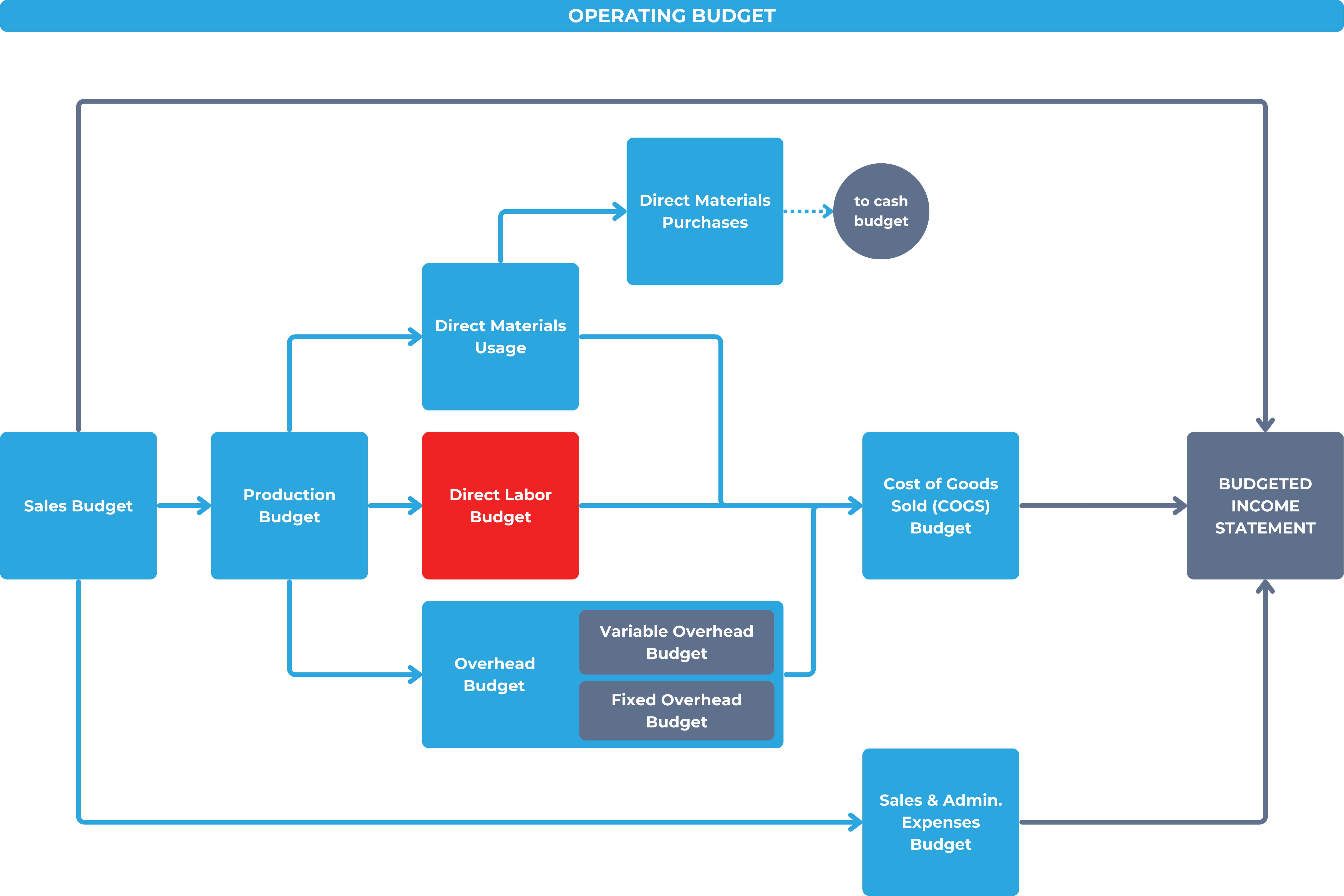
Operating budget - DL budget component

Linking the direct labor budget to the production budget

The direct labor budget is based on production requirements defined in the production budget. For each unit to be produced, a set amount of direct labor hours is required. This connection ensures that labor is aligned with production goals, allowing for accurate staffing and cost planning.

In actual practice, direct labor budgeting can be more complex, as different types of labor may be required at various stages of production, each with distinct wage rates and skill requirements. For the continued example with GreenLine Furniture, we’ve simplified the scenario to one type of labor for clarity in calculations.

Components and preparation of the direct labor budget

The direct labor budget involves calculating both the total hours and the total labor cost required to meet production targets.

Let’s assume the following for GreenLine Furniture:

  • Direct labor hours per unit produced: 1.5 hours
  • Hourly direct labor cost rate: $20 per hour
  • The required units to be produced (5,500 units for Q4) are still coming from the production budget of the previous chapters

In the direct labor budget, the hourly cost of labor often includes more than just the basic wages paid to employees. While the base wage rate forms the primary component, additional costs such as payroll taxes, benefits, and any allowances directly associated with labor are typically included to reflect the true cost per hour. For example, payroll taxes like Social Security and Medicare contributions, healthcare benefits, retirement contributions, and even overtime premiums are commonly factored into the hourly rate if they are regularly incurred. By including these associated costs, the budget provides a more accurate representation of labor expenses, ensuring that projected costs closely align with actual expenditures.

Direct labor budget calculation

The following is the direct labor budget for GreenLine Furniture using the provided assumptions:

Month Production
units
Direct labor (DL)
Hours per unit
Total labor hours required
(Units × DL per unit)
Hourly DL rate Total DL cost
October 1,700 1.5 2,550 $20 $51,000
November 2,033 1.5 3,050 $20 $61,000
December 1,767 1.5 2,650 $20 $53,000
Total 5,500 8,250 $165,000

This breakdown allows GreenLine to budget accurately for labor costs by month and for the entire quarter.

Evaluating production goals based on direct labor

By preparing the direct labor budget, GreenLine Furniture can assess whether it has the workforce capacity to meet its production targets. If total labor hours required ( 8,250 hours) exceed available staff hours or shift capacity, adjustments in scheduling, hiring, or overtime may be necessary to avoid production delays. Additionally, the direct labor budget helps identify cost management opportunities, ensuring that the labor needed to achieve production goals aligns with financial constraints.

Relationship between direct labor budget and production budget

  • Direct labor budget derives from production budget requirements
  • Ensures labor hours and costs align with production targets
  • Prevents workforce shortages or excess labor costs

Linking the direct labor budget to the production budget

  • Labor hours per unit multiplied by production units determines total labor hours
  • Accurate staffing and cost planning depend on this link
  • Real-world scenarios may require multiple labor types and wage rates

Components and preparation of the direct labor budget

  • Key inputs: direct labor hours per unit, hourly labor cost, production units
  • Hourly labor cost includes:
    • Base wage
    • Payroll taxes, benefits, overtime premiums
  • Budget reflects true labor expense, not just base wages

Direct labor budget calculation

  • Formula: Total labor hours = Production units × Direct labor hours per unit
  • Total labor cost = Total labor hours × Hourly labor rate
  • Example: For 5,500 units, 1.5 hours/unit, $20/hour → 8,250 hours, $165,000 total cost

Evaluating production goals based on direct labor

  • Compare required labor hours to available workforce capacity
  • Identify need for scheduling changes, hiring, or overtime
  • Budget helps manage labor costs and supports production feasibility

Sign up for free to take 10 quiz questions on this topic

Previous
Next  | 2.5.1.6 Overhead budget
All rights reserved ©2016 - 2026 Achievable, Inc.

Direct labor budget

Learning outcome statements

The learning outcome statements relevant for this section are:

  1. demonstrate an understanding of the relationship between the direct labor budget and the production budget
  2. prepare a direct labor budget based on relevant information and evaluate the feasibility of achieving production goals on the basis of these budgets

The direct labor budget calculates the hours and cost of direct labor necessary to meet production targets, directly linking to the production budget. By projecting labor needs, the budget helps ensure that the company can achieve production goals without workforce shortages or excess costs.

Linking the direct labor budget to the production budget

The direct labor budget is based on production requirements defined in the production budget. For each unit to be produced, a set amount of direct labor hours is required. This connection ensures that labor is aligned with production goals, allowing for accurate staffing and cost planning.

In actual practice, direct labor budgeting can be more complex, as different types of labor may be required at various stages of production, each with distinct wage rates and skill requirements. For the continued example with GreenLine Furniture, we’ve simplified the scenario to one type of labor for clarity in calculations.

Components and preparation of the direct labor budget

The direct labor budget involves calculating both the total hours and the total labor cost required to meet production targets.

Let’s assume the following for GreenLine Furniture:

  • Direct labor hours per unit produced: 1.5 hours
  • Hourly direct labor cost rate: $20 per hour
  • The required units to be produced (5,500 units for Q4) are still coming from the production budget of the previous chapters

In the direct labor budget, the hourly cost of labor often includes more than just the basic wages paid to employees. While the base wage rate forms the primary component, additional costs such as payroll taxes, benefits, and any allowances directly associated with labor are typically included to reflect the true cost per hour. For example, payroll taxes like Social Security and Medicare contributions, healthcare benefits, retirement contributions, and even overtime premiums are commonly factored into the hourly rate if they are regularly incurred. By including these associated costs, the budget provides a more accurate representation of labor expenses, ensuring that projected costs closely align with actual expenditures.

Direct labor budget calculation

The following is the direct labor budget for GreenLine Furniture using the provided assumptions:

Month Production
units
Direct labor (DL)
Hours per unit
Total labor hours required
(Units × DL per unit)
Hourly DL rate Total DL cost
October 1,700 1.5 2,550 $20 $51,000
November 2,033 1.5 3,050 $20 $61,000
December 1,767 1.5 2,650 $20 $53,000
Total 5,500 8,250 $165,000

This breakdown allows GreenLine to budget accurately for labor costs by month and for the entire quarter.

Evaluating production goals based on direct labor

By preparing the direct labor budget, GreenLine Furniture can assess whether it has the workforce capacity to meet its production targets. If total labor hours required ( 8,250 hours) exceed available staff hours or shift capacity, adjustments in scheduling, hiring, or overtime may be necessary to avoid production delays. Additionally, the direct labor budget helps identify cost management opportunities, ensuring that the labor needed to achieve production goals aligns with financial constraints.

Key points

Relationship between direct labor budget and production budget

  • Direct labor budget derives from production budget requirements
  • Ensures labor hours and costs align with production targets
  • Prevents workforce shortages or excess labor costs

Linking the direct labor budget to the production budget

  • Labor hours per unit multiplied by production units determines total labor hours
  • Accurate staffing and cost planning depend on this link
  • Real-world scenarios may require multiple labor types and wage rates

Components and preparation of the direct labor budget

  • Key inputs: direct labor hours per unit, hourly labor cost, production units
  • Hourly labor cost includes:
    • Base wage
    • Payroll taxes, benefits, overtime premiums
  • Budget reflects true labor expense, not just base wages

Direct labor budget calculation

  • Formula: Total labor hours = Production units × Direct labor hours per unit
  • Total labor cost = Total labor hours × Hourly labor rate
  • Example: For 5,500 units, 1.5 hours/unit, $20/hour → 8,250 hours, $165,000 total cost

Evaluating production goals based on direct labor

  • Compare required labor hours to available workforce capacity
  • Identify need for scheduling changes, hiring, or overtime
  • Budget helps manage labor costs and supports production feasibility

More from Operational budgets

  • Introduction
  • Sales budget
  • Production budget
  • Direct materials budget
  • Overhead budget