


Achievable logoAchievable logo
CMA Part 1
Sign in
Sign up
Purchase
Textbook
Practice exams
Support
How it works
Exam catalog
Mountain with a flag at the peak
Textbook
1. External financial reporting decisions
2. Planning, budgeting, and forecasting
3. Performance management
4. Cost management
5. Internal control
6. Technology and analytics
Achievable logoAchievable logo
2.5.1.6 Overhead budget
Achievable CMA Part 1
2. Planning, budgeting, and forecasting
2.5. Annual profit plan and supporting schedules
2.5.1. Operational budgets
Our CMA Part 1 course is currently in development and is a work-in-progress.

Overhead budget

4 min read
Font
Discuss
Share
Feedback

Learning outcome statements

The learning outcome statements relevant for this section are:

  1. demonstrate an understanding of the relationship between the overhead budget and the production budget
  2. separate costs into their fixed and variable components
  3. prepare an overhead budget

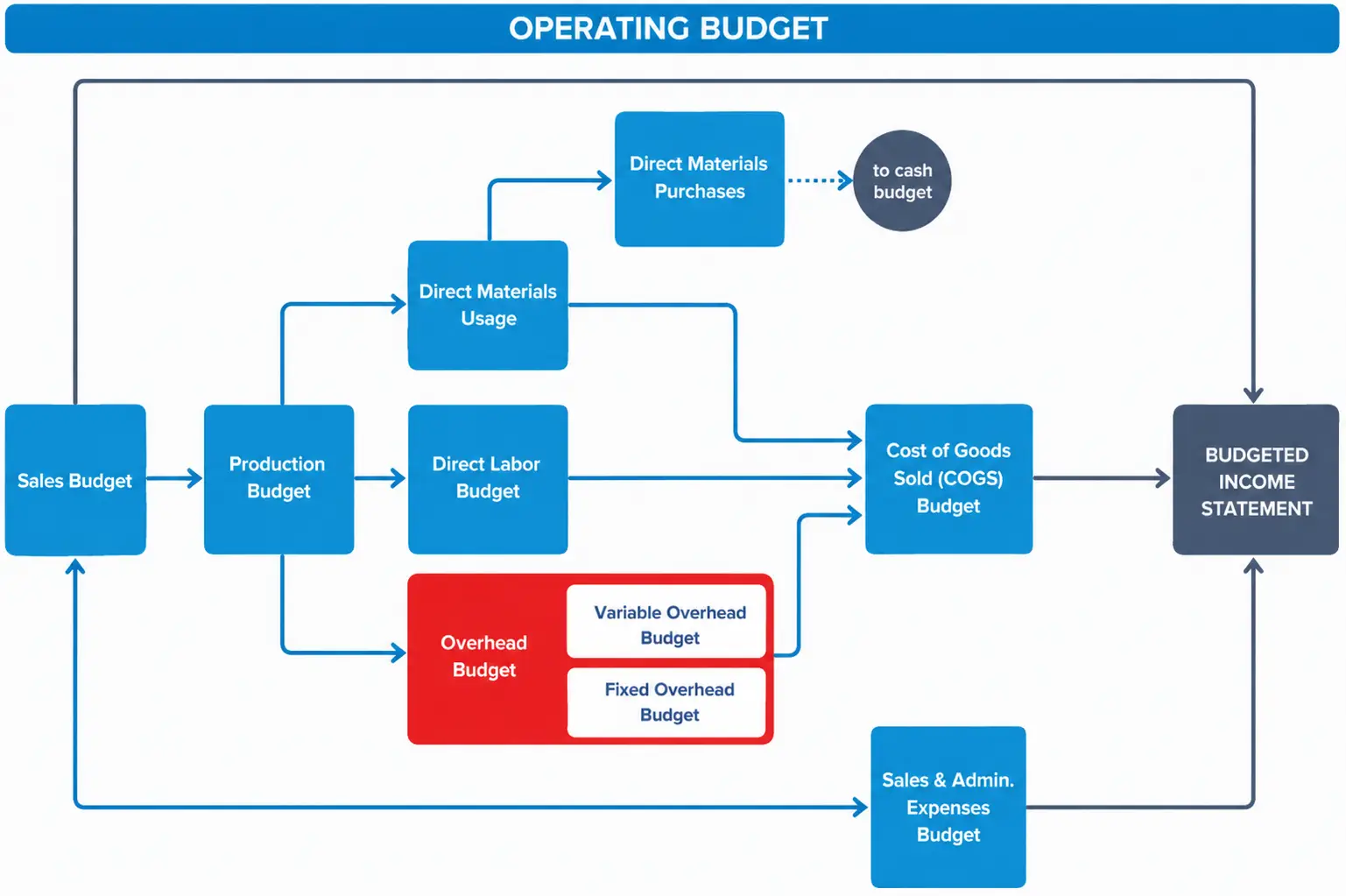
The overhead budget outlines all indirect production costs (i.e. overhead costs), that are not directly tied to specific units produced but are necessary to support production activities. Overhead costs can include a wide range of expenses, such as utilities, rent, insurance, and indirect materials. These costs are separated into fixed and variable components to provide an accurate estimate of the indirect expenses associated with production goals. The overhead budget is essential for calculating both the cost of goods sold and the contribution margin, ensuring that production can proceed smoothly without financial strain.

Operating budget flowchart with the overhead budget box highlighted in red.
Overhead Budget Component

Relationship between production and overhead budgets

The overhead budget is closely linked to the production budget, as overhead costs often fluctuate based on production levels. Variable overhead costs, such as utilities and indirect materials, increase with higher production volumes. In contrast, fixed overhead costs, like rent and insurance, remain constant regardless of production levels within a relevant range. Accurate overhead budgeting ensures that all indirect costs are accounted for, supporting the achievement of production targets without unexpected cost overruns.

Components of the overhead budget

Overhead costs in the budget are classified as either variable or fixed:

  • Variable overhead costs: These change with production levels and may include indirect materials, utilities, or maintenance costs.
  • Fixed overhead costs: These remain constant regardless of production volume within the relevant range and may include expenses like rent, insurance, or salaries for administrative staff.

By separating these costs, the budget provides a clearer picture of total overhead expenses, allowing GreenLine to allocate resources accurately.

Preparing the overhead budget

For GreenLine Furniture, the following are the overhead items:

Variable overhead costs per unit amounts to a total $1.50, composed of:

  • Indirect materials: $1 per unit produced
  • Utilities: $0.50 per unit produced

Fixed overhead is composed of:

  • Factory rent of $6,000 per month
  • Insurance of $1,500 per month

Fixed overhead costs remain constant, as they are not tied to production levels within the relevant range.

In this example, we’re using units produced as the cost driver for variable overhead allocation. This is because GreenLine’s production process is relatively straightforward, and overhead costs like indirect materials and utilities increase directly with the number of units produced, making per-unit allocation a practical approach. In more labor-intensive processes, however, direct labor hours might be a more suitable cost driver, as it would better align overhead with the labor effort required. For GreenLine’s purposes, per-unit allocation effectively captures variable overhead costs with fewer adjustments.

Using GreenLine’s production levels for Q4, the overhead budget calculates the costs associated with each overhead category.

Month Production
units
Variable overhead
per unit
Total variable
overhead
Rent Insurance Total fixed
overhead
Total
overhead
October 1,700 $1.50 $2,550 $6,000 $1,500 $7,500 $10,050
November 2,033 $1.50 $3,050 $6,000 $1,500 $7,500 $10,550
December 1,767 $1.50 $2,650 $6,000 $1,500 $7,500 $10,150
Total 5,500 $8,250 $22,500 $30,750

This overhead budget provides GreenLine Furniture with a comprehensive view of indirect costs required to meet production goals for Q4. With detailed projections, GreenLine can allocate resources efficiently, ensuring they maintain a balance between supporting production and controlling overhead expenses.

Overhead budget basics

  • Outlines all indirect production costs (overhead)
  • Separates costs into fixed and variable components
  • Essential for cost of goods sold and contribution margin calculations

Relationship between production and overhead budgets

  • Overhead budget linked to production budget
  • Variable overhead fluctuates with production levels
  • Fixed overhead remains constant within relevant range

Components of the overhead budget

  • Variable overhead: changes with production (e.g., indirect materials, utilities, maintenance)
  • Fixed overhead: remains constant (e.g., rent, insurance, admin salaries)
  • Separation allows accurate resource allocation

Preparing the overhead budget

  • Identify variable overhead per unit (e.g., indirect materials $1, utilities $0.50; total $1.50/unit)
  • Identify fixed overhead (e.g., rent $6,000/month, insurance $1,500/month)
  • Choose cost driver (units produced for GreenLine; direct labor hours for labor-intensive processes)
  • Calculate total overhead:
    • Total variable overhead = variable overhead rate × units produced
    • Total fixed overhead = sum of fixed expenses
    • Total overhead = total variable + total fixed overhead

Purpose and use

  • Provides detailed projections of indirect costs
  • Supports efficient resource allocation and cost control
  • Ensures production goals are met without unexpected overhead overruns

Sign up for free to take 9 quiz questions on this topic

Previous
Next  | 2.5.1.7 Cost of goods sold budget
All rights reserved ©2016 - 2026 Achievable, Inc.

Overhead budget

Learning outcome statements

The learning outcome statements relevant for this section are:

  1. demonstrate an understanding of the relationship between the overhead budget and the production budget
  2. separate costs into their fixed and variable components
  3. prepare an overhead budget

The overhead budget outlines all indirect production costs (i.e. overhead costs), that are not directly tied to specific units produced but are necessary to support production activities. Overhead costs can include a wide range of expenses, such as utilities, rent, insurance, and indirect materials. These costs are separated into fixed and variable components to provide an accurate estimate of the indirect expenses associated with production goals. The overhead budget is essential for calculating both the cost of goods sold and the contribution margin, ensuring that production can proceed smoothly without financial strain.

Relationship between production and overhead budgets

The overhead budget is closely linked to the production budget, as overhead costs often fluctuate based on production levels. Variable overhead costs, such as utilities and indirect materials, increase with higher production volumes. In contrast, fixed overhead costs, like rent and insurance, remain constant regardless of production levels within a relevant range. Accurate overhead budgeting ensures that all indirect costs are accounted for, supporting the achievement of production targets without unexpected cost overruns.

Components of the overhead budget

Overhead costs in the budget are classified as either variable or fixed:

  • Variable overhead costs: These change with production levels and may include indirect materials, utilities, or maintenance costs.
  • Fixed overhead costs: These remain constant regardless of production volume within the relevant range and may include expenses like rent, insurance, or salaries for administrative staff.

By separating these costs, the budget provides a clearer picture of total overhead expenses, allowing GreenLine to allocate resources accurately.

Preparing the overhead budget

For GreenLine Furniture, the following are the overhead items:

Variable overhead costs per unit amounts to a total $1.50, composed of:

  • Indirect materials: $1 per unit produced
  • Utilities: $0.50 per unit produced

Fixed overhead is composed of:

  • Factory rent of $6,000 per month
  • Insurance of $1,500 per month

Fixed overhead costs remain constant, as they are not tied to production levels within the relevant range.

In this example, we’re using units produced as the cost driver for variable overhead allocation. This is because GreenLine’s production process is relatively straightforward, and overhead costs like indirect materials and utilities increase directly with the number of units produced, making per-unit allocation a practical approach. In more labor-intensive processes, however, direct labor hours might be a more suitable cost driver, as it would better align overhead with the labor effort required. For GreenLine’s purposes, per-unit allocation effectively captures variable overhead costs with fewer adjustments.

Using GreenLine’s production levels for Q4, the overhead budget calculates the costs associated with each overhead category.

Month Production
units
Variable overhead
per unit
Total variable
overhead
Rent Insurance Total fixed
overhead
Total
overhead
October 1,700 $1.50 $2,550 $6,000 $1,500 $7,500 $10,050
November 2,033 $1.50 $3,050 $6,000 $1,500 $7,500 $10,550
December 1,767 $1.50 $2,650 $6,000 $1,500 $7,500 $10,150
Total 5,500 $8,250 $22,500 $30,750

This overhead budget provides GreenLine Furniture with a comprehensive view of indirect costs required to meet production goals for Q4. With detailed projections, GreenLine can allocate resources efficiently, ensuring they maintain a balance between supporting production and controlling overhead expenses.

Key points

Overhead budget basics

  • Outlines all indirect production costs (overhead)
  • Separates costs into fixed and variable components
  • Essential for cost of goods sold and contribution margin calculations

Relationship between production and overhead budgets

  • Overhead budget linked to production budget
  • Variable overhead fluctuates with production levels
  • Fixed overhead remains constant within relevant range

Components of the overhead budget

  • Variable overhead: changes with production (e.g., indirect materials, utilities, maintenance)
  • Fixed overhead: remains constant (e.g., rent, insurance, admin salaries)
  • Separation allows accurate resource allocation

Preparing the overhead budget

  • Identify variable overhead per unit (e.g., indirect materials $1, utilities $0.50; total $1.50/unit)
  • Identify fixed overhead (e.g., rent $6,000/month, insurance $1,500/month)
  • Choose cost driver (units produced for GreenLine; direct labor hours for labor-intensive processes)
  • Calculate total overhead:
    • Total variable overhead = variable overhead rate × units produced
    • Total fixed overhead = sum of fixed expenses
    • Total overhead = total variable + total fixed overhead

Purpose and use

  • Provides detailed projections of indirect costs
  • Supports efficient resource allocation and cost control
  • Ensures production goals are met without unexpected overhead overruns

More from Operational budgets

  • Introduction
  • Sales budget
  • Production budget
  • Direct materials budget
  • Direct labor budget