


Achievable logoAchievable logo
CMA Part 1
Sign in
Sign up
Purchase
Textbook
Practice exams
Support
How it works
Exam catalog
Mountain with a flag at the peak
Textbook
1. External financial reporting decisions
2. Planning, budgeting, and forecasting
3. Performance management
4. Cost management
5. Internal control
6. Technology and analytics
Achievable logoAchievable logo
2.5.1.9 Selling and administrative expense budget
Achievable CMA Part 1
2. Planning, budgeting, and forecasting
2.5. Annual profit plan and supporting schedules
2.5.1. Operational budgets
Our CMA Part 1 course is currently in development and is a work-in-progress.

Selling and administrative expense budget

6 min read
Font
Discuss
Share
Feedback

Learning outcome statements

The learning outcome statements relevant for this section are:

  1. identify the components of a selling and administrative expense budget
  2. explain how specific components of the selling and administrative expense budget may affect the contribution margin

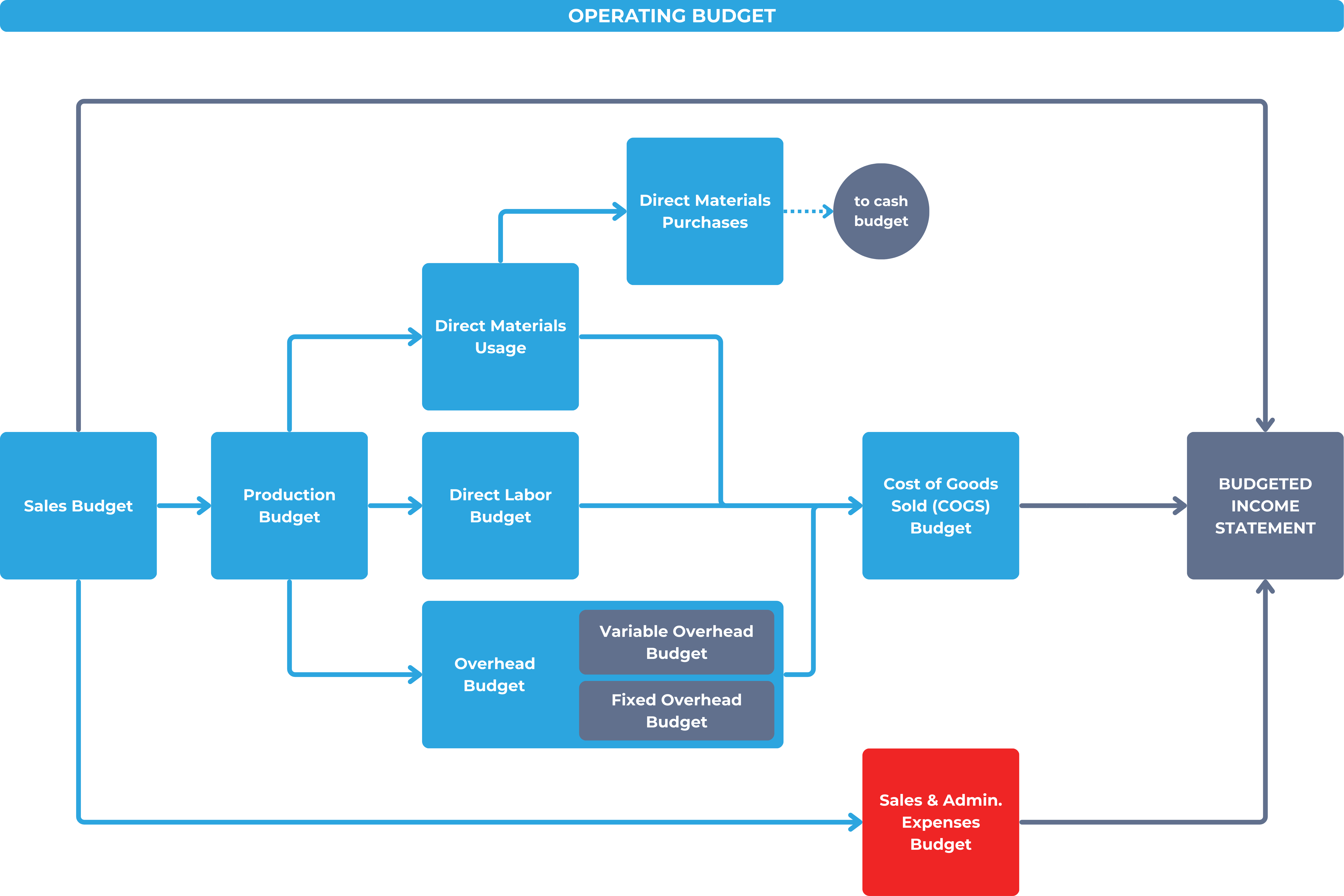
The selling and administrative (S&A) expense budget forecasts all non-production-related expenses that are expected to be incurred during the budget period. These expenses encompass all costs associated with marketing, distribution, and general administration, which are essential to support sales and operational activities. A thorough understanding of these components helps determine their impact on overall profitability, particularly the contribution margin.

Operating budget - sales and admin expenses budget component

Typical categories of selling and administrative expenses

Selling and administrative expenses often fall into specific categories based on their purpose and nature, aiding in clearer budget organization and analysis. Each expense is classified as fixed or variable depending on whether it has a specific cost driver or varies with sales volume or activity levels.

Selling expenses

Selling expenses are those directly related to the promotion, distribution, and sales of products. Common categories include:

  • Sales commissions: Payments to sales personnel based on units sold, often a variable expense.
  • Advertising and marketing: Costs for promotions and campaigns, which may vary depending on planned marketing activities.
  • Shipping and delivery: Costs to deliver products to customers, typically a variable expense driven by sales volume.
  • Customer service: Costs related to handling inquiries and resolving customer issues, which can be variable or fixed based on volume.

Administrative expenses

Administrative expenses support the organization’s general operations and are typically broader in scope. Categories often include:

  • Salaries of administrative staff: Salaries for management, HR, and support staff, often fixed within the relevant range.
  • Office supplies: Materials and supplies required for daily operations, often variable depending on usage.
  • Rent and utilities: Costs for office space and basic utilities, generally fixed but can vary if operations expand.
  • Professional fees: Costs for legal, consulting, and audit services, which may be either fixed or vary with specific projects.

Impact of the S&A budget on contribution margin (CM) analysis

The selling and administrative (S&A) budget plays a crucial role in refining the contribution margin analysis by including variable costs directly tied to sales activities. When variable S&A expenses are factored in, the contribution margin per unit becomes a more accurate reflection of profitability by deducting all variable expenses associated with production and sales.

By including variable S&A expenses in contribution margin calculations, companies can gain a clearer view of its profitability, considering both production and non-production-driven variable costs. This adjusted contribution margin aids in setting more precise performance targets, managing profitability expectations, and planning for desired profit levels after covering both variable and fixed costs.

The S&A budget is typically divided into two primary components:

  1. Variable selling and administrative costs: These expenses vary directly with the volume of units sold.
  2. Fixed selling and administrative costs: These costs remain constant within the relevant range, irrespective of sales volume.

For GreenLine Furniture, the budgeted variable and fixed expenses for Q4 are as follows. In this example, variable costs like sales commissions, shipping, and office supplies depend on the projected sales volume of 5,000 units for Q4. Fixed costs, such as marketing, administrative salaries, and other admin expenses, remain constant each month within Q4.

Expense type Cost classification Budgeted amount (per month) Total Q4 cost Variable cost per unit
Sales commissions Variable $5 per unit $25,000 $5
Shipping expenses Variable $3 per unit $15,000 $3
Marketing expense Fixed $6,000 $18,000 -
Administrative salaries Fixed $8,000 $24,000 -
Office supplies Variable $1 per unit $5,000 $1
Other admin expenses Fixed $2,000 $6,000 1

Calculating the total variable S&A cost per unit

The variable costs that we include in the Contribution Margin analysis is increased by the amount of variable S&A costs. For the example of GreenLine Furnitures we have the following:

Expense type Variable cost per unit
Sales commissions $5
Shipping expense $3
Office supplies $1
Total variable S&A cost per unit $9

Revised per unit CM

The CM per unit originally computed is reduced by the amount of variable S&A costs. For the example of GreenLine Furnitures we have the following:

Description Amount
Original contribution margin $156.50
Total variable S&A cost per unit ($9.00)
Revised contribution margin $147.50

Total CM for Q4

The total contribution margin is recomputed following the additional data on the variable S&A costs. For the example of GreenLine Furnitures we have the following:

Description Amount
Revised contribution margin $147.50
Total budgeted units to be sold in Q4 5,000 units
Revised total contribution margin for Q4 $737,500

This adjusted total contribution margin of $737,500 reflects GreenLine’s profitability after accounting for all variable expenses related to production and sales. The adjusted contribution margin serves as a more realistic measure of profitability for Q4 after including variable S&A expenses.

Selling and administrative (S&A) expense budget

  • Forecasts all non-production-related expenses
  • Includes marketing, distribution, and general administration costs
  • Essential for supporting sales and operations

Typical categories of selling and administrative expenses

  • Classified as fixed or variable
  • Selling expenses:
    • Sales commissions (variable)
    • Advertising/marketing (variable or fixed)
    • Shipping/delivery (variable)
    • Customer service (variable or fixed)
  • Administrative expenses:
    • Administrative staff salaries (fixed)
    • Office supplies (variable)
    • Rent and utilities (fixed)
    • Professional fees (fixed or variable)

Impact of S&A budget on contribution margin (CM) analysis

  • Variable S&A costs reduce contribution margin per unit
  • Contribution margin = Sales price - (Variable production costs + Variable S&A costs)
  • Fixed S&A costs do not affect per-unit CM, but impact overall profitability

Variable vs. fixed S&A costs

  • Variable S&A: Change with sales volume (e.g., commissions, shipping, office supplies)
  • Fixed S&A: Remain constant within relevant range (e.g., marketing, admin salaries, rent)

Calculating variable S&A cost per unit (GreenLine example)

  • Sales commissions: $5 per unit
  • Shipping: $3 per unit
  • Office supplies: $1 per unit
  • Total variable S&A per unit: $9

Revised contribution margin calculations (GreenLine example)

  • Original CM per unit: $156.50
  • Less variable S&A per unit: $9.00
  • Revised CM per unit: $147.50
  • Revised total CM for Q4 (5,000 units): $737,500

Key takeaways

  • Including variable S&A costs gives a more accurate contribution margin
  • Adjusted CM better reflects true profitability after all variable costs

Sign up for free to take 5 quiz questions on this topic

Previous
Next  | 2.5.1.10 Operational budget
All rights reserved ©2016 - 2026 Achievable, Inc.

Selling and administrative expense budget

Learning outcome statements

The learning outcome statements relevant for this section are:

  1. identify the components of a selling and administrative expense budget
  2. explain how specific components of the selling and administrative expense budget may affect the contribution margin

The selling and administrative (S&A) expense budget forecasts all non-production-related expenses that are expected to be incurred during the budget period. These expenses encompass all costs associated with marketing, distribution, and general administration, which are essential to support sales and operational activities. A thorough understanding of these components helps determine their impact on overall profitability, particularly the contribution margin.

Typical categories of selling and administrative expenses

Selling and administrative expenses often fall into specific categories based on their purpose and nature, aiding in clearer budget organization and analysis. Each expense is classified as fixed or variable depending on whether it has a specific cost driver or varies with sales volume or activity levels.

Selling expenses

Selling expenses are those directly related to the promotion, distribution, and sales of products. Common categories include:

  • Sales commissions: Payments to sales personnel based on units sold, often a variable expense.
  • Advertising and marketing: Costs for promotions and campaigns, which may vary depending on planned marketing activities.
  • Shipping and delivery: Costs to deliver products to customers, typically a variable expense driven by sales volume.
  • Customer service: Costs related to handling inquiries and resolving customer issues, which can be variable or fixed based on volume.

Administrative expenses

Administrative expenses support the organization’s general operations and are typically broader in scope. Categories often include:

  • Salaries of administrative staff: Salaries for management, HR, and support staff, often fixed within the relevant range.
  • Office supplies: Materials and supplies required for daily operations, often variable depending on usage.
  • Rent and utilities: Costs for office space and basic utilities, generally fixed but can vary if operations expand.
  • Professional fees: Costs for legal, consulting, and audit services, which may be either fixed or vary with specific projects.

Impact of the S&A budget on contribution margin (CM) analysis

The selling and administrative (S&A) budget plays a crucial role in refining the contribution margin analysis by including variable costs directly tied to sales activities. When variable S&A expenses are factored in, the contribution margin per unit becomes a more accurate reflection of profitability by deducting all variable expenses associated with production and sales.

By including variable S&A expenses in contribution margin calculations, companies can gain a clearer view of its profitability, considering both production and non-production-driven variable costs. This adjusted contribution margin aids in setting more precise performance targets, managing profitability expectations, and planning for desired profit levels after covering both variable and fixed costs.

The S&A budget is typically divided into two primary components:

  1. Variable selling and administrative costs: These expenses vary directly with the volume of units sold.
  2. Fixed selling and administrative costs: These costs remain constant within the relevant range, irrespective of sales volume.

For GreenLine Furniture, the budgeted variable and fixed expenses for Q4 are as follows. In this example, variable costs like sales commissions, shipping, and office supplies depend on the projected sales volume of 5,000 units for Q4. Fixed costs, such as marketing, administrative salaries, and other admin expenses, remain constant each month within Q4.

Expense type Cost classification Budgeted amount (per month) Total Q4 cost Variable cost per unit
Sales commissions Variable $5 per unit $25,000 $5
Shipping expenses Variable $3 per unit $15,000 $3
Marketing expense Fixed $6,000 $18,000 -
Administrative salaries Fixed $8,000 $24,000 -
Office supplies Variable $1 per unit $5,000 $1
Other admin expenses Fixed $2,000 $6,000 1

Calculating the total variable S&A cost per unit

The variable costs that we include in the Contribution Margin analysis is increased by the amount of variable S&A costs. For the example of GreenLine Furnitures we have the following:

Expense type Variable cost per unit
Sales commissions $5
Shipping expense $3
Office supplies $1
Total variable S&A cost per unit $9

Revised per unit CM

The CM per unit originally computed is reduced by the amount of variable S&A costs. For the example of GreenLine Furnitures we have the following:

Description Amount
Original contribution margin $156.50
Total variable S&A cost per unit ($9.00)
Revised contribution margin $147.50

Total CM for Q4

The total contribution margin is recomputed following the additional data on the variable S&A costs. For the example of GreenLine Furnitures we have the following:

Description Amount
Revised contribution margin $147.50
Total budgeted units to be sold in Q4 5,000 units
Revised total contribution margin for Q4 $737,500

This adjusted total contribution margin of $737,500 reflects GreenLine’s profitability after accounting for all variable expenses related to production and sales. The adjusted contribution margin serves as a more realistic measure of profitability for Q4 after including variable S&A expenses.

Key points

Selling and administrative (S&A) expense budget

  • Forecasts all non-production-related expenses
  • Includes marketing, distribution, and general administration costs
  • Essential for supporting sales and operations

Typical categories of selling and administrative expenses

  • Classified as fixed or variable
  • Selling expenses:
    • Sales commissions (variable)
    • Advertising/marketing (variable or fixed)
    • Shipping/delivery (variable)
    • Customer service (variable or fixed)
  • Administrative expenses:
    • Administrative staff salaries (fixed)
    • Office supplies (variable)
    • Rent and utilities (fixed)
    • Professional fees (fixed or variable)

Impact of S&A budget on contribution margin (CM) analysis

  • Variable S&A costs reduce contribution margin per unit
  • Contribution margin = Sales price - (Variable production costs + Variable S&A costs)
  • Fixed S&A costs do not affect per-unit CM, but impact overall profitability

Variable vs. fixed S&A costs

  • Variable S&A: Change with sales volume (e.g., commissions, shipping, office supplies)
  • Fixed S&A: Remain constant within relevant range (e.g., marketing, admin salaries, rent)

Calculating variable S&A cost per unit (GreenLine example)

  • Sales commissions: $5 per unit
  • Shipping: $3 per unit
  • Office supplies: $1 per unit
  • Total variable S&A per unit: $9

Revised contribution margin calculations (GreenLine example)

  • Original CM per unit: $156.50
  • Less variable S&A per unit: $9.00
  • Revised CM per unit: $147.50
  • Revised total CM for Q4 (5,000 units): $737,500

Key takeaways

  • Including variable S&A costs gives a more accurate contribution margin
  • Adjusted CM better reflects true profitability after all variable costs

More from Operational budgets

  • Introduction
  • Sales budget
  • Production budget
  • Direct materials budget
  • Direct labor budget