


Achievable logoAchievable logo
ASVAB
Sign in
Sign up
Purchase
Textbook
Practice exams
Support
How it works
Exam catalog
Mountain with a flag at the peak
Textbook
Introduction
1. Word Knowledge
2. Math Knowledge
3. Paragraph Comprehension
4. Arithmetic Reasoning
5. Shop Information
5.1 Measuring Tools
5.2 Striking Tools
5.3 Turning Tools
5.4 Cutting Tools
5.5 Finishing Tools
5.6 Other Tools
6. Auto Information
Wrapping up
Achievable logoAchievable logo
5.1 Measuring Tools
Achievable ASVAB
5. Shop Information
Our ASVAB course is currently in development and is a work-in-progress.

Measuring Tools

5 min read
Font
Discuss
Share
Feedback

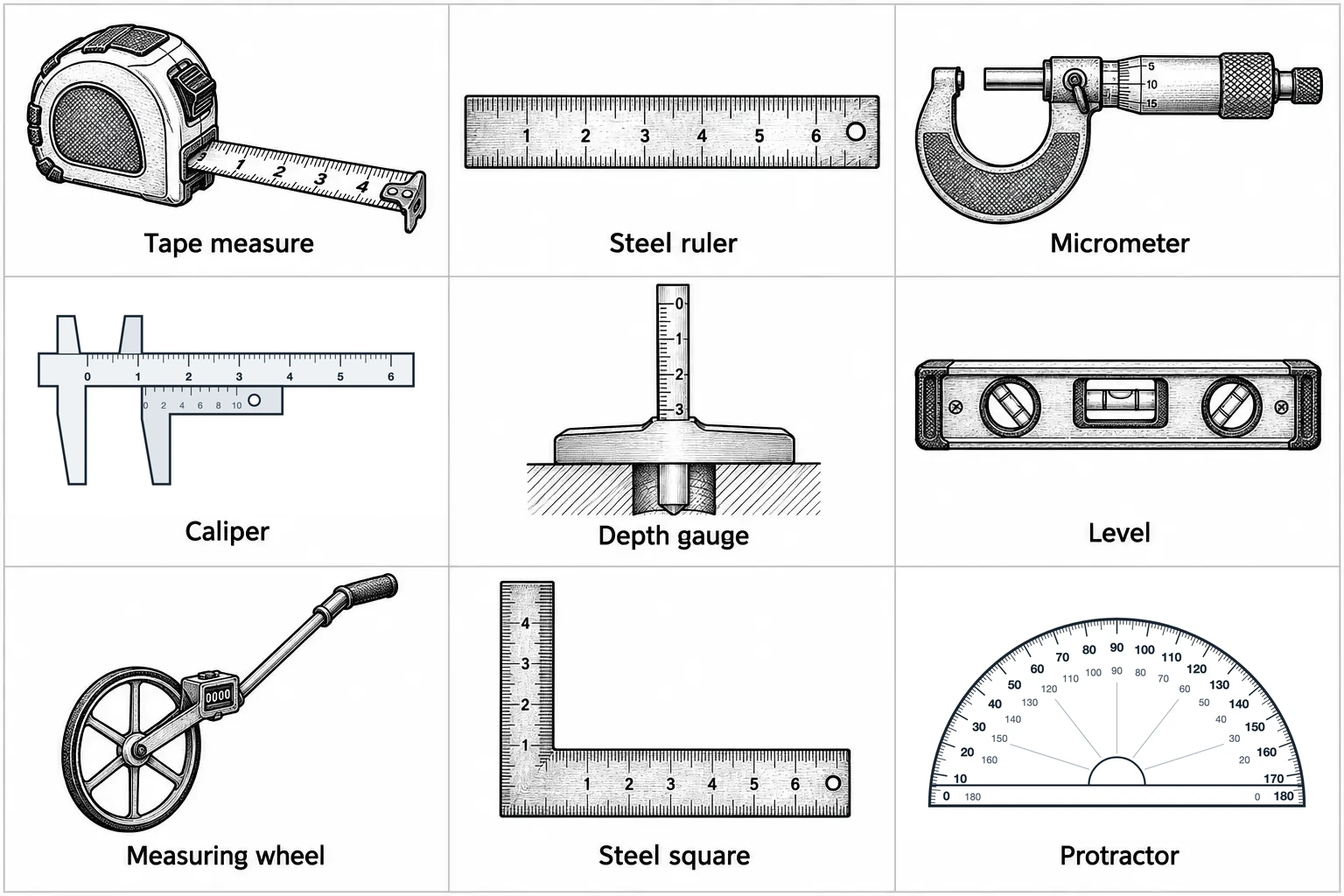
Shop is all about picking the right tool for the job. In this section, we will learn about different types of classifications of tools, and how they are used in the real world and the military.

Measuring and layout tools

These tools help you take accurate measurements and check angles before cutting, assembling, or installing parts.

Tape measure

Used for: Measuring lengths and distances. It is especially useful when a flexible measuring tool is needed such as measuring wire runs or equipment clearances. It is also useful for measuring large distances.

Tape measure extending from the case
Tape measure

Steel ruler

Used for: Measuring short, rigid materials with precision. Its straight edge also serves as a guide for marking and making straight cuts.

Straight steel ruler with measurement markings
Steel ruler

Micrometer

Used for: Measuring the thickness or diameter of small parts with very high precision, such as sheet metal, wire, or bolts.

Micrometer with rotating thimble
Micrometer

Caliper

Used for: Measuring outside and inside diameters of cylindrical objects such as pipes. It also measures the thickness of materials or components such as sheet metal.

Caliper with open measuring jaws
Caliper

Depth gauge

Used for: Measuring the depth of holes, slots, and recesses. Similar gauges are also used for setting spark plug gaps and checking tire tread depth.

Depth gauge with extended measuring rod
Depth gauge

Level

Used for: Determining whether a surface is level or plumb. Commonly used when setting posts, installing equipment, or ensuring proper drainage.

Bubble level with center vial
Level

Measuring wheel

Used for: Measuring long distances quickly, such as runways, roads, utility lines, or property boundaries.

Measuring wheel with long handle
Measuring wheel

Steel square

Used for: Marking and checking 90° angles to ensure accurate layouts, cuts, and assembly of materials.

Steel square with right-angle shape
Steel square

Protractor

Used for: Measuring and marking angles other than 90°, such as for map reading, machining, or cutting materials to a specific angle.

Protractor with curved degree markings
Protractor
Previous
Next  | 5.2 Striking Tools
All rights reserved ©2016 - 2026 Achievable, Inc.

Measuring Tools

Shop is all about picking the right tool for the job. In this section, we will learn about different types of classifications of tools, and how they are used in the real world and the military.

Measuring and layout tools

These tools help you take accurate measurements and check angles before cutting, assembling, or installing parts.

Tape measure

Used for: Measuring lengths and distances. It is especially useful when a flexible measuring tool is needed such as measuring wire runs or equipment clearances. It is also useful for measuring large distances.

Steel ruler

Used for: Measuring short, rigid materials with precision. Its straight edge also serves as a guide for marking and making straight cuts.

Micrometer

Used for: Measuring the thickness or diameter of small parts with very high precision, such as sheet metal, wire, or bolts.

Caliper

Used for: Measuring outside and inside diameters of cylindrical objects such as pipes. It also measures the thickness of materials or components such as sheet metal.

Depth gauge

Used for: Measuring the depth of holes, slots, and recesses. Similar gauges are also used for setting spark plug gaps and checking tire tread depth.

Level

Used for: Determining whether a surface is level or plumb. Commonly used when setting posts, installing equipment, or ensuring proper drainage.

Measuring wheel

Used for: Measuring long distances quickly, such as runways, roads, utility lines, or property boundaries.

Steel square

Used for: Marking and checking 90° angles to ensure accurate layouts, cuts, and assembly of materials.

Protractor

Used for: Measuring and marking angles other than 90°, such as for map reading, machining, or cutting materials to a specific angle.

More from Shop Information

  • Striking Tools
  • Turning Tools
  • Cutting Tools
  • Finishing Tools
  • Other Tools