


Achievable logoAchievable logo
ASVAB
Sign in
Sign up
Purchase
Textbook
Practice exams
Support
How it works
Exam catalog
Mountain with a flag at the peak
Textbook
Introduction
1. Word Knowledge
2. Math Knowledge
3. Paragraph Comprehension
4. Arithmetic Reasoning
5. Shop Information
6. Auto Information
Wrapping up
Achievable logoAchievable logo
4. Arithmetic Reasoning
Achievable ASVAB
Our ASVAB course is currently in development and is a work-in-progress.

Arithmetic Reasoning

9 min read
Font
Discuss
Share
Feedback

The arithmetic reasoning section of the ASVAB focuses on word problems. These questions test how well you can take a real-world situation and turn it into math you can solve.

At first, these can feel tricky. But with a clear strategy and careful reading, they become much more manageable.

If you’re already comfortable with topics like money, time, and percentages, you’re starting from a strong place. If not, that’s okay! This step-by-step approach will guide you and help you achieve success.

Word problem strategy

Use these steps:

1. Read carefully and recognize what the problem is really asking
2. Identify your given information
3. Draw it out!
4. Write the equation (if needed)
5. Solve

Let’s break down these steps even more.

Read carefully and identify what the problem is asking

It may seem obvious, but reading and understanding the question is the most important step in the Arithmetic Reasoning section. Take your time and read carefully without making assumptions.

The test will often word questions in a way that can be confusing or misleading. Sometimes it may seem like they’re asking for one thing, when they’re actually asking for something else. Always double-check what the question is really asking before you start solving.

Example:

A recipe uses a ratio of 4 cups of flour for every 3 cups of sugar. If a baker uses 16 cups of flour, how much more flour than sugar did they use?

A. 4 cups
B. 6 cups
C. 9 cups
D. 12 cups

Someone who didn’t read this question closely might assume the question is asking for the total cups of sugar used. If that were the case, they might pick D, 12 cups.

But that’s not what the question is asking.

The question is asking for the difference between flour and sugar.

So first, we need to find how much sugar was used.

The ratio is:

34​

This means:

  • 4 cups of flour for every 3 cups of sugar

We are told the baker used 16 cups of flour, so we set up a proportion:

34​​=x16​​

Here:

  • 16 is the flour used
  • x is the unknown amount of sugar

Now solve by cross multiplying:

4x4x​=3∗16=48​

Now divide both sides by 4:

x​=12​

So, the baker used 12 cups of sugar.

Now we know:

  • Flour = 16 cups
  • Sugar = 12 cups

The question asks for the difference, so subtract:

16−12=4

Answer: A

Identify your given information

No word problem exists in a vacuum. Every problem gives you some information and expects you to find what’s missing.

Your job is to identify what you know and what you’re trying to find, even if it’s not immediately obvious. Start by pulling out the given values and relationships before trying to solve.

Example:

A teacher gives group lessons that last 1 hour and private lessons that are half as long. She teaches 4 group lessons and 3 private lessons. How many hours does she teach?

A. 4
B. 5.5
C. 7
D. 8.5

Let’s break this down carefully.

  • Group lessons: 1 hour each, 4 lessons

1×4=4

  • Private lessons: half as long → 0.5 hours each, 3 lessons

0.5×3=1.5

Now add both parts:

4+1.5=5.5

Answer: B

Draw it out

Not every problem requires a diagram, but drawing or writing things out is a smart move when you feel stuck or unsure.

A quick sketch helps you keep track of multiple pieces of information and makes relationships easier to see. This is especially helpful for spatial or geometry problems.

The less you try to hold in your head, the fewer mistakes you’ll make. Let’s look at an example where drawing it out helps:

Example:

Kenny has a concrete patio that is 4 meters wide and 6 meters long. He wants to expand the patio by adding an additional 1 meter of concrete to each of the four sides. What is the new area of the patio?

A. 24m2
B. 35m2
C. 48m2
D. 72m2

If you don’t draw this out, it’s very easy to make a mistake.

A common error is to just add 1 to each dimension and say the new patio is 5 by 7:

5×7=35

This is incorrect.

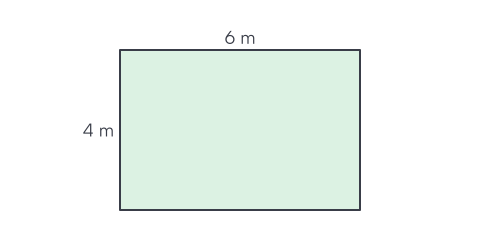
Let’s look at the original patio:

A rectangular patio with its original dimensions labeled
Original patio diagram
Achievable
Image not to scale

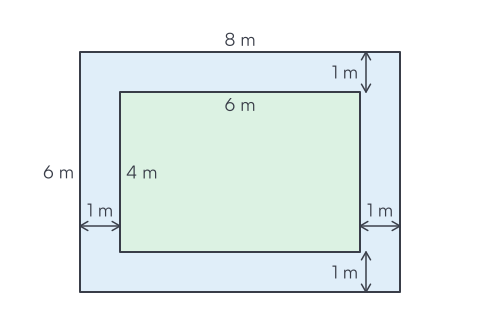
Now, Kenny is adding 1 meter to each side.

That means:

  • The width increases by 2 total (left + right)
  • The length increases by 2 total (top + bottom)

So the new dimensions are:

6×8

A patio with a new section added and updated dimensions labeled
Patio with addition
Achievable
Image not to scale

Now find the area:

6×8=48

The new area is 48m2.

Answer: C

Write the equation (if needed)

Once you understand what the question is asking and have identified your given information, the next step is to turn the words into math by writing an equation.

Not every problem requires a complex equation, but using algebra can help organize your thinking and make it easier to solve for the unknown.

Example:

On Monday, Savannah read the first three chapters of her book. Each chapter was one page longer than the one before it. If she read a total of 78 pages, how many pages were in the first chapter?

A. 25 pages
B. 30 pages
C. 35 pages
D. 40 pages

This problem involves consecutive values, since each chapter is one page longer than the previous one.

Let the first chapter be x.

Then:

  • Second chapter = x+1
  • Third chapter = x+2

We know all three add up to 78, so write the equation:

x+(x+1)+(x+2)=78

Now combine like terms and solve:

3x+33xx​=78=75=25​

Before finishing, double-check what the question is asking.

We are looking for the number of pages in the first chapter, and that is what x represents.

So the first chapter is 25 pages.

Answer: A

Solve

You’ve read the problem, identified the information, drawn it out, and (if needed) written an equation. Now it’s time to solve.

This is the final step—carry out the math and make sure your answer matches what the question is asking.

Example:

A 32 inch party sub is divided in half, and then each half is divided into fourths to make several equal portions. If Annabelle eats two portions of the sandwich, how many inches of sandwich did she eat?

A. 4 inches
B. 8 inches
C. 12 inches
D. 16 inches

Let’s walk through this step by step.

Step 1: Read carefully. We’re being asked for the length of two pieces, not just one.

Step 2: Identify the given information.

  • Total length = 32 inches
  • Cut in half
  • Then each half is cut into 4 equal pieces

Step 3: Draw it out (physically or mentally).

First, cut the sandwich in half:

232​=16

Now divide each half into 4 pieces:

416​=4

Each piece is 4 inches long.

Step 4: Write the equation. Annabelle eats 2 pieces:

4×2

Step 5: Solve.

4×2=8

Answer: B

Other arithmetic reasoning skills

Now that we’ve gone through strategies for solving Arithmetic Reasoning questions, let’s look at some of the math concepts you might see on this section.

Conversions
Sometimes you’ll need to convert units to get your final answer. Here are some common conversions you should memorize for the ASVAB (and that are useful in general):

1 minute = 60 seconds
1 hour = 60 minutes
1 foot = 12 inches
1 yard = 3 feet

Statistics and probability

The goal of probability is to find the likelihood of an event happening out of all possible outcomes.

possibilitiesevent​

Probabilities are always between 0 and 1.

  • A probability of 0 means an outcome is impossible
  • A probability of 1 means an outcome is guaranteed

We can also think of probability as a percentage:

  • 0 → 0%
  • 1 → 100%
  • 21​ or 0.5 → 50%

Let’s look at an example:

Example:

There are 6 red marbles and 4 blue marbles in a bag. What is the probability of pulling a blue marble?

Step 1: Find all possible outcomes. There are 10 total marbles:

6+4=10

This will be our denominator:

10event​

Step 2: Find how many times the event can occur. We want a blue marble, and there are 4 blue marbles:

104​

Step 3: Simplify the fraction.

104​=52​

Step 4: Convert to a decimal (if needed). If you want a decimal, you can use 104​ since it’s easier to convert:

0.4

Knowledge check

A recipe uses a ratio of 3 cups of water for every 2 cups of juice. A large batch uses 18 cups of water.

If the mixture is then poured equally into 5 containers, how many cups are in each container?

A. 4
B. 6
C. 9
D. 10

(spoiler)

Answer: B. 6

Sign up for free to take 5 quiz questions on this topic

Previous
Next  | 5.1 Measuring Tools
All rights reserved ©2016 - 2026 Achievable, Inc.

Arithmetic Reasoning

The arithmetic reasoning section of the ASVAB focuses on word problems. These questions test how well you can take a real-world situation and turn it into math you can solve.

At first, these can feel tricky. But with a clear strategy and careful reading, they become much more manageable.

If you’re already comfortable with topics like money, time, and percentages, you’re starting from a strong place. If not, that’s okay! This step-by-step approach will guide you and help you achieve success.

Word problem strategy

Use these steps:

1. Read carefully and recognize what the problem is really asking
2. Identify your given information
3. Draw it out!
4. Write the equation (if needed)
5. Solve

Let’s break down these steps even more.

Read carefully and identify what the problem is asking

It may seem obvious, but reading and understanding the question is the most important step in the Arithmetic Reasoning section. Take your time and read carefully without making assumptions.

The test will often word questions in a way that can be confusing or misleading. Sometimes it may seem like they’re asking for one thing, when they’re actually asking for something else. Always double-check what the question is really asking before you start solving.

Example:

A recipe uses a ratio of 4 cups of flour for every 3 cups of sugar. If a baker uses 16 cups of flour, how much more flour than sugar did they use?

A. 4 cups
B. 6 cups
C. 9 cups
D. 12 cups

Someone who didn’t read this question closely might assume the question is asking for the total cups of sugar used. If that were the case, they might pick D, 12 cups.

But that’s not what the question is asking.

The question is asking for the difference between flour and sugar.

So first, we need to find how much sugar was used.

The ratio is:

34​

This means:

  • 4 cups of flour for every 3 cups of sugar

We are told the baker used 16 cups of flour, so we set up a proportion:

34​​=x16​​

Here:

  • 16 is the flour used
  • x is the unknown amount of sugar

Now solve by cross multiplying:

4x4x​=3∗16=48​

Now divide both sides by 4:

x​=12​

So, the baker used 12 cups of sugar.

Now we know:

  • Flour = 16 cups
  • Sugar = 12 cups

The question asks for the difference, so subtract:

16−12=4

Answer: A

Identify your given information

No word problem exists in a vacuum. Every problem gives you some information and expects you to find what’s missing.

Your job is to identify what you know and what you’re trying to find, even if it’s not immediately obvious. Start by pulling out the given values and relationships before trying to solve.

Example:

A teacher gives group lessons that last 1 hour and private lessons that are half as long. She teaches 4 group lessons and 3 private lessons. How many hours does she teach?

A. 4
B. 5.5
C. 7
D. 8.5

Let’s break this down carefully.

  • Group lessons: 1 hour each, 4 lessons

1×4=4

  • Private lessons: half as long → 0.5 hours each, 3 lessons

0.5×3=1.5

Now add both parts:

4+1.5=5.5

Answer: B

Draw it out

Not every problem requires a diagram, but drawing or writing things out is a smart move when you feel stuck or unsure.

A quick sketch helps you keep track of multiple pieces of information and makes relationships easier to see. This is especially helpful for spatial or geometry problems.

The less you try to hold in your head, the fewer mistakes you’ll make. Let’s look at an example where drawing it out helps:

Example:

Kenny has a concrete patio that is 4 meters wide and 6 meters long. He wants to expand the patio by adding an additional 1 meter of concrete to each of the four sides. What is the new area of the patio?

A. 24m2
B. 35m2
C. 48m2
D. 72m2

If you don’t draw this out, it’s very easy to make a mistake.

A common error is to just add 1 to each dimension and say the new patio is 5 by 7:

5×7=35

This is incorrect.

Let’s look at the original patio:

Image not to scale

Now, Kenny is adding 1 meter to each side.

That means:

  • The width increases by 2 total (left + right)
  • The length increases by 2 total (top + bottom)

So the new dimensions are:

6×8

Image not to scale

Now find the area:

6×8=48

The new area is 48m2.

Answer: C

Write the equation (if needed)

Once you understand what the question is asking and have identified your given information, the next step is to turn the words into math by writing an equation.

Not every problem requires a complex equation, but using algebra can help organize your thinking and make it easier to solve for the unknown.

Example:

On Monday, Savannah read the first three chapters of her book. Each chapter was one page longer than the one before it. If she read a total of 78 pages, how many pages were in the first chapter?

A. 25 pages
B. 30 pages
C. 35 pages
D. 40 pages

This problem involves consecutive values, since each chapter is one page longer than the previous one.

Let the first chapter be x.

Then:

  • Second chapter = x+1
  • Third chapter = x+2

We know all three add up to 78, so write the equation:

x+(x+1)+(x+2)=78

Now combine like terms and solve:

3x+33xx​=78=75=25​

Before finishing, double-check what the question is asking.

We are looking for the number of pages in the first chapter, and that is what x represents.

So the first chapter is 25 pages.

Answer: A

Solve

You’ve read the problem, identified the information, drawn it out, and (if needed) written an equation. Now it’s time to solve.

This is the final step—carry out the math and make sure your answer matches what the question is asking.

Example:

A 32 inch party sub is divided in half, and then each half is divided into fourths to make several equal portions. If Annabelle eats two portions of the sandwich, how many inches of sandwich did she eat?

A. 4 inches
B. 8 inches
C. 12 inches
D. 16 inches

Let’s walk through this step by step.

Step 1: Read carefully. We’re being asked for the length of two pieces, not just one.

Step 2: Identify the given information.

  • Total length = 32 inches
  • Cut in half
  • Then each half is cut into 4 equal pieces

Step 3: Draw it out (physically or mentally).

First, cut the sandwich in half:

232​=16

Now divide each half into 4 pieces:

416​=4

Each piece is 4 inches long.

Step 4: Write the equation. Annabelle eats 2 pieces:

4×2

Step 5: Solve.

4×2=8

Answer: B

Other arithmetic reasoning skills

Now that we’ve gone through strategies for solving Arithmetic Reasoning questions, let’s look at some of the math concepts you might see on this section.

Conversions
Sometimes you’ll need to convert units to get your final answer. Here are some common conversions you should memorize for the ASVAB (and that are useful in general):

1 minute = 60 seconds
1 hour = 60 minutes
1 foot = 12 inches
1 yard = 3 feet

Statistics and probability

The goal of probability is to find the likelihood of an event happening out of all possible outcomes.

possibilitiesevent​

Probabilities are always between 0 and 1.

  • A probability of 0 means an outcome is impossible
  • A probability of 1 means an outcome is guaranteed

We can also think of probability as a percentage:

  • 0 → 0%
  • 1 → 100%
  • 21​ or 0.5 → 50%

Let’s look at an example:

Example:

There are 6 red marbles and 4 blue marbles in a bag. What is the probability of pulling a blue marble?

Step 1: Find all possible outcomes. There are 10 total marbles:

6+4=10

This will be our denominator:

10event​

Step 2: Find how many times the event can occur. We want a blue marble, and there are 4 blue marbles:

104​

Step 3: Simplify the fraction.

104​=52​

Step 4: Convert to a decimal (if needed). If you want a decimal, you can use 104​ since it’s easier to convert:

0.4

Knowledge check

A recipe uses a ratio of 3 cups of water for every 2 cups of juice. A large batch uses 18 cups of water.

If the mixture is then poured equally into 5 containers, how many cups are in each container?

A. 4
B. 6
C. 9
D. 10

(spoiler)

Answer: B. 6

Related readings

  • Introduction
  • Paragraph Comprehension
  • Wrapping up