


This browser is too old to run Achievable.

Update it, or open this page in a current version of Chrome, Safari, Firefox or Edge. On an iPhone or iPad, update iOS: every browser there runs on the version of Safari that comes with it.

Achievable logoAchievable logo
ASVAB
Sign in
Sign up
Purchase
Textbook
Practice exams
Support
How it works
Resources
Exam catalog
Mountain with a flag at the peak
Textbook
Introduction
1. Word Knowledge
2. Mathematics Knowledge
3. Paragraph Comprehension
4. Arithmetic Reasoning
5. General Science
5.1 Life Science
5.2 Chemistry
5.3 Environmental Science
6. Mechanical Comprehension
7. Electronics Information
8. Shop Information
9. Auto Information
10. Assembling Objects
Wrapping up
Achievable logoAchievable logo
5.1 Life Science
Achievable ASVAB
5. General Science
Our ASVAB course is currently in development and is a work-in-progress.

Life Science

7 min read
Font
Discuss
Share
Feedback

Biology

Biology is the study of living things, including plants, animals, and single-celled organisms. In this section, we’ll explore the basic building blocks of life and how they function.

Life

Something that is living undergoes self-sustaining physical processes such as growth, homeostasis, and reproduction. Humans, other animals, plants, and bacteria are all examples of living organisms.

Cells

A cell is the smallest unit of life that can carry out biological functions. It is contained within a protective membrane. Single-celled organisms like bacteria are made of just one cell.

Multicellular organisms like plants and animals are made up of many cells, each of which has its own specialization.

The human body is made of approximately 30 trillion cells. We are our cells, and our cells are us, so it’s important to understand how they function.

Anatomy of a cell

Cells contain smaller components called organelles that have specialized purposes. There are more than 15 organelles within an animal cell, but here are some of the most important ones to know.

Nucleus: holds the genetic information (DNA) of the organism. It is the largest organelle.

Sidenote
Exceptions

Some specialized cells, such as red blood cells, do not contain a nucleus, but the vast majority of cells do.

Mitochondria: produce energy. Also called the “powerhouse” of the cell.

Ribosome: creates proteins.

Cell membrane: acts as a barrier that separates the cell from the surrounding environment.

Animal vs. plant cells

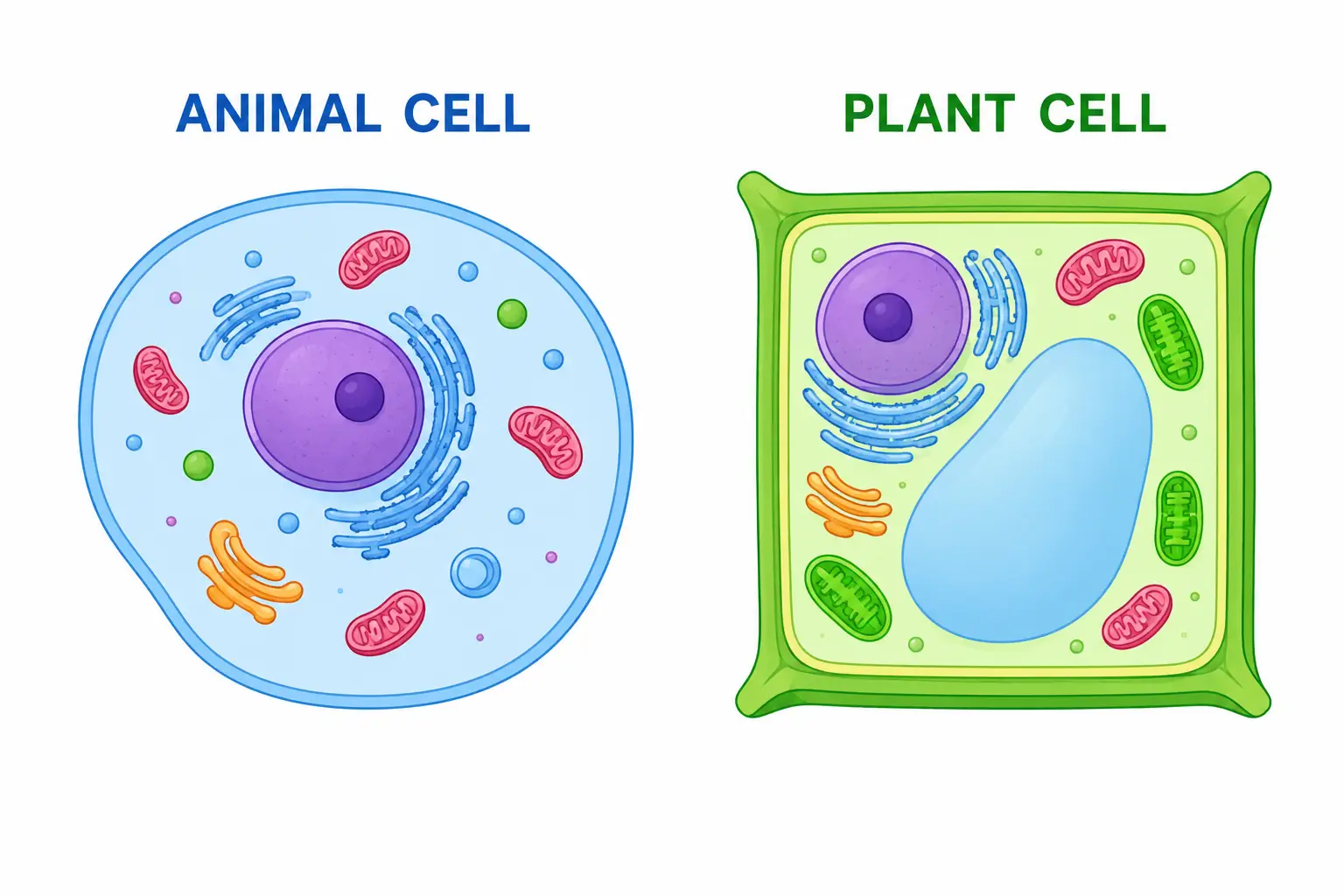
Comparison of animal and plant cell structures.
Animal vs Plant Cell
Achievable

Both animal and plant cells have a nucleus, mitochondria, ribosomes, and cell membranes, but plant cells also have a few additional organelles.

Cell wall: gives a plant cell a rigid structure.

Chloroplasts: allow a plant to photosynthesize (convert sunlight into energy).

Because animal cells lack a cell wall, they are more rounded and flexible than plant cells.

Genetics

Genetics is the study of gene expression, gene variation, and heredity in organisms.

DNA: the molecule that holds all of an organism’s genetic instructions

Genes: segments of DNA that produce traits. They are passed from organism to offspring during reproduction.

Heredity: how organisms pass down genes to their offspring.

Chromosomes

DNA is packaged into structures called chromosomes, which are arranged into 23 pairs. This means that most humans have 46 chromosomes total.

Sidenote
Chromosomal Disorders

Chromosomal disorders alter the amount of genetic material a person has by either reducing, gaining, or otherwise altering the genes.

The genetic disorder most people are familiar with is Down syndrome, which is caused by either having an extra copy of chromosome 21 or having extra material from chromosome 21.

Reproduction

Reproduction is the creation of offspring.

Some species use asexual reproduction, where one parent produces offspring that are genetically identical to itself (though mutations can occasionally introduce genetic differences).

Most species of plants and animals use sexual reproduction, where offspring are created with genetic information from two parents. This produces offspring with unique DNA, roughly half from each parent.

Sexual reproduction allows for more genetic diversity, which increases a species’ chance of survival. Asexual reproduction grows a population faster, as only one member of the species is needed to complete the process, and all members of the species can do it.

Mutations

When DNA is replicated (either from parent to offspring or within one organism), it is sometimes copied incorrectly. This is called a mutation and is a naturally occurring part of genetics and inheritance.

Most mutations are neutral: they neither help nor harm the organism that carries them.

Some mutations are harmful and can cause problems for the organism or even lead to death.

Occasionally, a mutation will be beneficial to the organism. When that happens, it is most likely to be passed to the next generation.

There are four main types of genetic mutations:

Substitution: one nucleotide is replaced with another
Deletion: one or more nucleotides are deleted
Insertion: one or more nucleotides are added
Frameshift: an insertion or deletion that shifts the reading frame, changing how the DNA is translated into proteins

Evolution

Evolution is the process by which a population’s inherited traits change over generations, often driven by natural selection acting on genetic mutations.

If a mutation is particularly beneficial for a population, the organism with the mutation is more likely to live and pass the mutation to their offspring. These offspring are then more likely to live and pass the mutation to their offspring as well. Over millions of years, the mutations that benefit the group the most end up shaping the population as a whole.

Sidenote
Survival of the Fittest

You may have heard the term “survival of the fittest” as a way to describe evolution. This means the mutations that best help an organism “fit” its environment are the ones that survive. “Fittest” means “fits best,” NOT “in best physical shape”.

Ecology and Natural Systems

Ecology is the study of how organisms interact with their environment. Within one environment, there will be many different types of living organisms, all with their own particular role in keeping that environment balanced.

Trophic Levels

Organisms are often grouped by the role they play in the food chain (also called a “food web” because it’s an interconnected system). The main categories that an organism can fit into are producers, consumers, and decomposers.

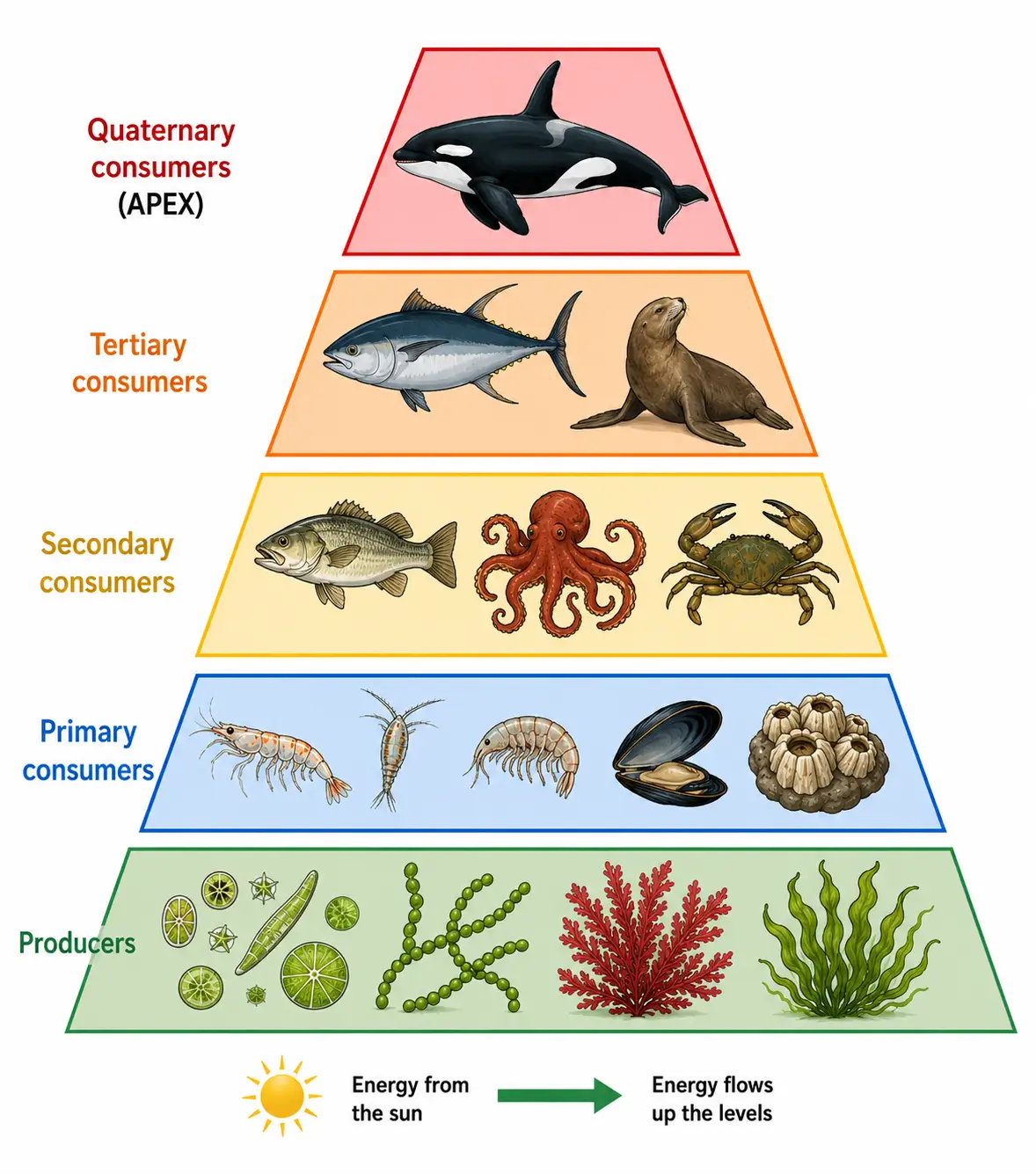
Trophic levels within a food chain.
Trophic Levels
Achievable

Level 1 - Primary Producers

At the first level are the producers. These are organisms that can produce their own food using nutrients from the earth and energy from the sun, such as plants and algae.

Level 2 - Primary Consumers

At the second level are the herbivores. These are organisms that cannot make their own food and primarily consume producers to survive. These include insects like butterflies and grasshoppers as well as mammals like rabbits, deer, and giraffes.

Level 3 - Secondary Consumers

The third level is for organisms that eat primary consumers. Many animals at this level are omnivorous (meaning they eat both plants and animals), so they often eat both primary producers and primary consumers. Secondary consumers include rats, foxes, snakes, owls, and coyotes.

Level 4 - Tertiary Consumers and Apex Predators

Tertiary consumers feed on secondary consumers (though, again, they may occasionally eat primary consumers or even primary producers as well). If the tertiary consumer has no natural predators, they are considered apex predators and sit at the “top” of the food chain. Tertiary consumers include hawks, lions, sharks, and tigers.

Decomposers

Decomposers act on every level of the food chain. All living organisms will eventually die, and decomposers break down dead organisms and organic waste back into nutrients. These nutrients go back into the soil to sustain the primary producers, which is how the food web continues to sustain itself. Decomposers include bacteria and fungi.

This system is also sometimes called a “food pyramid,” because each level must have fewer organisms than the one before it. For instance, a primary consumer population can not survive if they do not have enough plants to eat, and a tertiary consumer population will collapse if there are not enough secondary consumers for them to feed on.

Life and Cells

  • Living things self-sustain via growth, homeostasis, reproduction
  • Cell = smallest functional unit of life, enclosed by membrane; single-celled (bacteria) vs multicellular (plants, animals) organisms
  • Human body ≈ 30 trillion cells

Cell Organelles

  • Nucleus: stores DNA, largest organelle (exception: red blood cells lack one)
  • Mitochondria: energy production (“powerhouse”)
  • Ribosome: builds proteins
  • Cell membrane: separates cell from environment
  • Plant-only organelles: cell wall (rigid structure), chloroplasts (photosynthesis) — explains why plant cells are more rigid than animal cells

Genetics Basics

  • DNA holds genetic instructions; genes = DNA segments coding traits; heredity = passing genes to offspring
  • Chromosomes: DNA packaged into 23 pairs (46 total in humans)
    • Chromosomal disorders alter gene amount (e.g., Down syndrome = extra chromosome 21 material)

Reproduction

  • Asexual: one parent, genetically identical offspring, faster population growth
  • Sexual: two parents, genetically unique offspring, greater genetic diversity (better survival odds)

Mutations

  • Naturally occurring copying errors in DNA replication
  • Most are neutral; some harmful, rare ones beneficial (more likely passed on)
  • Four types: substitution, deletion, insertion, frameshift (shifts reading frame)

Evolution

  • Change in inherited traits across generations via natural selection acting on mutations
  • Beneficial mutations spread through populations over many generations
  • “Survival of the fittest” = best fit for environment, not physical fitness

Ecology & Trophic Levels (Food Web/Pyramid)

  • Level 1 Producers: make own food (plants, algae)
  • Level 2 Primary consumers: herbivores eating producers
  • Level 3 Secondary consumers: eat primary consumers, often omnivorous
  • Level 4 Tertiary consumers/apex predators: top of chain, no natural predators
  • Decomposers (bacteria, fungi): break down dead matter at all levels, recycle nutrients
  • Pyramid structure: each level must have fewer organisms than the one below to sustain itself

Sign up for free to take 5 quiz questions on this topic

Previous
Next  | 5.2 Chemistry
All rights reserved ©2016 - 2026 Achievable, Inc.

Life Science

Biology

Biology is the study of living things, including plants, animals, and single-celled organisms. In this section, we’ll explore the basic building blocks of life and how they function.

Life

Something that is living undergoes self-sustaining physical processes such as growth, homeostasis, and reproduction. Humans, other animals, plants, and bacteria are all examples of living organisms.

Cells

A cell is the smallest unit of life that can carry out biological functions. It is contained within a protective membrane. Single-celled organisms like bacteria are made of just one cell.

Multicellular organisms like plants and animals are made up of many cells, each of which has its own specialization.

The human body is made of approximately 30 trillion cells. We are our cells, and our cells are us, so it’s important to understand how they function.

Anatomy of a cell

Cells contain smaller components called organelles that have specialized purposes. There are more than 15 organelles within an animal cell, but here are some of the most important ones to know.

Nucleus: holds the genetic information (DNA) of the organism. It is the largest organelle.

Sidenote
Exceptions

Some specialized cells, such as red blood cells, do not contain a nucleus, but the vast majority of cells do.

Mitochondria: produce energy. Also called the “powerhouse” of the cell.

Ribosome: creates proteins.

Cell membrane: acts as a barrier that separates the cell from the surrounding environment.

Animal vs. plant cells

Both animal and plant cells have a nucleus, mitochondria, ribosomes, and cell membranes, but plant cells also have a few additional organelles.

Cell wall: gives a plant cell a rigid structure.

Chloroplasts: allow a plant to photosynthesize (convert sunlight into energy).

Because animal cells lack a cell wall, they are more rounded and flexible than plant cells.

Genetics

Genetics is the study of gene expression, gene variation, and heredity in organisms.

DNA: the molecule that holds all of an organism’s genetic instructions

Genes: segments of DNA that produce traits. They are passed from organism to offspring during reproduction.

Heredity: how organisms pass down genes to their offspring.

Chromosomes

DNA is packaged into structures called chromosomes, which are arranged into 23 pairs. This means that most humans have 46 chromosomes total.

Sidenote
Chromosomal Disorders

Chromosomal disorders alter the amount of genetic material a person has by either reducing, gaining, or otherwise altering the genes.

The genetic disorder most people are familiar with is Down syndrome, which is caused by either having an extra copy of chromosome 21 or having extra material from chromosome 21.

Reproduction

Reproduction is the creation of offspring.

Some species use asexual reproduction, where one parent produces offspring that are genetically identical to itself (though mutations can occasionally introduce genetic differences).

Most species of plants and animals use sexual reproduction, where offspring are created with genetic information from two parents. This produces offspring with unique DNA, roughly half from each parent.

Sexual reproduction allows for more genetic diversity, which increases a species’ chance of survival. Asexual reproduction grows a population faster, as only one member of the species is needed to complete the process, and all members of the species can do it.

Mutations

When DNA is replicated (either from parent to offspring or within one organism), it is sometimes copied incorrectly. This is called a mutation and is a naturally occurring part of genetics and inheritance.

Most mutations are neutral: they neither help nor harm the organism that carries them.

Some mutations are harmful and can cause problems for the organism or even lead to death.

Occasionally, a mutation will be beneficial to the organism. When that happens, it is most likely to be passed to the next generation.

There are four main types of genetic mutations:

Substitution: one nucleotide is replaced with another
Deletion: one or more nucleotides are deleted
Insertion: one or more nucleotides are added
Frameshift: an insertion or deletion that shifts the reading frame, changing how the DNA is translated into proteins

Evolution

Evolution is the process by which a population’s inherited traits change over generations, often driven by natural selection acting on genetic mutations.

If a mutation is particularly beneficial for a population, the organism with the mutation is more likely to live and pass the mutation to their offspring. These offspring are then more likely to live and pass the mutation to their offspring as well. Over millions of years, the mutations that benefit the group the most end up shaping the population as a whole.

Sidenote
Survival of the Fittest

You may have heard the term “survival of the fittest” as a way to describe evolution. This means the mutations that best help an organism “fit” its environment are the ones that survive. “Fittest” means “fits best,” NOT “in best physical shape”.

Ecology and Natural Systems

Ecology is the study of how organisms interact with their environment. Within one environment, there will be many different types of living organisms, all with their own particular role in keeping that environment balanced.

Trophic Levels

Organisms are often grouped by the role they play in the food chain (also called a “food web” because it’s an interconnected system). The main categories that an organism can fit into are producers, consumers, and decomposers.

Level 1 - Primary Producers

At the first level are the producers. These are organisms that can produce their own food using nutrients from the earth and energy from the sun, such as plants and algae.

Level 2 - Primary Consumers

At the second level are the herbivores. These are organisms that cannot make their own food and primarily consume producers to survive. These include insects like butterflies and grasshoppers as well as mammals like rabbits, deer, and giraffes.

Level 3 - Secondary Consumers

The third level is for organisms that eat primary consumers. Many animals at this level are omnivorous (meaning they eat both plants and animals), so they often eat both primary producers and primary consumers. Secondary consumers include rats, foxes, snakes, owls, and coyotes.

Level 4 - Tertiary Consumers and Apex Predators

Tertiary consumers feed on secondary consumers (though, again, they may occasionally eat primary consumers or even primary producers as well). If the tertiary consumer has no natural predators, they are considered apex predators and sit at the “top” of the food chain. Tertiary consumers include hawks, lions, sharks, and tigers.

Decomposers

Decomposers act on every level of the food chain. All living organisms will eventually die, and decomposers break down dead organisms and organic waste back into nutrients. These nutrients go back into the soil to sustain the primary producers, which is how the food web continues to sustain itself. Decomposers include bacteria and fungi.

This system is also sometimes called a “food pyramid,” because each level must have fewer organisms than the one before it. For instance, a primary consumer population can not survive if they do not have enough plants to eat, and a tertiary consumer population will collapse if there are not enough secondary consumers for them to feed on.

Key points

Life and Cells

  • Living things self-sustain via growth, homeostasis, reproduction
  • Cell = smallest functional unit of life, enclosed by membrane; single-celled (bacteria) vs multicellular (plants, animals) organisms
  • Human body ≈ 30 trillion cells

Cell Organelles

  • Nucleus: stores DNA, largest organelle (exception: red blood cells lack one)
  • Mitochondria: energy production (“powerhouse”)
  • Ribosome: builds proteins
  • Cell membrane: separates cell from environment
  • Plant-only organelles: cell wall (rigid structure), chloroplasts (photosynthesis) — explains why plant cells are more rigid than animal cells

Genetics Basics

  • DNA holds genetic instructions; genes = DNA segments coding traits; heredity = passing genes to offspring
  • Chromosomes: DNA packaged into 23 pairs (46 total in humans)
    • Chromosomal disorders alter gene amount (e.g., Down syndrome = extra chromosome 21 material)

Reproduction

  • Asexual: one parent, genetically identical offspring, faster population growth
  • Sexual: two parents, genetically unique offspring, greater genetic diversity (better survival odds)

Mutations

  • Naturally occurring copying errors in DNA replication
  • Most are neutral; some harmful, rare ones beneficial (more likely passed on)
  • Four types: substitution, deletion, insertion, frameshift (shifts reading frame)

Evolution

  • Change in inherited traits across generations via natural selection acting on mutations
  • Beneficial mutations spread through populations over many generations
  • “Survival of the fittest” = best fit for environment, not physical fitness

Ecology & Trophic Levels (Food Web/Pyramid)

  • Level 1 Producers: make own food (plants, algae)
  • Level 2 Primary consumers: herbivores eating producers
  • Level 3 Secondary consumers: eat primary consumers, often omnivorous
  • Level 4 Tertiary consumers/apex predators: top of chain, no natural predators
  • Decomposers (bacteria, fungi): break down dead matter at all levels, recycle nutrients
  • Pyramid structure: each level must have fewer organisms than the one below to sustain itself

More from General Science

  • Chemistry
  • Environmental Science